
The Canadian province of Manitoba, often referred to as the gateway to the North, recently hosted a specialized ornithological expedition focused on the diverse owl species that inhabit the region’s vast prairies and boreal forests. From March 14 to March 18, 2026, a group of dedicated birding enthusiasts and conservationists navigated the challenging winter landscapes of southern and eastern Manitoba. This expedition not only highlighted the region’s unique biodiversity but also underscored the critical role of citizen science and eco-tourism in supporting local conservation efforts. Led by experienced guides and supported by insights from leading raptor experts, the tour provided an in-depth look at some of the most elusive avian predators in North America, including the Great Grey Owl, the Snowy Owl, and the Northern Hawk Owl.

Foundations of Conservation: The Great Grey Owl and Regional Research
The expedition commenced on the evening of March 14 in Winnipeg, where participants gathered to outline the scientific and observational goals of the journey. A focal point of the opening evening was a keynote presentation by Dr. Jim Duncan, a renowned biologist and a leading authority on Great Grey Owls. Dr. Duncan was accompanied by Oska, a Great Grey Owl that serves as an ambassador for the species.
Dr. Duncan’s presentation detailed decades of research into the Great Grey Owl (Strix nebulosa), which is recognized as Manitoba’s official provincial bird. He addressed the complexities of managing forest habitats to ensure the survival of these "Phantoms of the North." Because Great Grey Owls do not build their own nests—instead relying on the abandoned nests of other large birds or the tops of broken snags—conservation efforts often involve the installation of artificial nesting platforms. The group learned about the specific environmental pressures facing these birds, including climate change-induced shifts in small mammal populations, which serve as their primary food source. This academic grounding set the stage for the field observations that would follow, emphasizing that these tours are as much about education and conservation awareness as they are about wildlife photography.

Field Observations in the Red River Valley and Winnipeg Urban Parks
On the second day of the expedition, March 15, the group transitioned from theory to field observation, traveling southwest of Winnipeg toward the communities of Oak Bluff and Fannystelle. This region, characterized by its flat agricultural expanses, provides an ideal wintering ground for the Snowy Owl (Bubo scandiacus). As an irruptive species, Snowy Owls migrate south from the Arctic tundra during the winter months, seeking the open fields of the Canadian prairies that mimic their native hunting grounds.
The morning search was highly productive, yielding sightings of three Snowy Owls. One particular specimen, a nearly pure white male, was observed perching on a fence post near the town of Sanford. In addition to the owls, the group recorded significant numbers of Horned Larks and a solitary Snow Bunting, species that are hallmarks of the Manitoba winter landscape. The presence of these birds indicates a healthy, albeit harsh, ecosystem capable of supporting specialized winter residents.

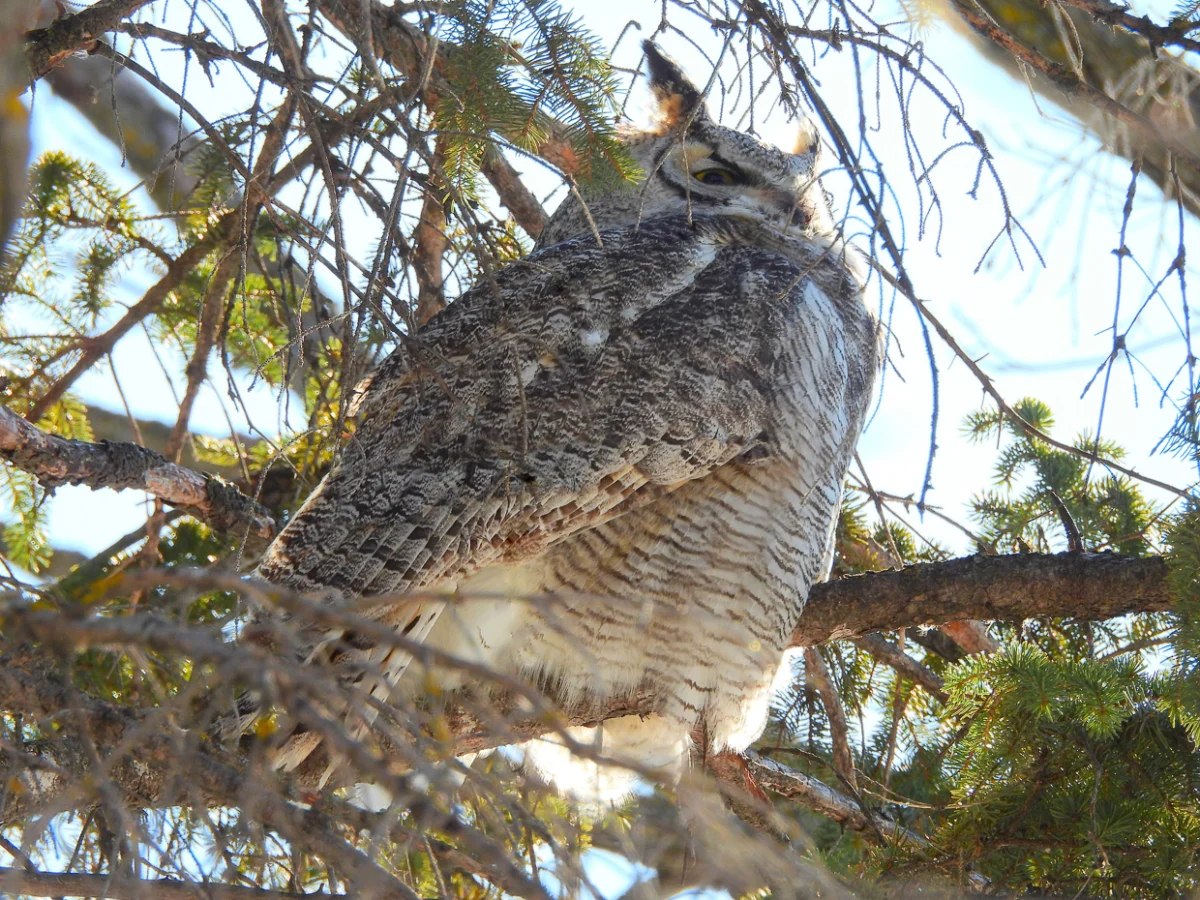
The afternoon focused on urban biodiversity within the city of Winnipeg. Despite the density of human habitation, Winnipeg’s park systems, such as St. Vital Park and Assiniboine Park, serve as vital corridors for wildlife. While a known Western Screech-Owl roost was found unoccupied, the group successfully documented a Pileated Woodpecker, the largest woodpecker species in North America. The day concluded with the observation of a pair of nesting Great Horned Owls along Bunn’s Creek and a Northern Saw-whet Owl in Assiniboine Park. The latter, a diminutive species often difficult to spot due to its nocturnal habits and preference for dense coniferous cover, was found roosting against the trunk of a spruce tree, providing a rare opportunity for close-range study.
The Boreal Transition: Northern Hawk Owls and Feeder Surveys
March 16 saw the expedition move toward the eastern edge of the province, where the prairie gives way to the Canadian Shield and the Boreal Forest. This transition zone is the preferred habitat of the Northern Hawk Owl (Surnia ulula). Unlike most owls, the Northern Hawk Owl is diurnal, meaning it hunts during the day, making it a prized sighting for ornithologists.

Along Highway 317, the group located a Northern Hawk Owl perched at the apex of a dead tree, a typical hunting behavior that allows the bird to scan the snow-covered ground for voles. The success of this sighting was followed by a visit to the Lac du Bonnet region. In the vicinity of Henry Bellin Road, the group conducted surveys at various bird feeding stations. These stations provide essential data on winter bird populations and offer a glimpse into the health of non-raptorial species. The survey recorded Evening Grosbeaks, Redpolls, and Blue Jays, alongside a flock of Sharp-tailed Grouse.
The data collected at these feeders is often contributed to databases like eBird, which scientists use to track avian migration patterns and population fluctuations. The presence of Evening Grosbeaks is of particular interest to conservationists, as the species has seen significant population declines across North America over the last several decades, leading to its listing as a species of special concern in some jurisdictions.

High-Density Sightings and the Importance of Managed Wetlands
On March 17, the penultimate day of the tour, the itinerary was adjusted to capitalize on high-density Snowy Owl reports near the town of Rosenort. This area of the Red River Valley proved to be exceptionally fertile ground, with the group documenting six Snowy Owls in a single morning. These sightings provided ample opportunity to observe the phenotypic variations in the species, from the heavily barred plumage of juvenile females to the stark white of older males.
Beyond the raptor sightings, the group encountered a covey of Grey Partridge in Rosenort. While an introduced species, the Grey Partridge has become a naturalized part of the Manitoban agricultural ecosystem. The afternoon was spent at Oak Hammock Marsh, a globally recognized Ramsar site and the headquarters of Ducks Unlimited Canada. Although the marsh was largely frozen, the interpretive center and its surrounding feeders offered sightings of Redpolls, Downy Woodpeckers, and unexpectedly, two female Red-winged Blackbirds—an early sign of the impending spring migration.

Oak Hammock Marsh represents one of North America’s most successful wetland restoration projects. For the expedition members, the visit served as a reminder of the interconnectedness of habitats. The health of the marsh directly impacts the availability of prey for the raptors observed throughout the week.
Scientific and Economic Impact of Avian Tourism in Manitoba
The conclusion of the expedition on March 18 marked the end of a highly successful data-gathering and observation mission. Over the course of four days, the group recorded numerous species and documented their locations, contributing to the broader understanding of winter bird distribution in Manitoba.

The implications of such expeditions extend beyond mere hobbyism. From an economic perspective, "birding" is a rapidly growing sector of the eco-tourism industry. In Manitoba, winter tours bring revenue to rural communities like Lac du Bonnet, Rosenort, and Oak Bluff during the shoulder season when traditional tourism is low. Local hotels, restaurants, and interpretive centers benefit from the influx of visitors who are drawn by the province’s reputation as one of the best places in the world to view owls.
Furthermore, the educational component of the trip, led by figures like Dr. Jim Duncan, fosters a culture of stewardship. By connecting the public with charismatic "mega-fauna" like the Great Grey Owl, conservation organizations can garner more support for habitat preservation. The data collected by participants—ranging from GPS coordinates of sightings to behavioral notes—serves as a form of non-professional biological monitoring that supports professional research.

Chronology of Sightings and Environmental Context
The success of the 2026 Manitoba Owls tour can be attributed to a combination of expert guiding and favorable environmental conditions. While the cold temperatures (typical for mid-March in the prairies) presented a challenge for the participants, the clear skies and lack of heavy precipitation allowed for high visibility.
Chronological Summary of Key Avian Sightings:

- March 14: Great Grey Owl (Educational Presentation).
- March 15: 3 Snowy Owls, Horned Larks, Snow Bunting, Pileated Woodpecker, Great Horned Owls (Nesting), Northern Saw-whet Owl.
- March 16: Northern Hawk Owl, Sharp-tailed Grouse, Evening Grosbeaks, Common Redpolls.
- March 17: 6 Snowy Owls, Grey Partridge, Hooded Merganser, Red-winged Blackbirds.
The high frequency of Snowy Owl sightings suggests that 2026 may have been an "irruption year," a biological phenomenon where large numbers of owls move south of their normal range, often due to a boom in the lemming population the previous summer followed by a winter scarcity.
Conclusion and Future Outlook
The Manitoba Owls expedition of 2026 stands as a testament to the enduring appeal and scientific value of winter birding in the Canadian North. By combining field observations with expert academic insight, the tour provided a comprehensive overview of the challenges and triumphs of avian life in a sub-arctic climate.

As climate change continues to alter the timing of migrations and the stability of winter habitats, the role of such expeditions in monitoring these shifts becomes increasingly vital. The participants left not only with photographs and memories but with a deeper understanding of the delicate balance required to maintain Manitoba’s status as a sanctuary for some of the world’s most magnificent birds of prey. The province remains a critical link in the migratory chain, and the continued study of its owl populations will remain a priority for conservationists for years to come.
