
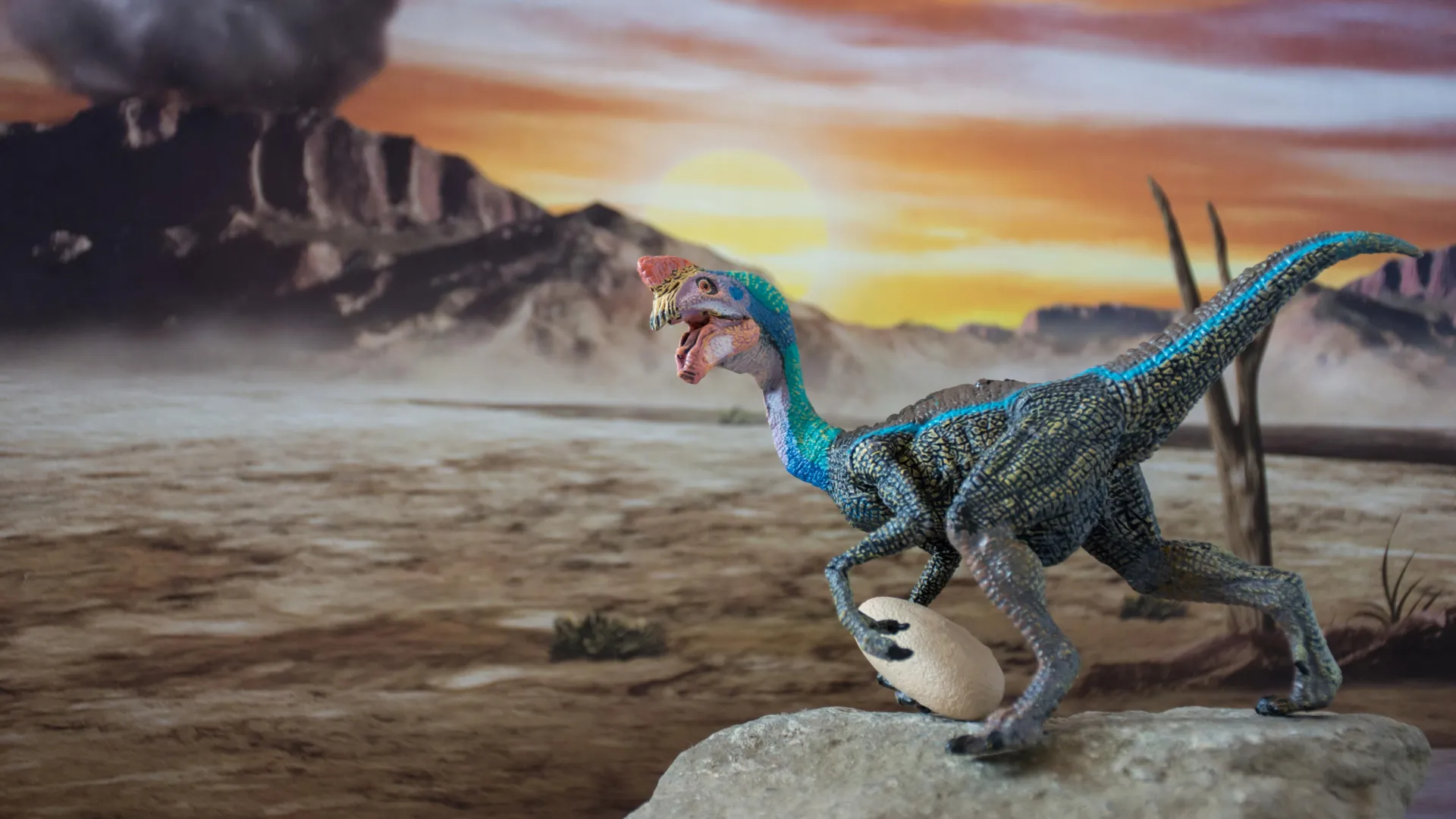
The long-standing enigma surrounding how oviraptors, the bird-like yet flightless dinosaurs, hatched their eggs has taken a significant step towards resolution. For decades, paleontologists have debated whether these fascinating creatures relied on ambient environmental heat, akin to modern crocodiles, or if they actively warmed their clutches directly, much like contemporary birds. A groundbreaking new study published in Frontiers in Ecology and Evolution delves deep into this question, meticulously examining oviraptor nesting behavior and the resulting hatching patterns, offering unprecedented insights into their unique reproductive strategies.
Researchers based in Taiwan have spearheaded this innovative investigation, employing a sophisticated interdisciplinary approach that combines advanced heat transfer simulations with meticulous physical experiments. Their objective was to gain a comprehensive understanding of the thermal dynamics involved in how these dinosaurs incubated their eggs. To contextualize their findings, the team also conducted comparative analyses with the incubation methods of modern avian species. A crucial component of their methodology involved constructing a life-sized, anatomically accurate model of an oviraptor and a painstakingly recreated realistic nest, allowing them to precisely track and evaluate the movement of heat through the eggs within the simulated environment.
"Our research clearly demonstrates that the observed differences in oviraptor hatching patterns were directly influenced by the relative physical position of the incubating adult in relation to its eggs," explained Dr. Tzu-Ruei Yang, the study’s senior author and an associate curator of vertebrate paleontology at Taiwan’s National Museum of Natural Science. This finding highlights a crucial aspect of oviraptor parental care that distinguishes it from many contemporary avian species.
Adding another layer of understanding, first author Chun-Yu Su, who contributed to this significant research while attending Washington High School in Taichung, further elaborated on the findings. "Furthermore, we were able to derive an estimate of the incubation efficiency of oviraptors, which, remarkably, proved to be considerably lower than that observed in modern birds." This distinction suggests a different evolutionary pathway and adaptive strategy for dinosaurian reproduction.
The Oviraptor Enigma: A History of Misconceptions and Discovery
The story of oviraptors in paleontology is one marked by fascinating discoveries and subsequent re-evaluations. The genus name "Oviraptor," meaning "egg seizer" or "egg thief," was famously coined in 1924 by Henry Fairfield Osborn after the discovery of a specimen near a clutch of what were then believed to be Protoceratops eggs in the Gobi Desert. This initial interpretation painted oviraptors as nest predators, a reputation that persisted for decades.
However, subsequent fossil discoveries dramatically altered this narrative. In the late 20th century, paleontologists unearthed multiple oviraptorid specimens, including Citipati osborni and later Oviraptor philoceratops itself, preserved in brooding postures directly atop nests of their own eggs. These remarkable fossils, often showing the adult’s limbs symmetrically arranged around the clutch, unequivocally demonstrated that oviraptors were not egg thieves but rather dedicated parents protecting their offspring. This revelation transformed our understanding of dinosaurian parental care, proving that complex brooding behaviors, once thought exclusive to birds, had deep roots in their non-avian dinosaur ancestors.
The species chosen for this study, Heyuannia huangi, is particularly representative of these brooding dinosaurs. Living approximately 70 to 66 million years ago during the Late Cretaceous period in what is now southern China, Heyuannia was a medium-sized oviraptorid, typically measuring about 1.5 meters in length and weighing around 20 kilograms. Fossil evidence indicates that these dinosaurs constructed semi-open nests characterized by a distinctive arrangement of eggs in multiple, often double, rings. This specific nest architecture played a pivotal role in the research team’s experimental design.
Reconstructing an Ancient Nest: Bridging Paleontology and Engineering
The challenge of realistically reconstructing oviraptor incubation cannot be overstated. Unlike extant species, where direct observation is possible, studying extinct animals requires ingenuity and a multidisciplinary approach. The Taiwanese research team meticulously recreated the ancient nesting environment and the dinosaur parent.
To model the Heyuannia huangi adult, researchers constructed the torso using a lightweight yet sturdy polystyrene foam core supported by a wooden frame. This structural base was then meticulously layered with cotton, bubble paper, and various fabrics to accurately mimic the soft tissues and insulating properties of a living dinosaur’s body. The eggs themselves presented another unique hurdle; oviraptor eggs possess distinct shapes and shell properties unlike those of any living bird or reptile. To overcome this, the team ingeniously fabricated the eggs from casting resin, carefully designed to approximate the thermal characteristics and dimensions of authentic oviraptor eggs. In the physical experiments, two clutches were precisely arranged in double rings, faithfully replicating the fossilized nesting patterns observed in the field.
"Part of the difficulty lies in reconstructing oviraptor incubation realistically," Su acknowledged. "For example, their eggs are unlike those of any living species, so we invented the resin eggs to approximate real oviraptor eggs as best as we could, ensuring the thermal properties were as close as possible." This commitment to material accuracy was critical for the validity of their heat transfer simulations.
The simulations themselves involved complex computational fluid dynamics and finite element analysis to model heat flow, convection, and radiation within the nest system. This digital modeling allowed the researchers to test various environmental parameters and adult brooding positions before validating their hypotheses with the physical setup. The integration of these two methodologies provided a robust framework for their conclusions.
Heat, Nest Design, and Divergent Hatching Patterns
The core of the study involved testing how both the physical presence of a brooding adult and varying environmental conditions influenced egg temperatures and, consequently, potential hatching outcomes. The results unveiled a dynamic and adaptable incubation strategy.
Under colder ambient conditions, when a brooding adult was present on the nest, significant temperature variations were observed within the clutch. Specifically, temperatures in the outer ring of eggs could vary by as much as 6°C. Such substantial thermal gradients within a single nest are highly indicative of asynchronous hatching, a phenomenon where eggs within the same clutch hatch at different times. This strategy, common in some modern birds, can be an adaptation to unpredictable food availability or to ensure at least some offspring survive if resources become scarce.
Conversely, in warmer environmental conditions, the temperature variation across the outer ring of eggs dramatically decreased, dropping to approximately 0.6°C. This stark contrast suggests a crucial role for ambient heat, particularly solar radiation, in leveling out temperature disparities across the clutch in warmer climates. In such scenarios, sunlight would have significantly contributed to evening out the internal nest temperatures, potentially leading to more synchronous hatching.
Dr. Yang elaborated on this environmental dependence: "It’s unlikely that large dinosaurs sat atop their clutches and provided all the heat. Supposedly, they used the heat of the sun or soil to hatch their eggs, like turtles. Since oviraptor clutches are open to the air, heat from the sun likely mattered much more than heat from the soil." This perspective highlights a fundamental difference from the deep, buried nests often associated with modern reptiles, and instead points to a more exposed, adaptable strategy. The semi-open nature of oviraptor nests would have facilitated this interaction with solar radiation, allowing for efficient heat absorption when conditions were favorable.
Dinosaur vs. Bird Incubation Efficiency: A Tale of Two Strategies
A pivotal aspect of the study involved a direct comparison between oviraptor incubation and the highly specialized methods employed by modern birds. The vast majority of avian species rely on what is known as thermoregulatory contact incubation (TCI). In TCI, the adult bird sits directly and continuously on its eggs, acting as the primary, if not sole, heat source. For TCI to be effective, several conditions must be met: the adult must maintain consistent physical contact with all eggs in the clutch, provide the main source of warmth, and diligently regulate and maintain a stable, uniform temperature across the entire clutch.
The research clearly indicates that oviraptors, given their anatomy and nest structure, were likely unable to fully meet these stringent TCI conditions. Their distinctive ring-shaped egg arrangement meant that a single adult, even one in a brooding posture, could not simultaneously maintain direct and consistent physical contact with every egg in the clutch. The central space within the ring, often left open, would have been difficult to cover effectively, leading to temperature differentials.
"Oviraptors may not have been able to conduct TCI as modern birds do," Su concluded. Instead, the evidence strongly suggests that these dinosaurs practiced a form of "co-incubation," where the parental brooding efforts worked in concert with environmental heat sources. This synergistic approach, combining endogenous heat from the parent with exogenous heat from the sun or ambient air, represents a distinct evolutionary strategy. While this co-incubation method was demonstrated to be less efficient in terms of maintaining uniform temperatures compared to the highly evolved TCI of modern birds, it was likely an adaptive and well-suited strategy for their specific nesting style, which appears to have undergone an evolutionary shift from buried nests to more exposed, semi-open configurations. This shift itself could have been driven by factors such as improved gas exchange for developing embryos, reduced predation risk from burrowing animals, or enhanced utilization of solar radiation.
Dr. Yang emphasized that this difference in efficiency does not imply superiority. "Modern birds aren’t ‘better’ at hatching eggs. Instead, birds living today and oviraptors have a very different way of incubation or, more specifically, brooding," he clarified. "Nothing is better or worse. It just depends on the environment." This perspective underscores the principle of adaptive evolution, where different strategies emerge and thrive based on specific ecological pressures and available resources.
Implications for Dinosaur Parenting and Evolutionary Pathways
While the study offers profound insights, the researchers prudently acknowledge certain limitations. Their results are based on a reconstructed nest model and environmental conditions that mimic the modern era, which inherently differ from the Late Cretaceous period’s specific climatic variables. The Earth’s atmosphere, solar intensity, and average temperatures during the time of Heyuannia huangi could have influenced incubation dynamics in ways not fully captured by the current models. Furthermore, oviraptors likely had significantly longer incubation periods than modern birds, a factor that could impact the overall efficiency and thermal requirements of their eggs.
Despite these considerations, the study undeniably provides an invaluable new lens through which to understand how oviraptors may have cared for their eggs. By pioneering the combination of physical models with advanced simulations, the work opens up exciting new possibilities for future research into dinosaur reproduction and behavior. This interdisciplinary approach can be applied to other dinosaur species and behaviors, pushing the boundaries of what can be inferred from fossil evidence.
The findings also contribute significantly to our understanding of the evolutionary trajectory from non-avian dinosaurs to birds. Oviraptors, as advanced maniraptoran theropods closely related to birds, represent a crucial transitional form. Their co-incubation strategy might represent an intermediate stage in the evolution of avian parental care, bridging the gap between the purely environmental incubation of many reptiles and the highly active, endothermic brooding of modern birds. This nuanced approach to incubation further strengthens the evidence for complex parental care among dinosaurs, challenging earlier simplistic views of reptilian-like indifference.
Finally, the study carries an inspirational message, particularly for the scientific community in Taiwan. "It also truly is an encouragement for all students, especially in Taiwan," concluded Dr. Yang. "There are no dinosaur fossils in Taiwan, but that does not mean that we cannot do dinosaur studies." This emphasizes that scientific curiosity, innovative methodology, and a collaborative spirit can transcend geographical limitations, allowing researchers to contribute significantly to global paleontological understanding even without local fossil records. The work by Dr. Yang, Chun-Yu Su, and their team stands as a testament to the power of scientific inquiry and the ongoing quest to unravel the enduring mysteries of our planet’s ancient past.
