
A groundbreaking study, spearheaded by researchers from Tel Aviv University, has unveiled compelling evidence suggesting that some feathered dinosaurs, long before the advent of modern birds, had already shed the ability to fly. This remarkable finding, derived from the meticulous analysis of exceptionally preserved dinosaur fossils, challenges long-held assumptions about the linear progression of flight evolution, painting a far more intricate and dynamic picture of how winged creatures developed over millions of years. As the research team aptly notes, "Feather molting seems like a small technical detail — but when examined in fossils, it can change everything we thought about the origins of flight, highlighting how complex and diverse wing evolution truly was."
The pivotal research, led by Dr. Yosef Kiat from the School of Zoology and the Steinhardt Museum of Natural History at Tel Aviv University, in collaboration with international partners from China and the United States, focused on rare fossils that retained not only their feathers but also their original coloration. Published in the esteemed journal Communications Biology by Nature Portfolio, the study offers an unprecedented glimpse into the lives of animals approximately 160 million years ago, profoundly reshaping our understanding of avian evolution. The implications are broad, suggesting that the development of flight was not a simple, unidirectional path, but rather a complex interplay of gains and losses, with certain species potentially developing rudimentary flight capabilities only to abandon them later in their evolutionary journey, echoing the flightless birds we observe today.
The Mesozoic Stage: Dinosaurs, Feathers, and the Dawn of Flight
To fully appreciate the significance of this discovery, it is essential to contextualize it within the vast evolutionary timeline of the Mesozoic Era, often referred to as the Age of Dinosaurs. Approximately 240 million years ago, during the Triassic period, dinosaurs diverged from other reptilian lineages. It wasn’t long, in geological terms, before a remarkable evolutionary innovation emerged: feathers. Initially, these lightweight, protein-based structures were likely not for flight but served crucial functions such as insulation, camouflage, or display in mating rituals. This concept of "exaptation," where a trait evolved for one purpose is later co-opted for another, is central to understanding the evolution of flight.
Fast forward to around 175 million years ago, during the Jurassic period, and a distinct group of feathered dinosaurs known as Pennaraptora made their appearance. This lineage is particularly significant as it includes the direct ancestors of modern birds. For decades, paleontologists have debated the precise mechanisms and timeline of how flight evolved within this group. Theories range from the "trees-down" hypothesis, suggesting flight evolved from gliding arboreal ancestors, to the "ground-up" hypothesis, where bipedal, cursorial dinosaurs developed flapping motions to aid in running or leaping. The Pennaraptora were the only dinosaur lineage to survive the catastrophic mass extinction event at the end of the Mesozoic era, approximately 66 million years ago, leading to the diverse avian species we see today.
For a long time, the prevailing scientific consensus assumed a largely linear progression: feathers evolved, then flight abilities steadily improved within these feathered dinosaurs, eventually leading to the highly specialized flight of modern birds. However, the new Tel Aviv University-led research, focusing on the dinosaur Anchiornis, introduces a crucial nuance: the capacity for flight, once potentially gained, could also be lost, much like in modern ostriches, emus, penguins, or kiwis. This highlights a dynamic evolutionary landscape where adaptations are constantly re-evaluated against environmental pressures and ecological niches.
Anchiornis: A Jewel from the Jehol Biota
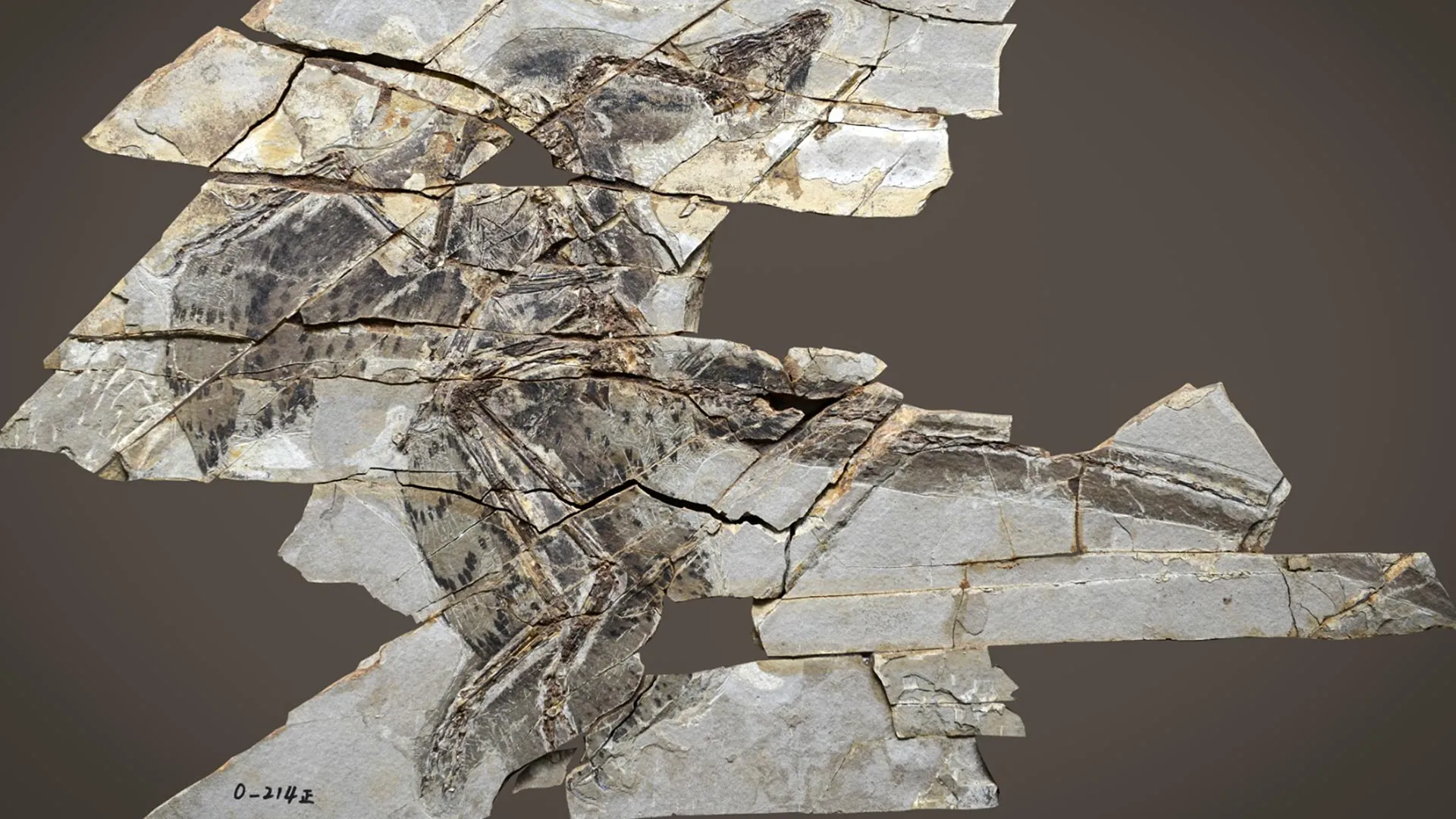
The study honed in on nine exquisite fossils belonging to Anchiornis, a small, feathered Pennaraptoran dinosaur. These specimens were unearthed from the rich fossil beds of eastern China, particularly the Liaoning Province, an area globally renowned for its exceptional preservation of feathered dinosaurs and early birds. The unique geological conditions of the Jehol Biota, characterized by volcanic ashfalls rapidly burying organisms in fine-grained sediments, created an unparalleled window into the Mesozoic ecosystem. This rapid burial minimized decomposition and scavenging, allowing for the fossilization of delicate soft tissues, including feathers, and even their internal cellular structures.
Anchiornis huxleyi, first described in 2009, is a particularly significant species. It was a diminutive dinosaur, roughly the size of a modern crow, possessing long feathers on all four limbs (forelimbs and hindlimbs), leading to its popular depiction as a "four-winged" dinosaur. Its small size, extensive feathering, and arboreal-like limb proportions had previously led many scientists to hypothesize that Anchiornis was either capable of gliding or even some form of rudimentary flapping flight. The extraordinary preservation of these Liaoning fossils allowed researchers to identify not only the intricate structure of the feathers but also their original coloration, thanks to the fossilized melanosomes – pigment-bearing organelles. Each specimen revealed wing feathers that were predominantly white, strikingly adorned with a distinct black spot at the tip. This level of detail is exceedingly rare and provided the critical data needed for the study’s innovative analysis.
Decoding Flight Through Feather Molting
The true ingenuity of Dr. Kiat’s research lies in its novel application of ornithological principles to ancient fossils. Dr. Kiat, an ornithologist specializing in feathers, understood that the growth and shedding of feathers—a process known as molting—could betray an animal’s flight capabilities.
Feathers are complex epidermal outgrowths made primarily of keratin. They grow from follicles in the skin for a period of two to three weeks, during which they are nourished by a rich blood supply. Once fully formed, they detach from these blood vessels, becoming "dead" structures that are eventually worn out by environmental exposure and mechanical stress. To maintain their aerodynamic efficiency and insulating properties, birds periodically replace these worn feathers through molting.
However, the pattern of molting varies dramatically between flighted and flightless birds, a critical distinction that Dr. Kiat exploited. Birds that depend on flight for survival—such as most songbirds, raptors, and migratory species—employ a highly ordered, gradual, and symmetrical molting process. They typically shed primary flight feathers one or two at a time from each wing, ensuring that aerodynamic balance is maintained. This allows them to continue flying effectively throughout the molting period, albeit sometimes with reduced efficiency. For example, a raptor might shed its innermost primary first, then the next, and so on, with the corresponding feather on the opposite wing being shed at a similar time to maintain symmetry.
In stark contrast, birds that have lost the ability to fly exhibit a much more random, irregular, or even synchronous molting pattern. Flightless birds have no aerodynamic imperative to maintain wing symmetry or continuous flight. Some flightless species, like many ducks, may undergo a "simultaneous molt" where all or most of their primary flight feathers are shed at once, rendering them temporarily grounded and highly vulnerable. Others, like ostriches or penguins, may show a haphazard shedding pattern, replacing feathers as needed without strict regard for symmetry or the maintenance of lift. The lack of selective pressure for flight allows for this less constrained molting strategy. "The molting pattern tells us whether a certain winged creature was capable of flight," Dr. Kiat emphasizes.
The Evidence from Anchiornis: A Flightless Past
The unique preservation of coloration in the Anchiornis fossils proved indispensable for this analysis. The black spots at the tips of the feathers acted as natural markers, allowing the researchers to track their growth and shedding patterns with unprecedented clarity. By meticulously examining the fossilized wings, the team identified a continuous line of these black spots along the wing edges, indicating mature feathers. Crucially, they also observed developing feathers whose black spots were distinctly out of alignment, suggesting they were still growing and had not yet reached their final position or size.
A detailed analysis of these observations revealed a molting pattern that was unequivocally irregular, rather than the orderly, symmetrical process characteristic of flying birds. This irregularity was the smoking gun. Dr. Kiat concluded, "Based on my familiarity with modern birds, I identified a molting pattern indicating that these dinosaurs were probably flightless." This conclusion represents a significant methodological leap, leveraging a functional trait preserved in the fossil record—feather growth dynamics—rather than solely relying on skeletal or anatomical structures. "This is a rare and especially exciting finding: the preserved coloration of the feathers gave us a unique opportunity to identify a functional trait of these ancient creatures—not only the body structure preserved in fossils of skeletons and bones."
Rethinking Avian Evolution: Complexity, Losses, and the Non-Linear Path
The finding that Anchiornis, a feathered dinosaur from 160 million years ago, was likely flightless has profound implications for our understanding of avian evolution. It adds a critical layer of complexity to the narrative of flight origins, suggesting that the development of flight was far from a simple, unidirectional progression.
Firstly, it reinforces the idea that flight capability may have evolved multiple times or, more precisely, that different lineages within feathered dinosaurs explored various aerial strategies, some succeeding and others failing or being abandoned. Anchiornis was previously considered by some researchers to be a potential glider or even an active flier based on its morphology. This new evidence forces a re-evaluation of its locomotion and ecological role.
Secondly, it highlights the phenomenon of secondary flightlessness. Just as modern birds like ostriches and penguins have independently lost the power of flight after their ancestors gained it, Anchiornis appears to represent a much earlier instance of this evolutionary reversal among feathered dinosaurs. This suggests that the advantages of flight were not universally applicable or permanently beneficial across all feathered dinosaur lineages. Environmental factors, predation pressures, changes in food availability, or the development of alternative adaptations could have rendered flight less advantageous, leading to its regression. For a small, feathered dinosaur like Anchiornis, a terrestrial or arboreal lifestyle without flight might have been more energetically efficient or safer in its specific niche.
The study also contributes to the ongoing debate about the "ground-up" versus "trees-down" hypotheses of flight evolution. While Anchiornis‘s morphology had been interpreted to support an arboreal, gliding stage, its apparent flightlessness complicates this interpretation. It suggests that even creatures with extensive feathering and potentially arboreal adaptations might not have been committed to an aerial existence.
Finally, this research underscores the incredible diversity and experimentation that characterized dinosaur evolution. The "Age of Dinosaurs" was not just about colossal predators and herbivores; it was a period of vast biological innovation, including the repeated evolution and loss of complex traits like flight. "Anchiornis now joins the list of dinosaurs that were covered in feathers but not capable of flight, highlighting how complex and diverse wing evolution truly was," Dr. Kiat concludes.
Broader Implications and Future Research
This innovative study opens new avenues for paleontological and ornithological research. The methodological breakthrough—using molting patterns in exceptionally preserved fossils—provides a powerful new tool for inferring functional traits in extinct animals, moving beyond mere skeletal analysis. Future studies could apply similar techniques to other feathered dinosaur fossils, potentially revealing more instances of flightlessness or varying degrees of aerial capabilities across different lineages.
The discovery also serves as a potent reminder for the scientific community and the public that evolutionary pathways are often circuitous, involving detours, regressions, and multiple attempts at adaptation. It challenges the simplistic notion of evolution as a ladder of progress, instead presenting it as a branching bush, with many paths explored and many dead ends. The story of flight is not a straight line from scales to wings, but a fascinating saga of innovation, adaptation, and occasional relinquishment, painting an ever-richer tapestry of life 160 million years ago and the intricate journey to the skies.
