
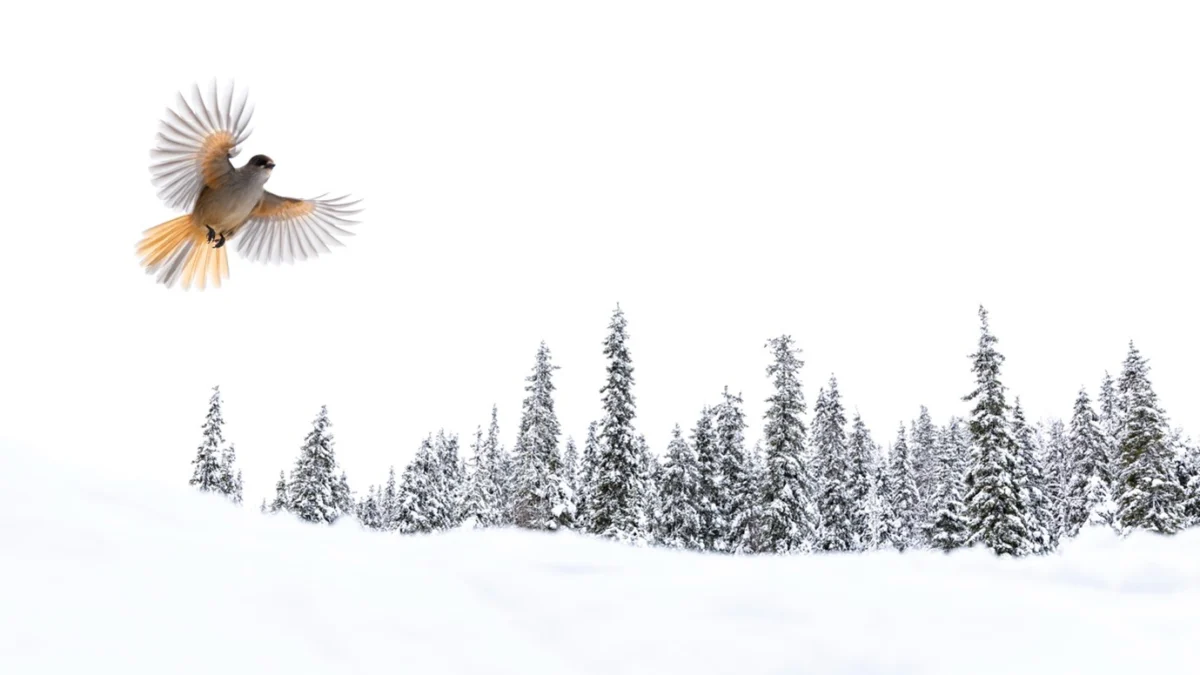
Stefan Gerrits, a renowned nature photographer based in Sundsberg, Kirkkonummi, Finland, has carved a distinctive niche in the photographic world by capturing the essence of the Nordic landscape through a deeply personal and minimalistic lens. His work, characterized by its imaginative, two-dimensional, and often high-key aesthetic, transcends conventional nature photography, offering viewers a profound sense of calmness, vastness, and timelessness inherent in the northern climes. Gerrits’ philosophy posits that the North is not merely a geographical location but a unique way of perceiving, feeling, and experiencing the world, where, as he often states, "less truly becomes more."

For Gerrits, the Nordic expanse evokes an immediate sense of space and tranquility—an almost palpable emptiness that fosters peace. This environment, with its stark contrasts of snow, periods of darkness, and extreme cold, paradoxically presents a canvas for simplicity and an enduring sense of timelessness. His photographic style meticulously reflects these sensations, employing minimalism to strip away the superfluous and draw immediate focus to the essential. The resulting images are flat, graphic, and quiet, offering a unique interpretation of the North that resonates deeply with its inherent serene character.
Mastering High-Key and Minimalism: A Technical and Emotional Choice

At the core of Gerrits’ approach is the deliberate application of high-key photography, utilized not merely as a technical setting but as a fundamental tool to evoke specific emotions. High-key images, predominantly bright with minimal shadows and a limited tonal range, naturally align with the ethereal and often snow-laden landscapes of the North. This technique, combined with a steadfast commitment to minimalism, allows Gerrits to simplify reality, selectively ignoring elements and details that might otherwise distract. The goal is to reduce the frame to only what is essential, compelling the viewer’s gaze directly to the subject and fostering a moment of quiet contemplation.
Minimalism in photography, as practiced by Gerrits, is not about arbitrary reduction but about revealing a deeper truth by eliminating distractions. It is about crafting visual breathing room, allowing the subject to stand alone and command attention, and providing the viewer with space for pause and reflection. This intentional simplification, Gerrits explains, is a journey of growth, achieved step by step, gradually building the confidence to omit elements and trust in the power and sufficiency of what remains.

The Art of Omission: "Simple, Simpler, Simplest"
Gerrits outlines a three-tiered process for achieving simplicity, emphasizing that "simple" is never synonymous with "boring." On the contrary, he argues, simplicity often imbues an image with greater strength, emotional resonance, and memorability. The initial step involves aiming for a clean frame, constructing a composition around a singular visual focal point. This demands asking, "What does this image truly need to be powerful?"

The subsequent steps involve a continuous refinement process:
- In-Field Simplification: While on location, Gerrits actively seeks to remove distractions by adjusting his physical position. This might involve moving slightly left or right, tilting the camera, or even lying on the ground to exclude a cluttered background or foreground. Framing a subject against a neutral backdrop, such as pristine snow or an expansive sky, is a favored tactic.
- Post-Processing Refinement: If optimal simplification isn’t achievable in the field, Gerrits employs post-processing techniques. This includes judicious cropping to tighten the composition, simplifying tones to reduce visual complexity, or selectively erasing minor distracting elements. This iterative process underscores that minimalism is not a rigid rule but a guiding principle aimed at strengthening the image’s core message.
Beyond Color: The Power of Monochrome Conversion

A significant aspect of Gerrits’ artistic palette is the deliberate choice to convert images to monochrome or black and white. He cautions that not all subjects benefit from this transformation, citing vibrant subjects like a butterfly, which might lose much of its character without color. However, for subjects inherently suited to it, such as a mountain hare camouflaged in winter white, the impact can be profound.
The decision to go monochrome is a creative choice, not a fallback. It requires looking beyond superficial color and evaluating whether an image’s impact is enhanced or diminished without it. For subjects with a muted color palette, or those where mood, silence, harmony, and focus are paramount, black and white can amplify these qualities dramatically. Gerrits frequently utilizes tools like Silver Efex Pro, which provides precise control over contrast, structure, and tonality—elements that become critically important when color is absent. This ensures that the monochrome image is not merely a desaturated version but a carefully crafted piece designed to evoke a specific emotional response. Historically, black and white photography has been celebrated for its ability to distill a scene to its fundamental elements of light, shadow, and form, often lending a timeless and dramatic quality that color might obscure.

Structural Foundations: Geometry and Repetition
Gerrits incorporates basic geometric forms and lines as fundamental building blocks in his minimalistic compositions. Angles, triangles, circles, and straight lines are inherently associated with minimalistic design, offering clarity, structure, and balance. By framing an image around a distinct shape—even a partial one, like a curve suggesting a half-circle—the photographer provides a strong visual anchor. These elements serve to guide the viewer’s eye through the composition and can also contribute to a sense of scale within the vast Nordic landscapes.

Furthermore, repetition, whether symmetrical or mirrored, is a powerful tool in Gerrits’ arsenal. A series of identical lines, shapes, or even multiple similar subjects, like the common guillemots captured in silent conversation, can create rhythm, order, and a playful yet hypnotic visual effect. This technique fosters emotion without introducing clutter, transforming simple patterns into compelling narratives. This echoes art history where repetition has been used across various movements, from ancient tessellations to modern abstract art, to create harmony and visual interest.
Embracing Emptiness: Negative Space, Isolation, and Visual Balance

The strategic use of negative space, isolation, and visual balance is paramount in Gerrits’ work, often referred to as providing "breathing space" around a subject. By intentionally including more negative space—the empty or relatively unadorned areas surrounding the main subject—Gerrits not only enhances the aesthetic appeal but also amplifies a sense of isolation. This makes the image feel more artistic and profoundly minimalistic.
This isolation, rather than creating distance, paradoxically strengthens the connection between the viewer and the subject. It guides both the eye and the mind towards a singular focal point, removing any competing elements that might dilute its impact. Because minimalistic images contain so few elements, the chosen subject must inherently carry significant emotional weight to achieve a "wow effect." Gerrits achieves this by selecting subjects that inherently express fragility, vulnerability, rarity, or evoke a sense of danger, mystery, solitude, or even something mystical. Elusive or endangered species, such as the great gray owl or the white-throated dipper, often resonate more quickly due to their scarcity and sought-after status, triggering an immediate emotional response.

Crucially, negative space does not necessitate a vast expanse of uniform white or black. It can still possess visually attractive qualities that capture attention without becoming a competing subject. For instance, in an image of a white-throated dipper, the bird might be small within the frame, surrounded by a calm, visually interesting, yet uniform environment. The simplicity of this setting supports the subject, allowing it to shine without competition.
Stefan Gerrits: A Decade of Nordic Vision

Born in Sambeek, one of the Netherlands’ quietest towns, Stefan Gerrits now calls Sundsberg, Kirkkonummi, in southern Finland, his home. This transition has undoubtedly deepened his connection to the Nordic environment that so profoundly influences his work. With over a decade of experience, Gerrits has become a respected voice in nature and wildlife photography. He leads specialized photo tours across the Nordic countries, both independently and in collaboration with NatureTalks (NL), sharing his unique vision and technical expertise with aspiring photographers. His insights are also frequently sought at events, where he speaks about his approach.
Gerrits’ distinctive work has garnered international recognition, appearing in various European magazines. His solo exhibition in Helsinki, titled "imaginature," showcased his signature style, emphasizing imaginative, minimalistic, and two-dimensional compositions. His artistic philosophy centers on respecting nature and presenting subjects and their surroundings in their purest, most honest form—a clear commitment to "function over form." This evolution in his photography reflects his personal experience of nature, focusing on the raw, unadorned beauty that characterizes the North.

Implications and Broader Impact of Minimalist Nature Photography
The rise of minimalist nature photography, championed by artists like Stefan Gerrits, carries significant implications for both the artistic community and broader environmental awareness. In an age saturated with visual information, the intentional paring down of elements offers a refreshing counterpoint, inviting viewers to slow down and engage more deeply with individual images. This style encourages mindful observation, fostering a greater appreciation for the subtle beauty often overlooked in more complex compositions.

From an environmental perspective, Gerrits’ focus on vulnerable and rare species within vast, often stark, environments implicitly highlights the delicate balance of these ecosystems. By isolating these subjects, he underscores their individuality and precarious existence, potentially inspiring greater conservation efforts. The quiet power of his images can evoke empathy and a sense of stewardship, reminding viewers of the intrinsic value of these creatures and their habitats. This artistic approach aligns with contemporary trends in environmental communication, which often seek to connect audiences emotionally with nature’s fragility and resilience.
Furthermore, Gerrits’ methodology serves as an educational model for photographers. It challenges them to move beyond mere technical proficiency and develop a deeper conceptual understanding of their craft. By demonstrating how intentional omission can amplify impact, he encourages a more thoughtful and deliberate approach to composition and storytelling. His work contributes to the ongoing dialogue about the role of art in shaping perception and fostering a deeper connection with the natural world.

In conclusion, Stefan Gerrits’ journey through the Nordic landscapes is a testament to the profound power of minimalism in nature photography. It invites both the photographer and the viewer to pause, to truly observe, and to understand that what is intentionally excluded from the frame can speak as loudly as what remains. His selective, intentional, and bold choices in composition and processing reveal not just the subject and the moment, but also the deep feeling and unique perspective of the artist behind the camera, ultimately enriching our appreciation for the quiet majesty of the North.
