
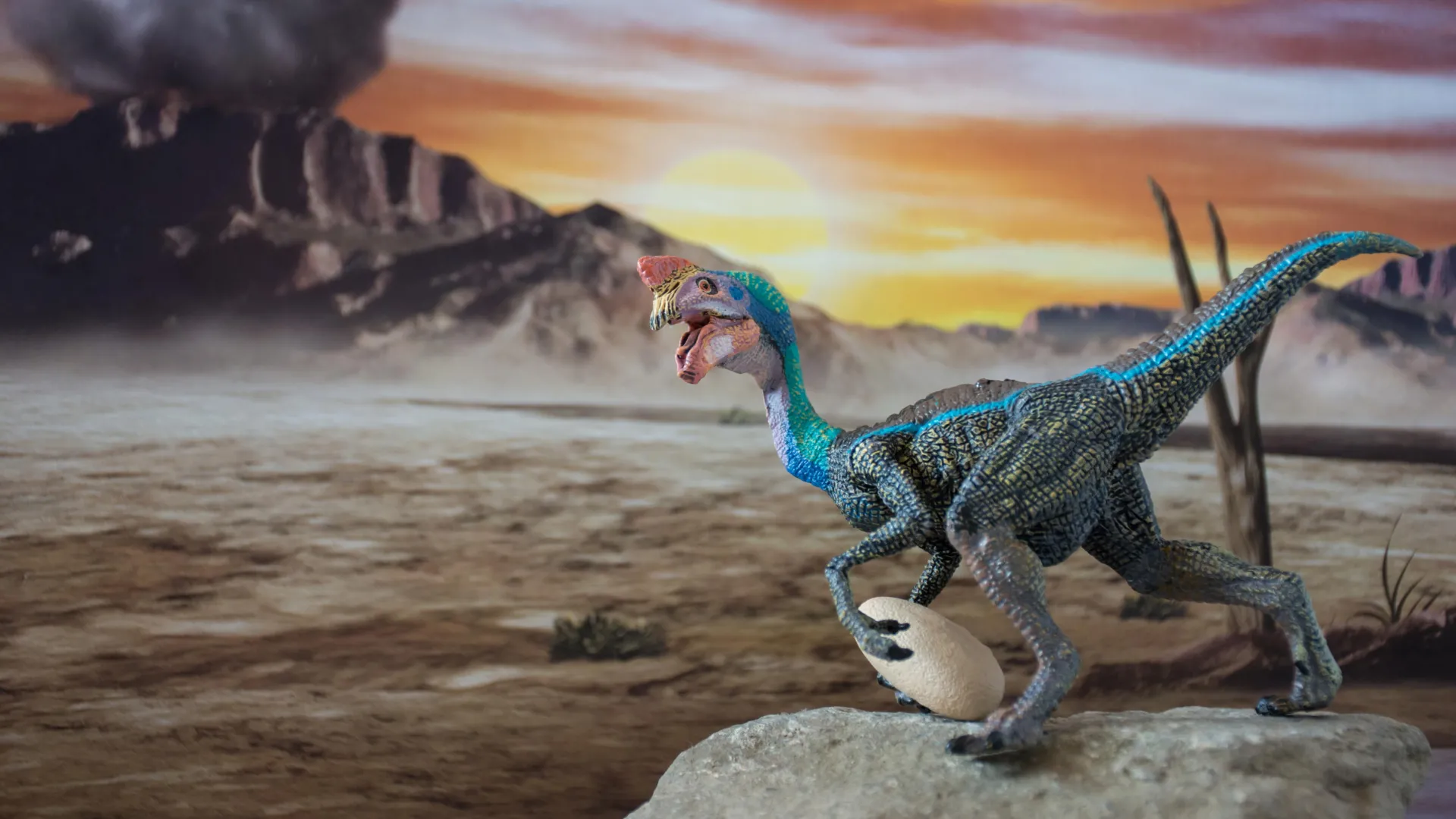
The long-standing mystery surrounding how oviraptors, bird-like but flightless dinosaurs, hatched their eggs has been significantly clarified by a groundbreaking new study. For decades, paleontologists debated whether these enigmatic creatures relied on external heat sources, much like modern crocodiles, or if they actively warmed their clutches through direct contact, akin to birds. A comprehensive study published in Frontiers in Ecology and Evolution now offers compelling evidence, suggesting oviraptors employed a sophisticated "co-incubation" strategy, blending parental brooding with environmental heat. This research not only sheds light on the reproductive behavior of these fascinating dinosaurs but also provides crucial context for understanding the evolutionary trajectory of avian parental care.
Unraveling the Mystery: The Oviraptor Enigma
Oviraptors, whose name translates to "egg thief," were first discovered in the early 20th century. This initial moniker, based on a fossil found atop what was presumed to be a Protoceratops nest, was later proven to be a misidentification. Subsequent discoveries revealed that the oviraptor was, in fact, brooding its own eggs, firmly establishing them as dedicated parents rather than opportunistic predators. These theropod dinosaurs, characterized by their short, deep skulls, often adorned with crests, and toothless beaks, roamed the Late Cretaceous landscapes of what is now Asia and North America between approximately 80 and 66 million years ago. Their anatomy, particularly their skeletal structure, shows striking similarities to modern birds, placing them firmly within the lineage leading to extant avians. However, unlike their modern descendants, oviraptors were flightless, making their incubation strategies a key area of scientific inquiry for understanding the transition from reptilian to avian reproduction.
The question of dinosaur incubation methods has profound implications for understanding their physiology, particularly their metabolic rates. Dinosaurs have long been a subject of debate regarding whether they were cold-blooded (ectothermic) like modern reptiles, warm-blooded (endothermic) like mammals and birds, or somewhere in between (mesothermic). Active brooding, which requires significant metabolic heat production, would lend strong support to a higher metabolic rate, challenging purely ectothermic models. Conversely, reliance solely on ambient heat would suggest a more reptilian physiological profile. The study, led by researchers in Taiwan, directly addresses this physiological puzzle by meticulously examining the mechanics of oviraptor nesting and the thermal dynamics involved in their egg development.
A Novel Approach: Combining Simulation with Physical Experimentation
To tackle this complex paleontological question, the research team adopted an innovative, multidisciplinary approach. They combined advanced heat transfer simulations with detailed physical experiments, a methodology that allowed them to model the intricate interplay between a brooding oviraptor, its eggs, and the surrounding environment. This integrated strategy is crucial for reconstructing behaviors from millions of years ago, where direct observation is impossible.
"We show the difference in oviraptor hatching patterns was induced by the relative position of the incubating adult to the eggs," explained senior author Dr. Tzu-Ruei Yang, an associate curator of vertebrate paleontology at Taiwan’s National Museum of Natural Science. The study’s rigor involved creating a life-sized model of an oviraptor and a realistic nest, enabling them to physically test how heat would have propagated through the egg clutches. This hands-on experimental phase provided tangible data to validate and refine their computational models.
The specific oviraptor species chosen for this detailed reconstruction was Heyuannia huangi, a relatively small oviraptorid that lived approximately 70 to 66 million years ago in what is now southern China. This species was an ideal candidate due to the relatively abundant and well-preserved fossil evidence of its nesting sites. Heyuannia huangi was estimated to be about 1.5 meters (5 feet) long and weigh around 20 kilograms (44 pounds), roughly the size of a modern emu or ostrich chick. Crucially, fossil discoveries have provided clear insights into their nesting architecture: semi-open nests arranged in multiple, often double, rings of eggs. This distinctive ring-shaped arrangement, with a central open space, became a critical feature of the experimental setup.
The construction of the oviraptor model itself was a meticulous process. Researchers crafted the torso using lightweight but sturdy polystyrene foam and a wooden frame, providing the basic skeletal structure. This core was then layered with materials designed to mimic the dinosaur’s soft tissues and insulation properties, including cotton, bubble paper, and various fabrics. These materials were carefully chosen not only for their structural integrity but also for their thermal properties, aiming to replicate the heat retention and transfer characteristics of a living animal. The eggs, another critical component, were fabricated from casting resin. This material was selected for its ability to approximate the thermal conductivity and specific heat capacity of real dinosaur eggs, which are known to have thicker shells and different porous structures compared to modern bird eggs. In the experiments, two clutches of these resin eggs were arranged in double rings, precisely matching the patterns observed in the fossil record.
Chun-Yu Su, the first author of the study, who was a high school student at Washington High School in Taichung when the research was conducted, highlighted the challenges inherent in such a reconstruction: "Part of the difficulty lies in reconstructing oviraptor incubation realistically. For example, their eggs are unlike those of any living species, so we invented the resin eggs to approximate real oviraptor eggs as best as we could." This dedication to accuracy in reconstruction underscores the scientific integrity of the study.
Heat, Nest Design, and Asynchronous Hatching
The core of the experimental phase involved testing how both the presence of a brooding adult and varying environmental conditions influenced egg temperatures and, consequently, potential hatching outcomes. The results revealed a complex interplay of factors, demonstrating that oviraptor incubation was not a monolithic process but rather a dynamic one influenced by both internal (parental) and external (environmental) heat sources.
In simulated colder conditions, the presence of a brooding adult led to significant temperature variations within the nest. Eggs in the outer ring of the clutch experienced temperature fluctuations of up to 6°C. Such substantial thermal disparities across a single clutch are a strong indicator of asynchronous hatching, where eggs do not hatch simultaneously but rather over an extended period. This phenomenon is observed in some modern birds and reptiles and can have various evolutionary advantages, such as spreading the risk of predation or allowing parents to focus resources on fewer, more developed hatchlings at a time.
Conversely, in simulated warmer environments, the temperature variation within the outer ring of eggs dropped dramatically to approximately 0.6°C. This stark difference suggests that in warmer climates, ambient heat, particularly from direct sunlight, played a crucial role in evening out the egg temperatures. This environmental contribution would have reduced the thermal gradient across the nest, potentially leading to more synchronous hatching or at least a narrower hatching window.
Dr. Yang elaborated on the likely mechanism: "It’s unlikely that large dinosaurs sat atop their clutches. Supposedly, they used the heat of the sun or soil to hatch their eggs, like turtles. Since oviraptor clutches are open to the air, heat from the sun likely mattered much more than heat from the soil." This observation is critical. While some dinosaurs, like sauropods, are thought to have buried their eggs and relied on geothermal or decaying vegetation heat, the semi-open, ring-shaped nests of oviraptors would have been highly exposed to solar radiation. The Late Cretaceous period, during which Heyuannia huangi lived, was characterized by a generally warmer global climate than today, with higher atmospheric CO2 levels, potentially intensifying the role of solar radiation in incubation.
Dinosaur vs. Bird Incubation Efficiency: The Rise of "Co-incubation"
A significant aspect of the study involved comparing oviraptor incubation strategies with those of modern birds. Most extant birds employ a highly efficient method known as Thermoregulatory Contact Incubation (TCI). In TCI, the adult bird sits directly on its eggs, using specialized brood patches (areas of bare skin with increased blood flow) to transfer metabolic heat directly to the eggs. For TCI to be effective, several conditions must be met: the adult must be able to maintain direct contact with all or most of the eggs, act as the primary heat source, and consistently regulate the egg temperatures within a narrow optimal range.
The research clearly indicated that oviraptors likely could not meet these stringent conditions for efficient TCI. Their distinctive ring-shaped egg arrangement, with a central open space, meant that even a dedicated brooding adult would have been unable to maintain continuous, direct contact with every single egg simultaneously. The physical geometry of the nest itself imposed limitations on heat transfer from the parent.
"Oviraptors may not have been able to conduct TCI as modern birds do," Su noted. Instead, the evidence points to a different, more cooperative strategy: oviraptors and environmental heat likely worked together, effectively making them "co-incubators." This model suggests that while the parent provided some direct heat and protection, particularly to the inner rings of eggs or during cooler periods, the sun’s energy played a substantial, often dominant, role in maintaining the overall nest temperature, especially for the outer rings.
The study quantified this difference in efficiency, finding that oviraptor incubation was "much lower" than that of modern birds. This lower efficiency is not necessarily a sign of evolutionary inferiority but rather an adaptation to their specific biological and environmental context. It represents an intermediate stage in the evolution of parental care. This method of co-incubation, balancing parental investment with environmental resources, appears to have been well-suited to their nesting style, which represents a significant evolutionary shift. The fossil record suggests a transition from fully buried nests (common in many reptiles and earlier dinosaurs) to the semi-open, ring-shaped clutches seen in oviraptors. This transition likely offered advantages in terms of gas exchange for the developing embryos, potentially reducing the risk of suffocation, and allowing for greater parental involvement and protection from predators, while still leveraging available environmental heat.
Dr. Yang emphasized this point, stating, "Modern birds aren’t ‘better’ at hatching eggs. Instead, birds living today and oviraptors have a very different way of incubation or, more specifically, brooding. Nothing is better or worse. It just depends on the environment." This perspective highlights the adaptive nature of evolution, where different strategies emerge and persist based on the specific ecological pressures and opportunities of an organism’s niche.
Implications for Dinosaur Parenting and Evolutionary Biology
While the study provides compelling new insights, the researchers responsibly caution that their results are based on a reconstructed nest and modern environmental conditions. The Late Cretaceous period, approximately 70 million years ago, had a different atmospheric composition (e.g., higher CO2 levels), potentially different solar intensity, and certainly different average global temperatures and seasonal variations than today. These discrepancies could influence the precise thermal dynamics within a real oviraptor nest. Furthermore, the study notes that oviraptors likely had significantly longer incubation periods than modern birds, a characteristic more akin to reptiles, which has implications for parental investment, hatchling vulnerability, and overall reproductive strategies.
Despite these limitations, the study marks a significant leap forward in our understanding of dinosaur reproduction and parental care. By meticulously combining physical models with advanced simulations, the research team has opened new avenues for studying the behaviors of long-extinct animals. This methodology provides a robust framework for future investigations into other dinosaur species, exploring variations in nest architecture, clutch sizes, and the impact of differing paleoenvironmental conditions on incubation success.
The findings contribute broadly to the field of evolutionary biology. They paint a picture of oviraptors as complex, engaged parents, whose brooding behaviors were a sophisticated blend of instinct and environmental adaptation. This "co-incubation" model positions oviraptors as a critical link in the evolutionary chain between the purely environmental incubation of many reptiles and the metabolically intensive contact incubation perfected by modern birds. It suggests a gradual increase in parental thermal control over evolutionary time, paralleling the development of endothermy and more advanced forms of parental care. Understanding this transition helps us piece together the puzzle of how birds evolved their unique reproductive strategies, which are fundamental to their ecological success today.
Moreover, this research has a particularly inspiring message for the scientific community, especially in regions like Taiwan. "It also truly is an encouragement for all students, especially in Taiwan," concluded Dr. Yang. "There are no dinosaur fossils in Taiwan, but that does not mean that we cannot do dinosaur studies." This sentiment underscores the global, collaborative, and innovative spirit of modern paleontology, demonstrating that impactful research can originate anywhere, driven by ingenuity and a passion for uncovering the secrets of Earth’s ancient past. The study serves as a testament to the power of interdisciplinary science and the enduring human curiosity about the world that existed long before our time.
