
While the popular imagination might picture the neotropics as a perpetual Eden, a continuous celebration of life where birds breed without pause, the reality is far more intricate and strategically demanding. Even in the world’s most verdant and seemingly stable environments, the act of raising young comes with significant trade-offs and highly specialized adaptations. Unlike the distinct, sun-driven breeding windows familiar to temperate regions, tropical bird reproduction operates on a spectrum from surprising year-round flexibility to acutely timed seasonal peaks, dictated less by day length and more by the subtle, yet powerful, influence of rainfall and its direct impact on food availability. This ecological dance, a mosaic of strategies across diverse tropical landscapes, is a field of ongoing discovery, revealing profound insights into avian resilience and the delicate balance of ecosystems.
The Temperate Paradigm: A Northern Blueprint
In North America, the rhythm of bird breeding is largely predictable. As the days lengthen and temperatures climb in spring, neotropical migrants journey north, joining resident species to capitalize on an explosion of flowers, fruits, and insects. This period of intense resource abundance fuels the energy-intensive process of nesting, egg-laying, and chick-rearing. When resources inevitably dwindle with the approach of autumn and winter, migrants retreat south, seeking favorable conditions to recuperate and prepare for the next breeding cycle. This strong seasonality, driven primarily by photoperiod (day length), has long served as a foundational model for understanding avian reproduction. It raises a fundamental question: do birds inhabiting the perpetually warm, twelve-hour-day equatorial regions adhere to a similar seasonal pattern, or do they indeed engage in continuous reproduction?
Amazonian Anomaly: Aseasonality in a Land of Plenty
Initial assumptions might lead one to believe that the Amazon rainforest, a biome renowned for its year-round leaf cover, consistent precipitation, and seemingly endless supply of bugs, fruits, and flowers, would foster continuous breeding. However, the energy demands of reproduction – from nest construction and egg production to incubation and constant foraging for demanding chicks – are too substantial for individual birds to sustain indefinitely. Yet, research by ornithologist Phil Stouffer of Louisiana State University has uncovered fascinating and counter-intuitive patterns in Amazonian breeding. While some bird families show clear associations with either wet or dry seasons, a significant proportion, surprisingly, exhibits little to no seasonality in their reproductive efforts.
Stouffer’s extensive observations have revealed that species like the Wedge-billed Woodcreeper (Glyphorynchus spirurus) and the Common Scale-backed Antbird (Willisornis poecilinotus), both common Amazonian residents, display evidence of breeding activity in every single month of the year. This remarkable flexibility extends even further, with some individuals attempting subsequent nests as little as six months after a previous effort. What is particularly astonishing is their willingness to interrupt their molt – the crucial process of replacing old feathers – to engage in breeding. For most temperate species, molting is a highly energy-intensive and vulnerable period, typically avoided during reproduction. The idea of a Northern Cardinal, for instance, breeding in February, then again in August, pausing its often awkward, naked-headed molt to raise young, is almost unimaginable within the temperate framework. As Stouffer notes, this "flies in the face of having an annual period when you would breed."
This aseasonal approach in parts of the Amazon appears to be facilitated by the region’s extraordinary environmental stability. With relatively consistent conditions and food resources broadly available throughout the year, these Amazonian species have developed a unique flexibility. Stouffer posits that "in the absence of any particular period being impossible to breed, the birds don’t really have a mechanism that shuts them off." This suggests an evolutionary strategy where the physiological and environmental cues that trigger or suppress breeding in other regions are either absent or significantly dampened, allowing opportunistic reproduction whenever individual conditions permit.
Beyond the Amazon: Rainfall as the Master Regulator
While the Amazon offers examples of remarkable aseasonality, not all tropical ecosystems share this level of environmental constancy. From the lush, cloud-draped peaks of the Andes to the scorching, seasonally parched plains of Venezuela, many tropical regions experience dramatic environmental shifts between wet and dry seasons. In these dynamic environments, tropical birds have evolved sophisticated adaptations, timing their breeding to coincide with periods of optimal conditions and lying low when food resources become scarce.
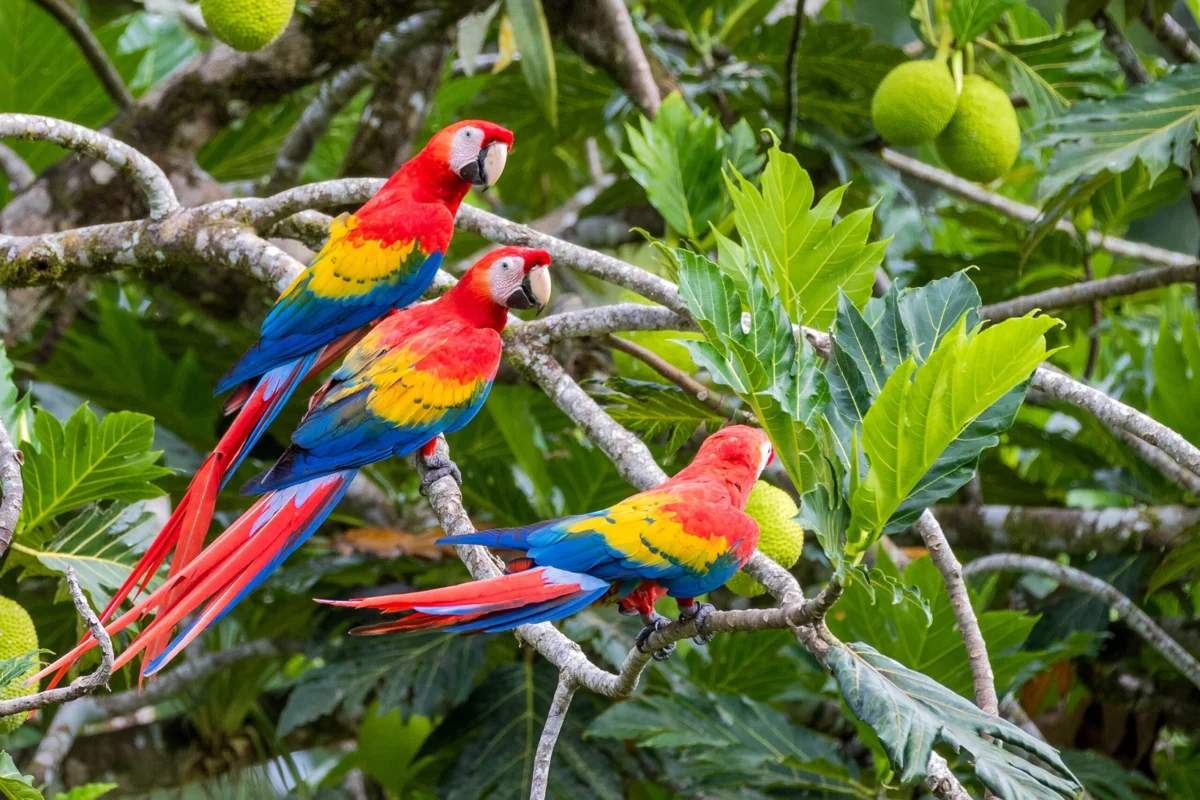
This strategic alignment of reproduction with food availability mirrors the fundamental principle observed in temperate zones: reproduction is inextricably linked to seasonal variations in food resources. Felicity Newell, an ecologist at Texas A&M University specializing in the environmental factors influencing tropical breeding, confirms this global pattern. When food is abundant, birds breed; when it is scarce, they do not. This universal ecological truth explains why, for example, Scarlet Macaws (Ara macao) in the Peruvian rainforest predominantly breed during the wet season, typically from January to April, when the fruits they rely on are most plentiful.
Despite this shared big-picture strategy, a critical distinction emerges between tropical and temperate ecosystems. Outside the tropics, day length is the primary environmental driver, directly correlating with solar energy input and, consequently, the plant growing season. However, in equatorial regions, where daylight hours remain relatively constant throughout the year, rainfall emerges as the dominant factor shaping the environment and, by extension, avian breeding patterns. The timing, intensity, and duration of wet and dry seasons directly dictate the abundance of the fruits, flowers, and insects that tropical birds require to successfully reproduce. While these resources often peak in spring and summer in North America, their peak availability in the tropics is intricately tied to precipitation cycles, which can vary significantly across different microclimates and altitudes.
Diverse Seasonal Strategies Across Tropical Landscapes
These rainfall patterns translate into distinct, yet locally predictable, spikes in breeding activity. The variability across different tropical sites is immense, reflecting the incredible ecological diversity of the region.
Consider the arid Venezuelan thorn and scrub forests, where bird communities have universally adopted a "wetter is better" strategy. They meticulously time their nesting efforts to avoid the harsh dry season, which typically runs from November to April, and instead capitalize on the explosion of fruit, flowers, and insects that accompanies the return of the rains in mid-May. Here, the challenge is not just finding food, but surviving the intense aridity that renders large swathes of the landscape inhospitable for breeding.
In contrast, the mountainous regions of Costa Rica present a different set of cues. Here, flowers often peak around November, marking the early dry season. This specific resource availability drives the breeding patterns of nectar-feeding hummingbirds, which do not breed in the early wet months from April through June, a period when many fruit- and insect-eating birds are actively nesting. This highlights how different dietary guilds within the same ecosystem can respond to distinct seasonal resource peaks, creating a complex temporal partitioning of breeding activities.
Even more localized differences in rainfall can profoundly impact tropical breeding behavior. Newell’s research in the Peruvian Andes provides a compelling example. She discovered that communities of insectivores separated by as few as 60 miles exhibit almost completely opposite breeding schedules, directly correlated with variations in local topography and rainfall. Through five years of meticulous field sampling of precipitation, insect abundance, and nest tracking, Newell found that birds in rainier mountain patches bred in May, late in the wet season, when their six-legged prey remained abundant. Conversely, insectivores inhabiting drier patches initiated breeding earlier in the wet season, in October, before the landscape succumbed to aridity and insect populations dwindled. This demonstrates an astonishing level of fine-tuned adaptation. As Newell observes, "Climate typically varies at much larger spatial scales. Here, it’s just varying at really small spatial scales, and the birds are responding to the availability of the resources." This precision underscores the profound sensitivity of tropical species to their immediate environmental conditions.
The Energetic Imperative: Why Breeding Isn’t Constant
The underlying reason for these diverse and often highly specialized breeding strategies, even in seemingly abundant environments, lies in the immense energetic cost of reproduction. Breeding is arguably the most metabolically demanding phase in a bird’s life cycle.
- Nest Construction: Building a secure and insulating nest requires significant time and physical exertion, gathering materials and weaving them together.
- Egg Production: Laying eggs is physiologically taxing. Each egg represents a substantial investment of nutrients, particularly calcium for the shell and proteins and lipids for the yolk and albumen. A female bird must dramatically increase her caloric intake to synthesize these components.
- Incubation: Maintaining a constant, optimal temperature for eggs demands sustained energy expenditure, often for weeks, with the parent bird often sacrificing foraging time.
- Parental Care: Once chicks hatch, the demands escalate dramatically. Parents must forage almost continuously to meet the insatiable appetites of their rapidly growing young, often delivering food hundreds of times a day. This includes not only finding the food but also protecting the nest from predators, a constant vigilance that burns calories and adds stress.
- Molting Trade-off: As seen with the Amazonian example, even the interruption of molt is a significant trade-off. Molt is crucial for maintaining feather integrity, which is essential for efficient flight, thermoregulation, and camouflage. Delaying or rushing this process can compromise a bird’s health and survival outside the breeding season.
Given these intense demands, continuous reproduction, even in a resource-rich environment, would quickly deplete a bird’s reserves, leading to exhaustion, poor health, reduced future reproductive success, and ultimately, death. Thus, the observed patterns – whether aseasonal flexibility in stable Amazonia or strict seasonality elsewhere – are all manifestations of evolutionary strategies to optimize energy allocation, ensuring survival and successful propagation of the species.
Implications for Conservation in a Changing Climate
Understanding these complex and often localized breeding patterns is not merely an academic exercise; it holds critical implications for conservation, especially in the face of a rapidly changing global climate. The neotropics, home to an unparalleled diversity of life, are also among the most vulnerable ecosystems.
Climate change is already manifesting in altered precipitation regimes across tropical regions, including shifts in the timing, intensity, and duration of wet and dry seasons. For species that have evolved over millennia to synchronize their breeding with specific rainfall-driven resource peaks, such changes could be catastrophic. A mismatch between breeding initiation and peak food availability – a phenomenon known as "trophic mismatch" – could lead to widespread reproductive failure. If the insects that insectivorous birds rely on emerge earlier or later than the birds’ nesting period, or if the fruiting season of a particular tree shifts, chicks could starve, and adult populations could decline.
The observed declines in many tropical species, even in seemingly intact habitats, are a stark warning. While habitat loss and fragmentation remain primary threats, a deeper understanding of these intricate breeding strategies suggests that disruptions to environmental cues and resource availability due to climate change could be an equally insidious factor. For instance, increased frequency or intensity of droughts could severely impact species in arid regions, while altered monsoonal patterns could disrupt the finely tuned breeding cycles of rainforest inhabitants.
The highly localized nature of these breeding cues, as highlighted by Newell’s research in the Andes, presents a significant challenge for conservationists. Broad-stroke conservation strategies based on generalized seasonal patterns may fail to protect species adapted to hyper-local microclimates and resource availability. Instead, targeted, site-specific monitoring and conservation efforts are crucial to identifying and mitigating the impacts of climate change on these vulnerable populations.
Future Research and Unanswered Questions
Despite the groundbreaking work of researchers like Stouffer and Newell, many tropical ecosystems remain poorly understood. The vastness and incredible ecological complexity of these regions mean that countless species and their unique life histories are yet to be fully documented. Newell’s ongoing collaborations with researchers worldwide are crucial to piecing together the intricate cause-and-effect relationships governing tropical breeding. This collaborative, multi-faceted research is not only expanding our fundamental biological knowledge but is also providing vital data to inform conservation strategies aimed at reversing the sharp declines observed in many tropical species.
Ultimately, there is no single, unified "tropical breeding season." Instead, the neotropics present a captivating and bewildering mosaic of breeding strategies, each exquisitely tailored to the specific environmental pressures and resource dynamics of its particular locale. From the opportunistic, aseasonal breeders of the Amazon to the meticulously timed reproductive cycles of birds responding to hyper-local rainfall patterns in the Andes, the avian inhabitants of the tropics offer a profound testament to the power of natural selection. Continuing to unravel these complexities is not just about understanding birds; it is about grasping the fundamental principles of life’s resilience and vulnerability in a rapidly changing world.
