
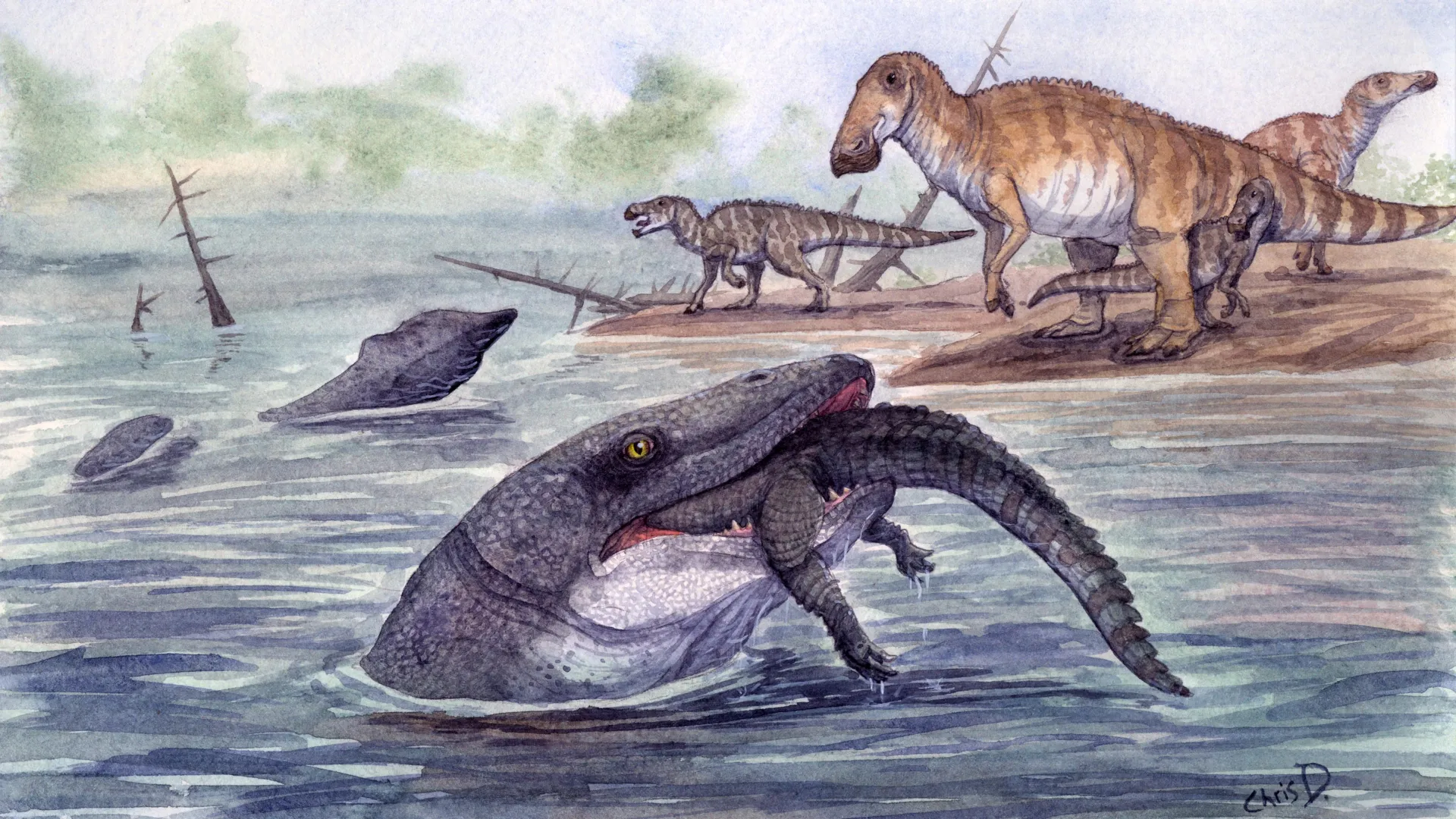
Mosasaurs, the colossal marine reptiles that dominated ancient oceans more than 66 million years ago, are now revealed to have expanded their domain beyond the salty depths, with compelling new evidence suggesting some populations thrived in freshwater river systems. This groundbreaking discovery stems from the analysis of a mosasaur tooth unearthed in North Dakota, providing strong indications that these formidable predators, some reaching up to 11 meters in length, adapted to a riverine existence during the critical final million years leading up to the end-Cretaceous extinction event. The international research team, spearheaded by scientists at Uppsala University, has published findings that redefine our understanding of mosasaur ecological flexibility and the complex environmental shifts of the late Cretaceous period.
The Unveiling of an Unusual Discovery
The pivotal discovery occurred in 2022, when a mosasaur tooth was retrieved from a river deposit in North Dakota. What made this find particularly striking was its unusual companionship: the tooth lay alongside a formidable tooth from a Tyrannosaurus rex and a robust jawbone belonging to a crocodylian. This fossil assemblage was recovered from a region already renowned for its paleontological treasures, including numerous remains of the duck-billed dinosaur Edmontosaurus. The juxtaposition of terrestrial apex predators, typical river-dwelling crocodilians, and a creature previously considered exclusively marine immediately raised profound questions. Palaeontologists wrestled with the enigma: how could the tooth of a giant marine reptile, an undisputed denizen of the open ocean, come to be preserved in the sediment of an ancient river system? This discovery challenged long-held assumptions about mosasaur habitat and distribution, setting the stage for an in-depth scientific investigation.
Isotopic Signatures: Unlocking Ancient Habitats
To unravel this palaeontological puzzle, an international consortium of researchers from the United States, Sweden, and the Netherlands employed sophisticated isotope analysis, meticulously examining the chemical composition of the mosasaur tooth enamel. The geological context proved invaluable: the mosasaur tooth, the T. rex tooth, and the crocodylian jawbone all shared a similar stratigraphic horizon, dating back approximately 66 million years ago, allowing for direct comparative chemical analysis.
The investigative work, primarily conducted at the Vrije Universiteit (VU) in Amsterdam, focused on the stable isotopes of oxygen, strontium, and carbon. These isotopes act as geochemical fingerprints, providing invaluable clues about an animal’s diet, physiology, and the water sources it inhabited throughout its life. The mosasaur tooth presented a compelling signature: unusually high levels of the lighter oxygen isotope (¹⁶O). In the natural world, ¹⁶O is preferentially evaporated from oceans and subsequently falls as rain, making it characteristic of freshwater environments. Conversely, marine waters tend to have higher concentrations of the heavier isotope, ¹⁸O. The prevalence of ¹⁶O in the mosasaur tooth enamel therefore strongly indicated a prolonged association with freshwater rather than marine habitats. Further corroborating this finding, the strontium isotope ratios within the tooth enamel also pointed definitively towards a freshwater environment, reinforcing the initial hypothesis.
Melanie During, one of the study’s corresponding authors and a key researcher from Uppsala University, elaborated on the nuanced insights gained from carbon isotopes. "Carbon isotopes in teeth generally reflect what the animal ate," During explained. "Many mosasaurs typically exhibit low ¹³C values, which is often associated with deep-diving habits where they consume prey from deeper ocean layers, less influenced by surface photosynthesis. However, the mosasaur tooth found with the T. rex tooth, remarkably, displayed a higher ¹³C value than any other known mosasaur, dinosaur, or crocodile from that period. This suggests a different ecological niche: it likely did not dive deep and, intriguingly, may have sometimes fed on terrestrial animals, such as drowned dinosaurs, indicative of a riverine diet."
During further emphasized the broader implications of these isotopic findings: "The isotope signatures unequivocally indicated that this mosasaur had inhabited this freshwater riverine environment. To ascertain if this was an isolated incident or part of a broader trend, we extended our analysis to two additional mosasaur teeth discovered at nearby, slightly older sites within North Dakota. We observed similar freshwater signatures in these specimens as well. These consistent analyses collectively demonstrate that mosasaurs were indeed living in riverine environments during the critical final million years before their eventual extinction." This robust isotopic evidence provides a powerful argument for a significant ecological shift in a subset of mosasaur populations.
A Shifting Ancient Seaway: The Western Interior’s Transformation
The research findings not only confirm the presence of mosasaurs in freshwater but also shed light on the geological and climatic conditions that facilitated such a dramatic lifestyle shift. The late Cretaceous period witnessed profound environmental changes across North America, particularly impacting the vast Western Interior Seaway. This epicontinental sea, which had for millions of years bisected the North American continent, stretching from the Arctic to the Gulf of Mexico, began to experience increasing freshwater input.
Driven by intensified rainfall and runoff from the newly forming Laramide Orogeny – a period of intense mountain building in western North America – prodigious volumes of freshwater flowed into the seaway. Over time, this influx gradually diluted the marine waters, transforming the seaway from a predominantly salty environment to one that was increasingly brackish and, in certain regions, eventually approached freshwater conditions. Researchers drew parallels to modern environments such as the Gulf of Bothnia, where the Baltic Sea’s salinity is significantly reduced by substantial freshwater input from surrounding rivers.
This process, the scientists proposed, led to the formation of a distinct ‘halocline’ within the Western Interior Seaway. A halocline is a strong vertical gradient in salinity within a body of water, where lighter, less dense freshwater forms a surface layer atop denser, more saline bottom waters. The isotope data from various marine animals studied for comparison provided compelling support for this ‘halocline’ hypothesis.
Per Ahlberg, a coauthor of the study and Dr. During’s doctoral supervisor, elaborated on this critical distinction: "For comparison with the mosasaur teeth, we also measured fossilized remains from other marine animals found in the seaway deposits and observed a clear difference. All gill-breathing animals, such as fish and ammonites, consistently exhibited isotope signatures linking them to brackish or salty water, indicating they inhabited the deeper, more saline layers. In stark contrast, all lung-breathing animals, including the mosasaurs, lacked such signatures. This crucial distinction shows that mosasaurs, which, like modern whales, needed to periodically surface to breathe, inhabited the upper, less saline, freshwater layer of the seaway, rather than the deeper, more marine-like layer." This adaptation allowed mosasaurs to exploit a previously untapped freshwater niche within what was once considered an entirely marine domain.
Ecological Adaptability: A Lesson from the Past
The researchers contend that the teeth examined unequivocally belonged to mosasaurs that had not merely made a brief excursion into freshwater but had genuinely adapted and adjusted to these novel environmental conditions. The phenomenon of large predators shifting between different habitats, even drastically different ones like marine and freshwater, is not unprecedented in the annals of evolutionary history. Such flexibility underscores the remarkable adaptive capacities of life.
Melanie During highlighted the relative ease of such transitions in certain directions: "Unlike the complex physiological adaptations required to transition from freshwater to entirely marine habitats, which often involves significant changes in osmoregulation to cope with higher salinity, the reverse adaptation – moving from marine to freshwater – is generally considered simpler from an evolutionary standpoint." This insight helps explain how mosasaurs, already possessing robust physiological systems, might have successfully navigated the shift.
Modern biology offers compelling analogues to this ancient adaptability. River dolphins, for instance, are cetaceans whose ancestors were fully marine but have evolved to live exclusively in freshwater river systems across South America and Asia. Another pertinent example is the estuarine crocodile (Crocodylus porosus), famously known in Australia as the saltwater crocodile. While capable of inhabiting and thriving in open marine environments, these formidable reptiles regularly move between rivers, estuaries, and the open ocean, opportunistically hunting wherever prey is most abundant. These modern examples illustrate that ecological flexibility, particularly in large, generalist predators, is a powerful evolutionary trait. The mosasaur’s foray into freshwater thus aligns with observed patterns of biological adaptation, making the discovery scientifically robust.
Giants in the River: The Mosasaur’s Size and Role
Mosasaur fossils are typically abundant in marine sedimentary deposits across vast geographical ranges, including North America, Europe, and Africa, spanning their evolutionary zenith from approximately 98 to 66 million years ago. Consequently, their rarity in North Dakota, particularly in freshwater or brackish environments, makes this specific discovery exceptionally noteworthy. The sheer scale of the mosasaur tooth itself provides a vivid glimpse into the animal’s imposing size. Based on tooth morphology and known mosasaur proportions, the researchers estimate the individual from which the tooth originated could have measured up to 11 meters long – a length comparable to that of a modern city bus. This estimate is further supported by earlier discoveries of mosasaur bone fragments at a nearby site, which also pointed to individuals of similarly colossal dimensions.
While the exact genus of the mosasaur cannot be definitively identified from a single tooth, the characteristics suggest it likely belonged to a prognathodontine mosasaur. Close relatives within the genus Prognathodon were renowned for their massive, powerfully built heads, exceptionally strong jaws, and robust, often crushing, teeth. These features indicate that they were formidable, opportunistic predators, capable of tackling and subduing a wide array of large prey.
Ahlberg underscored the startling implications of encountering such a predator in a riverine setting: "The size of this mosasaur means that the animal would rival the largest killer whales (Orcinus orca) in terms of its predatory presence. This makes it an extraordinary and potentially terrifying predator to encounter in riverine environments, which were not previously associated with such giant marine reptiles. Imagine a creature the size of a killer whale, accustomed to ocean depths, now navigating the murky waters of an ancient river, hunting alongside T. rex and crocodilians." This paints a vivid picture of a diverse and dynamic late Cretaceous ecosystem, far more complex than previously understood.
Broader Implications for End-Cretaceous Ecosystems
This discovery significantly enriches our understanding of the palaeoecology of the late Cretaceous, particularly the final million years preceding the devastating K-Pg extinction event. It demonstrates that as environments changed, some species, including apex predators like mosasaurs, possessed the adaptive capacity to shift their habitats and exploit new ecological niches. The transformation of the Western Interior Seaway from a fully marine environment to one with significant freshwater influence created unique opportunities for marine organisms capable of tolerating or even thriving in reduced salinity.
The presence of a massive mosasaur in freshwater environments alongside terrestrial dinosaurs and crocodilians highlights the intricate interconnectivity of ecosystems at the close of the Mesozoic Era. It suggests that these river systems were not isolated but were critical interfaces between terrestrial and marine biomes, supporting a rich and diverse faunal community. This mosaic of habitats and the adaptability of its inhabitants likely played a role in the survival strategies of various species during a period of immense environmental flux, even if ultimately, for the mosasaurs, it did not prevent their eventual demise with the rest of the non-avian dinosaurs. The research deepens our appreciation for the resilience of life and the often-unforeseen ways in which species respond to profound environmental pressures, offering a valuable lens through which to view contemporary challenges to biodiversity.
The comprehensive research was a collaborative effort involving scientists from Uppsala University, Eastern West Virginia Community and Technical College, Moorefield, West Virginia, Vrije Universiteit Amsterdam, and the North Dakota Geological Survey. The article draws upon a crucial chapter from Melanie During’s doctoral thesis, which she successfully defended at Uppsala University in November 2024, marking a significant contribution to the field of palaeontology.
