
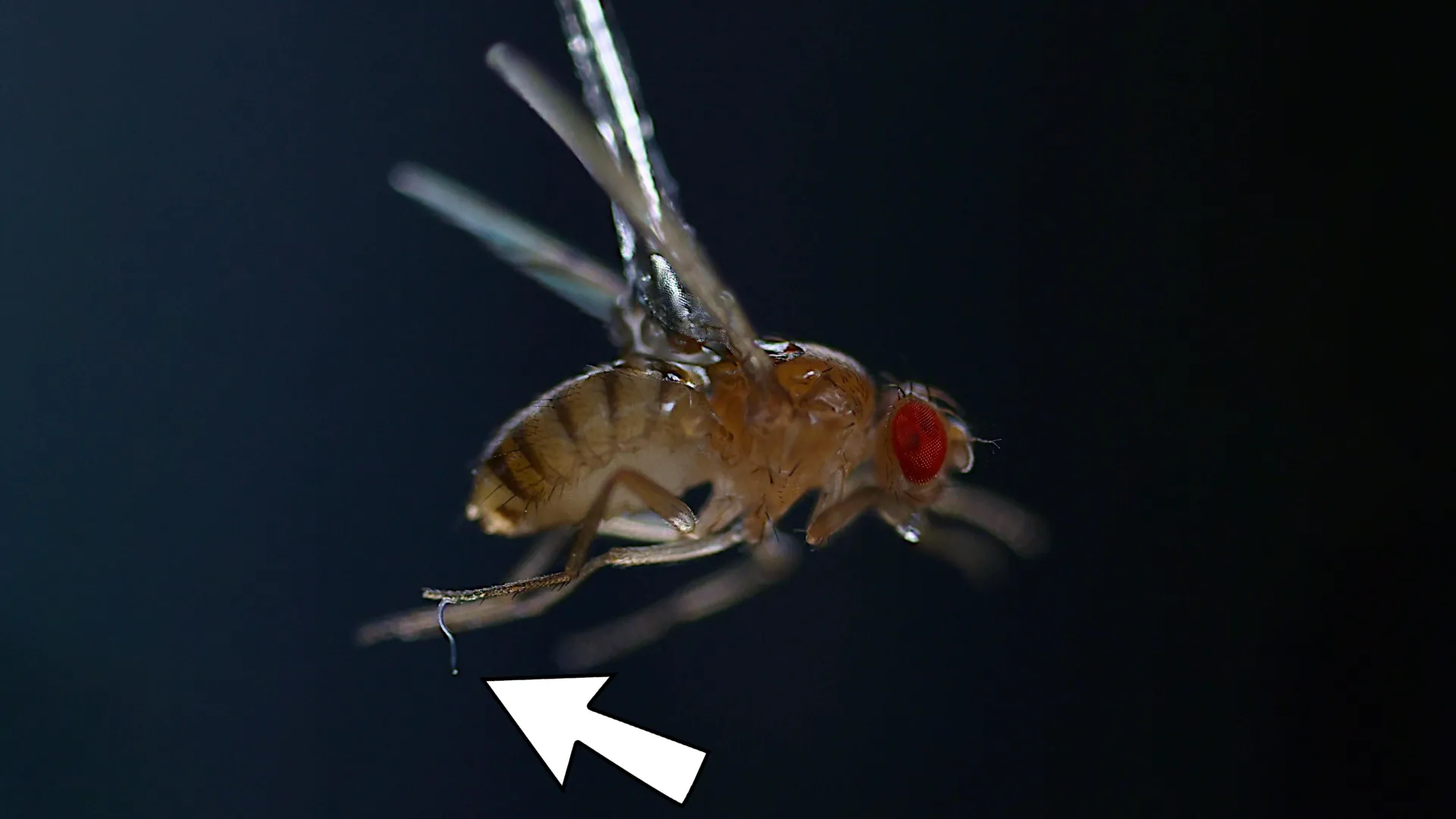
New groundbreaking research has unveiled a previously unknown mechanism by which a minuscule parasitic worm, Steinernema carpocapsae, achieves its remarkable predatory feats: by harnessing static electricity. This nematode, capable of launching itself an astonishing 25 times its own body length into the air, effectively latches onto passing flying insects through electrostatic induction, a phenomenon akin to the familiar static cling. Published in the prestigious journal PNAS, these findings represent a collaborative effort between scientists at Emory University and the University of California, Berkeley, opening new avenues in our understanding of ecological interactions at the micro-scale and pioneering the emerging field of electrostatic ecology.
The Mechanics of a Microscopic Leap
The study meticulously details how Steinernema carpocapsae, a nematode barely visible to the naked eye, transforms into an aerial hunter. When sensing an insect overhead, the worm contorts its body into a coiled loop, then explosively propels itself skyward. This acrobatic leap, equivalent to a human jumping over a ten-story building, involves a dizzying rotation of approximately 1,000 times per second. However, mere physical prowess was found to be insufficient for consistent targeting of fast-moving aerial prey. The crucial missing piece, the researchers discovered, was the interplay of electrical forces.
Unveiling Electrostatic Induction: The Worm’s Secret Weapon
At the heart of this discovery lies electrostatic induction. As an insect’s wings beat through the air, they generate an electric field, often accumulating a charge of several hundred volts. This charge, a result of friction with air molecules (a process known as the triboelectric effect), is not merely incidental but fundamentally critical to the worm’s survival strategy. When the jumping worm approaches this charged insect, the insect’s electric field induces an opposite charge on the worm’s surface. This creates an irresistible attractive force, effectively pulling the two together and significantly boosting the worm’s chances of hitting its target mid-air.
"We’ve identified the electrostatic mechanism this worm uses to hit its target, and we’ve shown the importance of this mechanism for the worm’s survival," stated Justin Burton, an Emory professor of physics and co-author of the study, whose lab was instrumental in the mathematical analyses. "Higher voltage, combined with a tiny breath of wind, greatly boosts the odds of a jumping worm connecting to a flying insect." This statement underscores the dual importance of both electrical forces and subtle aerodynamic factors in the worm’s hunting success, revealing a sophisticated predatory strategy previously unknown.
A New Frontier: Electrostatic Ecology
This research doesn’t merely describe a unique biological adaptation; it helps solidify the foundation of "electrostatic ecology" – a burgeoning scientific discipline focused on understanding the pervasive yet often overlooked role of static electricity in the natural world. While the concept of static electricity is familiar to humans through minor shocks from doorknobs or clothing, its profound impact on small organisms is only now being fully appreciated.
Victor Ortega-Jiménez, co-lead author and assistant professor of biomechanics at the University of California, Berkeley, whose experimental work involved high-speed microscopy to capture these incredible leaps, emphasized the broader implications: "You might expect to find big discoveries in big animals, but the tiny ones also hold a lot of interesting secrets." This sentiment perfectly encapsulates the shift towards exploring the intricate physics governing the lives of smaller creatures. Ranjiangshang Ran, co-lead author and a postdoctoral fellow in Burton’s lab, further articulated this, noting, "Using physics we learned something new and interesting about an adaptive strategy in an organism. We’re helping to pioneer the emerging field of electrostatic ecology." This collaborative effort, bridging the traditionally distinct fields of physics and biology, exemplifies the interdisciplinary nature required to uncover such complex natural phenomena.
Historical Context and Growing Evidence of Nature’s Electrical Side
The idea that static electricity plays a crucial role in ecological interactions is not entirely new, but the depth of current understanding is unprecedented. Ortega-Jiménez himself made a significant contribution in 2013, discovering that spider webs strategically exploit the electrical charge of nearby insects to draw them in, acting as an almost invisible electrostatic net. This early work hinted at a hidden dimension of interaction in micro-environments.
Further studies have since illuminated a fascinating array of electrostatic adaptations across the animal kingdom. Bees, for instance, utilize static forces to gather pollen more efficiently; their charged bodies, developed through friction with air, attract oppositely charged pollen grains from flowers, enhancing pollination success. Flower mites employ electrostatic attraction to cling to hummingbirds, facilitating their dispersal across habitats. Perhaps most famously, "ballooning" spiders harness charged silk to drift across vast distances, propelled by atmospheric electric fields that can reach thousands of volts per meter. These examples collectively illustrate that static electricity is not just a nuisance but a fundamental force shaping survival and behavior across diverse species.
More recently, Burton and Ortega-Jiménez co-authored a commentary in Trends in Parasitology, examining the critical role of static electricity in ticks. Burton explained, "Ticks can get sucked up from the ground by fluffy animals, purely through the static electricity in the animal’s fur." This observation led Ortega-Jiménez to develop innovative techniques for precisely controlling the electric charge of tethered ticks, an experimental methodology that proved invaluable for the subsequent nematode research, providing the missing piece to investigate the complex interplay of electrostatics and aerodynamics in precise laboratory conditions.
The Biology of Steinernema carpocapsae: A Natural Biocontrol Agent
Steinernema carpocapsae is an unsegmented roundworm, a nematode, with a fascinating and brutal life cycle. Thriving in soils across nearly every terrestrial environment outside the polar regions, this species is a significant player in soil ecosystems and has increasingly found application in biological pest control. Nematodes, as a phylum, are among the most abundant animals on Earth, occupying diverse ecological niches from marine sediments to the guts of other organisms. S. carpocapsae belongs to a group known as entomopathogenic nematodes (EPNs), meaning they are parasitic to insects.
Its effectiveness as a natural pesticide stems from a symbiotic relationship with specific bacteria, primarily Xenorhabdus nematophila. When the worm successfully latches onto and enters an insect host—typically through a natural opening like the mouth, anus, or spiracles—it releases these symbiotic bacteria into the insect’s hemocoel (body cavity). The bacteria rapidly multiply, producing toxins that kill the insect within 24 to 48 hours, often leading to a characteristic red or brown discoloration of the cadaver. Post-mortem, the nematode feeds on the proliferating bacteria and the insect’s decaying tissues, maturing and reproducing internally. Multiple generations of worms can complete their life cycle within a single insect cadaver before juvenile worms, known as infective juveniles (IJs), emerge into the environment, ready to infect new hosts and perpetuate the cycle. This efficient and deadly mechanism makes S. carpocapsae a subject of intense research globally, with scientists continually seeking ways to enhance its efficacy as an environmentally friendly alternative to chemical pesticides, particularly in agriculture and horticulture.
Painstaking Experimental Design and High-Tech Observation
To precisely quantify the role of electrostatic forces in the worm’s predatory success, the researchers devised an intricate series of experiments. A critical challenge was replicating and controlling the natural electric fields generated by flying insects. In nature, an insect’s wings rubbing against atmospheric ions can generate hundreds of volts, a phenomenon that varies with humidity, air pressure, and insect size. To simulate this in a controlled environment, Ortega-Jiménez undertook the delicate task of attaching a tiny wire, connected to a high-voltage power supply, to the back of individual fruit flies (Drosophila melanogaster). "It’s very difficult to glue a wire to a fruit fly," he recounted, detailing how this painstaking procedure often took between half an hour to an hour per fly, requiring immense patience and precision.
Another hurdle involved creating the optimal conditions to induce the worms to jump in a controlled laboratory setting. A substrate of moistened paper was employed, requiring precise hydration—just wet enough to encourage activity, but not overly saturated, as excessive moisture could inhibit jumping or alter electrostatic properties. Finally, a gentle puff of air or a slight mechanical disturbance was often necessary to prompt the worm’s characteristic leap towards a suspended, electrically charged fruit fly.
Ortega-Jiménez meticulously conducted dozens of these experiments, capturing every detail with a specialized high-speed camera. This camera, capable of recording at an astounding 10,000 frames per second, was essential for resolving the mid-air trajectories of the sub-millimeter worms, which are virtually invisible to the human eye during their rapid aerial maneuvers. To further analyze the influence of environmental factors, a miniature wind tunnel was integrated into some experimental setups, allowing the physicists to study the impact of subtle ambient breezes on the worm’s target success rate, thereby simulating more realistic conditions.
Digitizing Trajectories and Statistical Validation with MCMC
The raw high-speed video data then transitioned to the analytical phase, led by Ranjiangshang Ran. Using specialized computer software, Ran painstakingly digitized the trajectories of the worms from approximately 60 experimental videos. This process was particularly labor-intensive when worms occasionally drifted out of the camera’s focal plane, blurring the image and necessitating manual tracking of their blurred positions frame by frame—a testament to the meticulous effort involved in quantitative biological physics.
To interpret this vast dataset and determine the probabilities of successful encounters, Ran employed a sophisticated computer algorithm known as Markov chain Monte Carlo (MCMC). This algorithm, named after the mathematician Andrey Markov and the famous casinos of Monte Carlo for its reliance on random explorations to map out probability distributions, is designed to efficiently sample complex parameter spaces and determine the mathematical probability of an outcome based on varying sets of parameters.
Ran’s MCMC analysis generated a set of 50,000 plausible values for fitting parameters related to a single worm’s trajectory. These parameters included the insect’s voltage, the worm’s physical dimensions (e.g., length, mass), and its launching velocity. The objective was to test the probability of a particular electrical charge in a worm enabling it to hit its target. The results were stark: without the influence of electrostatics, only one out of 19 worm trajectories successfully reached the target, indicating that the worm’s jumping behavior would be largely ineffective and energetically inefficient in a purely mechanical context.
The model conclusively demonstrated that a charge of a few hundred volts—a magnitude commonly observed in flying insects—induces an opposite charge in a jumping worm, dramatically increasing its odds of connecting with an insect mid-air. For instance, a charge of merely 100 volts resulted in a target hit probability of less than 10%, whereas an elevated charge of 800 volts boosted the probability of success to an impressive 80%. Given that a worm expends significant energy during its jump and faces risks of predation or desiccation while airborne, these findings strongly suggest that "without electrostatics, it would make no sense for this jumping predatory behavior to have evolved in these worms," as Ran concluded. This underscores the critical evolutionary advantage conferred by this electrostatic mechanism.
Maxwell’s Legacy and the Critical Role of Drag Force
The theoretical underpinnings of this discovery hark back to the 19th century. The researchers initially theorized that electrostatic induction was the key mechanism. Their deep dive into scientific literature led them to a law of induction posited by the Scottish physicist James Clerk Maxwell in 1870. Maxwell, renowned for his foundational work in classical electromagnetic theory, including Maxwell’s equations that unify electricity and magnetism, proved remarkably prescient. "Maxwell, one of the most prolific physicists of all time, had a wild imagination, similar to Einstein," Ran remarked. "It turns out that our model for the worm-charging mechanism agreed with a prediction for electrostatic induction that Maxwell made in 1870. There are many buried treasures in scientific history. Sometimes being a scientist is like being an archeologist," highlighting the enduring relevance of classical physics in explaining modern biological mysteries.
Beyond electrostatic attraction, drag force played another critical role in the complex equation. Due to the worm’s minuscule size, air resistance significantly influences its aerial trajectory. The researchers drew an apt comparison: a bowling ball flying through the air is minimally affected by drag, whereas a floating feather is highly dependent on it. The worm, being closer to a feather in its interaction with air, experiences substantial drag, which could easily impede its ability to reach a target. Ran’s simulations, integrating experimental data with various wind speeds and electrostatic charges, revealed that even the faintest breeze—as gentle as 0.2 meters per second—combined with higher voltage, further amplified the worm’s likelihood of hitting its target. This highlights the intricate dance between physics, biology, and environmental factors, where even a slight air current can become an ally for the tiny predator.
Broader Impact and Future Inquiries in a Charged World
The implications of this research extend far beyond the fascinating life cycle of a single nematode. It provides a robust new framework for future investigations into the pervasive, yet largely unexplored, role of electrostatics in ecological systems. Understanding these mechanisms can inform novel strategies for biological pest control, potentially enhancing the efficacy of beneficial nematodes like S. carpocapsae in agricultural settings. For instance, future research might explore methods to optimize the electrostatic charge of these worms or their immediate environment to improve their predatory success in crop protection, potentially leading to more targeted and sustainable pest management solutions.
"We live in an electrical world, electricity is all around us, but the electrostatics of small organisms remains mostly an enigma," Ortega-Jiménez reflected. "We are developing the tools to investigate many more valuable questions surrounding this mystery." This sentiment underscores the vast potential of electrostatic ecology, promising to uncover a hidden layer of interaction that shapes biodiversity and ecosystem function, from the microscopic scale to potentially broader ecological phenomena. The work was supported by a grant from the W.M. Keck Foundation and the Tarbutton Postdoctoral Fellowship of Emory College of Arts and Sciences, acknowledging the vital funding required for such pioneering interdisciplinary research that pushes the boundaries of our scientific understanding.
