
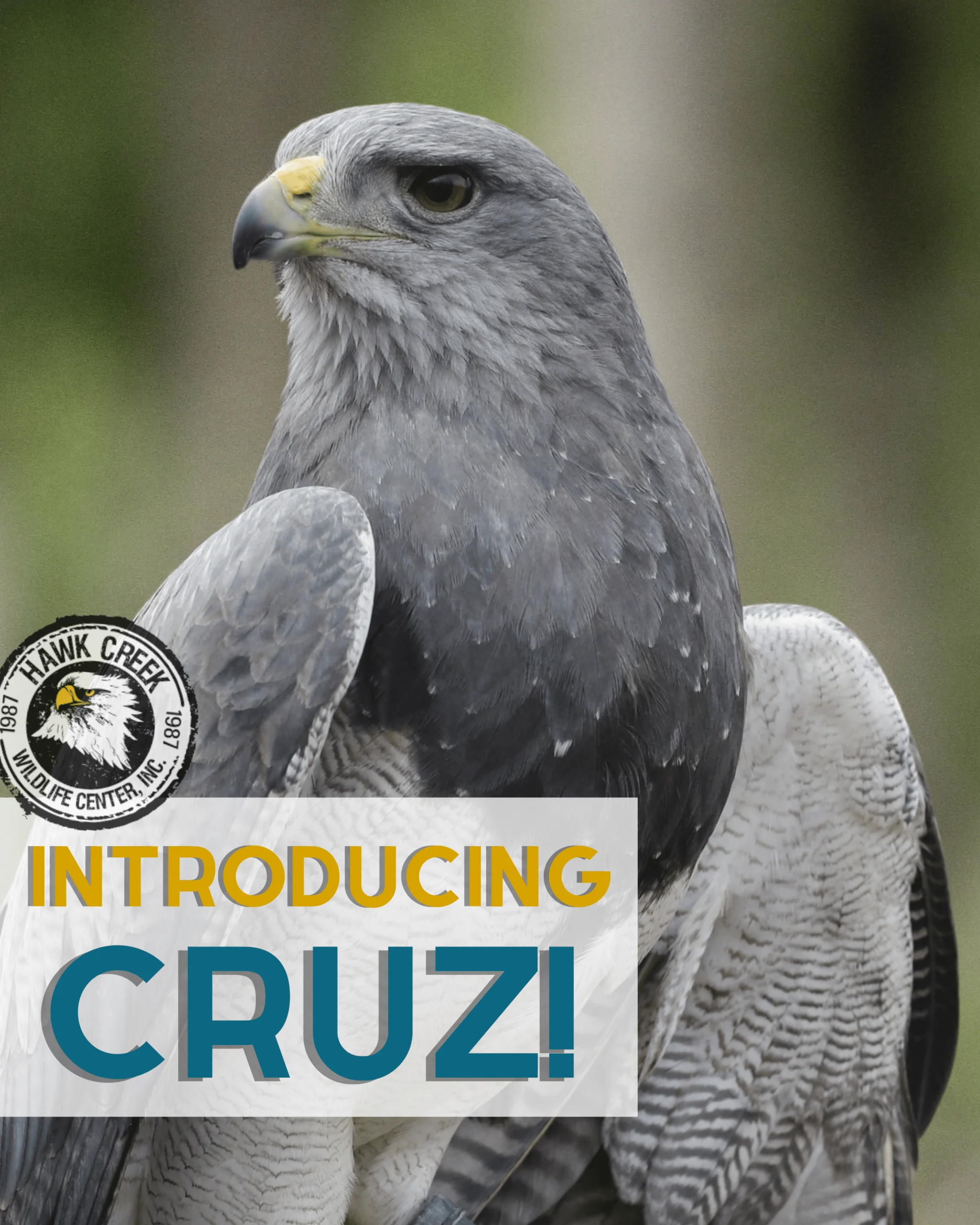
Hawk Creek Wildlife Center has officially welcomed a magnificent new resident, a Black-chested Buzzard-eagle, who will be known to the community as Cruz. This striking raptor, also recognized by a variety of other names including the Chilean Blue Eagle, Patagonian Eagle, or Gray Buzzard Eagle, represents a significant addition to Hawk Creek’s educational and conservation outreach programs. Native to the expansive, elevated open landscapes of South America, Cruz embodies the vital importance of understanding and protecting avian species that often remain beyond the immediate observation of many. His presence at Hawk Creek serves as a tangible link to distant ecosystems and underscores the center’s commitment to global wildlife conservation.
The introduction of Cruz is a direct result of a burgeoning partnership between Hawk Creek and Sia, a leading eagle conservation organization based in Oklahoma. This collaboration is not merely about acquiring new species for display; it is a strategic alliance aimed at bolstering eagle conservation initiatives worldwide and, crucially, bringing rarely seen species to the attention of the American public. Through this partnership, Hawk Creek aims to foster a deeper appreciation for avian biodiversity and the complex ecological roles these birds play.
Cruz’s daily life, as described by the center, involves the characteristic behavior of his species: extensive aerial patrols across his natural habitat in search of sustenance. His diet primarily consists of small mammals like degus, native rodents of South America, and, notably, invasive European hares. This dietary preference highlights an interesting ecological dynamic, where this apex predator can play a role in managing introduced species, a complex issue with far-reaching environmental implications.
A New Ambassador for South American Raptors
The Black-chested Buzzard-eagle (Geranoaetus melanoleucus) is a large bird of prey found in South America, inhabiting a range that extends from Venezuela and Colombia south to Tierra del Fuego. Their preferred habitats are open and semi-open areas, including grasslands, savannas, shrublands, and the edges of forests, often at elevations ranging from sea level up to 4,000 meters (approximately 13,000 feet). This adaptability to diverse, often challenging, environments speaks to their resilience.
Physically, the Black-chested Buzzard-eagle is an impressive specimen. Adults typically measure between 55 to 75 centimeters (22 to 30 inches) in length with a wingspan that can range from 130 to 170 centimeters (51 to 67 inches). Their plumage is characterized by a dark gray or blackish upper body, contrasting with a paler gray or whitish underside. A distinctive feature, from which the species derives its name, is the black chest patch. Their legs are often bright yellow, and their eyes are typically a deep orange or reddish-brown. Sexual dimorphism is present, with females generally being larger than males.
The hunting strategies of the Black-chested Buzzard-eagle are diverse and opportunistic. They are known to soar high in the sky, using their keen eyesight to spot prey from considerable distances. Once a target is identified, they can execute swift, powerful dives. Their diet is varied, reflecting their adaptability. It includes a range of vertebrates such as birds, small mammals (like the aforementioned degus), reptiles, and amphibians. The mention of European hares as a prey item for Cruz is particularly noteworthy. European hares (Lepus europaeus) are an introduced species in many parts of South America, and their proliferation can sometimes disrupt native ecosystems. The predatory pressure exerted by birds like the Black-chested Buzzard-eagle can, in some instances, help to regulate populations of invasive species, contributing to ecological balance. However, the overall impact of such predation on invasive species is a complex ecological question that varies significantly depending on the specific ecosystem and the densities of both predator and prey.
The Significance of the Hawk Creek-Sia Partnership
The introduction of Cruz to Hawk Creek is a testament to the growing global awareness of the need for collaborative conservation efforts. The partnership with Sia, a leading eagle conservation organization, is crucial in this regard. Sia, whose full name is not provided in the initial announcement but is associated with William "Two-Raven" Voelker, is recognized for its work in supporting various eagle conservation programs. The mention of the Comanche Ethno-Ornithological Initiative associated with William Voelker suggests a deep understanding and respect for indigenous knowledge systems concerning raptors, which can be invaluable in conservation strategies.
This partnership enables Hawk Creek to showcase species that are rarely encountered in the United States, expanding the educational horizons for its visitors. The center already hosts Jara, a Short-toed Snake Eagle (Circaetus gallicus), and Onyx, a Verreaux’s Eagle (Aquila verreauxii). These birds, each with their unique ecological niches and conservation challenges, provide invaluable learning opportunities.
The Short-toed Snake Eagle, for instance, is a specialized predator found across parts of Europe, Asia, and Africa, renowned for its diet of reptiles, particularly snakes. Its presence allows for discussions on specialized predatory adaptations and the importance of maintaining healthy reptile populations. Verreaux’s Eagle, a magnificent large eagle native to Africa and the Arabian Peninsula, is known for its association with rocky habitats and its primary prey of rock hyraxes. Its inclusion offers insights into the conservation needs of large raptors in mountainous and arid environments.
The addition of Cruz, the Black-chested Buzzard-eagle, further diversifies the raptor species represented at Hawk Creek, offering a window into the biodiversity of South America’s open landscapes. This fosters a broader understanding of the interconnectedness of global ecosystems and the shared challenges faced by raptor populations worldwide.
Wild Earth Event: A Hub for Conservation Dialogue
The educational outreach surrounding Cruz’s arrival will culminate at Hawk Creek’s upcoming Wild Earth event on May 13th. This event promises to be a significant platform for public engagement with raptor conservation. A key highlight of the event will be the presence of Global Eagle Conservationist Waha Thuweeka, also known as William "Two-Raven" Voelker. As a representative of Sia and the Comanche Ethno-Ornithological Initiative, Voelker is expected to provide invaluable insights into the complexities of eagle conservation.
Voelker’s expertise is likely to cover a range of critical topics, including the threats facing eagle populations globally, such as habitat loss, pesticide contamination, direct persecution, and climate change. His involvement underscores the multi-faceted approach required for effective conservation, potentially integrating scientific research with traditional ecological knowledge. The Comanche Ethno-Ornithological Initiative’s name suggests a focus on understanding the relationships between the Comanche people and birds, particularly eagles, which often hold significant cultural and spiritual importance. This perspective can enrich discussions on conservation by highlighting the human dimension and the importance of community involvement in protecting these species.
The Wild Earth event on May 13th will therefore serve not only as an introduction to Cruz but also as a forum for learning about the broader efforts to safeguard eagles and their habitats. Attendees can anticipate discussions on conservation strategies, the role of partnerships like the one between Hawk Creek and Sia, and the importance of public awareness and support for these critical initiatives. This event aims to inspire a sense of responsibility and action among the community, empowering them to become advocates for raptor conservation.
Broader Implications for Conservation and Education
The introduction of Cruz and the ongoing partnership with Sia have several important implications for both conservation and public education. Firstly, it expands the geographic scope of species that the public can learn about and connect with. By showcasing birds from South America, Hawk Creek is effectively broadening the educational canvas beyond North American species, fostering a more global perspective on conservation issues. This is particularly important in an era of increasing globalization and interconnected environmental challenges.
Secondly, the emphasis on understudied species like the Black-chested Buzzard-eagle highlights a critical area within conservation biology. Many species, especially those in less accessible regions or with less charismatic appeal, receive less research attention and funding. By bringing Cruz into the public eye, Hawk Creek and Sia are indirectly drawing attention to the need for greater research and conservation efforts for a wider array of raptor species. This can inspire future scientific inquiry and advocate for increased resources for understudied wildlife.
Thirdly, the collaborative nature of this initiative serves as a model for how organizations can effectively pool resources and expertise to achieve greater conservation impact. The exchange of species, knowledge, and resources between Hawk Creek and Sia exemplifies a proactive approach to conservation that transcends geographical boundaries. Such partnerships are essential for addressing complex conservation challenges that often require international cooperation.
Finally, the educational component, particularly through events like Wild Earth and the involvement of experts like William "Two-Raven" Voelker, is vital for building public support and understanding. By making these magnificent birds accessible and providing platforms for dialogue with conservation leaders, Hawk Creek is cultivating a more informed and engaged public. This engagement is the bedrock of successful long-term conservation efforts, as it translates into public advocacy, volunteerism, and financial support for wildlife protection.
The arrival of Cruz at Hawk Creek is more than just the addition of a new animal; it is a strategic step in a broader conservation mission. It represents a commitment to education, collaboration, and the vital work of protecting avian biodiversity on a global scale. The community’s engagement with Cruz, and the broader conservation narrative he represents, holds the potential to foster a deeper appreciation for the natural world and inspire action towards its preservation. The success of such initiatives hinges on continued support for organizations like Hawk Creek and Sia, and on the public’s willingness to learn, connect, and contribute to the ongoing efforts to conserve these magnificent birds of prey and the ecosystems they inhabit. The presence of Cruz serves as a powerful reminder of the wild wonders that exist beyond our immediate horizons and the shared responsibility we all have in ensuring their survival for generations to come.
