
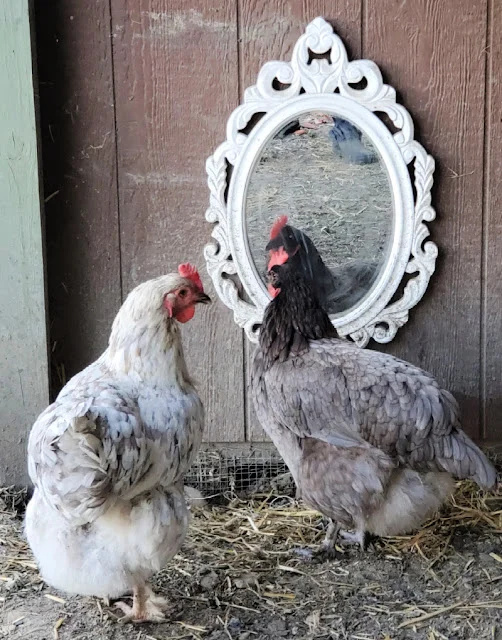
Recent scientific inquiries into avian cognition have challenged long-held assumptions regarding the intellectual limits of domesticated fowl. For decades, the ability to recognize oneself in a reflection—a psychological milestone known as self-awareness—was thought to be the exclusive domain of a small group of highly intelligent mammals, such as great apes, dolphins, and elephants. However, new research involving roosters (Gallus gallus domesticus) suggests that chickens may possess a level of self-consciousness far more sophisticated than previously understood. By adapting the traditional "mirror test" to account for species-specific behaviors, researchers have uncovered evidence that roosters can distinguish their own reflections from other members of their species, a finding that carries significant implications for animal welfare and the study of evolutionary biology.

The Evolution of the Mirror Self-Recognition Test
The Mirror Self-Recognition (MSR) test was first developed in 1970 by American psychologist Gordon Gallup Jr. The premise of the original test was straightforward: a visible mark, such as a dot of red dye, was placed on an animal’s body in a location it could not see without the aid of a mirror. If the animal looked in the mirror and attempted to touch or remove the mark on its own body, rather than reacting to the reflection as if it were a different animal, it was considered to have passed the test. This behavioral response was interpreted as proof of a "self-concept."
Over the last half-century, only a handful of species have consistently passed the MSR test. Chimpanzees and orangutans were the first, followed by bottlenose dolphins, orcas, and Asian elephants. In the avian world, the Eurasian magpie became the first non-mammal to pass the test in 2008, sparking a renewed interest in bird intelligence. Despite these successes, many researchers argued that the mark test was fundamentally flawed because it relied on the assumption that an animal is motivated to investigate a visual anomaly on its body. For species that rely more on smell or sound, or those that do not prioritize grooming, the mark test often results in "false negatives."

A New Methodology: The Alarm Call Paradigm
Recognizing the limitations of the traditional mark test, a team of researchers at the University of Bonn and Ruhr University Bochum in Germany sought a more ecologically relevant way to test self-recognition in chickens. Their study, published in the journal PLOS ONE in 2023, shifted the focus from physical grooming to social communication.
The experiment centered on a natural behavior: the alarm call. In the wild and in domestic settings, roosters act as sentinels for their flock. When a rooster spots a predator, such as a hawk, it emits a specific vocalization to warn others to seek cover. Crucially, a rooster typically only sounds this alarm if another chicken is present. If the rooster is alone, it remains silent to avoid drawing the predator’s attention to itself.

The researchers used this behavioral "audience effect" to test whether roosters perceived their reflection as a stranger or as themselves. The study was conducted in a controlled environment where roosters were exposed to the silhouette of a hawk projected onto a ceiling. The birds were tested under three distinct conditions:
- The Social Condition: The rooster was placed in a compartment with another rooster visible through a clear glass partition.
- The Solitary Condition: The rooster was alone in the compartment with no other birds in sight.
- The Mirror Condition: The rooster was alone but placed in front of a mirror, allowing it to see its own reflection.
Chronology of the Experiment and Supporting Data
The research team conducted multiple trials to ensure the statistical validity of the results. During the initial phase, when a second rooster was visible through the glass, the test subjects emitted a high frequency of alarm calls—averaging 1.33 calls per predator sighting. This confirmed the "audience effect" was active.

In the second phase, when the roosters were entirely alone, the frequency of alarm calls dropped significantly, nearly to zero. This established the baseline for "solitary behavior," where the bird recognized that no others were present to benefit from a warning.
The critical phase involved the mirror. If the roosters perceived their reflection as a rival or a companion, they should have sounded the alarm upon seeing the hawk silhouette. However, the data revealed that the roosters remained silent when facing the mirror, just as they did when they were alone. The researchers concluded that the roosters did not perceive the reflection as another bird. This suggests that the roosters were able to synchronize their own movements with the reflection and conclude that the image was not a social "audience," but rather a representation of themselves.

To further validate these findings, the researchers added a fourth condition: they placed a second rooster behind the mirror so the test subject could see it, but then covered the mirror with a film that obscured the reflection while still allowing the scent and sound of the other bird to pass through. In this scenario, the rooster still did not crow. This indicated that chickens rely primarily on visual cues rather than smell or sound to identify the presence of others, reinforcing the idea that the visual recognition in the mirror was the primary factor in their behavior.
Implications for Avian Intelligence and Sentience
The results of the Bonn study contribute to a growing body of evidence that avian brains, despite being structured differently than mammalian brains, are capable of complex cognitive processes. While mammals use the prefrontal cortex for high-level thinking, birds utilize a region called the nidopallium. The ability of chickens to pass a modified version of the mirror test suggests that self-awareness is not a linear evolutionary trait but may be an example of convergent evolution, where different species develop similar intellectual capabilities independently.

The study also highlights the importance of "ecological validity" in animal testing. For years, chickens were dismissed as lacking self-awareness because they failed the traditional mark test. By designing a test that aligned with the chicken’s natural social instincts, scientists were able to reveal a hidden depth of intelligence. This shift in perspective is prompting a re-evaluation of how we measure the "IQ" of various species.
Reactions and Broader Impact on Animal Welfare
The findings have been met with significant interest from both the scientific community and animal welfare advocates. Dr. Sonja Hillemacher, one of the lead researchers of the study, noted that the results challenge the "bird-brain" stereotype and suggest that chickens possess a level of internal life that must be considered in agricultural practices.

From a journalistic and ethical standpoint, the implications are profound:
- Factory Farming Standards: If chickens are self-aware, the ethical arguments against high-density confinement become even more compelling. The realization that these birds can recognize themselves suggests they may also experience subjective states such as boredom, frustration, and fear in more complex ways than previously assumed.
- Enrichment in Poultry Husbandry: For backyard poultry keepers and commercial farmers alike, the study supports the use of environmental enrichment. Lisa Steele, a prominent expert in backyard chicken keeping, has long advocated for the use of mirrors and "boredom busters" in coops. While some social media reports suggest that certain roosters may act aggressively toward mirrors, the scientific data suggests this is likely a failure of the bird to habituate to the mirror or a result of specific environmental stressors, rather than a lack of recognition.
- Comparative Cognition: This research opens the door for similar studies in other domesticated animals, such as ducks and geese. While the "jury is still out" on whether ducks possess the same level of self-recognition, the use of mirrors as "company" for solitary ducks suggests that even if they do not recognize themselves, they derive social comfort from the reflection.
Analysis of the Mirror Test’s Future
While the Bonn study is a landmark in ethology, it also invites healthy scientific skepticism. Some critics argue that the lack of an alarm call does not definitively prove "self-awareness" in the human sense, but rather a sophisticated level of "contingency checking"—the bird simply realizes that the image in the mirror moves exactly as it does and therefore isn’t a "real" bird.

However, even this conservative interpretation marks a significant jump in our understanding of poultry cognition. To distinguish between a "contingent" image and a living social peer requires a high level of visual processing and information integration.
As research continues, the scientific community is moving away from a "pass/fail" view of the mirror test. Instead, self-awareness is increasingly viewed as a spectrum. Chickens may not possess the same level of autobiographical memory as humans, but they clearly occupy a higher rung on the cognitive ladder than they were previously assigned.

Conclusion
The revelation that roosters may recognize their own reflections marks a turning point in our relationship with one of the world’s most common domestic animals. The transition from the 1970 mark test to the 2023 alarm call paradigm demonstrates that as our methods of inquiry become more sophisticated and empathetic to the nature of the subjects, our understanding of the animal kingdom expands.
As the agricultural industry and pet owners alike digest these findings, the focus will likely shift toward providing more stimulating and humane environments for poultry. The mirror, once seen as a simple toy or a tool for vanity, has become a window into the complex mind of the chicken, proving that there is much more to the backyard flock than meets the eye. Future studies will undoubtedly continue to peel back the layers of avian sentience, further blurring the lines between the cognitive abilities of humans and the animals we live alongside.
