
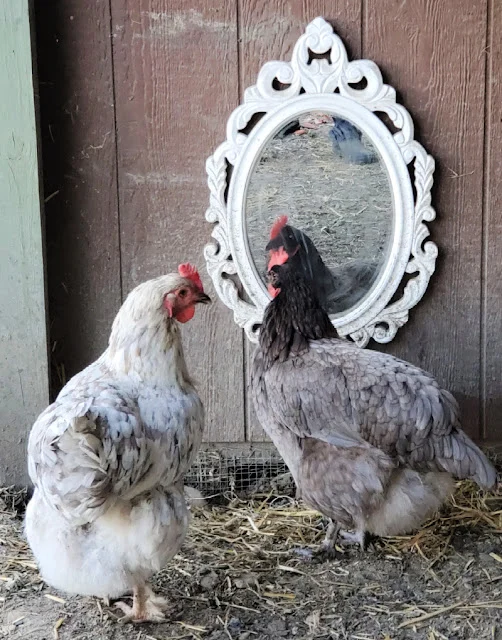
The scientific understanding of avian intelligence has undergone a significant paradigm shift following recent studies suggesting that chickens, specifically roosters, may possess the capacity for self-recognition. For decades, the "mirror test" has served as the gold standard for determining whether an animal possesses a level of self-awareness. While primates, dolphins, and elephants have historically passed this test, poultry were long dismissed as lacking the cognitive complexity required for such recognition. However, new experimental frameworks focusing on natural behaviors rather than artificial markings have provided compelling evidence that the domestic chicken (Gallus gallus domesticus) understands its own reflection, a discovery that carries profound implications for animal welfare, cognitive science, and the ethical treatment of livestock.

The Evolution of the Mirror Self-Recognition Test
To understand the significance of the recent findings, it is necessary to examine the history of the Mirror Self-Recognition (MSR) test. Developed in 1970 by psychologist Gordon Gallup Jr., the classic version of the test involves placing a scentless dye or mark on a part of the animal’s body that it cannot see without the aid of a mirror. If the animal investigates the mark on itself after seeing its reflection, it is considered to have passed, demonstrating an understanding that the image in the mirror is "me" and not another individual.
Historically, the list of animals that have passed the MSR test is exclusive. It includes:

- Great Apes: Chimpanzees, bonobos, and orangutans.
- Marine Mammals: Bottlenose dolphins and orca whales.
- Land Mammals: Asian elephants.
- Birds: Eurasian magpies.
- Fish: Bluestreak cleaner wrasses (though this remains debated).
- Insects: Certain species of ants have shown promising results in modified versions of the test.
Human children typically reach this developmental milestone at approximately 18 months of age. For many other species, including dogs and cats, the test is often a failure. Researchers believe this is because dogs and cats rely more heavily on olfaction (sense of smell) than vision to identify individuals. When a dog looks in a mirror, the "other dog" lacks a scent, leading to confusion or indifference rather than self-recognition.
Methodology: Redefining the Test for Poultry
The traditional "mark test" has frequently failed when applied to chickens. When researchers placed a sticker or paint on a chicken’s breast, the bird often ignored it or failed to use the mirror to investigate the mark. Critics argued this did not necessarily prove a lack of self-awareness but rather suggested that the test was poorly designed for the species. Chickens may not perceive a small mark as a priority, or they may lack the grooming motivation seen in primates.

Recognizing these limitations, a team of researchers from the University of Bonn and Ruhr University Bochum in Germany, led by Sonja Hillemacher and Inga Tiemann, developed a new approach published in the journal PLOS ONE. Instead of using marks, they utilized the "audience effect"—a natural social behavior specific to roosters.
The Audience Effect Experiment
Roosters are known to be protective of their flock. When a rooster spots an aerial predator, such as a hawk, it emits a specific alarm call to warn other chickens. Crucially, a rooster will typically remain silent if it is alone, as sounding an alarm would only draw the predator’s attention to itself without providing a benefit to others.

The researchers set up a controlled environment with three primary scenarios:
- The Social Scenario: A rooster was placed in a compartment where it could see another rooster through a clear partition. When a hawk silhouette was projected above, the rooster sounded the alarm.
- The Solitary Scenario: A rooster was placed alone in the compartment. When the hawk silhouette appeared, the rooster remained silent.
- The Mirror Scenario: A rooster was placed in the compartment with a mirror. When the hawk silhouette appeared, the rooster remained silent.
The results were statistically significant. In the presence of a mirror, the roosters behaved as if they were alone. This suggests that the birds did not perceive the reflection as another rooster, but rather recognized it as a representation of themselves. Had they perceived the reflection as a separate bird, the "audience effect" would have triggered an alarm call.

Chronology of Avian Cognitive Research
The journey to acknowledging chicken intelligence has been decades in the making. The following timeline highlights the progression of research in this field:
- 1970: Gordon Gallup Jr. publishes the first MSR test results on chimpanzees.
- 2008: The Eurasian magpie becomes the first non-mammal to pass the MSR test, opening the door for avian studies.
- 2013-2015: Various studies confirm that chickens possess a "complex language" consisting of at least 30 different vocalizations, indicating high-level communication.
- 2017: Research demonstrates that chickens can perform basic arithmetic and exhibit self-control when offered delayed food rewards.
- 2023: The PLOS ONE study provides the strongest evidence to date of self-recognition in roosters using the alarm-call methodology.
Supporting Data: Sensory Perception and Social Recognition
The ability to recognize oneself is closely tied to how a species processes sensory information. Chickens are highly visual animals with a sophisticated sense of hearing, though their sense of smell is relatively underdeveloped compared to mammals.

Visual Acuity
Chickens have nearly 300-degree vision due to the placement of their eyes on the sides of their heads. They possess five types of light receptors in their retinas, allowing them to see ultraviolet light and distinguish between subtle color variations that are invisible to humans. This high level of visual processing supports the theory that they are capable of interpreting complex visual data, such as a mirror reflection.
Social Hierarchies
Chickens are famous for their "pecking order," a complex social structure that requires each bird to recognize and remember dozens of other individuals in the flock. Research has shown that chickens can recognize up to 100 different faces, both of their own species and humans. This high capacity for individual recognition is a prerequisite for self-recognition; one must understand what "others" look like before one can identify the "self."

Official Responses and Scientific Debate
The findings have sparked a mixture of excitement and caution within the scientific community. While the PLOS ONE study is hailed as an innovative breakthrough, some researchers argue that the results could be interpreted differently.
Dr. Onur Güntürkün, a co-author of the study and a prominent biopsychologist, noted that the results challenge the idea that self-awareness is a "big bang" of consciousness that only a few species possess. Instead, it suggests that self-awareness may exist on a spectrum across the animal kingdom.

However, skeptics suggest that the roosters might not be "recognizing" themselves in the way humans do, but rather simply realizing that the figure in the mirror is mimicking their movements. In this view, the lack of an alarm call is not necessarily proof of a "concept of self," but rather a reaction to a stimulus that does not behave like a real, independent bird. Despite these critiques, the study is widely regarded as a significant step forward in animal behaviorism.
Broader Impact and Implications for Animal Welfare
The realization that chickens may possess a degree of self-awareness has immediate implications for the agricultural industry and domestic poultry keeping.

Enrichment in Poultry Management
For hobbyists and small-scale farmers, the use of mirrors has long been a method of "environmental enrichment." By providing mirrors in coops or brooders, owners aim to reduce boredom and prevent pecking behaviors. If chickens indeed recognize themselves, mirrors serve as a tool for cognitive engagement.
In the case of ducks or solitary birds, mirrors can provide a sense of "company," reducing the stress of isolation. While the jury is still out on whether ducks possess the same level of self-recognition as roosters, anecdotal evidence suggests that mirrors significantly lower cortisol levels in lonely waterfowl.

Ethical Considerations
On a larger scale, the discovery adds to the growing body of evidence that farm animals are sentient beings with complex internal lives. As public awareness of animal intelligence grows, there is increasing pressure on industrial farming operations to improve living conditions. If a chicken is self-aware, the ethical burden of providing a stimulating and humane environment becomes even more pressing.
Conclusion: A New Frontier in Comparative Psychology
The study of chicken self-recognition serves as a reminder that human-centric testing methods often fail to capture the true intelligence of other species. By tailoring experiments to the natural behaviors of the animal—such as the rooster’s alarm call—scientists are uncovering a world of animal consciousness that was previously hidden.

As research continues, the boundary between "higher" and "lower" animals continues to blur. The humble chicken, often dismissed as a simple food source, is proving to be a sophisticated creature capable of navigating complex social structures, communicating with nuance, and, perhaps, recognizing the face in the mirror as its own. This ongoing exploration into avian minds not only enriches our understanding of biology but also challenges us to reconsider our relationship with the creatures that share our world.
