
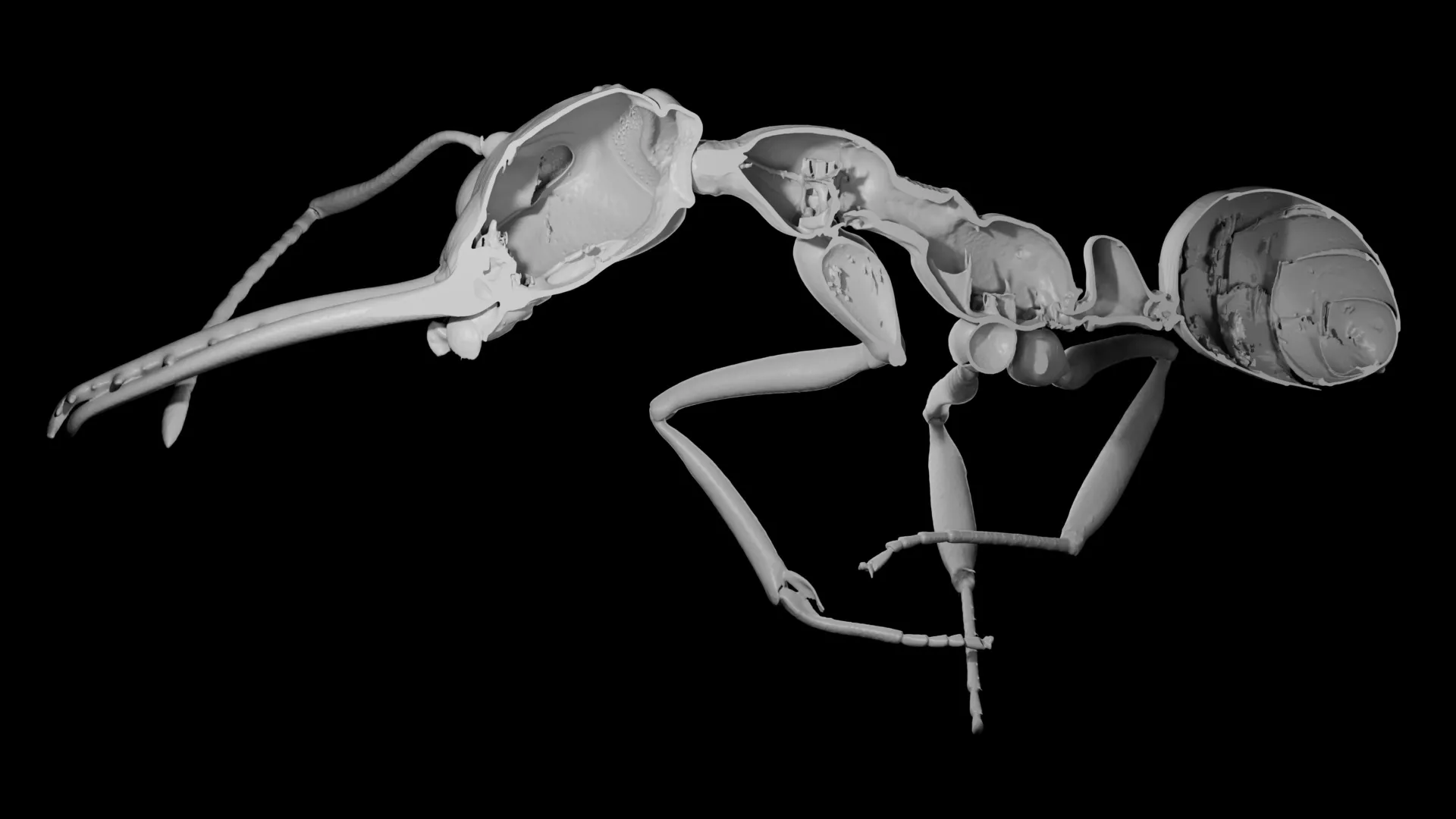
A groundbreaking study, published on December 19, 2025, in the esteemed journal Science Advances, provides compelling evidence that the fundamental biological trade-off between quantity and quality has profoundly shaped the evolution of complex animal societies, particularly in ants. This research posits that certain ant species have achieved evolutionary success by prioritizing the production of numerous, less-protected workers over fewer, heavily armored individuals, a strategy that has enabled the formation of vast, intricate colonies and accelerated the emergence of new species.
The Strategic Shift: Quantity Over Individual Robustness
The study challenges conventional notions of individual strength as the primary driver of survival, instead highlighting a collective strategy where individual vulnerability is offset by sheer numbers and sophisticated social organization. Researchers discovered that ant species forming larger colonies invest significantly less in the cuticle – the tough, chitinous outer layer of an ant’s exoskeleton – for each worker. This reduction in individual armor frees up valuable nutritional resources, particularly nitrogen and various minerals, which can then be reallocated to produce a greater number of workers. This strategic compromise, exchanging individual "toughness" for collective might, has proven to be an evolutionarily advantageous pathway.
"There’s this pervasive question in biology concerning the fate of individuals as the societies they inhabit grow more complex," explained senior author Evan Economo, chair of the Department of Entomology at the University of Maryland and the James B. Gahan and Margaret H. Gahan Professorship at UMD. "Our findings suggest a fascinating answer: individuals may, in fact, become ‘simpler’ or ‘cheaper’ because tasks that a solitary organism would need to perform independently can be effectively managed by a collective workforce." This concept of individuals becoming "cheaper" implies they require fewer resources for development and can be generated in larger quantities, even if their individual physical robustness is diminished. Economo further emphasized the novelty of their approach, stating, "This idea, while compelling, hadn’t been explicitly tested with large-scale, comparative analyses of social insects until now."
The research underscores a profound biological principle: the optimization of resource allocation. In the context of ant societies, this means a colony can achieve greater overall fitness by distributing resources across a larger workforce, rather than concentrating them on making each worker an impenetrable fortress. This echoes broader evolutionary patterns, such as the development of multicellular organisms where specialized, individually simpler cells cooperate to form a far more complex and resilient whole.
Ants: A Model System for Social Evolution
Ants (Formicidae) represent an unparalleled biological model for investigating the dynamics of social evolution. Their species diversity is immense, with over 15,000 known species and subspecies, inhabiting nearly every terrestrial ecosystem on Earth. Crucially, the social structures of ant colonies exhibit extraordinary variation, ranging from small, relatively simple colonies comprising just a few dozen individuals to mega-colonies housing millions. This vast spectrum of social complexity and colony size provides a natural laboratory for evolutionary biologists.
Lead author Arthur Matte, a Ph.D. student in zoology at the University of Cambridge, articulated the enduring mystery surrounding these ubiquitous insects: "Ants are omnipresent across the globe, yet the fundamental biological strategies that underpinned their massive colonies and their extraordinary diversification have remained largely enigmatic." The research team hypothesized that a critical, yet overlooked, factor linking colony size to evolutionary success might be the varying levels of investment in the workers’ cuticle.
The cuticle, more than just an outer shell, serves multiple vital functions. It acts as the primary defense against predators, protects against desiccation in harsh environments, and provides structural support for muscle attachment, enabling movement and task execution. Furthermore, it forms a crucial barrier against pathogens and parasites. However, the production of this protective layer comes at a significant biological cost. Chitin, the primary component of the cuticle, along with various associated proteins and minerals, requires a substantial investment of limited nutrients, particularly nitrogen. A thicker, more robust cuticle demands greater quantities of these precious resources, which in turn could impose a ceiling on the total number of individuals a colony can sustain. This inherent trade-off between individual protection and the potential for population growth forms the crux of the study’s central hypothesis.
Unveiling the Trade-off: Methodology and Key Findings
To rigorously test their hypothesis, the researchers embarked on an ambitious data collection and analysis endeavor. They amassed and analyzed an extensive dataset derived from 3D X-ray microtomography scans of more than 500 distinct ant species. This advanced imaging technique allowed for precise, non-invasive measurements of internal and external anatomical structures. For each ant specimen, the team meticulously measured both the total body volume and, crucially, the specific volume dedicated to the cuticle.
Their detailed analysis revealed a striking variability in cuticle investment across species, ranging from a mere 6% to a substantial 35% of an individual ant’s total body volume. This wide range underscored the evolutionary flexibility in how ants allocate resources to their protective layers. When these precise morphological measurements were integrated into sophisticated evolutionary models, a clear and consistent trend emerged: species that allocated a smaller proportion of their body mass to cuticle development consistently demonstrated a propensity for forming significantly larger colonies. This quantitative link provided strong empirical support for the "quantity over quality" hypothesis.
Bigger Colonies Through Collective Strength and Specialization
While the notion of individual ants being "less armored" might intuitively suggest increased vulnerability, the authors propose that this trade-off is not a weakness but rather a catalyst for the development of highly complex and successful societies. They argue that reduced individual armor goes hand-in-hand with the intensification of other beneficial social traits. These include highly coordinated cooperative foraging strategies, where large numbers of workers can efficiently exploit food sources; robust collective nest defense, where a massive, albeit individually less robust, force can overwhelm threats; and a highly developed division of labor, where specialized tasks enhance overall colony efficiency. All these traits are known to become more pronounced and sophisticated as colony size increases.
"Ants are actively reducing their per-worker investment in one of the most nutritionally expensive tissues for the greater good of the collective," Matte elucidated. "They are effectively shifting resources from self-investment towards fostering a distributed workforce, which, in turn, facilitates the emergence of more complex societies. This pattern resonates deeply with the evolutionary trajectory of multicellularity itself, where cooperative units—individual cells—can be individually simpler than a solitary cell, yet collectively achieve far greater complexity and adaptive capacity." This comparison highlights the universality of such evolutionary strategies across different scales of biological organization.
Beyond the link to colony size, the researchers uncovered another remarkable finding: lower investment in the cuticle was strongly correlated with higher diversification rates. In evolutionary biology, diversification rate, which quantifies the frequency at which new species arise within a lineage, is a key indicator of evolutionary success and adaptability. Economo emphasized the significance of this discovery, noting that "very few traits have been definitively linked to diversification rates in ants," making this particular result exceptionally striking and opening new avenues for research into the drivers of ant speciation.
The Paradox of Less Armor: Fueling Speciation
The precise mechanisms by which reduced cuticle investment promotes speciation remain an active area of inquiry. However, the research team put forth a leading hypothesis: ants with lower nutritional demands for cuticle production gain a significant ecological advantage, enabling them to expand into and colonize a wider array of environments, particularly those where resources, especially nitrogen, are scarce or unpredictable.
"Requiring less nitrogen for structural components could make these species far more versatile and capable of conquering novel environments and ecological niches," Matte suggested, reflecting on his work that began during his master’s program while interning in Economo’s lab at the Okinawa Institute of Science and Technology in Japan. This enhanced ecological flexibility could lead to increased geographical isolation, reproductive divergence, and ultimately, the formation of new species.
Another compelling explanation offered by the authors involves a positive feedback loop between individual investment and collective defense. As ant societies grow more complex and larger, group-level defenses—such as coordinated nest protection, sophisticated alarm systems, and collective disease control mechanisms (e.g., social immunity, grooming)—effectively reduce the selective pressure for individual workers to possess heavy, expensive armor. This reduction in individual armor, in turn, allows for even greater colony growth, further reinforcing the diminished need for individual protection. This dynamic creates a self-perpetuating cycle where collective strength progressively supplants individual robustness.
Economo playfully encapsulated this evolutionary trajectory: "I think of this as the evolution of squishability. Many kids, and indeed field biologists, have discovered that not all insects are equally robust, and this research helps explain why." While the study focused on ants, the researchers noted that other highly social organisms, such as termites, may have followed analogous evolutionary pathways, though this intriguing possibility warrants further dedicated investigation.
Broader Implications: From Insects to Human Societies
The profound implications of this research extend far beyond the intricate world of insects. The study offers valuable insights into fundamental principles governing the evolution of complex societies across the tree of life, including potential parallels with human societal development. The researchers drew compelling comparisons to human military history, where the era of individually heavily armored knights eventually gave way to more specialized, lighter-armored soldiers such as archers, crossbowmen, and later, disciplined infantry formations. In these historical shifts, collective tactical strength and numerical superiority often superseded individual protection.
Economo also highlighted the relevance of Lanchester’s Laws, a set of mathematical equations developed during World War I to model combat outcomes. These laws famously examine the conditions under which a numerically superior force of individually weaker fighters can overpower a smaller, but individually stronger, opposing force. The ant study provides a biological validation of these principles in an evolutionary context.
"The fundamental trade-off between quantity and quality is a ubiquitous theme in nature and human experience alike," Matte concluded, reflecting on the study’s philosophical reach. "It manifests in the food choices we make, the books we engage with, and even the strategies we employ in raising offspring. It has been utterly fascinating to retrace how ants navigated this crucial evolutionary dilemma throughout their extensive history. We could discern distinct lineages embarking on divergent paths, shaped by unique environmental pressures and inherent constraints, ultimately giving rise to the extraordinary biological diversity we witness today." This research not only illuminates a critical aspect of ant evolution but also offers a powerful lens through which to understand the broader forces shaping the rise and diversification of complex life forms.
Research Timeline and Institutional Support
The journey to these findings represents years of dedicated scientific inquiry. The foundational questions regarding individual investment within complex societies have been a long-standing interest of researchers like Professor Economo. The specific hypothesis linking cuticle investment to colony size and diversification likely emerged from meticulous observations and preliminary data, leading to the ambitious undertaking of collecting and analyzing hundreds of ant species using cutting-edge 3D imaging technology. The collaboration across international institutions – the University of Maryland, the University of Cambridge, and the Okinawa Institute of Science and Technology – underscores the global nature of modern scientific research, bringing together diverse expertise and resources. The work culminated in its publication in Science Advances on December 19, 2025, following a rigorous peer-review process, marking a significant milestone in the field of evolutionary biology.
This comprehensive research was made possible through the generous support of several key funding bodies, including the Okinawa Institute of Science and Technology, the Japan Society for the Promotion of Science KAKENHI (grant number 24K01785), the University of Cambridge, and the General Research Fund 2022/2023 (grant number 17121922) from the Research Grant Council of Hong Kong. It is important to note that the findings and interpretations presented in this article do not necessarily reflect the official views or endorsements of these funding organizations. The study’s impact is expected to resonate across entomology, evolutionary biology, and even inspire new perspectives in fields far removed from the insect world.
