
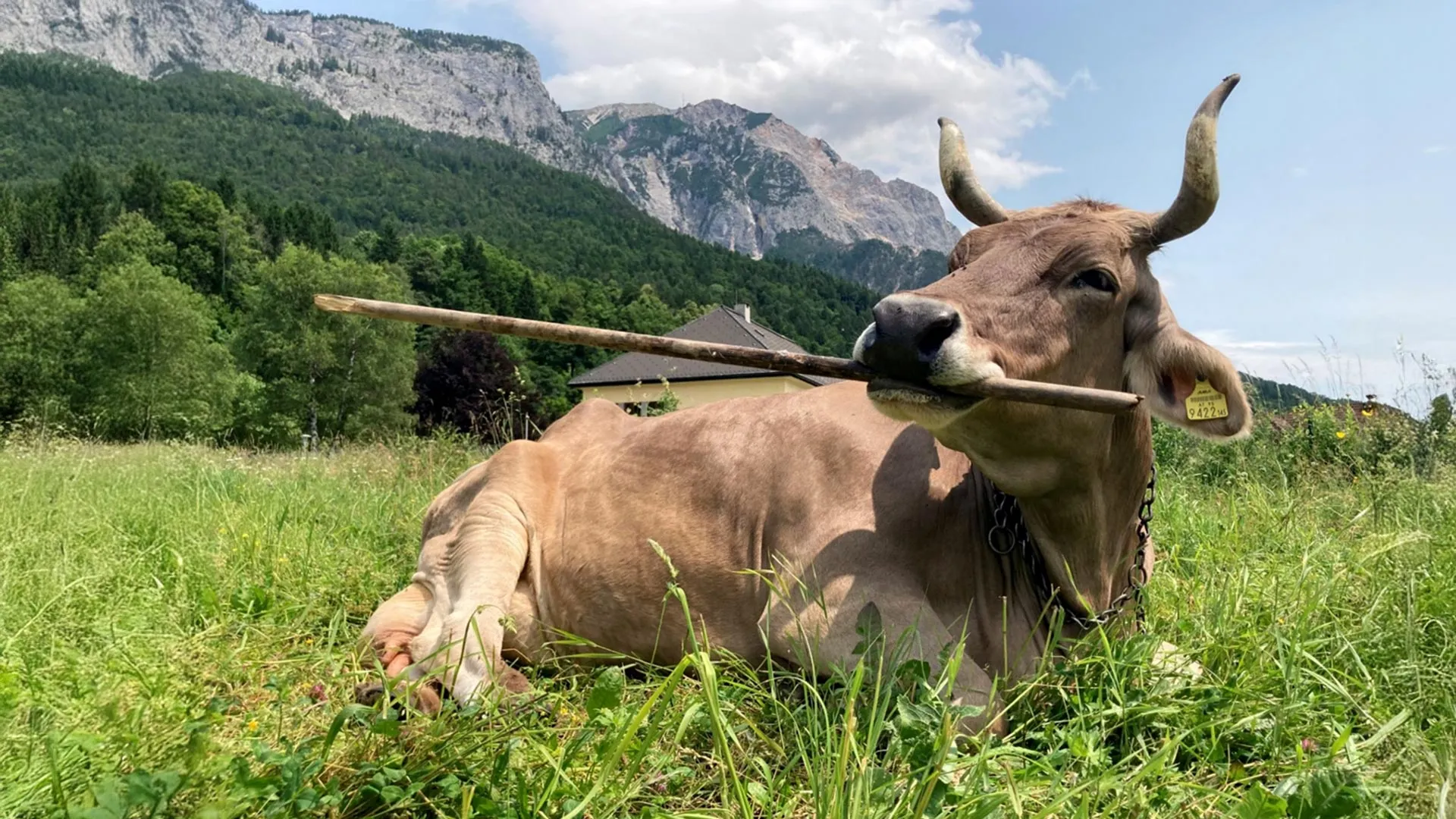
In 1982, cartoonist Gary Larson introduced a famous Far Side comic called Cow Tools. The illustration showed a cow proudly standing next to a strange collection of useless objects labeled as tools. The humor relied on a widely accepted idea that cows lack the intelligence to create or use tools, a stereotype deeply ingrained in popular culture and, to some extent, scientific understanding. However, that long-standing assumption is now being profoundly questioned thanks to a real Swiss Brown cow named Veronika, whose remarkable abilities are redefining the boundaries of bovine cognition. A groundbreaking study published in the esteemed journal Current Biology reports the first documented case of flexible, multi-purpose tool use in a pet cow, strongly suggesting that cattle may possess far greater cognitive capabilities than previously believed, urging a critical re-evaluation of how we perceive and interact with these animals.
The Myth of Bovine Stupidity: A Historical Perspective
For centuries, cattle have been largely viewed through the lens of utility—as sources of food, labor, and dairy. This utilitarian perspective has often overshadowed any serious consideration of their individual intelligence or complex emotional lives. The popular image of a cow, often depicted as placid, uncurious, and primarily driven by instinct, has been reinforced by cultural narratives, including humorous takes like Larson’s "Cow Tools." This pervasive stereotype has not only shaped public perception but has also influenced agricultural practices, where the focus has historically been on efficiency and production rather than on providing cognitively stimulating environments for livestock.
Scientific research into animal cognition has typically focused on primates, dolphins, and certain bird species, which have consistently demonstrated advanced problem-solving skills, social learning, and, critically, tool use. The ability to use tools—defined as employing an external object to achieve a goal through physical interaction—is considered a significant indicator of cognitive complexity, requiring planning, understanding of cause and effect, and motor control. Until recently, cattle were notably absent from the roster of species credited with this sophisticated behavior. This oversight, as cognitive biologist Alice Auersperg from the University of Veterinary Medicine, Vienna, points out, "highlights how assumptions about livestock intelligence may reflect gaps in observation rather than genuine cognitive limits."
Veronika’s Unconventional Life and the Dawn of a Discovery
Veronika’s story began over a decade ago, not in a research lab, but on an organic farm in Switzerland. Unlike most of her bovine counterparts, Veronika lives not as livestock destined for food production, but as a cherished companion animal to Witgar Wiegele, an organic farmer and baker who considers her an integral part of his family. This unique upbringing, fostering a close bond with humans and providing a stimulating environment, appears to have been a crucial factor in the development and observation of her extraordinary behavior.
Wiegele first noticed Veronika exhibiting an unusual habit: she would deliberately pick up sticks or other objects and use them to scratch parts of her body that she couldn’t reach directly. This was not an isolated incident but a consistent, purposeful action observed over many years. Initially, Wiegele may have simply regarded it as an interesting quirk, but its persistence and apparent intentionality eventually prompted him to record the behavior on video. These recordings, shared with researchers, marked the turning point that propelled Veronika from a beloved farm animal into a scientific marvel.
"When I saw the footage, it was immediately clear that this was not accidental," Auersperg stated, recalling her initial reaction. "This was a meaningful example of tool use in a species that is rarely considered from a cognitive perspective." The clarity and consistency of Veronika’s actions on video provided the compelling evidence needed to initiate a formal scientific investigation, moving beyond anecdotal observation to rigorous experimental validation.
Rigorous Scientific Scrutiny: Testing Tool Use in a Controlled Environment
To transition from casual observation to scientifically validated proof, researchers designed a series of structured experiments to test Veronika’s behavior under controlled conditions. The primary objective was to confirm whether her actions constituted genuine tool use, demonstrating flexibility, purpose, and an understanding of the tool’s properties, rather than mere accidental interaction or learned, rigid movements.
The research team, including Antonio Osuna-Mascaró, carefully introduced a common deck brush into Veronika’s environment. This brush, with its distinct bristled side and a smoother handle, provided a versatile object for her to manipulate. Researchers systematically placed the brush in different positions around Veronika, meticulously observing and recording her interactions. This methodical approach allowed them to gather quantifiable data on her choices and techniques.
Across multiple trials, Veronika’s behavior was remarkably consistent and deliberate. She did not randomly engage with the brush. Instead, she consistently selected specific parts of the tool based on the particular need and location of the itch on her body. Her selections were not arbitrary; they directly corresponded to the requirements of different body regions, showcasing a clear understanding of the brush’s functional properties and an ability to adapt her usage. "We show that a cow can engage in genuinely flexible tool use," Osuna-Mascaró affirmed. "Veronika is not just using an object to scratch herself. She uses different parts of the same tool for different purposes, and she applies different techniques depending on the function of the tool and the body region." This level of discernment and adaptability is what elevates her actions beyond simple object manipulation.
Flexible and Multi-Purpose Tool Use: A Benchmark of Intelligence
The detailed observations revealed clear and sophisticated patterns in Veronika’s tool-using repertoire. For larger, firmer, and less sensitive areas of her body, such as her back, she consistently preferred the bristled side of the deck brush. This choice allowed her to apply more vigorous pressure and achieve a thorough scratch. Conversely, when addressing more delicate or sensitive regions on her lower body, she would deliberately switch to using the smoother, less abrasive handle. This nuanced selection demonstrates a sophisticated understanding of tactile sensation and the varying properties of the tool.
Beyond selecting different parts of the brush, Veronika also adjusted her movements with remarkable precision. Scratching her upper body involved broader, more expansive, and stronger motions, indicative of a generalized need for relief. In contrast, movements directed at lower, more sensitive areas were notably slower, more precise, and controlled, suggesting a fine-tuned motor skill and an anticipation of the desired outcome. This adaptability in both tool selection and application is a hallmark of truly flexible tool use.
Tool use is scientifically defined as the deployment of an external object to achieve a goal through physical interaction. Veronika’s actions unequivocally meet this definition. However, her behavior extends significantly beyond this basic criterion. Her ability to utilize different features of the same object (bristles vs. handle) for distinct outcomes (vigorous vs. gentle scratching) and to modify her technique accordingly classifies her behavior as flexible, multi-purpose tool use. This advanced form of tool use is exceptionally rare in the animal kingdom, having previously been clearly and consistently documented only in chimpanzees among non-human species. Its discovery in cattle fundamentally broadens our understanding of cognitive capabilities across the animal phylogenetic tree.
Overcoming Physical Limitations: The Challenge of Lacking Hands
Veronika’s tool use is directed at her own body, a category known as egocentric tool use. While this form is sometimes considered less complex than using tools on external objects to manipulate the environment (e.g., a chimp using a stick to retrieve food), it still presents significant cognitive and physical challenges, particularly for an animal like a cow.
One of the most profound limitations Veronika faces is the absence of hands. Humans and primates primarily use their dexterous hands for tool manipulation. Cows, however, must rely solely on their mouths and tongues. Despite this anatomical constraint, Veronika demonstrates remarkable control and dexterity. She carefully grips the brush with her mouth, adjusting her hold and the angle of the tool with precision. Her actions suggest a clear anticipation of the effects of her movements, indicating a level of cognitive planning and motor control previously unattributed to cattle. The fact that she can effectively use a tool to alleviate an itch on her back, an area out of her direct sightline, further speaks to her spatial awareness and problem-solving abilities.
Why This Behavior May Be Rare: The Role of Environmental Enrichment
The researchers posit that Veronika’s unique living conditions have likely played a pivotal role in the development and expression of her tool-using capabilities. Most cattle live relatively short lives within production systems that, while varying in welfare standards, rarely prioritize cognitive stimulation or individual agency. Industrial farming environments, by their very nature, often limit opportunities for exploration, problem-solving, and novel interactions with objects.
Veronika, in stark contrast, has lived a long life (over a decade, which is significant for a cow) in a complex and highly stimulating environment. Her status as a companion animal means she benefits from daily, intricate interactions with humans, who provide a level of social and emotional engagement far beyond what most cattle experience. Furthermore, her access to a variety of objects in her environment—sticks, brushes, and other farm implements—has provided ample opportunities for exploration, experimentation, and ultimately, innovation. These factors collectively created a rich context for her natural curiosity and intelligence to flourish, allowing her to develop and refine behaviors that might otherwise remain dormant or simply go unnoticed in more restrictive settings.
As the researchers aptly conclude, "[Veronika] did not fashion tools like the cow in Gary Larson’s cartoon, but she selected, adjusted, and used one with notable dexterity and flexibility." This distinction is crucial: while she didn’t create the tool, her selection, adaptation, and multi-purpose use demonstrate a high level of cognitive function. The profound implication is eloquently summarized by the study team: "Perhaps the real absurdity lies not in imagining a tool-using cow, but in assuming such a thing could never exist."
Broader Implications: Rethinking Animal Intelligence and Welfare
This discovery represents a monumental shift in our understanding of bovine cognition. As the first confirmed case of flexible, multi-purpose tool use in cattle, it significantly expands the known range of species capable of this complex behavior. For ethologists and cognitive biologists, Veronika’s story serves as a powerful reminder that our current understanding of animal intelligence may be heavily biased by our observational limitations and preconceived notions, particularly concerning species we commonly exploit for human purposes. This research is poised to spark renewed interest in cattle cognition, potentially leading to a wave of new studies aimed at uncovering similar abilities in other individuals or herds.
The implications extend far beyond academic curiosity. If cattle possess such advanced cognitive capabilities, it raises profound ethical questions about current livestock farming practices. Environments that deny animals opportunities for natural behaviors, exploration, and mental stimulation may not only be detrimental to their welfare but also prevent the expression of their inherent intelligence. This research could become a powerful argument for advocating for more enriched environments, greater individual recognition, and higher welfare standards for cattle globally. It challenges the anthropocentric view that complex intelligence is exclusive to a select few "higher" species and encourages a more inclusive understanding of the diverse forms of intelligence found throughout the animal kingdom.
The research team is now actively exploring which specific environmental and social conditions foster the development of such sophisticated behaviors. This line of inquiry is crucial for understanding whether Veronika is an exceptional outlier or if her abilities represent a latent potential within the species that is simply rarely expressed due to typical living conditions. To further their investigation and gather more evidence, the researchers are actively encouraging others to report similar observations. "Because we suspect this ability may be more widespread than currently documented," Osuna-Mascaró says, "we invite readers who have observed cows or bulls using sticks or other handheld objects for purposeful actions to contact us." This call to action underscores the possibility that many more Veronikas might exist, their intelligence awaiting recognition by attentive human observers willing to challenge long-held assumptions. The journey from a humorous cartoon to a scientific revelation highlights the ever-evolving nature of our understanding of the animal world, urging us to look beyond stereotypes and appreciate the true depth of intelligence that surrounds us.
