
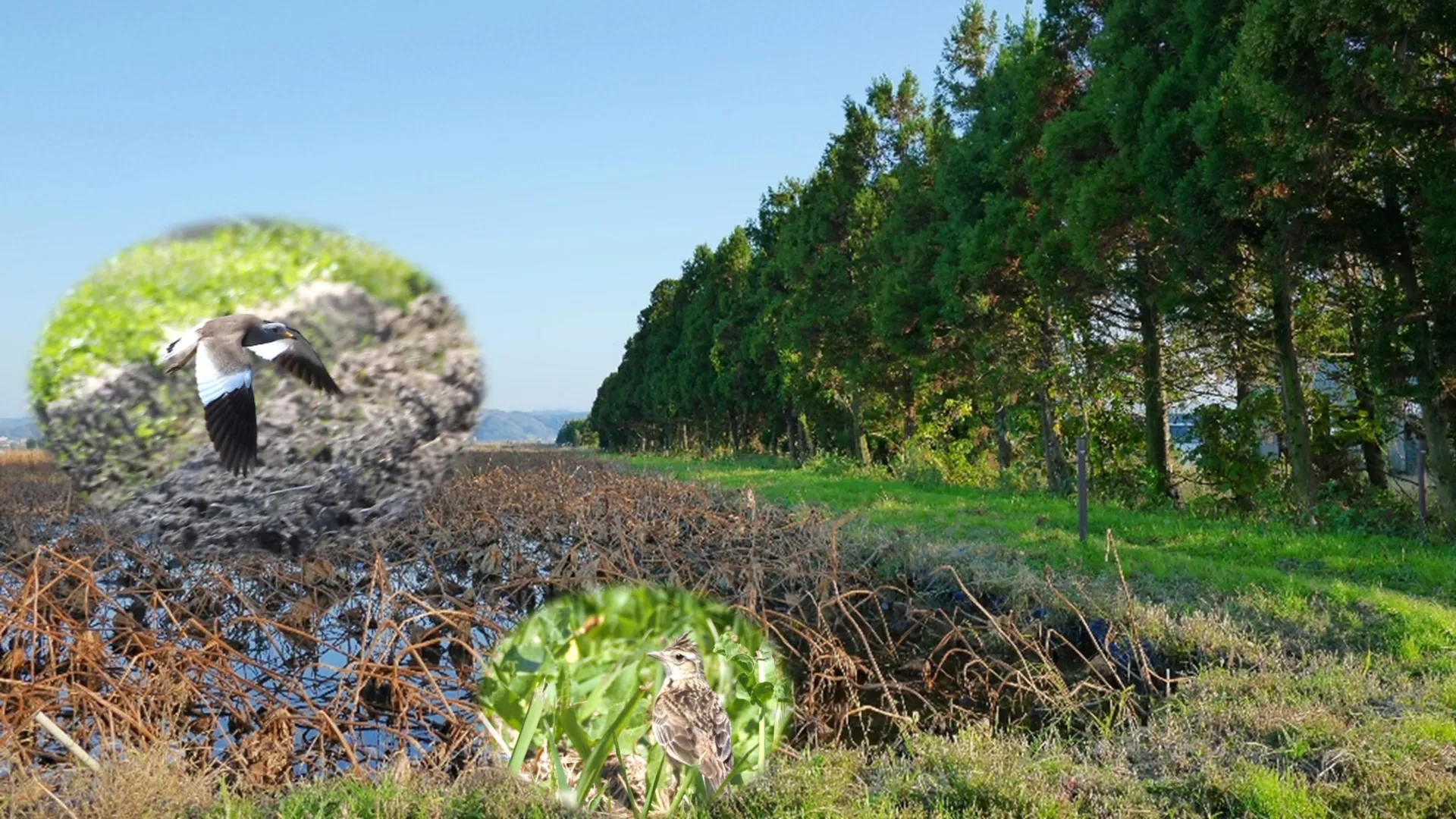
Trees planted along farmland to shield crops from strong winds are often viewed as a simple, universally beneficial strategy to support biodiversity. However, new research emanating from Japan suggests that this picture is far more intricate, particularly in agricultural wetlands where numerous bird species are intrinsically linked to open landscapes. A comprehensive study conducted by a team of researchers on farmland wetlands situated along the western coast of central Japan has unveiled that shelterbelts—rows of trees strategically planted as windbreaks—do not confer equal advantages to all avian populations. While these woody features undoubtedly provide crucial habitat for certain species, they simultaneously contribute to a significant reduction in the abundance and diversity of birds that are dependent on expansive, unobstructed grassland and wetland environments.
The findings, which challenge long-held assumptions in ecological conservation, were formally published in the esteemed Journal of Environmental Management, prompting a re-evaluation of current agri-environmental policies. This study introduces a critical nuance to the ongoing discourse surrounding biodiversity enhancement in farmed landscapes, particularly those characterized by a high proportion of wetlands.
The Global Imperative of Wetland Conservation
Wetlands, encompassing a diverse array of ecosystems from marshes and fens to peatlands and rice paddies, are among the most biodiverse and productive habitats on Earth. They provide invaluable ecosystem services, including water purification, flood control, climate regulation through carbon sequestration, and critical habitats for countless species, including a significant proportion of the world’s migratory birds. Despite their immense value, wetlands are also among the most threatened ecosystems globally. Over the past three centuries, more than 87% of the world’s natural wetlands have been lost, with a staggering 35% disappearing since 1970 alone, according to reports from the Ramsar Convention on Wetlands. This alarming rate of decline underscores the urgent need for effective conservation strategies.
In many parts of Asia, agricultural wetlands, most notably vast expanses of rice paddies, have come to serve as surrogate wetlands, compensating for the loss of natural habitats. These human-modified landscapes play a dual role: they are indispensable for global food security, providing staple crops for billions, and simultaneously act as vital refuges and feeding grounds for a wide array of wildlife. Given their widespread presence and ecological significance, understanding how agricultural management practices impact biodiversity in these unique environments is paramount.
A Critical Junction: Japan’s Agricultural Wetlands and the East Asian-Australasian Flyway
The research specifically focused on the farmlands surrounding Lake Kahokugata in central Japan, a region of immense ecological importance. Lake Kahokugata is not merely a local natural asset; it is recognized as a critical stopover location along the East Asian-Australasian Flyway (EAAF). This superhighway of the skies is one of the world’s nine major migratory bird flyways, stretching over 13,000 kilometers from the Arctic Circle through East and Southeast Asia to Australia and New Zealand. It connects more than 22 countries and supports over 50 million migratory waterbirds from more than 250 different species, including many critically endangered ones.
Birds utilizing the EAAF depend on a network of healthy wetlands for resting, refueling, and breeding during their arduous journeys. The area around Lake Kahokugata, with its large tracts of rice paddies, lotus fields, cultivated cropland, and pastureland, serves as a crucial staging post for wintering species seeking respite from colder northern climes and for breeding species occupying the region during the warmer summer months. Historically, nearly 300 bird species have been documented in this biodiverse area, highlighting its irreplaceable role in the global conservation of migratory birds. The region’s regular exposure to strong winter winds and storms has also made shelterbelts a ubiquitous feature of the agricultural landscape, installed primarily to safeguard crops from wind damage and soil erosion.
The Traditional View of Shelterbelts: A Double-Edged Sword
For decades, agricultural conservation programs across the globe have actively encouraged farmers to integrate woody landscape features, such as trees and hedgerows, into their farmlands. These shelterbelts have generally been lauded as beneficial interventions for enhancing biodiversity, providing nesting sites, foraging opportunities, and protective cover for various wildlife species. Much of the scientific evidence underpinning the ecological value of shelterbelts, however, originates from studies conducted in cropland and grassland systems predominantly in Europe and North America. These regions often feature different agricultural practices, landscape structures, and, crucially, distinct ecological contexts compared to the extensive wet farming landscapes found across Asia.
The prevailing assumption has been that the benefits observed in temperate croplands would translate directly to other agricultural settings. However, as corresponding author Masumi Hisano, an assistant professor at Hiroshima University’s Graduate School of Advanced Science and Engineering, articulated, "The central question of our study is, ‘Do shelterbelts and other woody linear features benefit all farmland birds equally in agricultural wetland landscapes, or do they create trade-offs by disadvantaging species that depend on open habitats?’" This question is particularly pertinent given the unique ecological functions of agricultural wetlands and their importance as substitute habitats for numerous bird species, including those undertaking vast migratory journeys. If the presence of shelterbelts inadvertently diminishes habitat quality for open grassland and wetland-dependent birds, then conservation efforts, despite their noble intentions, could lead to unforeseen and potentially detrimental consequences.
Unpacking the Research: Methodology and Study Site
To rigorously investigate this complex question, the research team focused their efforts on the agricultural landscape surrounding Lake Kahokugata. The area is characterized by a mosaic of land uses, with extensive rice paddies dominating the landscape alongside lotus fields, various cultivated crops, and pockets of pastureland. This diverse agricultural matrix, combined with the region’s strong winter winds, provided an ideal natural laboratory to study the ecological impacts of shelterbelts.
The researchers conducted comprehensive bird surveys across two distinct periods: February and March 2021, capturing the presence of wintering bird populations, and again in June 2023, to assess breeding species. Employing a standardized point count method, the team systematically recorded bird abundance and diversity at numerous locations, carefully noting the proximity of each survey point to existing shelterbelts. The point count method involves observers standing at a fixed point for a set duration, identifying and counting all birds seen or heard within a defined radius. This widely accepted methodology allows for robust data collection on avian communities and their spatial distribution relative to landscape features. The meticulous data collection spanned multiple seasons to account for the dynamic nature of bird populations and their habitat requirements throughout the year.
The Ecological Trade-off: Winners, Losers, and "Ecological Walls"
The painstaking surveys yielded a clear and unambiguous ecological trade-off, underscoring the nuanced impact of shelterbelts. The findings indicated that shelterbelts did indeed support bird species typically associated with shrubs and habitat edges, providing them with essential cover, nesting sites, and foraging opportunities. These "edge species" often thrive in environments with a mix of open and wooded areas.
However, the flip side of this benefit was a substantial and concerning reduction in both the abundance of grassland birds and the diversity of wetland species. These species are critically dependent on large, unobstructed open areas for their survival, including foraging, nesting, and predator avoidance. "We found that the abundance of grassland birds was more than 70 percent lower at sites next to shelterbelts compared with open sites located about one kilometer away," Hisano stated, providing a stark quantitative measure of the negative impact. This significant reduction highlights how even seemingly minor landscape modifications can profoundly alter avian communities.
The researchers conceptualized shelterbelts as acting like "ecological walls." While they create valuable habitat opportunities for certain species that prefer or require woody cover, they simultaneously diminish the usable space for birds that nest and feed exclusively in open environments. For species like various plovers, snipes, and certain waterfowl that rely on expansive sightlines to detect predators, the presence of trees can heighten their vulnerability. Shelterbelts can provide perches for avian predators such as raptors, offering them advantageous vantage points to spot prey in the open fields. They can also offer cover for mammalian predators, allowing them to approach open-habitat birds undetected. This increased exposure to predation risk can force open-habitat species to abandon otherwise suitable foraging or nesting grounds, thereby reducing their functional habitat. Furthermore, these "walls" can fragment formerly continuous open habitats, disrupting movement patterns and gene flow for species adapted to wide-ranging movements.
"Our study provides clear, quantitative evidence that small-scale landscape features can have large ecological consequences, directly relevant to land-use planning and environmental management," Hisano emphasized, highlighting the broader implications of their meticulous research.
A Paradigm Shift in Conservation Thinking
The study’s findings necessitate a significant re-evaluation of current approaches to agricultural biodiversity conservation. Rather than adopting a binary view of trees as either uniformly beneficial or harmful, the researchers advocate for a more nuanced perspective that emphasizes the critical importance of where and how trees are integrated into agricultural landscapes. The prevalent enthusiasm for tree planting as a panacea for biodiversity loss, particularly in the context of agri-environmental schemes, often overlooks the specific ecological requirements of diverse species assemblages.
"Biodiversity-friendly farmland management must balance structural complexity with the ecological needs of open-habitat species, especially in landscapes where wetlands have already been heavily modified by humans," Hisano explained. This message is particularly salient because many existing agricultural conservation programs, while well-intentioned, frequently encourage tree planting without fully considering the potential cascading effects these changes might have on entire bird communities, especially those reliant on increasingly scarce open wetland habitats. The study serves as a potent reminder that ecological interventions must be context-specific and guided by a thorough understanding of the local ecosystem dynamics and species’ needs.
Voices from the Field: Expert Perspectives and Stakeholder Considerations
The implications of this research extend beyond academic circles, resonating with conservation organizations, policymakers, and farmers alike. Conservation groups dedicated to the protection of migratory birds and wetlands, such as the Wild Bird Society of Japan or international organizations focused on the East Asian-Australasian Flyway, would likely welcome these findings as crucial evidence for more targeted conservation strategies. A spokesperson for such a group might state: "This research from Lake Kahokugata provides invaluable, data-driven insights that will allow us to refine our conservation blueprints. We must move beyond blanket recommendations and adopt integrated landscape management plans that safeguard the critical open spaces essential for our migratory waterbirds, many of which are already facing immense pressure from habitat loss and degradation across the flyway."
For farmers, the study presents a dilemma. Shelterbelts are often indispensable for protecting crops from harsh winds, preventing soil erosion, and potentially increasing yields. Policymakers developing agri-environmental subsidies must therefore consider both the agricultural benefits and the ecological trade-offs. The research urges a collaborative approach, perhaps involving incentives for farmers to implement windbreak solutions that are less ecologically disruptive to open-habitat species, or to strategically place woody features in areas where their impact on wetland birds is minimized. The findings underscore the need for policies that support sustainable agriculture while genuinely enhancing biodiversity, rather than inadvertently harming vulnerable species.
Charting the Course Forward: Future Research and Integrated Landscape Management
Looking ahead, the research team proposes several avenues for future investigation to further refine our understanding of shelterbelt ecology. These include exploring how specific characteristics of shelterbelts—such as their width, height, spacing, overall configuration, and the composition of tree species—influence wildlife across different regions and seasons. For instance, narrower, less dense shelterbelts or those composed of native, non-invasive species might have different ecological impacts than dense, broad windbreaks.
Furthermore, they hope to delve deeper into understanding indirect ecological effects. This could include how shelterbelts alter predator activity, influence microclimates (which can affect invertebrate prey availability), or impact habitat connectivity for different species. Understanding these complex interactions is vital for designing truly effective conservation measures.
"Ultimately, our goal is to help design evidence-based agri-environmental policies that work in wet-farmed landscapes worldwide," Hisano articulated. "Rather than promoting a single solution, such as planting more trees everywhere, we aim to support landscape-level planning that combines open habitats and woody features in ways that sustain diverse bird communities and the ecosystem functions they provide. By doing so, agricultural wetlands can remain productive for people while continuing to serve as vital habitats for wildlife in a rapidly changing world." This forward-thinking approach emphasizes the need for holistic, integrated landscape management that acknowledges the multifaceted roles of agricultural wetlands and strives for a harmonious coexistence between human activities and ecological health. The lessons learned from Lake Kahokugata hold global relevance, offering critical guidance for wetland conservation and sustainable agricultural practices far beyond Japan’s shores.
The interdisciplinary research team included Masumi Hisano with Hiroshima University, The University of Tokyo, and Kyoto University; Shota Deguchi with Fukui City Museum of Natural History; Wenhuan Xu with University of British Columbia and Simon Fraser University; Xike Xiao with Hiroshima University; Keinosuke Sannoh with Nihonkai Eco Engineering Technologies; Xinli Chen with Zhenjiang A&F University; and Ken Motomura with Nakano City Hall. The pivotal study was generously supported by the Kahokugata Lake Institute and the Japan Society for the Promotion of Science KAKENHI.
