
Fifty years after Donald Griffin’s groundbreaking 1976 book, The Question of Animal Awareness, the scientific community continues to grapple with the profound implications of nonhuman consciousness. Griffin’s seminal work challenged the prevailing view of animals as mere instinctual automatons, proposing instead that they possessed levels of self-awareness comparable to humans. This assertion, revolutionary at the time, ignited a debate that persists today, particularly concerning the consciousness of non-primate species like birds. While the initial consensus leaned towards instinct and learned responses, a growing body of evidence and a recent declaration signed by hundreds of scientists (Andrews et al., 2024) suggest "strong scientific support" for consciousness in mammals, birds, and potentially all vertebrates. Yet, definitive proof of consciousness, a challenge even in humans, remains an elusive goal.
The difficulty in establishing nonhuman consciousness is compounded by the complex nature of consciousness itself. Many studies attempt to gauge consciousness by examining sentience—the capacity to experience emotions and sensations. However, evaluating these subjective experiences in nonhumans presents a significant hurdle, especially given the acknowledged difficulty humans face in articulating their own emotional states (Plutchik, 2001). While sensitivity to pain offers a more tangible, albeit basic, indicator, it is widely considered insufficient on its own to argue for human-like consciousness. The quest for a comprehensive metric continues.
Researchers have proposed increasingly sophisticated methods for assessing animal consciousness. Scholars like Birch et al. (2020) and Bayne et al. (2024) have developed intricate frameworks, though some critics argue these frameworks may be overly anthropocentric. Decades ago, a collaborative effort between Dr. Irene Pepperberg and her student S.K. Lynn (Pepperberg & Lynn, 2000) posited the existence of "levels" of consciousness, intricately linked to quantifiable cognitive abilities within a species. They theorized that these cognitive levels likely arose from homologous or convergent evolutionary paths involving brain structures, perceptual systems, and learning mechanisms. This perspective immediately raised questions about the existence of parallels between human and nonhuman cognitive processes and the potential for a shared "neural correlate of consciousness" (NCC) across species. The ongoing search for an NCC in humans (Cognitive Consortium, 2025) underscores the immense complexity of extending this investigation to nonhuman subjects.
The advent of advanced artificial intelligence systems further complicates the discourse. While AI can demonstrate impressive cognitive processing power, current systems, lacking self-awareness, highlight that processing capacity alone does not equate to consciousness (Block, 2025). This observation potentially steers the debate back towards the importance of sentience over higher-order cognitive functions when defining consciousness.
The Evolving Scientific Debate Around Animal Consciousness
The scientific community’s understanding of animal consciousness has evolved significantly since Griffin’s initial hypothesis. In 1976, the notion that animals might possess internal subjective experiences was largely dismissed. The dominant paradigm viewed animals as biological machines reacting predictably to external stimuli, driven by instinct and the principles of operant conditioning—rewarding behaviors are reinforced, and punishing ones are extinguished. This mechanistic view permeated scientific and public understanding for decades.
However, a series of influential studies, including those conducted by Dr. Pepperberg with her renowned Grey parrot, Alex, began to chip away at this rigid framework. Alex demonstrated remarkable abilities in vocal learning, object categorization, and numerical comprehension, suggesting cognitive capacities far beyond what was previously attributed to birds. These findings, detailed in Pepperberg’s 1999 book, The Alex Studies, provided compelling anecdotal and empirical evidence that challenged the simplistic instinct-driven model.
The recent declaration by hundreds of scientists (Andrews et al., 2024) marks a significant milestone, signaling a broad consensus shift within the scientific community. This declaration, building upon decades of research across various disciplines, argues that substantial evidence supports the presence of consciousness in a wide array of animal species. The signatories, encompassing ethologists, neuroscientists, philosophers, and cognitive scientists, assert that the scientific understanding of consciousness has advanced to a point where attributing conscious experience to nonhuman animals is no longer a fringe hypothesis but a scientifically defensible position. The declaration emphasizes that the absence of definitive proof in humans should not preclude acknowledging the strong evidence in other species.
Defining and Measuring Consciousness: A Multifaceted Challenge
Full consciousness, as understood in human terms, involves more than simply processing sensory information. It encompasses the ability to monitor one’s own mental states, exert executive control over decisions and actions, and, crucially, possess an awareness of one’s own awareness—self-awareness. It is this latter aspect, self-awareness, that presents the most profound challenge when studying nonhuman animals. Lacking the symbolic language humans use to articulate their internal experiences, animals cannot directly report their self-awareness.
This limitation necessitates indirect methods of investigation. Researchers are increasingly turning to behavioral indicators that, when observed in humans, are strongly associated with self-awareness. Dr. Pepperberg, in her 2026 paper published in Comparative Cognition and Behavior Reviews (Pepperberg, 2026), explores several such behavioral patterns, emphasizing that these observations, while not definitive proof, offer vital insights into avian cognition. These insights are crucial for evaluating the levels and qualities of conscious behavior in birds.
One particularly compelling area of research involves tasks of delayed gratification. In these experiments, subjects are presented with a choice between an immediate, less desirable reward and a delayed, more desirable reward. Success in such tasks requires a sophisticated interplay of cognitive abilities: suppressing immediate impulses and desires, understanding the conflict between short-term satisfaction and long-term gain, maintaining the long-term goal in working memory, and actively employing strategies to achieve that goal.
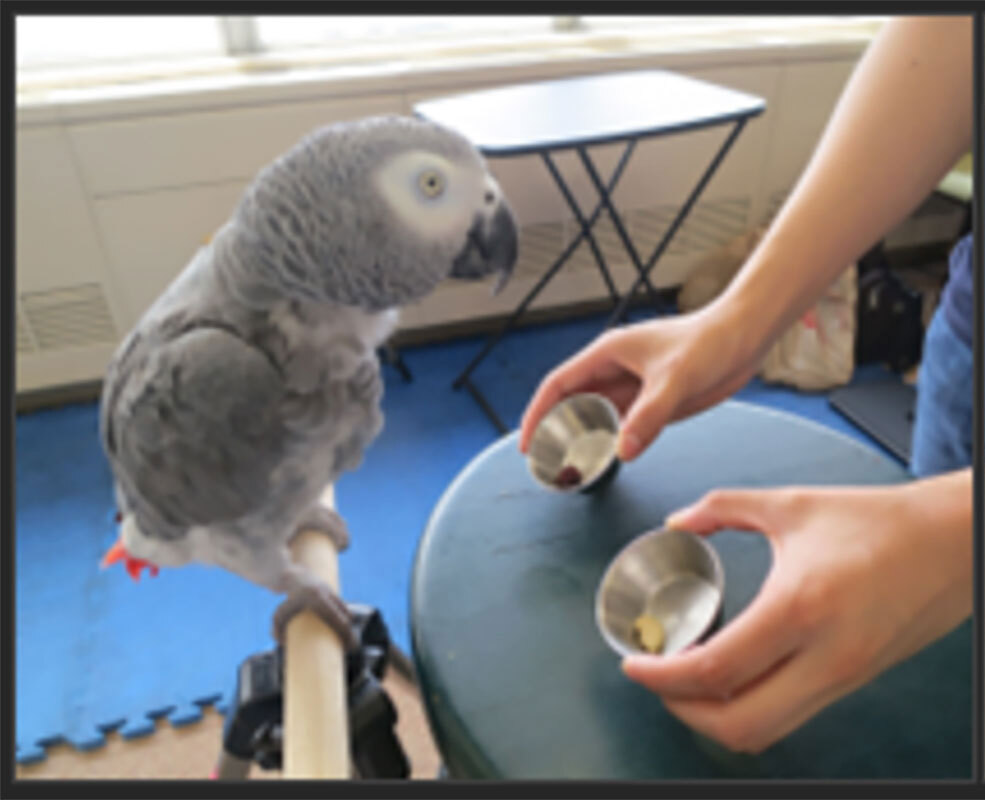
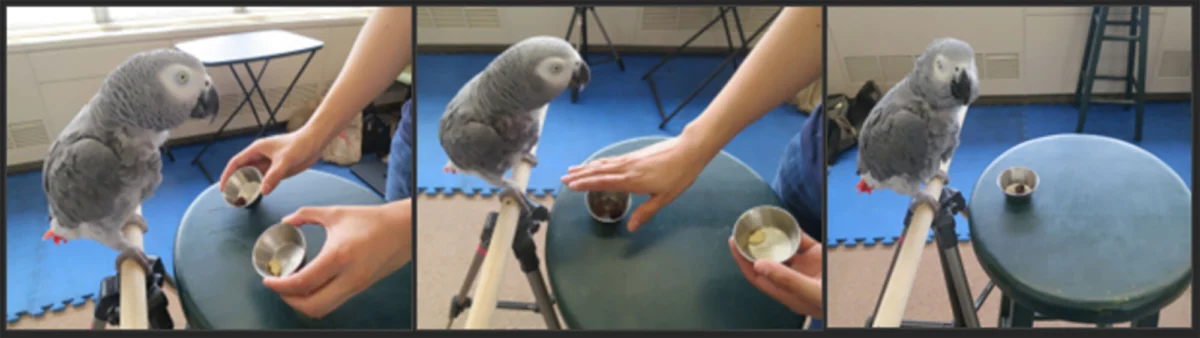
Grey parrots, notably, have demonstrated remarkable proficiency in delayed gratification tasks. Studies by Koepke et al. (2015), Pepperberg and Hartsfield (2023), and Pepperberg and Rosenberger (2022) have shown that Grey parrots, like the parrot Griffin featured in accompanying visuals, are capable of waiting for superior rewards. For instance, Griffin was presented with two types of treats. In one experimental setup, one treat was removed, and the other was briefly covered while he was instructed to "wait." Griffin was observed patiently sitting with the less appealing, though still desired, immediate reward during this delay period. This behavior suggests an ability to inhibit immediate urges, a capacity strongly linked to self-control and an understanding of future outcomes—hallmarks of higher cognitive function and potentially self-awareness.
While these findings are significant, Dr. Pepperberg acknowledges potential caveats and general issues associated with interpreting delayed gratification tasks in her 2026 publication. Nonetheless, these demonstrations provide compelling evidence that warrants careful consideration within the broader scientific framework for assessing animal consciousness.
Implications for Animal Welfare and Conservation
The ongoing debate surrounding animal consciousness has profound implications beyond academic discourse. The "Do no harm" principle, as advocated by Andrews et al. (2024), underscores the ethical imperative to consider the subjective experiences of animals. Even in the absence of absolute scientific certainty, evidence that merely indicates consciousness should inform protocols for animal welfare, humane treatment, and conservation efforts.
Lowering the threshold for considering evidence of consciousness, particularly in practical applications like welfare guidelines, is a prudent approach. This means that observations suggestive of sentience, self-awareness, or emotional capacity should be taken seriously, even if they do not meet the stringent standards required for definitive scientific proof. This precautionary principle acknowledges the inherent difficulties in studying nonhuman minds and prioritizes the well-being of animals.
The increasing scientific recognition of animal consciousness prompts a re-evaluation of our relationship with other species. It suggests that animals are not merely resources or biological automatons but sentient beings with their own internal lives. This shift in perspective could lead to more robust legal protections, improved living conditions in captivity, and more effective conservation strategies that recognize the intrinsic value of animal lives.
The journey to fully understand animal consciousness is far from over. However, the progress made over the past half-century, from Griffin’s initial revolutionary proposal to the current broad scientific consensus, has fundamentally reshaped our understanding of the animal kingdom and our ethical responsibilities towards it. The ongoing research, employing increasingly sophisticated methodologies and a growing awareness of the multifaceted nature of consciousness, promises further revelations in the years to come.
References:
Andrews, K., Birch, J., Sebo, J., & Sims, T. (2024, April 19). Background to the New York Declaration on Animal Consciousness. nydeclaration.com
Bayne, T., Seth, A. K., Massimini, M., Shepherd, J., et al. (2024). Tests for consciousness in humans and beyond. Trends in Cognitive Science, 28(5), 454–466.
Birch, J., Schnell, A. K., & Clayton, N. S. (2020). Dimensions of animal consciousness. Trends in Cognitive Science, 24(10), 789–801.
Block, N. (2025). Can only meat machines be conscious?. Trends in Cognitive Sciences, 30(4), 298–308.

Cognitive Consortium. (2025). Adversarial testing of global neuronal workspace and integrated information theories of consciousness. Nature, 6422(8066), 133–142.
Griffin, D.R. (1976). The question of animal awareness. Rockefeller University Press.
Koepke, A. E., Gray, S. L., & Pepperberg, I. M. (2015). Delayed gratification: A Grey parrot (Psittacus erithacus) will wait for a better reward. Journal of Comparative Psychology, 129(4), 339–346.
Pepperberg, I.M. (1999) The Alex studies. Harvard University Press.
Pepperberg, I.M. (2026). Comments on consciousness in Grey parrots. Comparative Cognition and Behavior Reviews. DOI:10.3819/CCBR.2026.210011.
Pepperberg, I. M., & Hartsfield, L-A. (2023). A study of executive function in Grey parrots: Experience can affect delay of gratification. Journal of Comparative Psychology, 138(1), 8–19.
Pepperberg, I. M., & Lynn, S. K. (2000). Possible levels of animal consciousness with reference to Grey parrots (Psittacus erithacus). American Zoologist, 40(6), 893–901.
Pepperberg, I. M., & Rosenberger, V. A. (2022) Delayed gratification: A Grey parrot (Psittacus erithacus) will wait for more tokens. Journal of Comparative Psychology, 136(1), 79–89.
Plutchik, R. (2001). The nature of emotions: Human emotions have deep evolutionary roots, a fact that may explain their complexity and provide tools for clinical practice. American Scientist, 89(4), 344–350.
