
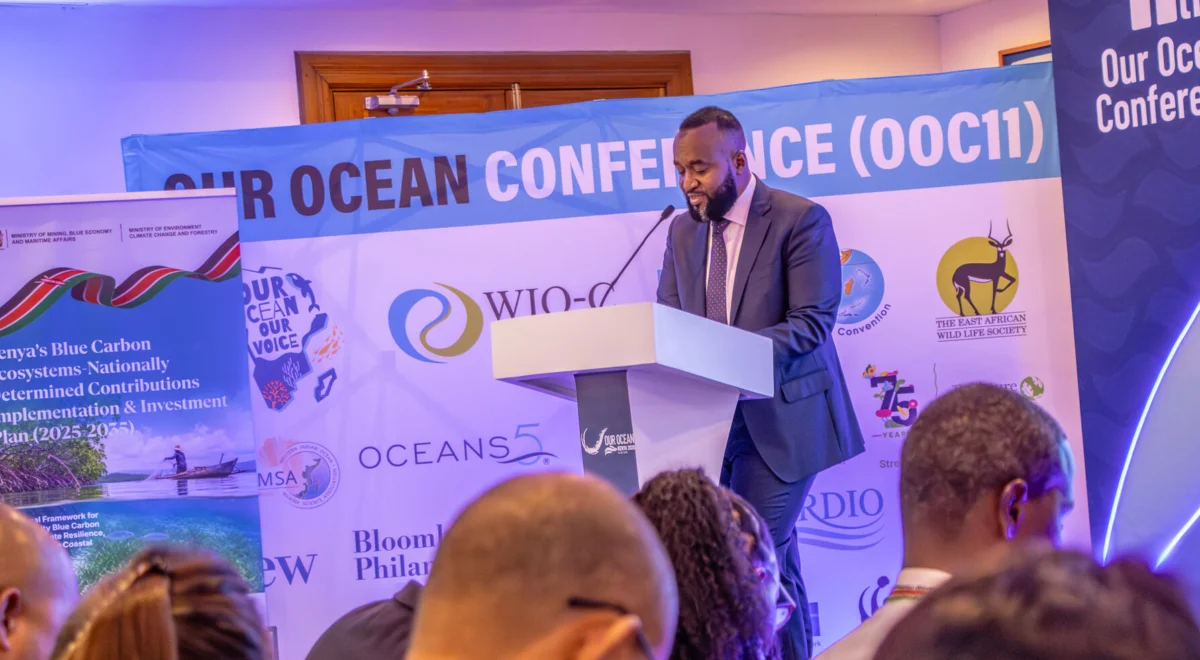
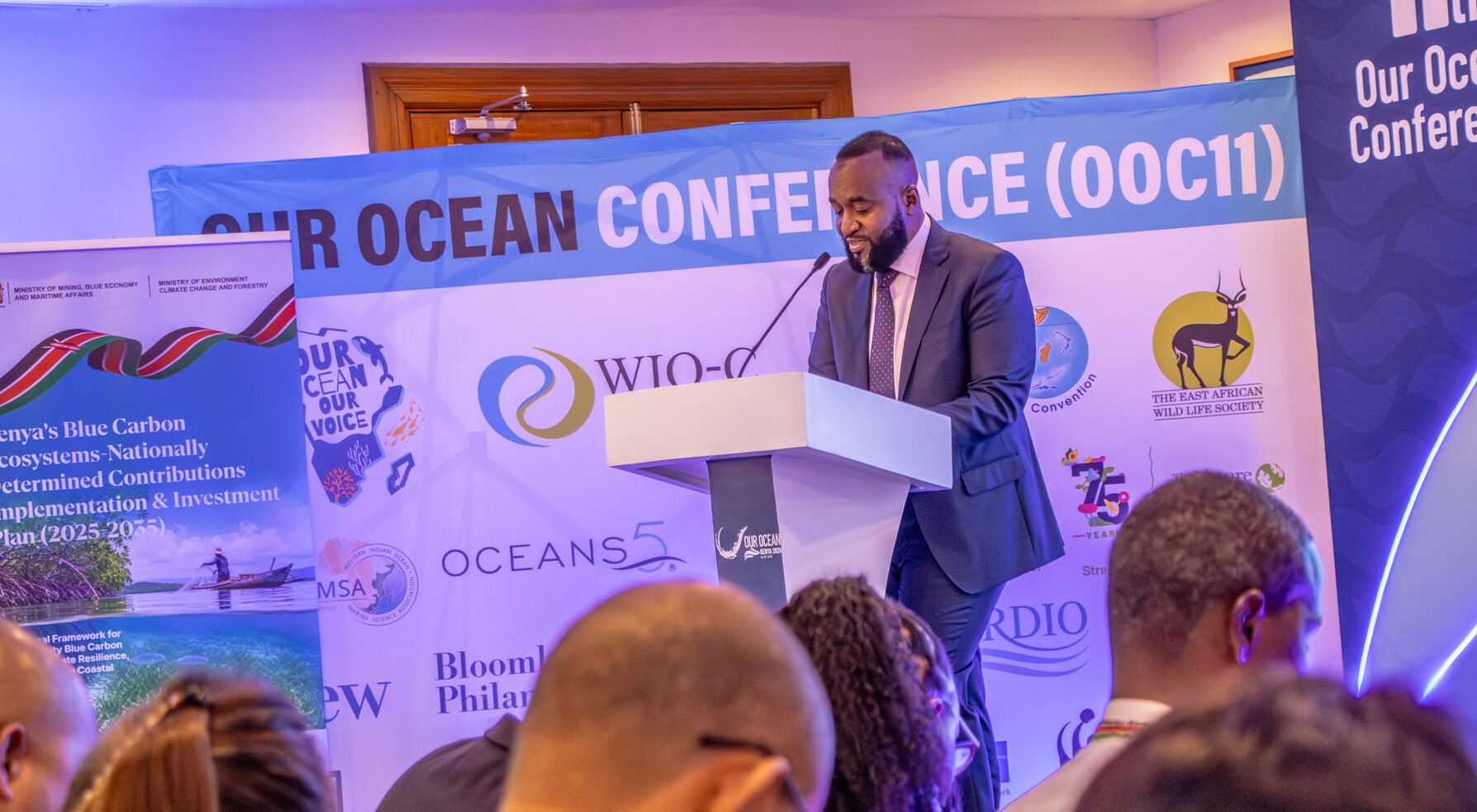
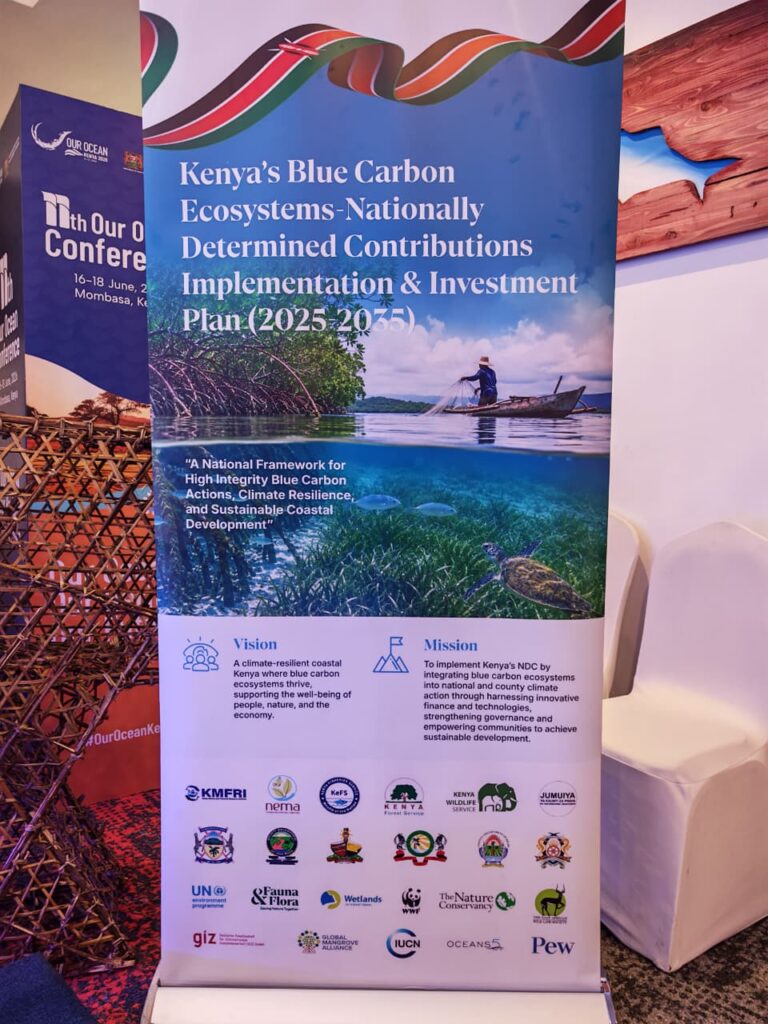
The Government of Kenya has officially unveiled a comprehensive and forward-looking roadmap to harness the power of its marine and coastal ecosystems in the fight against global climate change. Launched at the 11th Our Ocean Conference (OOC11) on June 23, 2026, the Blue Carbon Ecosystems NDC Implementation and Investment Plan 2025–2035 marks a significant milestone in East Africa’s environmental policy landscape. The framework is designed to bridge the historical gap between national climate ambitions and practical, ground-level execution, positioning Kenya as an influential regional leader in ocean-climate resilience and sustainable marine management.
The strategic initiative was developed through an intensive, multi-agency collaborative process led by the Ministry of Environment, Climate Change and Forestry, alongside the Ministry of Mining, Blue Economy and Maritime Affairs. By uniting various government departments, scientific organizations, and international conservation groups, the framework successfully consolidates Kenya’s Nationally Determined Contributions (NDCs) across two distinct implementation cycles—covering the periods from 2020 to 2030 and extending through 2031 to 2035—into a single, unified national strategy.
A Critical Intersection of Ecology and Economy
At the heart of Kenya’s new strategy lies the recognition that coastal ecosystems—specifically mangroves, seagrasses, and tidal marshes—are among the most intensive carbon sinks on the planet. According to recent environmental assessments, Kenya is steward to approximately 61,000 hectares of mangrove forests and 39,000 hectares of vital seagrass beds. Combined, these coastal habitats store over 75 million metric tons of carbon dioxide equivalent (tCO₂e). Crucially, these marine environments sequester carbon at rates five to ten times higher per hectare than typical terrestrial rainforests, making them irreplaceable assets in global mitigation efforts.
Beyond their capacity for carbon sequestration, these ecosystems form the ecological backbone of Kenya’s coastal zone. They directly support roughly 80 percent of the nation’s coastal fisheries and sustain the livelihoods of more than 800,000 artisanal fishers and local community members. Healthy mangroves serve as natural buffers against severe weather events, stabilize shorelines against rising sea levels, and prevent catastrophic coastal erosion.
However, these vital resources have faced severe anthropogenic and environmental pressures over recent decades. Historical data indicates that Kenya has experienced a troubling 40 percent decline in overall mangrove cover, with ongoing losses continuing at a rate of approximately 0.57 percent annually—translating to the destruction of thousands of hectares each year. Similarly, underwater seagrass meadows are currently shrinking at an estimated rate of 0.26 percent per year. Environmental economists estimate that this ongoing degradation inflicts a heavy toll on the national economy, costing an estimated KES 6 billion annually through heightened coastal erosion, diminished biodiversity, and increased vulnerability to extreme weather patterns.

Core Targets and Financial Commitments
To reverse these alarming trends, the newly launched plan establishes aggressive, measurable targets designed to transform environmental management along the Indian Ocean coastline. By the target year of 2035, the government aims to successfully restore at least 75 percent of all degraded mangrove ecosystems nationwide. Furthermore, the initiative is structured to catalyze significant economic growth in coastal regions, with projections indicating the creation of up to 70,000 green jobs centered on conservation, restoration, and sustainable resource management.
Achieving these sweeping objectives requires substantial capital investment. The implementation plan outlines a comprehensive financial mobilization strategy aimed at securing USD 620 million by 2035. This funding will be sourced through a combination of domestic public allocations, international climate finance mechanisms, multilateral development banks, and innovative private-sector instruments, including high-integrity blue carbon credit markets.
The long-term environmental and socio-economic dividends projected for 2035 are substantial. The framework anticipates reducing national emissions by 0.68 to 0.69 million tCO₂e, averting between USD 200 million and USD 500 million in potential coastal infrastructure and property damages, and boosting regional fisheries productivity by 25 percent. These improvements are expected to directly benefit between 300,000 and 600,000 vulnerable coastal households.

High-Level Political and Scientific Support
The rollout of the investment plan reflects a unified approach across Kenya’s government ministries and scientific institutions.
Hon. Dr. Deborah Mlongo Barasa, Cabinet Secretary for the Ministry of Environment, Climate Change and Forestry, emphasized the national and international significance of the launch during the conference. "This initiative reaffirms Kenya’s commitment to the Paris Agreement’s transparency framework and strengthens our position as a regional leader in ocean-climate resilience and sustainable development," Dr. Barasa stated.
Echoing these sentiments, Hon. Hassan Ali Joho, Cabinet Secretary for Mining, Blue Economy and Maritime Affairs, commended the unprecedented cooperation between state organs, civil society, and research entities. "We commend the collaboration between government, research institutions, partners, civil society, and community groups in developing this plan. We urge all stakeholders to continue supporting its implementation to protect and sustainably manage Kenya’s Blue Carbon Ecosystems," said Joho.

The formulation of the strategy drew heavily on empirical research provided by national scientific bodies. Dr. James Kairo, Chief Scientist at the Kenya Marine and Fisheries Research Institute (KMFRI) and a distinguished member of the International Blue Carbon Scientific Working Group, underscored the scientific rigor underpinning the policy. "This plan is critical for mobilizing the science, partnerships, and financial resources required to protect and restore blue carbon ecosystems, ensuring they align seamlessly with Kenya’s climate and development goals. By advancing investments in these areas, Kenya can drive meaningful climate action and promote sustainable development," noted Dr. Kairo.
Collaborative Framework and International Partnerships
The creation of the Blue Carbon Ecosystems plan was made possible through extensive technical assistance and financial backing from a coalition of national and international development partners. Prominent contributors include Fauna & Flora, The Pew Charitable Trusts, the International Union for Conservation of Nature (IUCN), Wetlands International Eastern Africa, World Wide Fund for Nature (WWF) Kenya, The Nature Conservancy (TNC), the Global Mangrove Alliance, the East African Wildlife Society, GIZ, the United Nations Environment Programme (UNEP), and the Government of Canada.
Representatives from these organizations highlighted the importance of shifting the focus from high-level policy formulation to grassroots execution.
Dr. Julie Mulonga, Regional Director of Wetlands International Eastern Africa, pointed out the holistic nature of the roadmap. "This Plan is an important step because it brings together what Kenya has been building over the years: science, policy, community knowledge, and partnerships into one clear roadmap for action. We know that protecting mangroves and seagrass is not only about conserving nature. It is about supporting fisheries, strengthening livelihoods, building resilience to climate change, and creating opportunities for coastal communities. The real work now is implementing the Plan in partnership with the people who are already stewarding these ecosystems every day," Dr. Mulonga explained.
George Maina, Africa Fisheries Strategy Manager at The Nature Conservancy, emphasized the necessity of community-centric financing mechanisms. "We are excited to be part of this process, ensuring we continue to catalyze the adoption of blue carbon ecosystems and ocean actions into NDCs. To achieve lasting and enduring impact, community-led solutions, sustainable finance, and enabling conditions are needed to drive action. This plan will help bridge the existing gap between climate ambitions and action," stated Maina.
Broader Implications and Future Outlook
The launch of Kenya’s Blue Carbon Ecosystems NDC Implementation and Investment Plan arrives at a critical juncture for global climate diplomacy. As nations worldwide grapple with the mounting economic and ecological costs of climate change, African coastal states are increasingly looking to nature-based solutions to build adaptive capacity.

By formalizing a ten-year investment pathway, Kenya has established a replicable model for other developing nations seeking to integrate coastal marine resources into their formal international climate commitments under the Paris Agreement. The success of the initiative will ultimately depend on transparent governance, the active participation of local indigenous and artisanal communities who manage the shorelines daily, and the steady influx of pledged international capital. As implementation begins, the international conservation community will monitor Kenya’s progress closely, viewing the East African nation as a testing ground for large-scale, marine-based climate resilience.
