
Fifty years after Donald Griffin’s groundbreaking proposition that nonhuman animals possess consciousness, the scientific community continues to grapple with the complexities of animal awareness, particularly in non-primate species like birds. This enduring debate, ignited by Griffin’s 1976 book, “The Question of Animal Awareness,” challenged the prevailing view of animals as mere instinctual automatons or conditioned responders. Today, a growing body of research, underscored by a recent declaration signed by hundreds of scientists, argues for robust scientific support for consciousness in mammals, birds, and potentially all vertebrates. However, the definitive proof of such consciousness, a challenge even when applied to humans, remains an elusive goal.
The intricate path to understanding animal consciousness often navigates through the concept of sentience—the capacity to experience emotions and sensations. Yet, evaluating these subjective states in nonhuman subjects presents significant hurdles. As noted in the original research, humans themselves often struggle to articulate their own emotions, making the interpretation of animal feelings a profoundly complex endeavor. While a simplified approach might focus on a more readily observable sensation like pain sensitivity, experts caution that this alone is insufficient to establish human-like consciousness. The quest for comprehensive metrics is therefore ongoing, with researchers like Birch, Bayne, and colleagues proposing sophisticated, albeit human-centric, evaluation frameworks.
A pivotal development in this field emerged decades ago when researchers, including Dr. Irene Pepperberg, proposed the existence of levels of consciousness. This hypothesis posits a direct correlation between the degree of consciousness and quantifiable cognitive abilities within a species. This perspective suggests that similarities in brain evolution, perceptual structures, and learning mechanisms could lead to convergent or homologous cognitive processes across different species. The search for a "neural correlate of consciousness" (NCC), a biological marker of conscious experience, continues in human neuroscience, further complicating the endeavor to find parallels in nonhuman animals. The ongoing challenges in identifying NCCs in humans underscore the immense difficulty in establishing them in other species.
The advent of sophisticated Artificial Intelligence (AI) systems has introduced another layer of complexity to the consciousness debate. While current AI demonstrates impressive cognitive processing capabilities, it fundamentally lacks self-awareness, raising the question of whether consciousness is solely tied to processing power or if other factors, such as sentience, play a more critical role. This distinction is crucial as researchers continue to refine their understanding of what constitutes true consciousness.
The Evolving Scientific Landscape of Animal Consciousness
The scientific discourse surrounding animal consciousness has evolved significantly since Griffin’s initial assertions. A landmark moment occurred with the New York Declaration on Animal Consciousness in April 2024, championed by researchers like K. Andrews, J. Birch, J. Sebo, and T. Sims. This declaration, endorsed by a broad spectrum of scientists, asserts that there is "strong scientific support" for consciousness in a wide range of animal groups, including mammals and birds. This collective statement signifies a growing consensus within the scientific community, moving beyond skepticism towards active investigation.
The declaration itself represents a culmination of decades of incremental research and theoretical development. Donald Griffin’s 1976 work served as a foundational text, challenging the prevailing Cartesian dualism that largely segregated human consciousness from the animal kingdom. In the ensuing years, researchers like Pepperberg, through her extensive work with Alex the African Grey parrot, provided compelling behavioral evidence that challenged assumptions about avian cognitive limitations. Her studies, detailed in "The Alex Studies" (1999), showcased remarkable abilities in vocal learning, object recognition, and even rudimentary numerical understanding in parrots.
However, moving beyond observable behaviors to infer internal conscious states remains the core challenge. Full consciousness, as understood in humans, encompasses not only the processing of sensory information and mental states but also executive control over decision-making, voluntary actions, and crucially, self-awareness—the awareness of being aware. The latter, self-awareness, is particularly elusive in nonhuman animals, especially those lacking the symbolic language necessary to articulate such internal states.
Behavioral Proxies for Consciousness: The Case of Grey Parrots
In the absence of direct subjective reporting, researchers often rely on behavioral indicators that, when observed in humans, are considered strong evidence of self-awareness. One such area of intensive study is the capacity for delayed gratification. This cognitive ability requires an individual to forgo an immediate, less desirable reward in anticipation of a larger or superior reward at a later time. Successfully navigating such tasks necessitates a complex interplay of cognitive functions: the ability to recognize and suppress immediate impulses, understand the conflict between short-term desires and long-term goals, maintain the long-term objective in memory, and actively strategize to achieve it.
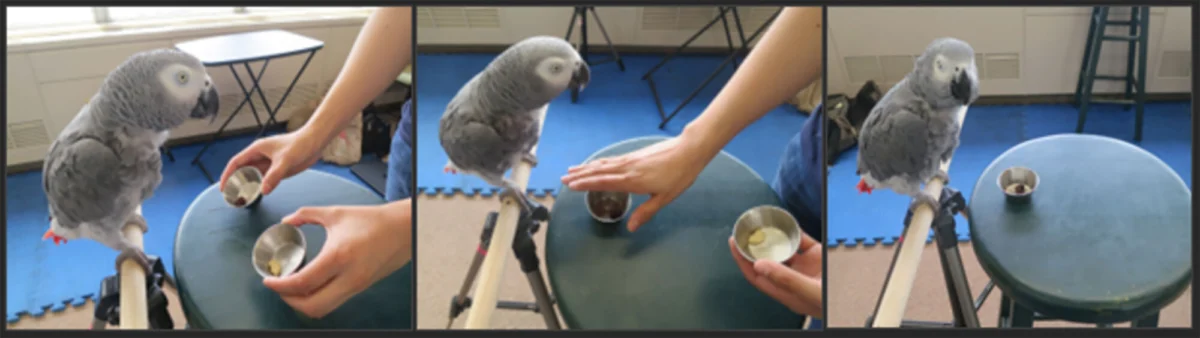
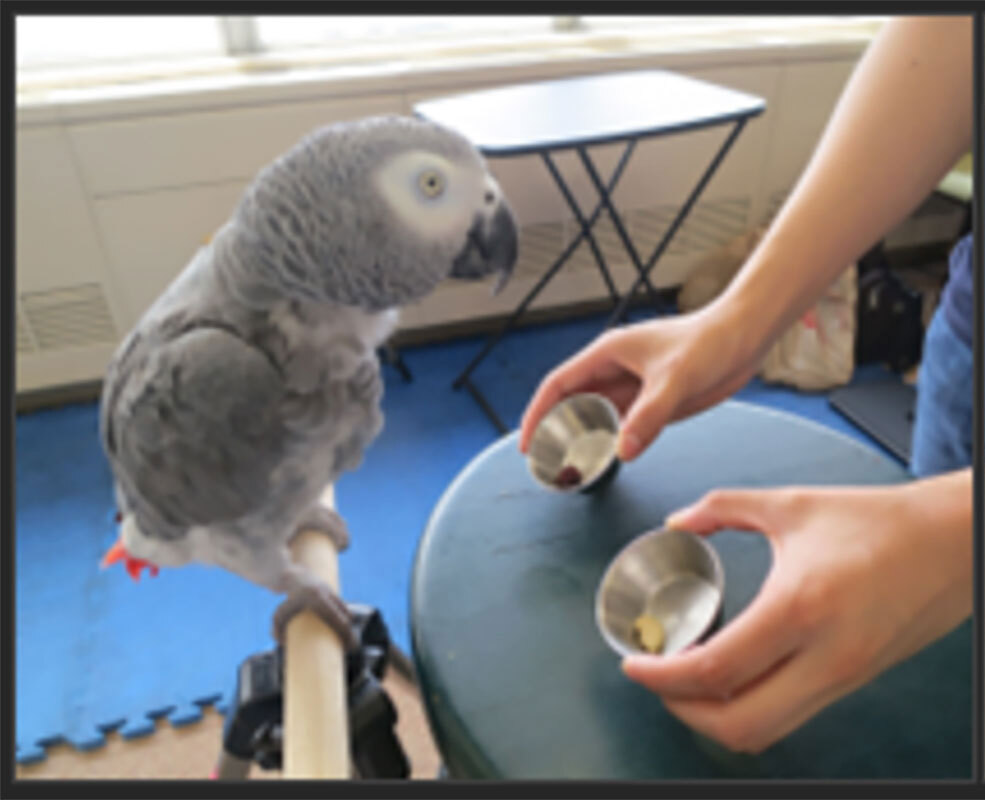
Grey parrots, such as the individual named Griffin in studies by Koepke, Gray, and Pepperberg (2015), have demonstrated remarkable proficiency in delayed gratification tasks. These experiments typically involve presenting the parrot with two distinct reward options. After understanding the choice, one option is removed, and the remaining, less appealing treat is presented while the bird is instructed to "wait." Griffin’s participation in these studies, as illustrated in accompanying imagery, showcases his engagement in this complex cognitive process. He is depicted being shown the two reward sets, then enduring the waiting period with the immediate, albeit less desirable, reward.
The success of Grey parrots in these delayed gratification scenarios is not merely anecdotal. Published research by Pepperberg and colleagues (e.g., Pepperberg & Hartsfield, 2023; Pepperberg & Rosenberger, 2022) has further explored executive functions in Grey parrots, demonstrating how experience can influence their ability to delay gratification. These findings suggest that these birds are capable of holding future goals in mind, inhibiting immediate urges, and exhibiting strategic planning—behaviors strongly associated with higher-order cognitive processing and, potentially, self-awareness.
While these behavioral demonstrations are compelling, researchers are cautious about definitive claims. The authors emphasize that these illustrative examples do not constitute absolute proof of avian consciousness. Instead, they offer valuable insights that must be considered alongside data derived from more formal consciousness testing methodologies. The interpretation of such behaviors requires careful consideration of alternative explanations and a nuanced understanding of the specific cognitive demands of each task.
Implications for Animal Welfare and Conservation
The ongoing scientific debate and accumulating evidence regarding animal consciousness carry profound implications for how humans interact with and perceive the animal kingdom. The principle of "Do no harm," as highlighted by the proponents of the New York Declaration, suggests a pragmatic approach. Even in the absence of absolute scientific certainty, behaviors that are merely indicative of consciousness should inform ethical considerations.
This translates into a call for a recalibration of the evidentiary standards applied to animal welfare protocols. The high degree of certainty typically demanded for scientific proof of consciousness might need to be tempered when designing policies for humane treatment and conservation efforts. By acknowledging the potential for conscious experience in nonhuman animals, and by acting on evidence that suggests such a possibility, humanity can move towards a more ethically responsible coexistence.
The practical application of this principle could influence everything from laboratory animal research regulations to zoo management and wildlife conservation strategies. For instance, understanding that an animal can experience stress, anticipate future events, or exhibit complex social behaviors could lead to enriched environments and more thoughtful handling procedures. In conservation, recognizing the subjective experiences of animals facing habitat loss or other threats could bolster efforts to protect not just species, but individual well-being.
The journey to fully understand animal consciousness is far from over. It is a multidisciplinary endeavor that draws on neuroscience, psychology, ethology, and philosophy. As scientific methodologies advance and our understanding deepens, the dialogue between humans and the animal world promises to become richer, more compassionate, and ultimately, more informed. The legacy of Donald Griffin’s early inquiry continues to inspire a critical re-evaluation of our place within the broader tapestry of conscious life on Earth.
