
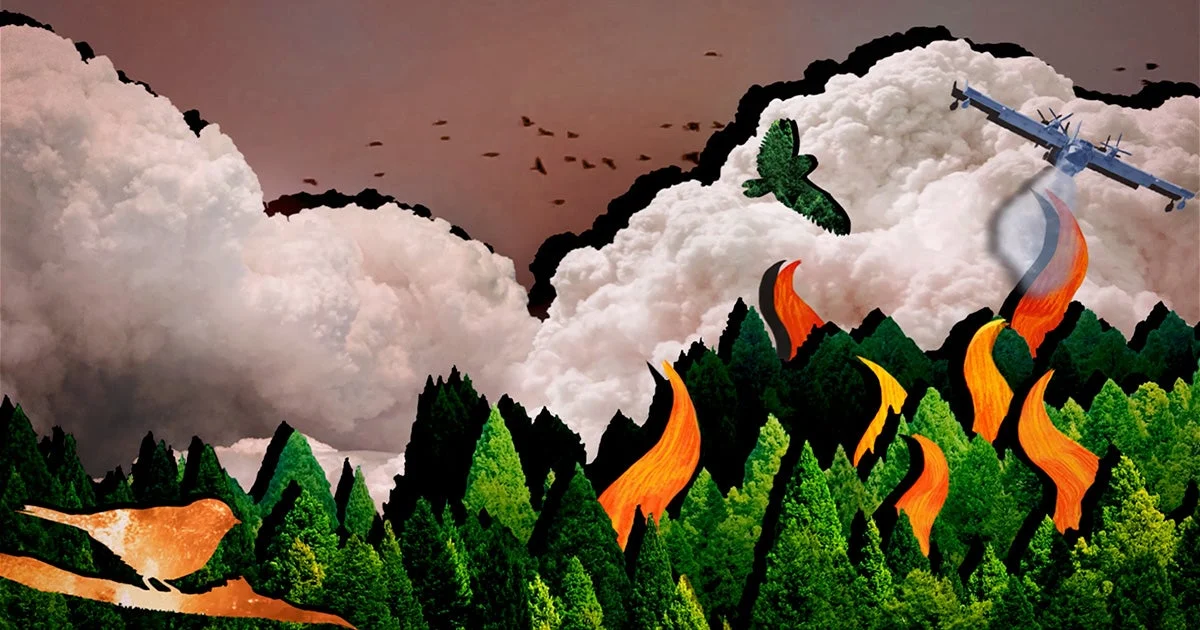
On the morning of January 7, 2025, Olivia Sanderfoot, a dedicated ecologist whose life’s work focuses on the atmospheric impacts of wildfire smoke, initially dismissed the routine fire warnings common to Southern California living. However, the situation deteriorated rapidly when a text message from her husband, accompanied by a photograph of an active blaze in the Santa Monica Mountains, shattered the normalcy of the day. From her West Los Angeles apartment, the horizon was no longer defined by clear skies but by a dense, billowing plume of smoke encroaching upon the hills. As gridlock paralyzed the city’s major arteries and residents began a desperate exodus from neighborhoods mere miles from the ignition points, Sanderfoot made the difficult decision to retrieve her nine-month-old son from daycare. By that evening, the Palisades Fire had advanced to within a single city block of her home. Recognizing the immediate threat not just from the flames, but from the toxic particulate matter suspended in the air, she and her family evacuated, enduring heavy smoke from the simultaneously burning Eaton Fire during their journey to safety.
This localized trauma was but a microcosm of a broader, national catastrophe. The Los Angeles wildfire event of January 2025 stands as one of the most destructive in U.S. history, resulting in 31 fatalities and the total destruction of nearly 16,000 homes and structures. Over 200,000 residents were displaced, and 22,000 acres of pristine open space were reduced to ash. Yet, these immediate, quantifiable losses fail to capture the secondary, invisible, and likely more lethal public health crisis that unfolded in the following weeks.
The Invisible Toll: Pulmonary and Cardiovascular Impacts
The aftermath of the 2025 fires triggered a surge in healthcare demand that overwhelmed local infrastructure. Data from Cedars-Sinai Medical Center reveals that in the 90 days following the blaze, emergency room visits for pulmonary illness spiked by 24 percent, while incidents of heart attacks rose by 46 percent. Perhaps more alarming was the observation that abnormal blood work indicative of systemic general illness more than doubled.
Dr. Susan Cheng, a cardiologist and researcher at Cedars-Sinai, describes these findings as both surprising and deeply significant. "While all wildfire smoke is harmful, the smoke from these specific fires was uniquely toxic," Cheng notes, citing the combustion of suburban infrastructure—including vehicles, homes, and household hazardous materials—which released a complex cocktail of synthetic pollutants into the air. Experts now acknowledge that the long-term health consequences for the millions of people exposed to this emissions plume will require years of longitudinal study to fully comprehend. To that end, a coalition of researchers has launched a 10-year study to map the short- and long-term public health trajectories of those caught in the fallout.
A Reversal of Environmental Progress
For decades, the United States viewed the Clean Air Act of 1970 as a permanent victory in the fight for respiratory health. The landmark legislation successfully curtailed emissions from factories, power plants, and internal combustion engines, leading to a steady, multi-generational improvement in air quality. This shift did more than protect human lungs; a 2020 study estimated that the reduction of ground-level ozone—a key component of smog—prevented the premature deaths of approximately 1.5 billion birds over four decades.
However, the modern era of climate-driven, high-intensity wildfires is effectively stalling, and in some regions, reversing these gains. Marshall Burke, director of Stanford University’s Environmental Change and Human Outcomes Lab, characterizes the current trend as an "unraveling of decades of progress." Analysis of particulate matter 2.5 (PM 2.5)—microscopic soot particles smaller than 2.5 microns that penetrate deep into the bloodstream—shows that between 2016 and 2022, wildfires were responsible for erasing nearly 25 percent of the air quality improvements gained since the turn of the millennium in three-quarters of the United States.
The Biological Consequences: Canaries in the Coal Mine
The sensitivity of avian populations to air quality serves as a stark warning for the human condition. Birds possess a highly efficient respiratory system required to fuel the metabolic demands of flight, a biological trait that makes them disproportionately vulnerable to toxic particulates. Lauren Hamlett, director of the wildlife program for Pasadena Humane, witnessed the severity of this vulnerability firsthand while treating birds for smoke inhalation during the 2025 fires. Many of her avian patients succumbed to the toxic exposure, unable to survive the inflammation of their delicate air sacs.
The impact extends beyond immediate mortality. Research indicates that smoke exposure alters the very behavior of local ecosystems. Ecologists have observed shifts in migratory patterns, such as the 2020 incident where four Greater White-fronted Geese wearing GPS trackers diverted their paths by hundreds of miles to skirt a smoke plume. In other cases, species have shown reduced activity, lower reproductive success, and diminished birdsong—a vital indicator of population health. Preliminary data from the 2025 breeding season suggests that cavity-nesting species, including Eastern Bluebirds and Purple Martins, delayed egg-laying in response to the presence of smoke, potentially misaligning their life cycles with the availability of food sources.
Smoke Ecology: A New Frontier
As global fire patterns shift, a burgeoning field of study known as "smoke ecology" is emerging to address these interdisciplinary challenges. Led by researchers like Sanderfoot, now at the Cornell Lab of Ornithology, this field seeks to understand how widespread smoke events fundamentally restructure ecosystems. Projects like "Project Phoenix" aim to mobilize community scientists to track how birds utilize feeders and refuges during smoky events, providing data that could inform future conservation efforts and habitat protection strategies.
Despite the scientific advancement, the root cause—the increased frequency and intensity of wildfires—remains the primary obstacle. Experts emphasize that while individual actions like air purifiers and N95 masks provide short-term protection, they are insufficient as a long-term strategy. The convergence of climate change-induced heat, severe drought, and the legacy of 20th-century fire suppression policies has created an environment where fuel loads are at historic highs.
Relearning the Role of Fire
A critical component of current forest management involves a paradoxical solution: the use of controlled, or prescribed, burns. For millennia, Indigenous land managers used fire to maintain the health of Western landscapes. Today, agencies are increasingly adopting these practices to reduce the amount of combustible "fuel" in forests, thereby lowering the risk of the massive, high-intensity blazes that generate the most toxic smoke.
Research indicates that while prescribed burns generate short-term emissions, they produce a net benefit for air quality over the long term. A pilot project in Albany, Georgia, provides a blueprint for this success; by utilizing real-time air quality monitoring and weather modeling, local landowners were able to conduct 5,000 acres of additional controlled burns without increasing the local average of PM 2.5. Expanding such programs, however, requires significant financial investment, policy reform, and public education. Current federal regulations, which often classify wildfires as "exceptional events" to exempt states from air quality penalties, inadvertently make it more difficult for land managers to obtain permits for beneficial, planned fires.
Preparing for a Smokier Future
As the summer of 2026 brought a new wave of severe wildfires to North America, the reality of a "smokier future" became undeniable. From Oregon school districts upgrading HVAC systems to Southern California residents seeking air filtration, the burden of adaptation is falling on local institutions. Heidi Huber-Stearns, director of the University of Oregon’s Center for Wildfire Smoke Research and Practice, highlights the difficulty of communicating these risks to a public already fatigued by overlapping crises. "We are asking public health officials to convey the dangers of yet another crisis," she notes, "while they are managing a dozen other major issues."
The plight of those on the front lines—including federal wildland firefighters—further underscores the need for structural change. These workers face chronic exposure to soot, sleep deprivation, and high-stress environments, often without adequate personal protective equipment. Advocates like Riva Duncan continue to push for a professionalized, better-resourced national wildland fire service that prioritizes the health and longevity of its personnel.
The ecological and public health challenges posed by wildfire smoke are global in scale, affecting everything from orangutans in Borneo to migratory songbirds in North America. As the scientific community continues to map these connections, the consensus is clear: the smoke is not just a symptom of a warming planet; it is a fundamental shift in the environment that mandates a transformation in how we manage landscapes, protect vulnerable populations, and define the limits of human activity in an increasingly flammable world. Whether through the lens of a biologist tracking bird movements or a resident monitoring the Air Quality Index, the message remains the same: the skies are changing, and the time to adapt is now.
