
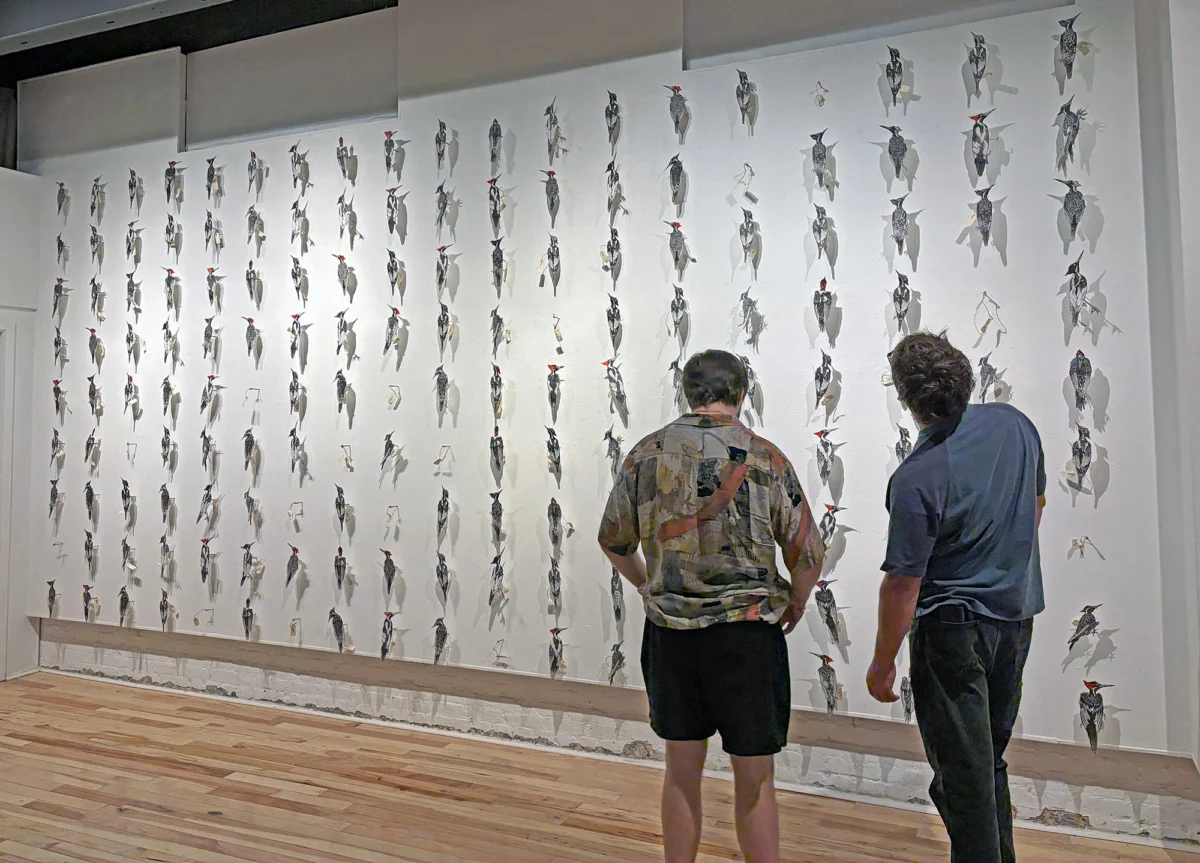
The Pensacola Art Museum has inaugurated its latest exhibition as part of the STEAM 2026 initiative, offering a provocative look at the fragility of biodiversity through the lens of contemporary fine art. Titled Extinct, Threatened, Restored, the installation is the brainchild of artist Pippin Frisbie-Calder. By utilizing floor-to-ceiling multimedia prints and expansive paintings, the exhibition transforms the gallery space into a visceral environmental narrative, challenging visitors to confront the reality of avian population decline while highlighting the potential for successful ecological restoration.
The installation is structured as a tripartite journey across three distinct gallery walls, each serving as a temporal and thematic anchor for the state of bird populations in North America. The exhibition serves as a centerpiece for the museum’s broader STEAM 2026 program, which seeks to integrate Science, Technology, Engineering, Art, and Mathematics to foster public discourse on complex global issues.
A Chronology of Avian Crisis and Recovery
The exhibition’s layout serves as a historical and ecological timeline, moving from irreversible loss to current peril and, ultimately, to the hopeful outcomes of conservation science.
The first wall confronts the visitor with the sobering reality of the Ivory-billed Woodpecker. Once an iconic resident of the southeastern United States’ old-growth forests, the species is widely considered extinct, with the last widely accepted sighting occurring decades ago. By dedicating the first section of the exhibit to a lost species, Frisbie-Calder establishes a baseline of urgency. The artistic representation serves as a visual eulogy, reminding viewers that the extinction of a species is not merely a biological statistic but a permanent erosion of the natural heritage of the Gulf Coast region.
The middle wall transitions from the past to the present, focusing on the precarious survival of contemporary songbird species. Here, the artist delineates the multifaceted threats currently facing avian populations. These threats are not abstract; they are the direct result of anthropogenic activity. According to the National Audubon Society, North America has lost approximately 2.9 billion birds—nearly 30% of its total population—since 1970. The exhibition highlights specific vectors of this decline, including predation by domestic cats, the hazards posed by urban migration corridors, and the rapid degradation of habitats driven by a changing climate.
The third wall serves as a counter-narrative, focusing on success stories such as the restoration of puffin populations in Maine. This section provides a necessary shift in perspective, demonstrating that when human intervention is guided by rigorous scientific data and protected by robust policy, ecosystems can demonstrate remarkable resilience.
Supporting Data and Environmental Context
The exhibition is grounded in a growing body of scientific evidence regarding the importance of seabirds and migratory birds to the health of global ecosystems. Seabirds, in particular, serve as "sentinel species," acting as indicators of ocean health. When seabird populations struggle, it is often a lagging indicator of larger, systemic failures within marine food webs.
Data from the U.S. Fish and Wildlife Service (USFWS) and various conservation non-profits indicates that forage fish—small, schooling fish like herring, sardines, and anchovies—are the essential building blocks for marine life. However, these fish are increasingly threatened by industrial overfishing. The exhibition specifically aligns its advocacy with the Forage Fish Conservation Act, a legislative effort aimed at ensuring that federal fisheries management accounts for the needs of birds and marine mammals that rely on these fish for survival.
The inclusion of an interactive "take-action" component within the gallery space is a deliberate move to bridge the gap between passive observation and active citizenship. Visitors are invited to remove paper birds from the walls, symbolizing a commitment to the cause, and are provided with materials to contact their congressional representatives. This integration of political advocacy into an art exhibition underscores the museum’s belief that cultural institutions play a vital role in civic engagement.
Official Perspectives and Expert Panel Discussion
To deepen the impact of the installation, the Pensacola Art Museum has organized a panel discussion scheduled for December 12. The panel, featuring artist Pippin Frisbie-Calder alongside experts from the Audubon Society—including Bethany Kraft, Brian Cammarano, and Collette Lauzau—is designed to provide a high-level overview of the conservation landscape in Florida and the broader Atlantic Flyway.
In advance of the discussion, conservationists have noted that Florida’s unique position as a migratory bottleneck makes it an essential laboratory for avian research. "The work showcased in this exhibition is more than just an aesthetic experience," notes one observer familiar with the project. "It functions as a synthesis of data and emotion. By putting a face—or a feather—to the statistics, the museum is creating a pathway for the public to understand why policy decisions regarding our coastlines are not just ‘environmental issues’ but essential public health and economic matters."
The panel is expected to address the specific challenges of managing seabird colonies in a warming climate, where rising sea levels threaten nesting grounds. Experts will likely discuss the shift in focus from "protection" to "active management," where humans must increasingly engineer habitats to compensate for the disruption of natural cycles.
Broader Implications for Conservation and Art
The STEAM 2026 initiative represents a significant shift in how regional museums are conceptualizing their roles. Rather than serving as static repositories for art, these institutions are increasingly acting as hubs for community dialogue on the climate crisis. By framing the avian extinction crisis through the lens of STEAM, the Pensacola Art Museum is positioning art as a tool for cognitive accessibility. Scientific reports, often dense with data and jargon, can be alienating to the general public. Art, by contrast, creates an emotional entry point.
The implications of this exhibition extend beyond the gallery walls. If the museum can successfully translate the urgency of the Forage Fish Conservation Act into actionable public sentiment, it could serve as a model for how cultural institutions nationwide can leverage their physical space to influence legislative outcomes.
Furthermore, the exhibition forces a reflection on the concept of "restoration." As the climate continues to change, the term is increasingly being debated in scientific circles. Can we truly "restore" a habitat to its pre-industrial state, or are we entering an era of "assisted migration" and "managed retreat"? The exhibition’s third wall, while optimistic, raises these quiet, underlying questions that will define the next century of environmental policy.
Conclusion: The Future of the Flyway
As visitors move through the exhibition, the interaction between the art and the viewer becomes the final, unfinished piece of the installation. The paper birds, once removed from the walls by participants, represent a shift in the exhibition’s volume and presence—a direct reflection of the public’s engagement with the issues presented.
The Pensacola Art Museum has provided a platform for an essential conversation. By synthesizing the stark reality of the Ivory-billed Woodpecker with the hopeful, albeit hard-won, success of puffin restoration, the exhibit provides a roadmap for the future. It asserts that while the trajectory of many species remains in jeopardy, the ability to alter that course rests with human policy and individual action. As the STEAM 2026 initiative progresses, the Extinct, Threatened, Restored exhibition stands as a testament to the fact that art, when paired with scientific rigor, remains one of the most potent vehicles for social and environmental change.
For those interested in participating in the ongoing dialogue, the panel discussion on December 12 offers a rare opportunity to engage directly with the professionals tasked with navigating these complex ecological challenges. The event, which begins at 4 p.m. with the discussion scheduled for 5 p.m., will be hosted at the Pensacola Art Museum, with further resources and legislative information available via the museum’s digital portal. The exhibition remains open to the public, serving as a reminder that in the delicate balance of our global ecosystem, every action—from a signature on a petition to the support of local conservation initiatives—holds weight.
