
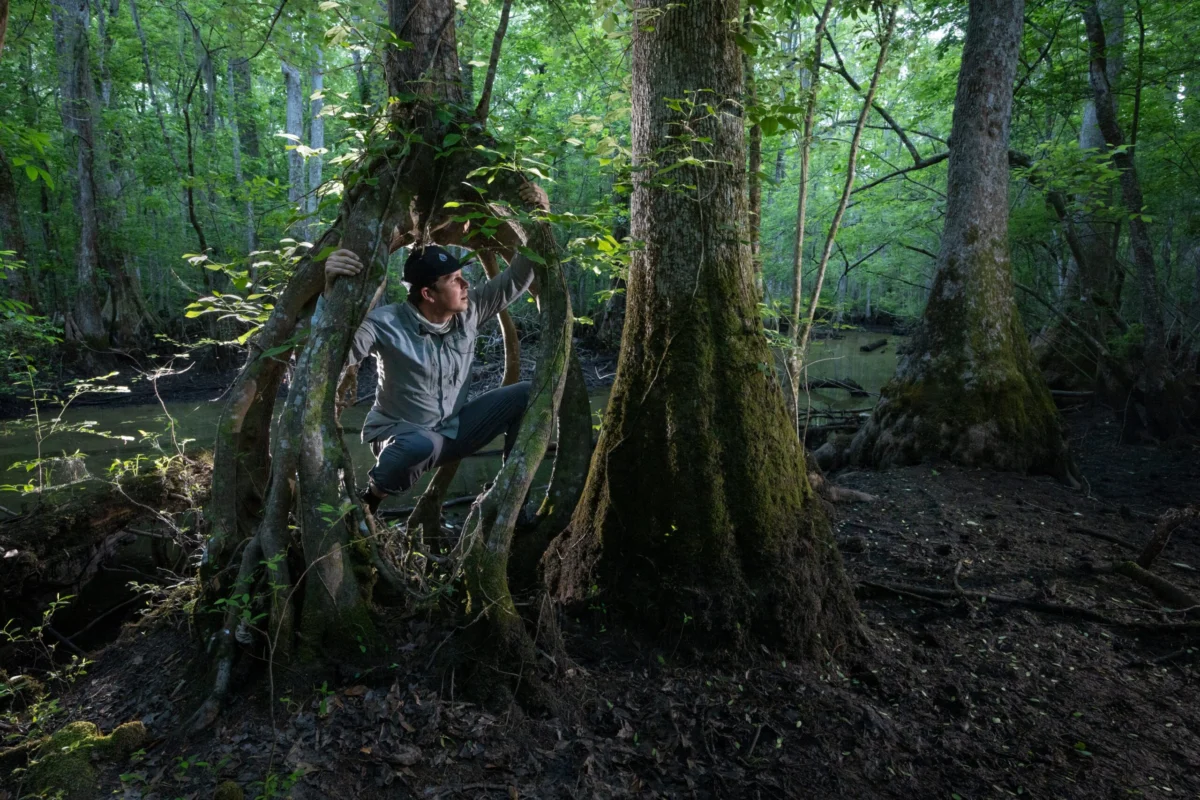
In the American South, few creatures command as much primal caution as the cottonmouth. This semi-aquatic pit viper, armed with hemotoxic venom capable of rupturing blood cells and dissolving tissue, is a creature most observers avoid. However, for conservation photographer Mac Stone, the snake is not an object of fear, but a subject of profound beauty. While trekking through the Beidler Forest in South Carolina, Stone bypassed the safety of the boardwalk, opting to traverse the swamp’s muck to capture the viper in its natural element. His approach—patient, deliberate, and deeply respectful—serves as a microcosm of his broader mission: to reframe the nation’s perception of wetlands from "second-class ecosystems" to essential, iconic landscapes.
The Evolution of a Conservationist
Mac Stone, 42, has spent decades immersing himself in the most challenging environments on the planet. From the Mekong River in Cambodia to the rainforests of Ecuador, his photography has garnered international acclaim. Yet, it is the U.S. Southeast that remains his primary focus. His connection to these waterlogged domains began in his childhood in Gainesville, Florida, where he spent his youth hunting for fossilized shark teeth and exploring blackwater creeks.
Stone’s transition from a curious youth to a professional photographer was marked by a rigorous, self-taught education. In the ninth grade, he began utilizing his father’s Minolta SR-T 101 to document the wetlands he discovered via regional atlases. This period served as his apprenticeship; he spent countless hours studying the works of masters such as John Moran and Joel Sartore, eventually learning to combine his artistic vision with the technical skills of a field biologist.
Bridging Science and Visual Storytelling
Stone’s career took a definitive turn when he began working as a field biologist for Audubon Florida. His tenure with the organization, specifically his work with ecologist Jerry Lorenz at the Everglades Science Center, allowed him access to remote, restricted regions of the 1.5-million-acre watershed. It was here that Stone realized his photographs could serve as a powerful tool for conservation advocacy.
"He shows people the beauty of these places and you go with him on these journeys," says Lorenz, who initially hired Stone for his biological expertise but was quickly won over by the visual documentation of the region’s precarious health. Stone’s 2014 book on the Everglades was a pivotal moment in his career, blending high-art photography with stark, emotional evidence of environmental degradation, such as the loss of Roseate Spoonbill populations due to water management failures.
The State of America’s Wetlands
The urgency of Stone’s work is underscored by sobering statistics from the U.S. Fish and Wildlife Service. Over the past 70 years, more than 50% of wetlands in the lower 48 states have disappeared. Since 2009, the rate of loss has accelerated, particularly within the Southeast. These ecosystems are not merely aesthetic assets; they are vital buffers against climate change, providing flood mitigation, storm protection, and critical carbon sequestration.
Despite their importance, the "drain the swamp" mentality—a cultural vestige of past land-use policies—has resulted in the near-total loss of the nation’s old-growth cypress forests. Of the original 40 million acres, only an estimated 10,000 to 12,000 acres remain today. Stone’s recent book, Cypress: The Last Old-Growth Swamps, serves as both a historical record and a call to action, aiming to humanize these landscapes for audiences who might otherwise view them as inhospitable or mosquito-ridden.
Scaling the Message: IMAX and Beyond
Stone’s influence is expanding through major media platforms. His co-production of the IMAX film and PBS series American Amazon explores the Southeast as a singular, interconnected eco-region. By highlighting the interdependence of rivers, mountains, and coastal wetlands, the project advocates for a shift in landscape management.
"Decisions in Georgia affect Florida," Stone notes, emphasizing that ecological health does not respect political boundaries. This holistic perspective is gaining traction among policy experts who argue that fragmented environmental management is no longer sufficient to combat the systemic threats of pollution and habitat loss. By presenting these ecosystems as a cohesive, national treasure comparable to the Grand Canyon or Yellowstone, Stone is successfully moving the conversation from local conservation to regional stewardship.
Land Acquisition and Direct Action
Beyond his role as a storyteller, Stone serves as the executive director of the nonprofit Naturaland Trust. Since moving to Greenville, South Carolina, in 2012, he has been instrumental in the organization’s mission to safeguard vulnerable land. Naturaland Trust, founded in 1973, has protected over 100,000 acres, often by identifying high-value biodiversity zones before they are sold to developers.
A notable example of this direct action occurred in Pickens County, where a 182-acre mountainous plot—previously slated for a 240-home subdivision—was brought under contract by Stone the moment it hit the market. By utilizing his photography to demonstrate the ecological value of the land to state grant committees and private donors, Stone successfully raised the $899,000 required for the acquisition. This synthesis of advocacy and tactical land preservation highlights a modern, pragmatic approach to environmentalism.
The Psychology of Engagement
Stone’s methodology is rooted in the belief that people protect what they love, and they love what they understand. In an era of digital fragmentation, where attention spans are increasingly shortened by constant notifications and social media, Stone acknowledges the difficulty of his task. "You’ll spend years working on something and have no idea if it’ll resonate with people or if they’ll just scroll to the next thing," he admits.
However, his commitment remains unshaken. Whether he is capturing the elusive ghost orchid or the quiet, still form of a fawn in tall grass, his goal is to force a pause. By documenting these scenes with technical precision and emotional gravity, he aims to anchor the viewer in the present moment, challenging the modern tendency to disconnect from the natural world.
Future Implications for Conservation
The work of Mac Stone suggests a new archetype for the 21st-century environmentalist: one who is as comfortable behind a camera lens as they are in a boardroom or a field office. His ability to synthesize complex ecological data into compelling visual narratives has proven effective in rallying public support and securing funding for land conservation.
As the impacts of climate change become more pronounced, the role of visual storytelling in conservation will likely grow in importance. The ability to visualize the "wonders we stand to lose" serves as a critical counterbalance to the abstract nature of environmental policy. As Stone continues to document the hidden corners of the American Southeast, his work stands as a testament to the idea that the most effective way to protect a landscape is to reveal its inherent, irreplaceable value to the public eye.
In the deepening twilight of Beidler Forest, as the sounds of the swamp swell and the fireflies begin their rhythmic display, the distinction between the observer and the observed seems to dissolve. For Mac Stone, the swamp is not a place to be feared, but a library of life that is still being written. His ongoing efforts—from IMAX screens to local land trusts—ensure that the story of these wetlands will continue to be told, and more importantly, protected for future generations. Through his lens, the murky waters of the South are finally coming into focus, revealing a complex, fragile, and magnificent world that demands our collective attention.
