
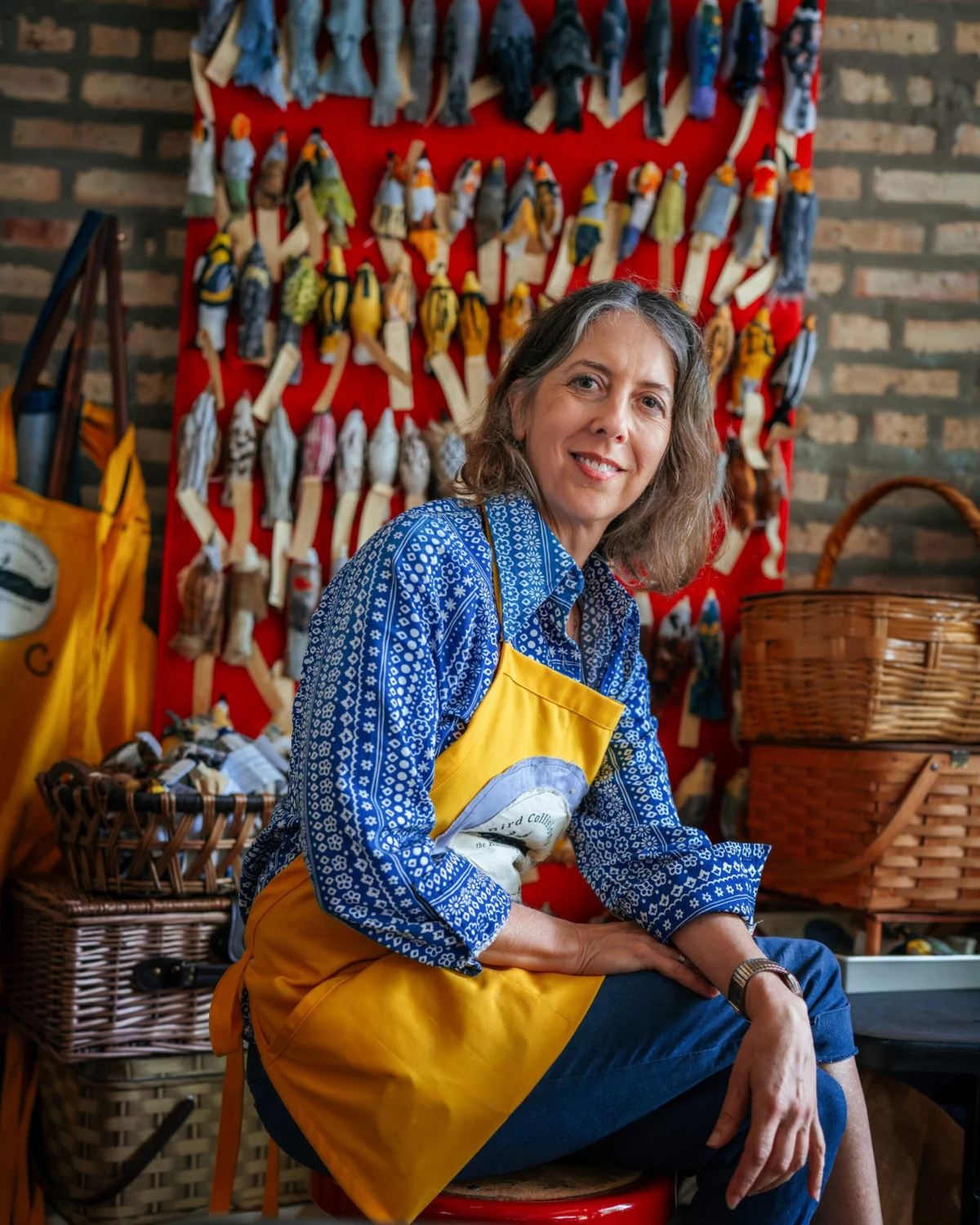
On a quiet Saturday afternoon at the Chicago Architecture Center, the atmosphere is one of meditative industry. Volunteers sit at long tables, their hands moving with precision as they transform bits of discarded fabric into delicate, colorful avian replicas. One participant carefully adheres a patch of velvet to mimic the breast of a Magnolia Warbler, while another meticulously layers brown and black felt to capture the specific markings of a House Sparrow. These are not merely craft projects; they are individual acts of mourning and advocacy. Each of these 10,836 fabric birds represents a single life lost in 2023, a casualty of the invisible but lethal barrier posed by Chicago’s glass-heavy skyline.
This ambitious public art installation, spearheaded by artist Holly Greenberg, seeks to turn the stark statistics of avian mortality into a tangible, 300-foot-long tapestry. By visualizing the scale of the tragedy, Greenberg hopes to galvanize the public and policymakers alike, transforming a collective grief into a rallying cry for bird-safe architecture.
The Anatomy of an Ecological Trap
Chicago’s geographic position makes it a critical nexus for North American biodiversity. Situated directly along the Mississippi Flyway—the primary migratory route for millions of birds—the city serves as both a haven and a hazard. During the spring and autumn migrations, vast numbers of birds congregate along the Lake Michigan shoreline, seeking refuge and food. However, the city’s architectural evolution has turned this natural corridor into a labyrinth of danger.
Birds possess a limited capacity to perceive glass as a solid object. For a migratory songbird, a clear pane of glass reflecting the sky or trees appears as an open flight path. When combined with the high-intensity artificial light emitted by skyscrapers at night, which disorients birds and draws them into the urban core, the result is often catastrophic. The phenomenon of window collisions is not merely a series of isolated accidents; it is a systemic failure of urban design that accounts for the deaths of hundreds of millions of birds annually across North America.
October 5, 2023: A Turning Point
The urgency behind Greenberg’s project crystallized following a particularly harrowing event in the fall of 2023. On the night of October 5, a perfect storm of atmospheric conditions and lighting resulted in a mass casualty event. Within a span of hours, volunteers monitoring the city’s bird strikes discovered over 2,000 dead or injured birds. The epicenter of this tragedy was the McCormick Place Lakeside Center, a glass-dominated convention complex that acted as a deadly lure for birds navigating the lakeshore.
Nearly 1,000 birds perished at that single location in one night, a statistic that shocked the conservation community and caught the attention of the general public. For Greenberg, who had been following the reports of urban bird mortality, the sheer scale of the incident felt overwhelming. "I just dreamed up this plan to make these pop-up art studios," she explains. She realized that while data points are necessary for policy, they often fail to capture the visceral reality of the loss. The "carpet" was conceived as a way to make the invisible visible.
A Grassroots Movement in Motion
Since the project’s inception, Greenberg has conducted more than 80 free workshops across the Chicago metropolitan area. The venues are diverse, ranging from public libraries and primary schools to bustling street fairs, ensuring that the message reaches beyond the traditional circles of birders and environmentalists. The momentum has spread far beyond Illinois; through her website, Greenberg provides patterns and instructions, leading to an additional 100 sessions hosted by volunteers across the country.
The material used in the project is as intentional as the message itself. By utilizing upcycled fabric and textile waste, Greenberg adheres to a philosophy of sustainability, ensuring that the creation of the memorial does not contribute to the environmental degradation that threatens the species it honors. Each participant is tasked with recreating one of the more than 200 species identified as victims of Chicago collisions in 2023, requiring a level of engagement that fosters a deeper understanding of the individual avian lives lost.
The Role of Advocacy and Policy Reform
The project serves a dual purpose: emotional memorialization and practical education. As participants assemble their birds, they are educated on the immediate steps they can take to mitigate risks at their own homes. Statistics show that nearly 50 percent of all bird collisions occur at residential buildings rather than massive commercial skyscrapers. Greenberg instructs participants on simple, effective retrofits, such as applying window films, decals, or tempera paint to glass, which break up reflections and alert birds to the presence of a barrier.
Beyond individual action, the project serves as a pressure campaign for systemic legislative change. Supporters of the project, including members of the Chicago Bird Alliance, are pushing for a city council ordinance that would mandate bird-safe building standards for new developments and significant renovations.
The effectiveness of such measures is not merely theoretical. Following the October 5, 2023 tragedy at McCormick Place, the building’s management worked alongside conservationists to implement bird-safe window treatments. The results were immediate and dramatic: reports indicated a 95 percent reduction in collisions at the site during the following migration season. This success story provides a blueprint for what can be achieved when architectural design prioritizes ecological coexistence.
Analysis of Implications: The Long Road to Completion
As of the latest count, Greenberg has amassed over 4,000 bird replicas, meaning she is roughly one-third of the way toward her goal of 10,836. She anticipates that the final assembly of the 300-foot-long tapestry will take several more years. Critics might argue that such a slow process risks losing public momentum, but Greenberg views the extended timeline as a strategic advantage.
"The longer it takes, the more people I get to talk to about fixing their windows," she asserts. This approach prioritizes sustained dialogue over a singular, fleeting spectacle. By engaging thousands of individuals in the creation of the piece, the project builds a decentralized network of advocates who are personally invested in the outcome.
The implications of this movement extend to the broader field of "biophilic urbanism"—the practice of designing cities that foster a connection between humans and nature. As urban centers continue to expand, the integration of bird-safe technology is becoming a standard expectation for sustainable development. Projects like Greenberg’s help normalize these expectations, shifting the narrative from seeing buildings as static objects to seeing them as participants in a larger, living ecosystem.
Conclusion: Weaving a Future
The tapestry, once completed, will serve as a staggering visual record of a single year’s mortality. It will be a testament to the resilience of the local community and a reminder of the fragility of the migratory birds that pass through Chicago. By bridging the gap between art and science, and between individual action and legislative reform, Holly Greenberg is creating a path toward a safer urban environment.
The project does not seek to blame or shame, but rather to illuminate a path forward. Each stitch, each patch of felt, and each workshop participant represents a conscious choice to prioritize life over glass, and connectivity over convenience. As the fabric birds continue to pile up, they serve as a quiet, persistent reminder: the city can, and must, be a place where birds can pass through without fear of the glass that blinds them. For now, the work continues, one bird at a time, moving toward a future where the city’s skyline is no longer a graveyard for the winged travelers of the Mississippi Flyway.
