
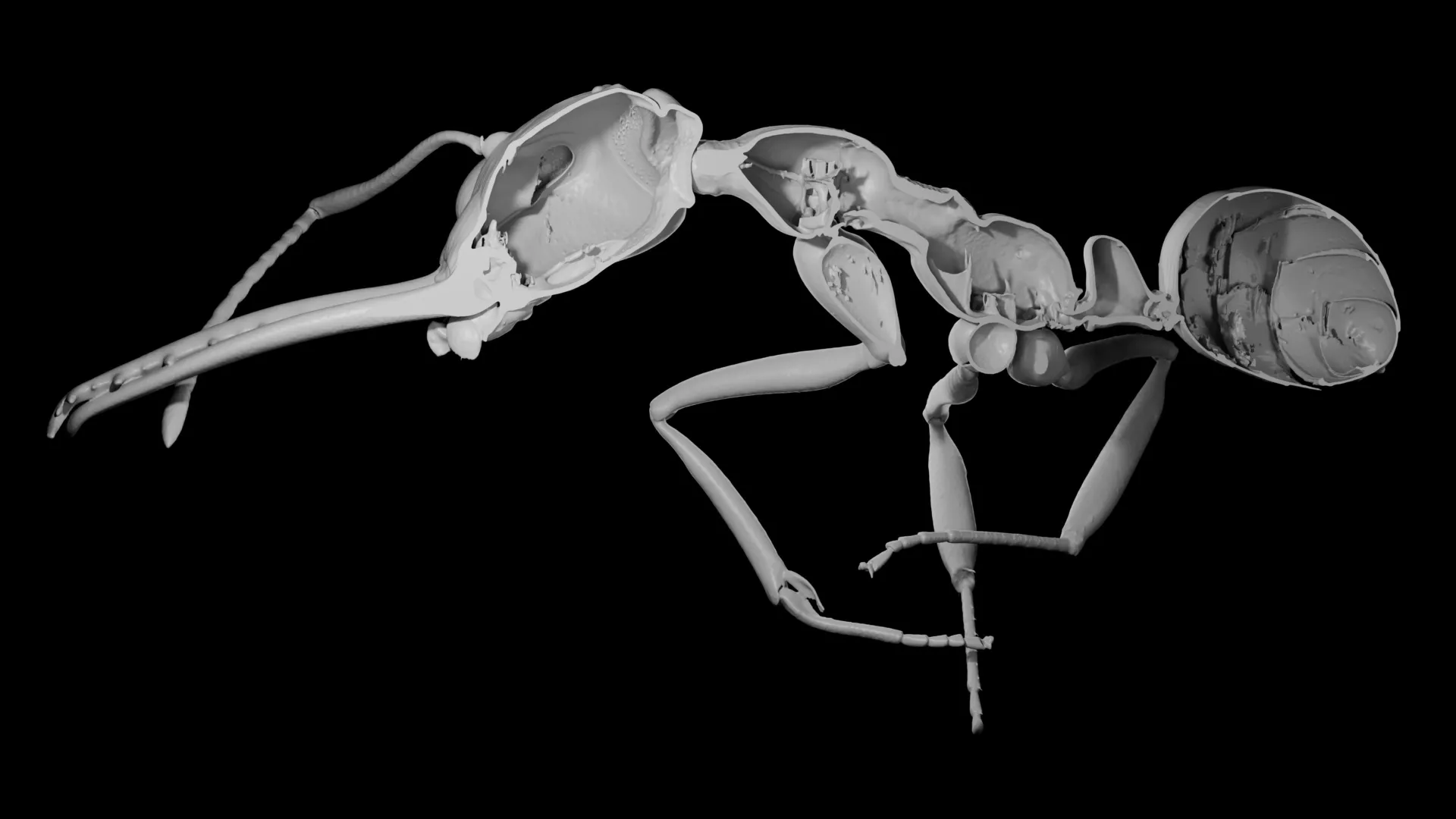
New groundbreaking research has unveiled a profound evolutionary strategy adopted by ants: a trade-off where individual physical robustness is sacrificed for the collective good of the colony, leading to an explosion in social complexity and species diversification. This radical shift, detailed in a study published on December 19, 2025, in the esteemed journal Science Advances, suggests that prioritizing quantity over individual quality has been a powerful driver in the development of highly complex animal societies, with implications extending even to human social structures.
The study, spearheaded by a team of international researchers including senior author Evan Economo, chair of the Department of Entomology at the University of Maryland, and lead author Arthur Matte, a Ph.D. student in zoology at the University of Cambridge, focuses on how ant species have optimized their resource allocation. Instead of investing heavily in the "body armor" of each worker ant – the cuticle, a hard outer layer of the exoskeleton – many species have evolved to produce more, less-protected individuals. This strategy frees up valuable nutrients and energy, which are then re-directed towards increasing overall colony size and reproductive output.
The Economic Imperative: Producing ‘Cheaper’ Workers
At the heart of this evolutionary paradigm lies the concept of the "cheaper" individual. In biological terms, a "cheaper" organism requires fewer resources to construct, allowing for greater numbers to be produced within the same resource budget. For ants, this means a thinner, less resource-intensive cuticle. While such individuals might be more vulnerable on their own, their collective strength, numerical superiority, and highly organized social structures compensate for any individual physical fragility.
"There’s this fundamental question in biology about what happens to individuals as the societies they inhabit become more complex," explained Dr. Economo, who also holds the James B. Gahan and Margaret H. Gahan Professorship at UMD. "For example, individuals themselves may become simpler because tasks that a solitary organism would need to complete can be handled by a collective." This concept, though theorized, had not been explicitly tested on a large scale in social insects until now, marking a significant step forward in understanding the fundamental drivers of social evolution.
The cuticle, primarily composed of chitin and proteins, serves multiple vital functions for an ant. It acts as a protective shield against predators, helps prevent desiccation (drying out), offers defense against pathogens, and provides the essential structural support for muscle attachment, enabling movement and strength. However, manufacturing this robust outer layer is metabolically expensive, demanding significant quantities of limited nutrients such as nitrogen and various minerals. By reducing the thickness and density of this armor, ants effectively lower the "production cost" of each worker.
Ants as a Premier Model for Social Evolution
Ants (Formicidae) offer an unparalleled system for studying the evolution of complex societies. Their social organization, known as eusociality, is characterized by cooperative brood care, overlapping generations, and a division of labor into reproductive and non-reproductive castes. Crucially, ant colonies exhibit an astonishing range in size and complexity, from small, primitive colonies with only a few dozen members to supercolonies numbering in the millions, spanning vast geographical areas. This immense diversity, both in social structure and ecological adaptation, makes them an ideal group for investigating the evolutionary mechanisms underpinning social complexity.
"Ants are everywhere; they are one of the most ecologically dominant groups of animals on Earth, representing an estimated 15-25% of terrestrial animal biomass," noted Arthur Matte. "Yet, the fundamental biological strategies which enabled their massive colonies and extraordinary diversification have remained largely unclear." The research team hypothesized that a key strategy might involve the efficiency of resource investment in individual workers, particularly concerning the cuticle.
Methodology: Peering Inside the Exoskeleton
To rigorously test their hypothesis, the researchers undertook an ambitious analytical project. They assembled and analyzed a vast dataset comprising 3D X-ray micro-computed tomography (micro-CT) scans from over 500 different ant species. This cutting-edge imaging technique allowed them to precisely measure both the total body volume and, critically, the cuticle volume of individual ants across a wide phylogenetic spectrum.
Their meticulous measurements revealed a remarkable variability in cuticle investment, ranging from a mere 6% to a substantial 35% of an ant’s total body volume. This wide spectrum indicated that different ant species have indeed adopted vastly different strategies regarding their individual worker’s physical protection. When these quantitative measurements were integrated into sophisticated evolutionary models, a compelling and consistent trend emerged: species that allocated a smaller proportion of their body mass to the cuticle tended to form significantly larger colonies. This direct correlation provided strong evidence for the "quantity over quality" trade-off.
Bigger Colonies Through Collective Strength: The Reinforcing Cycle
While a thinner cuticle undeniably makes individual ants more vulnerable to environmental stressors, predators, and pathogens, the study argues that this apparent weakness is, paradoxically, a driver of greater societal strength and complexity. Reduced individual armor fosters the development and intensification of various collective social traits. These include highly cooperative foraging strategies, where large numbers of workers can efficiently locate and exploit food sources; robust shared nest defense, where numerical superiority overwhelms threats; and an increasingly specialized division of labor, where individual ants perform specific tasks, enhancing overall colony efficiency. All these traits become more pronounced and effective as colony size increases.
"Ants reduce per-worker investment in one of the most nutritionally expensive tissues for the good of the collective," Matte explained, emphasizing the profound altruistic nature of this evolutionary path. "They’re shifting from self-investment toward a distributed workforce, resulting in more complex societies. It’s a pattern that echoes the evolution of multicellularity, where cooperative units can be individually simpler than a solitary cell, yet collectively capable of far greater complexity and resilience." This analogy highlights a fundamental principle of biological organization, where emergent properties arise from the interaction of simpler units.
Accelerated Diversification: A Marker of Evolutionary Success
Beyond merely enabling larger societies, the research uncovered another striking and perhaps counter-intuitive finding: lower investment in the cuticle was strongly linked to higher diversification rates among ant lineages. In evolutionary biology, diversification, which measures the frequency at which new species form (speciation), is a crucial indicator of evolutionary success and adaptability. Dr. Economo pointed out the significance of this discovery, noting that very few traits have been definitively connected to diversification rates in ants, making this result particularly noteworthy.
The exact mechanisms by which reduced cuticle investment promotes speciation are still subjects of ongoing investigation, but the researchers propose several compelling hypotheses. One leading idea is that ants with lower nutritional demands, due to their less robust exoskeletons, become more versatile and adaptable. This reduced resource requirement might enable them to colonize and thrive in environments where resources, especially nitrogen, are limited. "Requiring less nitrogen could make them more versatile and able to conquer new environments," Matte suggested, recalling how this idea first took root during his master’s program while interning in Economo’s lab at the Okinawa Institute of Science and Technology (OIST) in Japan.
Another hypothesis suggests a reinforcing feedback loop. As ant societies grew larger and more complex, group-level defenses became increasingly sophisticated. Collective nest protection, coordinated attacks on intruders, and even communal disease control mechanisms (such as social grooming and antiseptic secretions) effectively reduced the selective pressure for individual ants to possess heavy, expensive armor. This, in turn, allowed for further reductions in cuticle investment, enabling colonies to grow even larger, further diminishing the need for individual protection, and perpetuating the cycle. As Dr. Economo humorously put it, "I think of this as the evolution of squishability. Many kids have discovered that insects aren’t all equally robust."
Broader Implications: From Insect Societies to Human Strategies
The profound implications of this research extend far beyond the realm of entomology. The fundamental trade-off between individual quality and collective quantity is a pervasive theme across biological systems and even human endeavors. The researchers draw compelling parallels to human military history, where the highly armored, individually formidable medieval knight was eventually superseded by massed formations of specialized soldiers, such as archers, crossbowmen, and later, infantry armed with firearms. These specialized units, though individually less protected, collectively offered superior firepower, tactical flexibility, and numerical advantage.
Dr. Economo also referenced Lanchester’s Laws, a set of mathematical equations developed during World War I to model combat outcomes. Lanchester’s Square Law, for instance, posits that the combat power of a fighting force is proportional to the square of its numerical strength and the fighting quality of individual units. In scenarios where numbers are vastly superior, even a force of individually weaker fighters can overwhelm a smaller, more elite opposition. This principle resonates strongly with the evolutionary strategy observed in ants.
"The tradeoff between quantity and quality is all around us. It’s in the food you eat, the books you read, the offspring you want to raise," Matte reflected. "It was fascinating to retrace how ants handled it through their long evolution. We could see lineages taking different directions, being shaped by different constraints and environments, and ultimately giving rise to the extraordinary diversity we observe today." This universal principle underscores the research’s broad relevance, suggesting that similar evolutionary paths may have been followed by other social organisms, such as termites, though further empirical testing is needed for confirmation.
Future Directions and Unanswered Questions
This study marks a pivotal moment in understanding the evolutionary drivers of social complexity and biodiversity. Future research will likely delve deeper into the genetic and molecular mechanisms underpinning cuticle development and its regulation in response to social organization. Investigating other resource allocation trade-offs within ant colonies, such as investment in brains, sensory organs, or reproductive capacity versus physical robustness, could provide further insights. Additionally, comparative studies across a wider range of social insects and even other social animals could illuminate the universality of the "quantity over quality" principle in shaping life on Earth. The question of how precisely a reduction in individual armor translates into the formation of new species also remains a rich area for future exploration, potentially involving ecological niche expansion or shifts in reproductive strategies.
The paper, "The evolution of cheaper workers facilitated larger societies and accelerated diversification in ants," represents a significant contribution to evolutionary biology, offering a tangible mechanism for how the delicate balance between individual investment and collective strategy can drive the spectacular diversification and ecological success observed in some of the planet’s most complex societies.
This research was made possible through the generous support of various institutions, including the Okinawa Institute of Science and Technology, the Japan Society for the Promotion of Science KAKENHI (grant number 24K01785), the University of Cambridge, and the General Research Fund 2022/2023 (grant number 17121922) from the Research Grant Council of Hong Kong. It is important to note that the views expressed in this article do not necessarily reflect the official positions of these funding organizations.
