
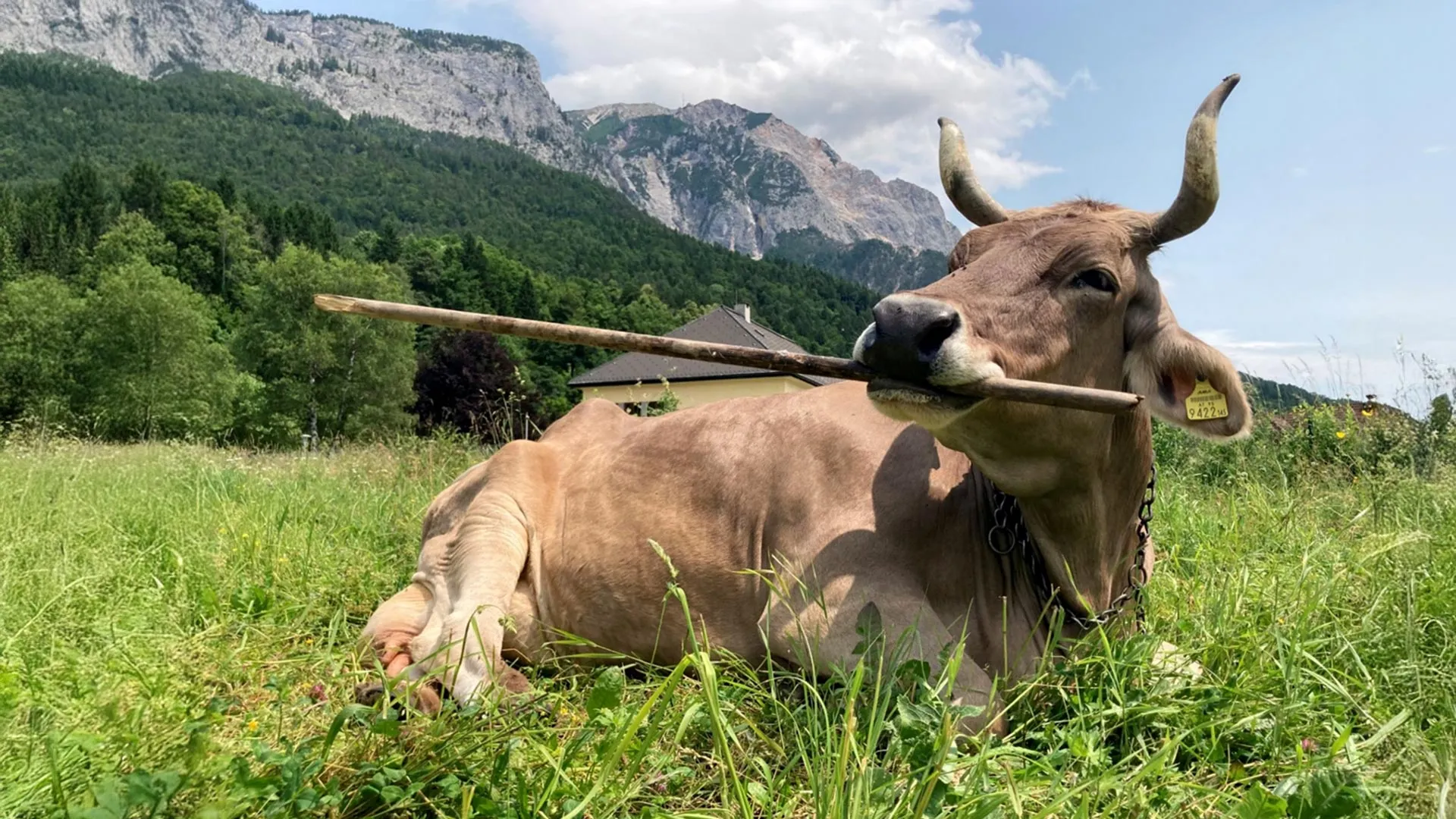
For decades, the popular imagination, heavily influenced by cultural touchstones like Gary Larson’s iconic 1982 Far Side comic, Cow Tools, has often depicted cattle as lacking the sophisticated cognitive abilities required for tool manipulation. Larson’s humorous panel, featuring a cow proudly displaying a bizarre assortment of crudely rendered, useless objects labeled as "tools," cemented an image of bovine intellectual simplicity. The comic, which became one of the most famous and debated in Far Side history, thrived on the absurdity of a cow attempting to engage in an activity widely considered beyond its mental capacity. This perception, while comedic, mirrored a scientific understanding that largely overlooked or underestimated the complex cognitive lives of livestock, often relegating them to the category of mere production units.
However, a groundbreaking study published in Current Biology has now provided compelling evidence that this long-standing assumption may be profoundly mistaken. The research details the extraordinary case of Veronika, a pet Swiss Brown cow whose spontaneous and adaptable use of sticks and brushes to scratch herself has forced scientists to reconsider the cognitive boundaries of bovines. "The findings highlight how assumptions about livestock intelligence may reflect gaps in observation rather than genuine cognitive limits," states Alice Auersperg, a cognitive biologist at the University of Veterinary Medicine, Vienna, and a lead author of the study. This revelation not only expands the known roster of tool-using species but also underscores the critical need for more nuanced and comprehensive observation in ethological research, particularly concerning animals traditionally viewed through a purely utilitarian lens.
Veronika: The Unconventional Companion Animal
Veronika’s story begins not in a research lab, but on an organic farm in Austria, where she lives an unconventional life. Unlike the vast majority of cattle globally—which number well over a billion and are typically raised for meat or dairy production, often in environments designed for efficiency rather than cognitive stimulation—Veronika is a companion animal. She belongs to Witgar Wiegele, an organic farmer and baker who considers her a cherished member of his family. This unique upbringing, characterized by extensive human interaction, a stimulating environment, and a prolonged lifespan far exceeding that of most production animals, is hypothesized to be a critical factor in the development and observation of her remarkable abilities.
More than a decade ago, Wiegele first noticed Veronika engaging in an unusual behavior: she would deliberately pick up sticks or other objects and use them to scratch parts of her body that were otherwise inaccessible. Initially, such observations might be dismissed as anecdotal or coincidental. However, Wiegele’s consistent reports and, crucially, video recordings of Veronika’s actions eventually captured the attention of the scientific community. These recordings provided the initial empirical basis that distinguished Veronika’s behavior from mere random interaction with objects. "When I saw the footage, it was immediately clear that this was not accidental," Auersperg confirms. "This was a meaningful example of tool use in a species that is rarely considered from a cognitive perspective."
Rigorous Scientific Validation: Testing Tool Use in Controlled Settings
To move beyond anecdotal evidence and systematically analyze Veronika’s behavior, researchers designed and implemented a series of structured experiments. The primary objective was to determine if her actions constituted genuine tool use—defined scientifically as the external manipulation of an object to achieve a goal through physical interaction—and to assess the flexibility and purposefulness of these actions.
The experimental setup was straightforward yet effective. Researchers placed a standard deck brush on the ground in various positions around Veronika. The brush itself offered different tactile properties: a bristled side for scrubbing and a smoother, harder handle. Over multiple trials, researchers meticulously observed and recorded Veronika’s interactions with the brush. The key findings were striking: Veronika consistently chose specific parts of the brush depending on the area of her body she wished to scratch. Her selections were not random or haphazard; instead, they demonstrated a clear understanding of the brush’s different properties and how they corresponded to her specific needs.
Antonio Osuna-Mascaró, another researcher involved in the study, elaborated on the sophistication of Veronika’s actions: "We show that a cow can engage in genuinely flexible tool use. Veronika is not just using an object to scratch herself. She uses different parts of the same tool for different purposes, and she applies different techniques depending on the function of the tool and the body region." This distinction is crucial for classifying tool use, moving it beyond simple object manipulation to a more cognitively demanding category.
Flexible and Multi-Purpose Tool Use: A Rare Cognitive Feat
The researchers identified clear and repeatable patterns in how Veronika employed the brush. For larger, firmer areas of her back or flanks, where a more vigorous scratch was desired, she consistently preferred the bristled side of the brush. Conversely, for more sensitive regions, such as her lower legs or belly, she would strategically switch to the smoother, harder handle, applying gentler pressure. This demonstrated not only an awareness of the tool’s different features but also an ability to match those features to specific desired outcomes.
Furthermore, Veronika adjusted her physical movements to suit the task. When scratching her upper body, she would engage in broader, stronger motions, indicative of a need for more extensive coverage and pressure. For lower, more delicate areas, her movements became slower and more precise, suggesting a fine-tuned control over the tool and an anticipation of its effects.
This level of behavior—flexible, multi-purpose tool use, where different features of the same object are employed for different outcomes—is exceptionally rare among non-human species. It has been clearly and consistently documented primarily in chimpanzees, and occasionally in other great apes, certain birds like New Caledonian crows, and sea otters. The discovery of such sophisticated behavior in a cow, a species far removed evolutionarily from these known tool users and with a vastly different physical morphology, represents a significant expansion of our understanding of cognitive evolution. It suggests that the capacity for complex problem-solving, planning, and environmental manipulation may be distributed more broadly across the animal kingdom than previously recognized.
Overcoming Physical Limitations: The Challenge of Lacking Hands
Veronika’s tool use is directed at her own body, a form known as egocentric tool use. While this type is often considered less complex than allocentric tool use (using tools on external objects), it still presents substantial cognitive and motor challenges, particularly for an animal without prehensile limbs. Cows lack hands, which are typically considered essential for fine motor control and tool manipulation in many species. Veronika must instead manipulate tools using her mouth, head, and neck.
Despite this significant physical limitation, she demonstrates remarkable dexterity and control. She carefully adjusts her grip on the tool, using her mouth to orient it correctly and her neck muscles to apply the appropriate force and direction. Her actions appear to be goal-directed and anticipatory; she seems to understand the immediate and future effects of her movements, adjusting them in real-time to achieve the desired scratching sensation. This adaptation highlights an impressive level of motor planning and sensory feedback integration, demonstrating that cognitive capacity can manifest in diverse behavioral forms, even when constrained by anatomy.
The Rarity Enigma: Why Veronika?
The question naturally arises: if cows are capable of such cognitive feats, why is Veronika’s behavior the first documented case? The researchers posit that Veronika’s unique living conditions are a critical factor. Most cattle, even those in well-managed herds, live relatively uniform lives focused on production. Their environments are often standardized, offering limited opportunities for exploration, complex problem-solving, or the kind of prolonged, stimulating interactions that might foster innovative behaviors.
Veronika, by contrast, has lived a long life (cows typically live for 18-22 years, but beef cattle are slaughtered much earlier, and even dairy cows often live only 4-6 years in commercial settings) in a rich and complex environment. As a companion animal, she experiences daily, diverse interactions with humans, who provide a level of social and cognitive stimulation rarely afforded to livestock. Crucially, she has continuous access to a variety of objects she can manipulate and explore without the constraints of a production system. These factors likely created a unique "opportunity niche" for the development and expression of her tool-using behavior, allowing for a decade of consistent observation by a dedicated owner who could recognize and document its significance.
The researchers summarize this point eloquently: "[Veronika] did not fashion tools like the cow in Gary Larson’s cartoon, but she selected, adjusted, and used one with notable dexterity and flexibility. Perhaps the real absurdity lies not in imagining a tool-using cow, but in assuming such a thing could never exist." This statement encapsulates the paradigm shift the study represents, urging the scientific community and the public to question ingrained assumptions about animal intelligence.
Rethinking Animal Intelligence: Broader Implications and Future Directions
This discovery represents a pivotal moment in cognitive ethology. It is the first confirmed case of tool use in cattle, unequivocally expanding the known range of species capable of this complex behavior. Beyond adding a new entry to the list, it profoundly challenges the anthropocentric bias that has historically shaped our understanding of animal minds. If cows, long considered relatively simple-minded, can exhibit such sophisticated cognitive abilities, it raises the possibility that similar behaviors may exist, unobserved or misinterpreted, in many other species.
The implications of this research are far-reaching:
- Animal Welfare and Livestock Management: If cattle possess greater cognitive complexity than previously acknowledged, it necessitates a critical re-evaluation of current livestock management practices. Providing enriched environments, opportunities for exploration, and cognitive stimulation might become not just an ethical consideration but a recognized need for their psychological well-being. This could lead to reforms in housing, social structures, and daily routines for the billions of cattle worldwide.
- Scientific Methodology: The study underscores the importance of long-term, naturalistic observation, particularly in unconventional settings. Many scientific studies are conducted in controlled laboratory environments, which, while valuable, might inadvertently limit the expression of complex behaviors. The initial observation by a dedicated owner highlights the role of citizen science and diverse observational contexts.
- Evolutionary Biology of Cognition: Tool use is a hallmark of advanced cognition, often associated with problem-solving, planning, and an understanding of cause-and-effect relationships. Discovering it in a species like cattle, which diverged from primates tens of millions of years ago, suggests that complex cognitive capacities may have evolved convergently in different lineages, driven by various ecological and social pressures. This challenges linear models of cognitive evolution and points to a more mosaic pattern of development.
- Challenging Speciesism: The study serves as a powerful reminder against speciesism—the prejudice or discrimination against living beings on the basis of their species. By demonstrating unexpected cognitive depth in a commonly exploited animal, it encourages a broader respect for the intrinsic value and intellectual capabilities of all species.
- Future Research Avenues: The research team is now actively exploring the environmental and social conditions that foster such complex behaviors. They are investigating whether specific types of enrichment, social structures, or individual personalities might predispose cattle to develop tool-using skills. Furthermore, they are actively encouraging farmers, ethologists, and the public to report any similar observations of cattle or bulls using sticks or other objects for purposeful actions. "Because we suspect this ability may be more widespread than currently documented," Osuna-Mascaró states, "we invite readers who have observed cows or bulls using sticks or other handheld objects for purposeful actions to contact us." This open call for data could potentially unearth more Veronikas, further enriching our understanding of the animal kingdom’s hidden cognitive depths.
The story of Veronika, the tool-using cow, is more than just a scientific curiosity; it is a profound reorientation. It invites humanity to look anew at the creatures with whom we share this planet, questioning our assumptions, expanding our empathy, and recognizing the intricate, often underestimated, intelligence that thrives in unexpected corners of the animal world. The laughter inspired by Cow Tools may now be tempered by a newfound respect for the cognitive prowess of its subjects, illustrating how science continually pushes the boundaries of what we believe to be possible.
