
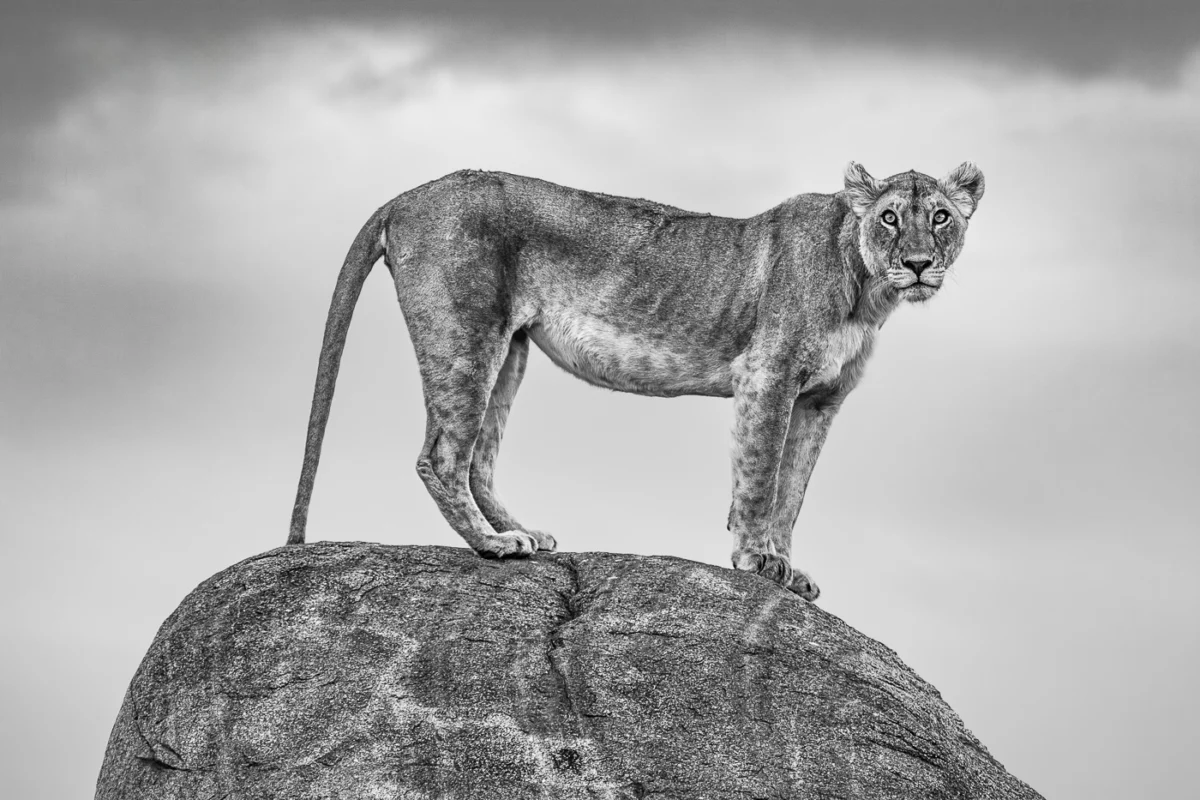
A profound connection to the natural world, nurtured since childhood, has blossomed into a distinctive photographic practice for Gabi Guiard, a visual artist who has seamlessly transitioned from a career in graphic design to capturing the raw essence of wildlife through the timeless medium of black and white photography. Guiard’s work is not merely about documenting animals; it is a deliberate artistic statement, a philosophy that prioritizes the essential over the superfluous, compelling viewers to engage with the profound narratives embedded within each frame. Her journey reflects a common artistic evolution, where foundational skills in commercial art converge with a deep personal passion to forge a unique and impactful voice.

From Commercial Art to Wild Canvas: A Chronology of Passion
Guiard’s early life was marked by an innate curiosity and fascination with animals, a natural attraction that steadily matured into an unwavering interest, profoundly shaping her worldview. While her professional path initially veered into the dynamic realm of graphic design and art direction within the advertising industry, this period proved to be an unexpected crucible for her photographic inclinations. Influenced by the masterful black-and-white fashion and advertising photographers she admired – artists who understood the power of light, shadow, and composition to evoke emotion without the distraction of color – Guiard’s own interest in photography steadily grew. This exposure to the highly stylized and impactful visual language of monochromatic commercial imagery laid the groundwork for her future artistic direction.

The transition was not abrupt but rather an organic progression. Guiard recognized photography as a potent vehicle to synthesize her extensive knowledge of art and design with her lifelong passion for wildlife. It became the perfect nexus, allowing her to apply sophisticated artistic principles to subjects that stirred her soul. This pivot, common among creatives seeking deeper personal expression, saw her trading the vibrant palettes of advertising for the stark, emotive power of grayscale, finding in nature a boundless canvas for her developing vision. This personal chronology highlights a crucial aspect of artistic development: the often-circuitous route one takes to align vocation with true calling.
Black and White: A Language Beyond Aesthetics

For Guiard, black and white is far more than an aesthetic choice or a stylistic preference; it is a fundamental language, a powerful means of storytelling, and an unfiltered expression of her emotional response to nature. In a world saturated with vibrant digital imagery, her deliberate removal of color serves a critical purpose: to eliminate distractions and direct the viewer’s gaze to the fundamental elements of texture, form, and contrast. "I don’t choose it because it sounds more ‘artistic’ or ‘classic’," Guiard asserts, "but because it allows me to focus on the essentials, on what I really want to convey."
This philosophy resonates deeply with the historical roots of photography, where black and white reigned supreme for over a century. Pioneers like Ansel Adams, known for his monumental black and white landscapes, demonstrated how tonal range and meticulous composition could convey immense drama and reverence for nature. Similarly, documentary photographers like Henri Cartier-Bresson utilized the medium to capture the "decisive moment," stripping away superficiality to reveal universal human experiences. Guiard’s approach aligns with this rich heritage, leveraging the monochromatic spectrum to elevate her wildlife subjects beyond mere biological representation into archetypal figures. By shedding the potentially distracting hues of the natural world, she invites a more visceral, almost meditative engagement with the subject, demanding that the viewer connect with the underlying structure and emotion of the scene. It is, as she describes, an "exercise in honesty: what you see is what remains when everything superfluous disappears."

The Essential Over the Superfluous: A Guiding Principle
The core of Guiard’s artistic credo is the conviction that true impact lies not in comprehensive depiction but in the distillation of reality to its most poignant elements. "I have always felt that the important thing is not to show everything, but to show what truly matters," she states. This principle manifests in her commitment to simplifying reality, allowing the inherent wild character of nature to take center stage. Her goal is to craft images where a mere gaze, a distinct silhouette, or a subtle gesture is sufficient to tell a compelling story.

In her black and white work, Guiard aims for an immersive experience, seeking to connect the viewer with the raw strength of the moment, devoid of extraneous sensory input. It’s an invitation to "hear the silence of the instant," a phrase that encapsulates her desire to transcend visual stimuli and evoke a deeper, almost auditory, sense of presence. This focus on the essential aligns with the "less is more" philosophy prevalent in various art forms, from minimalist sculpture to haiku poetry. By removing visual "noise," Guiard creates a space for introspection, allowing the viewer’s imagination and emotional landscape to complete the narrative. This artistic discipline is particularly powerful in wildlife photography, where the sheer complexity of natural environments can often overwhelm the singular beauty or drama of an animal. Guiard’s lens acts as a sophisticated filter, honing in on the soul of the scene.
Less Is More: Crafting Compelling Narratives through Simplification

Guiard’s unwavering belief in "less is more" serves as a foundational pillar for her photographic compositions. The deliberate act of simplifying an image, she explains, is designed to eliminate any element that might divert attention, thereby guiding the viewer directly to the heart of the subject. This approach allows a single, potent detail—a specific gesture, a fleeting shadow, an intense look, or a stark line—to imbue a photograph with its profound power.
The psychology behind this minimalist approach is well-documented. When presented with a simplified image, the human brain is less prone to distraction, allowing for a more direct and unmediated emotional response. Guiard meticulously curates her visual elements so that the viewer is not overwhelmed by unnecessary details but is instead drawn organically to the intrinsic essence of the scene. This "apparent emptiness," this "noise-free space," as she describes it, becomes an active component of the artwork. It is within these expansive, unadorned areas that the viewer is invited to project their own memories, experiences, and emotions, thereby co-creating the narrative. The image transforms from a mere depiction into an interactive canvas, fostering a deeply personal connection between the observer and the observed. This intentional void, far from being a lack, is a strategic choice that amplifies the presence and significance of the chosen subject.

Composition as the Backbone: Guiding the Viewer’s Eye
For Guiard, composition is not merely a technical arrangement but the very backbone, the invisible architecture, of every photograph. Its role extends beyond organizing elements within the frame; it is about artfully guiding the viewer’s eye, leading them inexorably towards the story she intends to tell. In the absence of color, which often provides natural cues and visual hierarchy, composition assumes an even more critical role in black and white photography.

Lines, shapes, and the strategic use of space gain new prominence and weight in her monochromatic world. The precise placement of an animal within its vast environment, the delicate balance between areas of intense light and deep shadow, or the powerful resonance of empty space—all these elements coalesce to create a simultaneous sense of harmony and tension. Guiard often seeks simplicity in her compositions, diligently avoiding superfluous elements that could dilute the core message. She might employ a diagonal line to draw the eye towards the intense gaze of a lion, utilize the natural curve of a tree to frame a powerful silhouette, or strategically deploy negative space to emphasize the isolation or majesty of a subject. Such deliberate choices imbue the image with both strength and intimacy.
Good composition, in Guiard’s view, transcends rigid adherence to rules; it is about the discerning wisdom to know when and how to break those rules to elicit a more profound emotional response. It is this invisible, yet palpable, structure that allows the image to "breathe," granting it both vitality and enduring power. This mastery of composition is essential for black and white photography, where the interplay of light and dark, form and void, must carry the entire weight of expression.

Contrast as a Tool: Painting with Light and Shadow
In Guiard’s artistic lexicon, light and shadow are not simply natural phenomena but rather the primary "brushes" with which she paints each image. This dramatic interplay of contrast is far from a mere aesthetic preference; it is a fundamental narrative tool, her chosen method for giving voice to the emotions and messages she seeks to communicate.

The strategic deployment of blacks and whites becomes an act of deliberate curation. The deep blacks serve to conceal, to hide what is deemed unnecessary for the story, pushing distractions into obscurity. Conversely, the luminous whites and nuanced grays reveal, illuminating precisely what Guiard desires the viewer to feel and perceive. In the realm of black and white photography, shadows are not merely the absence of light; they carry as much weight and communicative power as the subjects themselves. They can convey mystery, depth, vulnerability, or power, shaping the emotional landscape of the photograph.
This masterful manipulation of contrast is a hallmark of compelling black and white imagery. It creates a dynamic tension that can evoke a wide spectrum of feelings, from profound solitude to majestic grandeur. By carefully sculpting the light and shadow, Guiard crafts images that are not just visually striking but are deeply resonant, allowing the interplay of light and dark to tell a story that color might otherwise soften or complicate.

Emotion Behind Every Image: Beyond Mere Depiction
While Guiard’s photographs are rooted in the meticulous observation of wildlife, her ultimate quest transcends mere depiction; it is the pursuit of raw emotion. Her ambition is not for a photograph to simply showcase an animal or a landscape, but for it to convey something far deeper and more resonant: power, solitude, majesty, or even a profound fragility.

For Guiard, subjects like lions are not just animals to be cataloged. They are imbued with a regal status, "kings and queens of a territory that breathes at its own rhythm." Each image is intended to preserve a fragment of their unique story: a calm, piercing gaze that subtly hints at formidable strength, a serene gesture that communicates inherent dignity, or a quiet moment that speaks volumes about their existence. This anthropomorphic perspective, while artistic, serves to foster a deeper empathy and connection with the viewer.
Black and white photography, in Guiard’s experience, significantly intensifies this narrative thrust. By stripping away the visual information that color provides, it forces the viewer to engage with the core emotional content, to delve into the intrinsic character and presence of the subject. This deliberate reduction of visual data allows the emotional narrative to rise to the forefront, creating a more direct and impactful communication between the subject, the artist, and the audience. This makes her work particularly potent in a conservation context, as emotional connection often precedes intellectual understanding and action.

The Timelessness of Black and White: An Eternal Dialogue
One of the most compelling reasons Guiard embraces black and white is its inherent ability to render images timeless. There is a magical quality, she notes, that allows a photograph captured today to possess the same visual resonance as one taken forty years ago, and equally, to retain its impact decades into the future. This enduring quality transcends fleeting trends and technological advancements, firmly rooting the image in a universal aesthetic.

This timelessness allows Guiard to present nature as an eternal entity, a powerful mirror reflecting both humanity’s present condition and its historical past. In a rapidly changing world, her monochromatic images offer a sense of permanence and continuity, reminding viewers of the enduring grandeur of the wild. Furthermore, the removal of color creates a crucial space for individual interpretation, inviting each viewer to project their own memories, experiences, and emotions onto the image. Black and white, therefore, transforms every photograph into an intimate, personal dialogue between the captured moment and its observer. It becomes a catalyst for subjective engagement, fostering a deeper, more personal connection than might be possible with a color image that often dictates a specific visual reality. This makes her work accessible across generations and cultures, speaking to universal human experiences and emotions.
Technique, Yes… but Above All, Sensitivity

Guiard readily acknowledges the indispensable role of technique in her craft. The meticulous search for optimal light, the precise application of compositional principles, and the obsessive attention to detail are all foundational elements of her photographic process. However, she firmly asserts that what truly imbues her work with profound meaning is the sensitivity with which she observes the world.
For Guiard, the artistic act involves critical decisions: what to reveal and what to deliberately consign to the shadows, when to instinctively press the shutter, and, equally important, when to simply remain silent, observing and absorbing the moment without intervention. This nuanced understanding highlights that technical proficiency, while necessary, is ultimately insufficient on its own. "Technique without sensitivity tells nothing," Guiard emphasizes. It is only when both elements converge—when technical mastery is guided by profound emotional intelligence and observational acuity—that a photograph is truly born, one that possesses the power to move, to inspire, and to provoke genuine reflection. This blend of precision and empathy is what elevates her work from mere documentation to profound art.

In Summary: The Foundational Pillars of a Monochromatic Master
Gabi Guiard’s impactful monochromatic wildlife photography is anchored in a set of deeply considered principles that define her unique artistic voice. While the article initially omits them, based on her narrative, these principles can be clearly delineated:

- Black and White as a Language: Not a style, but a fundamental means of communication, stripping away distractions to reveal the core essence.
- Focus on the Essential: Prioritizing impact through simplification, emphasizing a gaze, a silhouette, or a gesture over comprehensive detail.
- Composition as the Backbone: Guiding the viewer’s eye through lines, shapes, and negative space to create harmony and tension.
- Contrast as a Narrative Tool: Using light and shadow to reveal and conceal, sculpting emotion and depth within the frame.
- Emotion Over Depiction: Seeking to convey deeper feelings like power, solitude, majesty, or fragility, rather than just illustrating an animal or landscape.
- Timelessness and Intimacy: Leveraging black and white to create images that transcend time and invite personal interpretation and dialogue.
- Sensitivity Over Sole Technique: Recognizing that technical skill must be imbued with profound emotional understanding and observational wisdom to create truly meaningful art.
For Guiard, black and white is not a superficial filter but a vital, conscious choice. It is her way of orchestrating a visual silence, a profound quietude that allows her to truly listen to and interpret the profound narratives that nature perpetually unfolds. In that intentional silence, stripped of the clamor of color, she consistently discovers and captures the images that most authentically represent her artistic soul and her deep reverence for the wild. Her work serves as a powerful testament to the enduring power of monochromatic photography to connect, to inspire, and to remind us of the intrinsic beauty and majesty of the natural world, urging a deeper appreciation and, by extension, a greater commitment to its preservation.
