
Stefan Gerrits, a nature and wildlife photographer originally from Sambeek, Netherlands, and now residing in Sundsberg, Finland, has cultivated a distinctive photographic style that transcends mere geographical representation. For Gerrits, the Nordic countries, often simply referred to as "the North," embody a profound philosophical and emotional landscape. This region, characterized by its serene yet often harsh conditions of snow, darkness, and extreme cold, has become the crucible for his "minimalistic, imaginative, and two-dimensional; flat, graphic, quiet" aesthetic. His work seeks to distill the essence of the North—its calmness, stark light or pervasive absence thereof, and profound silence—into images that evoke a deep sense of space, emptiness, and timeless peace. This article delves into Gerrits’ unique vision, exploring how he employs high-key photography and minimalism as powerful tools to connect viewers with the emotional core of nature.

The Philosophical Landscape of the North
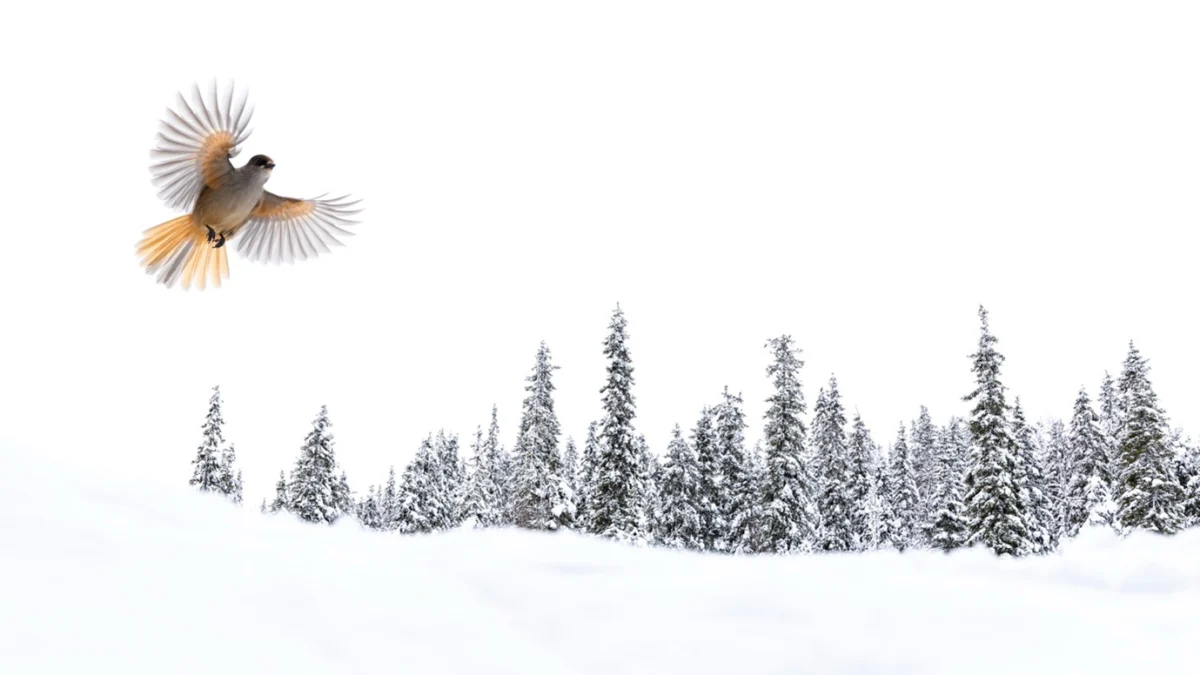
The Nordic region, encompassing countries like Finland, Sweden, Norway, Denmark, and Iceland, presents a unique palette for nature photographers. Beyond its dramatic fjords, expansive forests, and frozen tundras, it offers an environment where light behaves differently, seasons dramatically alter the landscape, and wildlife exhibits remarkable resilience. For Gerrits, this environment is not merely a backdrop but an active participant in his artistic expression. He perceives the North as a place where "less truly becomes more," a cliché he embraces to convey the profound impact of simplicity. This philosophy is deeply ingrained in his photographic approach, where he consciously strips away visual clutter to reveal the inherent power and beauty of his subjects. The vast, often monochrome expanses of winter, for instance, naturally lend themselves to a minimalist interpretation, allowing the solitary figure of a Siberian Jay (captured at f/8.0, 1/1250s, ISO 3200, +2 EV) to command the viewer’s full attention against a pristine, snow-laden backdrop. This deliberate reduction fosters a contemplative experience, inviting viewers to pause and connect with the subtle nuances of the scene.

High-Key Photography and the Art of Emotional Evocation
Central to Gerrits’ methodology is the strategic use of high-key photography. This technique involves intentionally overexposing an image to create a predominantly bright, often ethereal aesthetic, characterized by minimal shadows and a limited tonal range. While technically challenging, high-key photography, when mastered, can transform a scene, imbuing it with feelings of purity, lightness, and often a dreamlike quality. For Gerrits, it is more than a technical setting; it is a means to "simplify reality by removing, or rather ignoring, elements and details to reduce the frame to only what’s essential and draw immediate focus to the subject."

This approach aligns perfectly with the principles of minimalism, where the absence of elements is as significant as their presence. By embracing high-key, Gerrits creates a visual expanse around his subjects, allowing them "to breathe" and providing "space for the viewer to pause and feel." This is evident in his image of Common Cranes on Snow (ISO 260, f/2.8, 1/1600 sec, +2 EV), where the bright, almost stark white background accentuates the elegant forms of the birds, making them the undeniable focal point and enhancing the sense of quiet grace. The deliberate overexposure elevates the image beyond a mere depiction, transforming it into an emotional statement about the beauty found in starkness.
The Progressive Path to Simplicity: Simple, Simpler, Simplest

Gerrits articulates his journey into minimalism as a gradual, three-step process: "Simple, simpler, simplest." He emphasizes that simplicity is not an inherent trait but a skill honed through practice and growing confidence in the power of omission. This iterative process allows photographers to trust that what remains after reduction is indeed "enough and powerful." Far from being boring, simplicity, in Gerrits’ view, invariably strengthens an image, making it more emotional and memorable.
He advises photographers to actively question the necessity of every element within the frame: "What does this image truly need to be powerful?" This critical self-assessment begins in the field, where minor adjustments—shifting position, tilting the camera, or even lying on the ground—can exclude distracting backgrounds or foregrounds. Framing a subject against a neutral canvas, such as snow or sky, is a primary technique. When in-field adjustments are insufficient, post-processing becomes an extension of this minimalist philosophy, allowing for cropping, tonal simplification, or selective erasure of distracting elements. The goal is always to remove anything that does not "serve or strengthen the image," ensuring that every pixel contributes meaningfully to the overall narrative. An example of this meticulous framing is the Western Capercaillie in a wintery environment (f/4.5, 1/320s, ISO 3200, +2 EV), where the bird is isolated against a soft, muted background, its presence amplified by the surrounding calm.

Beyond Color: The Transformative Power of Monochrome
While color is often celebrated in nature photography, Gerrits advocates for a deliberate consideration of monochrome conversion. He acknowledges that not all subjects benefit from the removal of color; a vibrant butterfly, for instance, might lose much of its inherent character. However, for subjects where color is not the primary conveyor of impact, black and white can be profoundly transformative. The critical question, he posits, is whether an image "relies on color to be impactful" or if it "can be more impactful without it."

A Mountain Hare in winter, with its camouflage of white fur and subtle hints of pink in its ears or yellow beneath its paws, provides an ideal canvas for monochrome treatment (f/5.6, 1/1000s, ISO 800, +4/3 EV). In such instances, black and white amplifies the mood, silence, harmony, and focus, drawing attention to form, texture, and light rather than hue. Gerrits frequently employs tools like Silver Efex Pro, which offers precise control over contrast, structure, and tonal range—elements crucial for compelling monochrome imagery. He stresses that converting to black and white should never be a fallback option but a conscious, creative choice made to enhance the image’s emotional resonance and artistic impact. The striking image of Barnacles inverted to create a high-key effect (f/9.0, 1/1250s, ISO 400, -8/3 EV, inverted) further exemplifies how manipulating light and tone can create abstract, powerful monochrome compositions.
Geometric Precision: Lines and Shapes as Building Blocks

Minimalistic design frequently leverages basic geometric forms—angles, triangles, circles, and lines—to impart clarity, structure, and balance. In photography, these elements serve as powerful visual anchors, guiding the viewer’s eye and contributing to a sense of scale and order. Gerrits advises photographers to compose images around a single distinct shape, or even a partial one, such as a curve suggesting a half-circle. This deliberate use of geometry creates a strong visual area of focus, simplifying the composition while maintaining visual interest.
For example, a Bearded Reedling hanging from a stem of reed (f/4.0, 1/640s, ISO 1000, +2 EV) can be framed to emphasize the vertical lines of the reed and the bird’s delicate form. Similarly, the symmetrical pairing of Two Banded Demoiselles (f/5.0, 1/80s, ISO 250, +5/3 EV) waiting for the sun can highlight natural patterns and repetitions. By recognizing and isolating these inherent geometric structures in nature, photographers can imbue their images with a graphic quality that is both aesthetically pleasing and intellectually engaging.

Rhythm and Order: The Power of Repetition and Symmetry
Repetition, whether symmetrical or mirrored, is another highly effective tool in minimalistic photography. It introduces rhythm, order, and a playful quality, creating emotion without adding complexity or clutter. A series of identical or similar elements—lines, shapes, or multiple subjects—can become visually captivating, even hypnotic. This principle is vividly illustrated in his photograph of Common Guillemots (f/4.0, 1/400s, ISO 160, +7/3 EV) locked in what he describes as "a silent conversation." The repetition of their forms and postures creates a powerful, unified composition that draws the viewer in.

Similarly, the pattern created by Drake Mackerel (f/4.0, 1/80s, ISO 400, +5/3 EV) can be emphasized through careful framing to highlight the natural rhythm and texture. This technique leverages the human brain’s innate tendency to seek patterns, providing a sense of harmony and visual satisfaction that resonates deeply, particularly within a minimalist framework.
Negative Space, Isolation, and Visual Balance: The Art of Breathing Room

The concept of "negative space" or "isolation" refers to the deliberate inclusion of empty or uncluttered areas around the main subject. This "breathing space" not only enhances the aesthetic appeal but also amplifies the subject’s sense of solitude, making the image feel more artistic and profound. In minimalist photography, isolation strengthens the viewer’s connection with the subject, guiding both the eye and the mind towards a singular focal point.
Because minimalistic images contain so few elements, the chosen subject must carry significant emotional weight. Gerrits suggests selecting subjects that inherently express fragility, vulnerability, rarity, or evoke danger, mystery, solitude, or even a mystical quality. Elusive or endangered species, such as the Great Gray Owl (f/8.0, 1/2500s, ISO 8000, +5/3 EV) captured on freshly fallen snow, quickly elicit an emotional response due to their scarcity and sought-after status. The vast negative space around the owl accentuates its powerful presence and the silence of its environment. Similarly, a Willow Grouse (f/4.0, 1/500s, ISO 640, +2 EV) peeking from behind a snowdrift utilizes negative space to create a sense of intrigue and isolation.

It is crucial to understand that negative space doesn’t necessarily imply a monochromatic void. It can still be visually attractive, capturing attention without competing with the subject. Gerrits’ photograph of a White-throated Dipper (f/16.0, 0.3s, ISO 50, +2/3 EV) exemplifies this, placing the small bird within a calm, visually interesting, yet uniform environment. The silky waves of the river provide a compelling backdrop that supports, rather than distracts from, the dipper. This thoughtful use of negative space is a hallmark of his minimalist vision, creating compositions that are both serene and impactful.
Broader Implications and Artistic Recognition

Stefan Gerrits’ commitment to minimalism and high-key photography offers a refreshing counterpoint to the often detail-heavy and intensely colored imagery prevalent in nature photography. His approach encourages viewers to slow down, to engage deeply with an image, and to find profound beauty in simplicity. By stripping away the extraneous, he reveals the inherent character and emotional resonance of the natural world, fostering a more contemplative and intimate connection between observer and subject.
His work challenges conventional notions of what constitutes a "complete" nature photograph, demonstrating that deliberate omission can be a powerful act of creation. The success of his solo exhibition, imaginature, in Helsinki, and his contributions to Nature Vision Magazine, attest to the growing appreciation for this artistic perspective within the photography community. Gerrits’ philosophy that "what’s not in the frame says just as much as what is" speaks volumes about the subject, the captured moment, the evoked feeling, and, crucially, the artist behind the lens. His photography, exemplified by images like the Brown Bear on the run (f/11.0, 1/8s, ISO 100, +7/3 EV), serves as a powerful testament to the enduring allure of the Nordic landscape and the profound impact of a carefully honed, minimalist vision. Through his lens, the stark, quiet beauty of the North is not just seen, but deeply felt, inviting a meditation on nature’s intrinsic grace and the power of artistic interpretation.
