
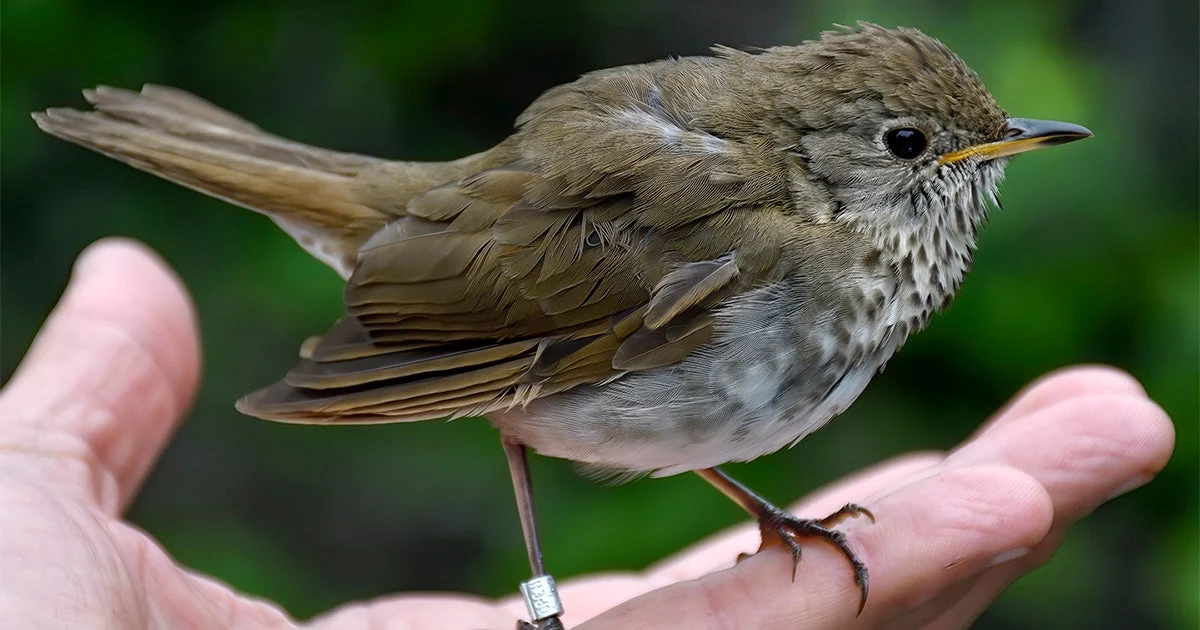
On a hazy day in late September 2025, a critical scientific mission unfolded on the sandy paths of the Foreman’s Branch Bird Observatory in coastal Maryland. Desiree Narango, a biologist with the Vermont Center for Ecostudies (VCE), was on a focused search for the secretive and increasingly rare Bicknell’s Thrush. This unassuming songbird, notoriously difficult to identify and dwindling in numbers, makes only a brief, vital stop here to rest and refuel on its arduous migration south to its Caribbean wintering grounds. Narango’s hope was to capture a few individuals, not just to track their movements, but to help solve a perplexing two-decade-old mystery: the dramatic scarcity of females within the species. This investigation represents a pivotal step in understanding and reversing the alarming decline of a bird that has seen its population plummet by an estimated 50 percent in the last half-century.
The Elusive Bicknell’s Thrush: A Species in Peril
The Bicknell’s Thrush (Catharus bicknelli) is a small, olive-brown songbird known for its ethereal, spiraling song and its preference for high-elevation spruce-fir forests in the northeastern United States and southeastern Canada during the breeding season. It is one of North America’s most elusive and least-understood migratory birds, often dwelling in dense, scrubby conifers that make observation challenging. Its rarity and specific habitat requirements have long made it a species of high conservation concern. The 2025 State of the Birds report underscored its precarious status, highlighting a species that epitomizes the broader crisis facing migratory birds across the continent, where billions of birds have been lost since the 1970s.
Historically, ornithological research has often been skewed towards male birds, which are typically more colorful, vocal, and thus easier to observe. This bias has inadvertently led to a significant gap in understanding the unique ecological roles, behaviors, and conservation needs of female birds. For the Bicknell’s Thrush, however, understanding the fate of its females has become paramount. As Narango emphasizes, "No matter what bird species you are studying, females are the limiting factor for population size. It doesn’t matter how many males you have, if there isn’t a female, they can’t breed." This fundamental biological principle drives the urgency of the current investigation.
The Two-Decade Mystery: A Skewed Sex Ratio Emerges
The mystery began to unfold in the early 2000s when Jim Goetz, a pioneering conservation scientist also with the Vermont Center for Ecostudies, published groundbreaking observations from breeding sites in Vermont. His data revealed a startling imbalance: male Bicknell’s Thrushes significantly outnumbered females, with ratios at some sites as skewed as eight males for every single female. This discovery immediately raised red flags for conservationists, as such a disparity severely limits the reproductive potential of the population.
This initial finding launched VCE scientists into a systematic, multi-stage investigation spanning over two decades, aiming to pinpoint where and why females were disappearing from the population. The scientific process, much like detective work, involved formulating hypotheses, collecting data, and eliminating possibilities one by one.
Early Hypotheses and Scientific Roadblocks
The first logical hypothesis was that the sex ratio might be skewed from the very beginning of life—perhaps more males were hatching than females. To test this, Goetz and his team painstakingly sought out nests hidden deep within the dense, scrubby conifers on mountaintops across the northeastern United States and in lower elevations of Canada. Since male and female Bicknell’s Thrushes are virtually indistinguishable by sight, the scientists had to draw tiny blood samples from nestlings for DNA analysis to determine their sex. The results were clear: nests were consistently hatching an equal number of males and females. This ruled out the initial hypothesis and deepened the enigma, pushing researchers to look further along the birds’ life cycle.
The next line of inquiry focused on the species’ wintering grounds, primarily the island of Hispaniola, which encompasses Haiti and the Dominican Republic. Researchers considered the possibility that females were experiencing disproportionately higher mortality rates during the non-breeding season. Between 2007 and 2011, VCE biologists, in collaboration with local partners, conducted extensive field studies on Hispaniola. Their findings revealed a notable segregation: female Bicknell’s Thrushes tended to occupy poorer-quality habitats in the central parts of the island, while males were more frequently found in richer, more pristine areas, such as the protected Sierra de Bahoruco national park in the Dominican Republic.
Despite this habitat segregation, further analysis by the Dominican Republic nonprofit SOH Conservation, led by director Jorge Brocca, indicated that the overall number of Bicknell’s Thrushes utilizing these habitats remained stable, both within a single winter season and from year to year. Brocca’s assessment, based on years of meticulous observation, was critical: "For us, they are not disappearing" on the wintering grounds. This conclusion, coupled with the continued observation of male-skewed ratios on the island similar to those in Vermont, strongly suggested that females were not dying off in greater numbers during their time on Hispaniola. This eliminated the second major hypothesis, leaving one primary suspect: the perilous journey of migration.
The Migration Hypothesis: A New Frontier of Inquiry
With breeding and wintering ground mortality largely ruled out, the scientists turned their attention to the periods of migration, particularly the fall journey, as the most likely time for females to face greater risks. However, studying migration presents its own formidable challenges. In the early stages of the investigation, the species’ exact migratory route was largely unknown, as were its crucial stopover points—places where the thrushes briefly rest and refuel. Furthermore, identifying sex-specific threats while birds are on the move, often at night and across vast distances, was a daunting prospect.
Traditional community science data, such as eBird observations, proved less useful for the Bicknell’s Thrush. Not only do the sexes look alike, but the Bicknell’s Thrush is also nearly identical in appearance to the more common Gray-cheeked Thrush (Catharus minimus). This visual similarity makes accurate identification by casual birders extremely difficult, leading to potential misidentification and unreliable data. In fact, for many years, scientists considered the two thrushes to be the same species, highlighting the deep challenge of distinguishing them in the field. Michael Hallworth, another VCE researcher involved in the project, emphasizes this difficulty, stating that the visual similarity is a major hurdle.
Technological Breakthroughs: Mapping the Invisible Journey
To overcome these challenges and gain a clearer picture of the thrushes’ movements and potential mortality points, VCE scientists turned to cutting-edge tracking technologies. An early breakthrough came when a VCE scientist deployed tiny geolocators on some birds. These devices record light levels, allowing researchers to infer approximate locations based on day length and time of sunrise/sunset. While the data from geolocators could only point to a general area, they provided the first crucial hint that birds leaving Vermont paused in the mid-Atlantic states before continuing south.
The next step involved the use of more sophisticated GPS tags. These devices offered significantly greater accuracy, pinpointing the birds’ stopover locations more precisely, including their staging areas along the North Carolina coast before launching over the ocean. However, GPS tags present a significant limitation: to retrieve the precious data, scientists must recapture the exact same bird after it has successfully survived both its fall and spring migrations and returned to its breeding grounds. This requirement meant that data could only be obtained from the most resilient individuals, providing no information on birds that perished during migration.
The true game-changer in this research came with the adoption of the Motus Wildlife Tracking System. Motus is a collaborative, international network of stationary automated radio telemetry towers designed to detect signals from tiny radio tags affixed to birds, bats, and insects. These towers, strategically placed across landscapes, can pick up radio signals from tagged individuals passing within a 12-mile radius, delivering data in real time. Over the last decade, the Motus network has seen significant expansion, particularly in the eastern United States, making it an invaluable tool for tracking small, migratory species that cover vast distances.
After affixing Motus tags to Bicknell’s Thrushes breeding on Vermont’s Mount Mansfield, researchers gained unprecedented insights. The data revealed that both sexes were spending up to three weeks on the Delmarva Peninsula and in nearby areas of Delaware and Virginia during their fall migration. This discovery identified a previously underestimated critical stopover region, providing a focused target for further investigation into the female scarcity mystery.
Unveiling Critical Stopover Sites: The Delmarva Peninsula’s Significance
The revelation of the Delmarva Peninsula’s importance is what brought Narango and Hallworth to the region in late September 2025. Their first stop was the Foreman’s Branch Bird Observatory, a banding station known for recording more Bicknell’s Thrushes than any other site along the species’ migration route, averaging about four detections per year. At first glance, the flat coastal plain seemed an incongruous habitat for thrushes that breed and winter in mountainous terrain. Narango initially wondered what drew them to such a different environment for rest.
However, on her very first day of fieldwork, Narango quickly observed that the thrushes were utilizing the coastal equivalent of their preferred montane habitat: wet, closed-canopy forests rich in tupelos and sweetgums. These dense, swampy woodlands provided the cover and food resources necessary for the birds to recuperate. Over three intensive weeks in the area, the VCE scientists, utilizing mist nets and skilled handling techniques, managed to capture and take blood samples from 23 thrushes that appeared to be Bicknell’s Thrushes. Subsequent genetic analysis, performed in the lab, confirmed that three of these were indeed Bicknell’s Thrushes, while the remaining individuals were the look-alike Gray-cheeked Thrushes. This result, while modest in number for Bicknell’s, underscores the challenge of species identification and the painstaking nature of this research.
Maren Gimpel, the associate director of the Foreman’s Branch Bird Observatory, a program of Washington College, reflected on the site’s evolving significance. For years, she believed the observatory’s value lay in its representation of an "ordinary place" along a common migration route, offering a typical cross-section of migratory bird activity. However, the emerging research, particularly the Motus data, has dramatically shifted her perspective. "This is a special place for these birds," Gimpel now affirms, recognizing the critical role the Delmarva Peninsula plays as a migratory bottleneck for the imperiled Bicknell’s Thrush.
Future Directions and Emerging Threats
The bulk of the investigation into this critical stopover region is still to come, as Narango notes. The VCE team now possesses a much clearer understanding of where, when, and how to locate and differentiate the two closely related thrush species during migration. As they collect more samples, their primary goal is to identify the key threats impacting both sexes during their stopover and, crucially, to determine if females face disproportionately greater risks.
One immediate line of inquiry involves analyzing the collected blood samples for environmental contaminants. Researchers want to test whether levels of pesticides or heavy metals are higher in birds during migration than they were on the breeding grounds, suggesting exposure during their journey or at stopover sites.
However, the scientists suspect that habitat loss and fragmentation remain the most critical overarching challenge for the species across its entire range. There is a strong theoretical basis to believe that females are more vulnerable to this pervasive threat, both on their migration stopover and wintering areas. In the Dominican Republic, for example, a leading theory suggests that males, typically larger and more dominant, arrive first on the wintering grounds and claim the best-quality habitats, relegating females to less desirable areas. The scientists now ponder whether a similar dynamic could be occurring at stopover sites like those in Maryland, where later-arriving or less dominant females might be forced into suboptimal habitats, increasing their vulnerability to predation, resource scarcity, or environmental hazards.
Looking ahead, Michael Hallworth expresses a desire to expand the Motus network even further. He envisions the installation of Motus towers on the north shore of the Dominican Republic. Such an expansion would provide invaluable data on how many avian migrants successfully complete their trans-oceanic journey and reach the island each fall, offering a more complete picture of survival rates during this critical leg of migration.
Broader Implications for Avian Conservation
The ongoing research into the Bicknell’s Thrush transcends the fate of a single species. It underscores the profound importance of sex-specific conservation strategies, recognizing that conservation efforts cannot be truly effective if they overlook the unique challenges faced by half of a population. This work also highlights the vital role of migratory stopover sites—often overlooked or considered less significant than breeding or wintering grounds—as critical bottlenecks where populations can be disproportionately impacted.
Through relentless dedication and the innovative application of technology, these scientists have significantly advanced the understanding of this elusive species in just a few years. Their findings are not only crucial for the Bicknell’s Thrush but also offer broader lessons for the conservation of countless other migratory birds facing similar pressures from habitat loss, environmental contaminants, and climate change. The quest continues, driven by the hope that unraveling the mystery of the missing females will ultimately lead to effective strategies to safeguard the future of the Bicknell’s Thrush and preserve the rich tapestry of avian life.
