
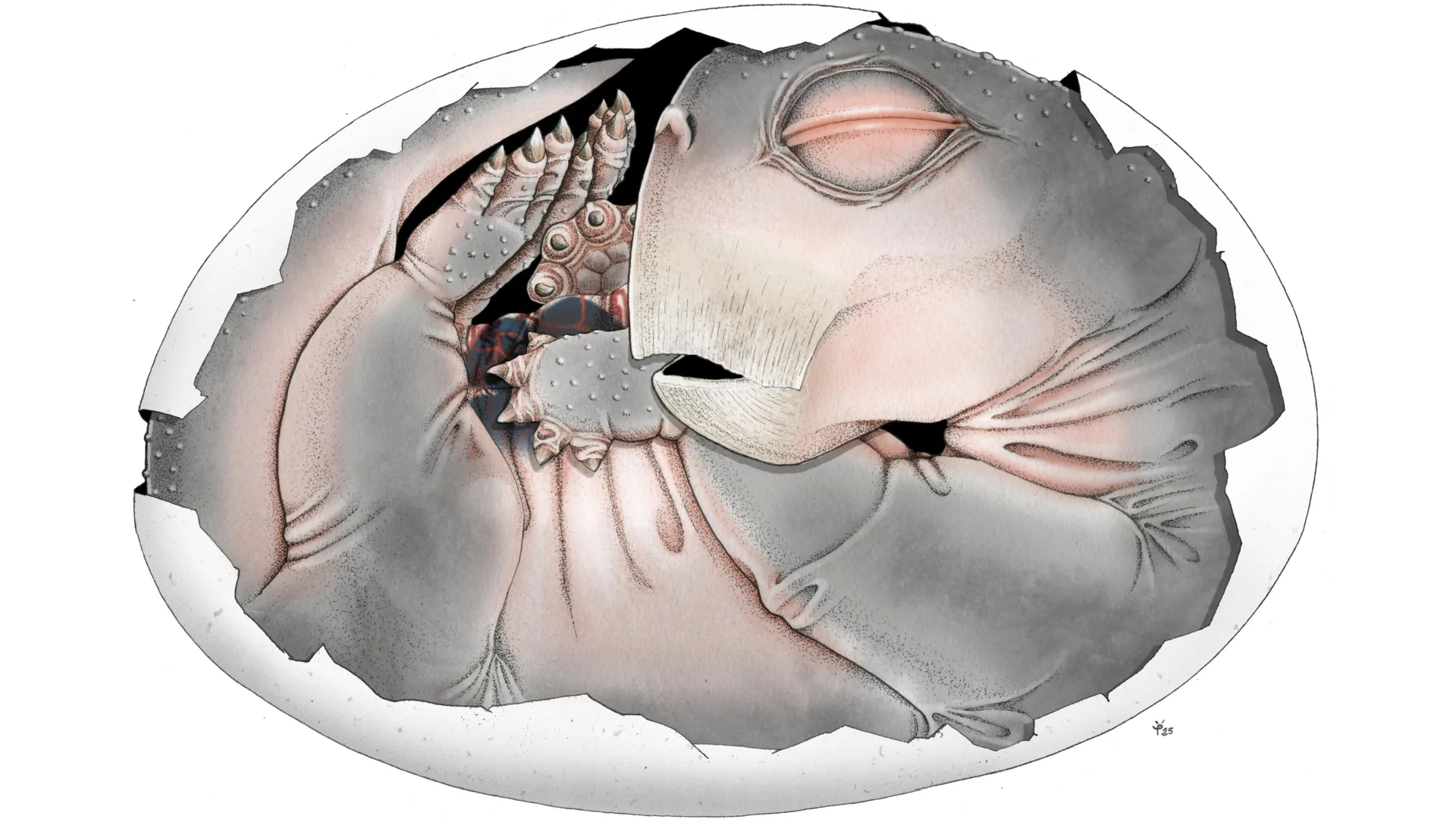
A groundbreaking fossil discovery is revolutionizing our understanding of early mammalian evolution and shedding new light on one of Earth’s most astonishing survival stories. Researchers have identified a 250-million-year-old egg containing a Lystrosaurus embryo, a finding that definitively answers a long-standing scientific question: did the ancestors of mammals lay eggs? The resounding answer, now confirmed, is yes. This remarkable find not only provides the first direct evidence of egg-laying in mammal ancestors but also offers crucial insights into the reproductive strategies that allowed Lystrosaurus, a resilient, plant-eating therapsid, to dominate the planet after the cataclysmic End-Permian Mass Extinction approximately 252 million years ago – an event that obliterated the vast majority of life on Earth.
A Glimpse into Earth’s Most Profound Crisis: The End-Permian Extinction
To fully appreciate the significance of Lystrosaurus‘s survival and its newly revealed reproductive habits, it is essential to understand the sheer scale of the environmental catastrophe it endured. The End-Permian Mass Extinction, often dubbed "The Great Dying," represents the most severe biotic crisis in Earth’s history. Occurring at the boundary between the Permian and Triassic periods, this event witnessed the extinction of an estimated 96% of all marine species and 70% of terrestrial vertebrate species. Entire ecosystems collapsed, and the planet was plunged into a prolonged period of extreme environmental instability.
The primary driver of this devastation is widely believed to be massive volcanic eruptions in the Siberian Traps large igneous province. Over hundreds of thousands of years, these eruptions released colossal volumes of greenhouse gases, including carbon dioxide and methane, into the atmosphere. This led to rapid and severe global warming, with average global temperatures soaring by as much as 8-10 degrees Celsius. The warming triggered a cascade of devastating effects: widespread ocean anoxia (oxygen depletion), ocean acidification, massive sea-level fluctuations, and extensive continental aridification. Terrestrial environments became characterized by extreme heat, volatile atmospheric conditions, and prolonged droughts, rendering much of the land inhospitable. Following the initial extinction pulse, the early Triassic period was a "dead zone" for biodiversity, with very few species able to adapt and recover. Yet, amidst this unprecedented ecological collapse, Lystrosaurus not only persisted but thrived, becoming the most abundant and widespread terrestrial vertebrate on the planet for millions of years.
Unraveling a Paleontological Enigma: The Lystrosaurus Egg
The new research, recently published in PLOS ONE, details the extraordinary discovery by an international team of scientists. Led by Professor Julien Benoit and Professor Jennifer Botha from the Evolutionary Studies Institute at the University of the Witwatersrand, South Africa, and Dr. Vincent Fernandez from ESRF – The European Synchrotron in France, the team’s findings represent a monumental step in understanding early mammal evolution.
The fossil in question is a tiny nodule containing a Lystrosaurus embryo, estimated to be around 250 million years old, still encased within its egg. This marks the first confirmed egg ever found from a therapsid, the group of synapsids that includes mammals and their direct ancestors. For decades, paleontologists have debated the reproductive methods of these ancient creatures. While it was widely accepted that early synapsids laid eggs, direct fossil evidence, particularly for groups as close to mammals as Lystrosaurus, remained elusive. This discovery provides the definitive proof.
The Elusive Nature of Ancient Eggs and a Serendipitous Find
The rarity of this fossil is a testament to the conditions under which these ancient animals reproduced. Unlike the hard, mineralized shells of many dinosaur eggs, which are robust and readily fossilize, the researchers believe Lystrosaurus laid soft-shelled eggs. Such eggs, similar to those of modern turtles, snakes, and some birds, are far more fragile and prone to rapid decay before they can be preserved through fossilization. This inherent vulnerability explains why direct evidence of egg-laying in many ancient groups, including mammal ancestors, has been so incredibly difficult to find.
The journey to this pivotal discovery began much earlier. Professor Botha recounted the initial find: "This fossil was discovered during a field excursion I led in 2008, nearly 17 years ago. My preparator and exceptional fossil finder, John Nyaphuli, identified a small nodule that at first revealed only tiny flecks of bone. As he carefully prepared the specimen, it became clear that it was a perfectly curled-up Lystrosaurus hatchling. I suspected even then that it had died within the egg, but at the time, we simply didn’t have the technology to confirm it." This initial hunch, born from years of paleontological experience, laid the groundwork for future technological validation.
Advanced Imaging Illuminates Hidden Details
The true breakthrough came with the application of cutting-edge imaging technology. Modern synchrotron x-ray CT scanning, particularly the powerful X-rays available at the ESRF, allowed researchers to non-invasively examine the delicate fossil in unprecedented detail. This sophisticated technique works by passing high-energy X-rays through the specimen, creating detailed cross-sectional images that can then be reconstructed into a three-dimensional model. This method is crucial for studying fragile fossils without causing any damage.
Dr. Fernandez highlighted the excitement of this technological leap: "Understanding reproduction in mammal ancestors has been a long-lasting enigma and this fossil provides a key piece to this puzzle. It was essential that we scanned the fossil just right to capture the level of detail needed to resolve such tiny, delicate bones." The high-resolution scans confirmed Professor Botha’s initial suspicion, revealing not only the embryo but also subtle indications of the soft eggshell material that had surrounded it.
Beyond merely confirming the egg’s presence, the scans also provided vital clues about the embryo’s developmental stage. Professor Benoit, upon examining the detailed images, noted a critical anatomical feature: "When I saw the incomplete mandibular symphysis, I was genuinely excited. The mandible, the lower jaw, is made up of two halves that must fuse before the animal can feed. The fact that this fusion had not yet occurred shows that the individual would have been incapable of feeding itself." This observation was key to understanding the specific developmental strategy of Lystrosaurus.
Reproductive Strategies for Survival: Large Eggs and Precocial Young
The study’s findings indicate that Lystrosaurus produced relatively large eggs in proportion to its body size. In the animal kingdom, larger eggs typically contain a greater quantity of yolk, a nutrient-rich substance that provides sustenance for the developing embryo. This abundance of yolk implies that Lystrosaurus hatchlings were likely "precocial," meaning they were born at an advanced stage of development. Precocial young are relatively mature and mobile at birth or hatching, capable of feeding themselves and often avoiding predators almost immediately. This contrasts with "altricial" young, which are born helpless and require extensive parental care, often including feeding.
The implication here is profound: unlike modern mammals that nourish their young with milk, Lystrosaurus relied on a different strategy. The large, yolk-rich eggs provided sufficient nutrients for the embryos to develop extensively before hatching, negating the need for post-hatching parental feeding. This reproductive mode offered several distinct advantages in the harsh, post-extinction environment. Firstly, larger eggs with thicker shells (even if soft) would have been more resistant to desiccation, a critical factor in the arid and unstable climate following the mass extinction. Secondly, the rapid development and precocial nature of the young meant they could quickly become independent, reducing the vulnerability period associated with altricial young.
In essence, Lystrosaurus thrived by employing a "fast-life history" strategy: growing quickly and reproducing early. This approach maximizes reproductive output and ensures that offspring reach maturity rapidly, a significant advantage when environmental conditions are unpredictable and resource availability can fluctuate dramatically.
The Broader Implications: Resilience in the Face of Crisis
This discovery provides the first direct evidence of egg-laying in mammal ancestors, resolving a long-standing question about the origins of mammalian reproduction. Beyond this fundamental insight, it illuminates how specific reproductive strategies can become pivotal for survival in extreme environments. By producing large, yolk-rich eggs and precocial young, Lystrosaurus was uniquely equipped to navigate the harsh, unpredictable conditions that defined the early Triassic period. Its ability to quickly produce self-sufficient offspring allowed its populations to rebound and flourish where most other life forms perished.
The lessons from Lystrosaurus‘s incredible journey extend far beyond the realm of paleontology, offering a "deep-time perspective" on resilience and adaptability in the face of rapid environmental change. As scientists continue to grapple with contemporary challenges like climate change, biodiversity loss, and ecological crises, understanding how past organisms survived global upheaval becomes increasingly relevant.
Professor Julien Benoit emphasized this modern context: "In a modern context, this work is highly impactful because it offers a deep-time perspective on resilience and adaptability in the face of rapid climate change and ecological crisis. Understanding how past organisms survived global upheaval helps scientists better predict how species today might respond to ongoing environmental stress, making this discovery not just a breakthrough in paleontology, but also highly relevant to current biodiversity and climate challenges." He also reflected on the scientific process, adding, "The opportunity to work at the European Synchrotron Radiation Facility alongside beamline scientists was also an unforgettable part of the journey. The cutting-edge data we generated there allowed us to ‘see’ inside the fossil in extraordinary detail, ultimately revealing that the embryo was still at a pre-hatching stage. That moment, when the pieces all came together, was incredibly rewarding."
Professor Jennifer Botha echoed the sentiment of scientific culmination: "What makes this work especially exciting is that we were able to quite literally follow in John Nyaphuli’s footsteps, returning to a specimen he discovered nearly two decades ago and finally solve the puzzle he uncovered. At the time, all we had was a beautifully curled embryo, but no preserved eggshell to prove it had died within an egg. Using modern imaging techniques, we were able to answer that question definitively." She also underscored the historical significance for South African paleontology: "It is also thrilling because this discovery breaks entirely new ground. For over 150 years of South African paleontology, no fossil had ever been conclusively identified as a therapsid egg. This is the first time we can say, with confidence, that mammal ancestors like Lystrosaurus laid eggs, making it a true milestone in the field."
The discovery of the Lystrosaurus egg is more than just a remarkable fossil find; it is a critical piece in the intricate puzzle of life’s evolution. It not only fills a significant gap in our understanding of how mammals came to be but also serves as a powerful testament to the adaptive power of life, even in the most extreme and challenging environments Earth has ever known. As research continues, the ancient world of Lystrosaurus offers enduring lessons on survival, adaptability, and the fundamental strategies that enable life to persist against all odds.
