
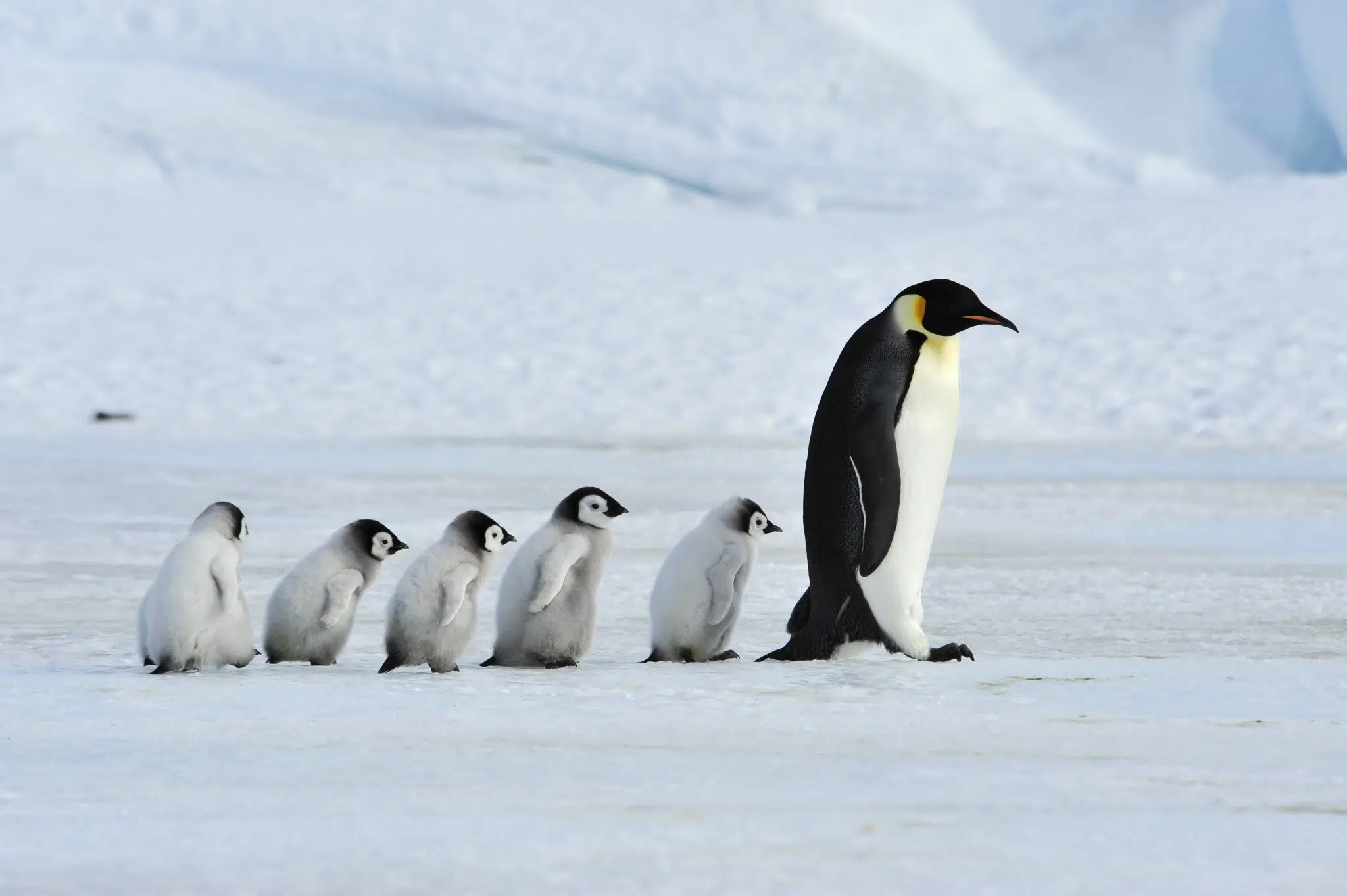
London, UK – In a stark revelation highlighting the profound and accelerating impact of climate change on Earth’s most remote ecosystems, the iconic Emperor Penguin has been uplisted from “Near Threatened” to “Endangered” on the IUCN Red List of Threatened Species. This critical reassessment, conducted by BirdLife International, the official Red List Authority for birds, in collaboration with the IUCN SSC Penguin Specialist Group, underscores an urgent global imperative for action to safeguard the future of this charismatic Antarctic species. The new classification comes with a pressing call for international governments to designate the Emperor Penguin as an Antarctic Specially Protected Species (ASPS) at the upcoming 48th Antarctic Treaty Consultative Meeting (ATCM) in Hiroshima this May.
The Escalating Threat: Climate Change and Sea Ice Dependence
The primary driver behind the Emperor Penguin’s precipitous decline is unequivocally climate change, manifesting most acutely through the drastic and increasingly unpredictable loss of sea ice in the Antarctic region. Emperor Penguins (Aptenodytes forsteri) are uniquely adapted to and entirely reliant on specific sea ice conditions for their survival. They require extensive, stable “fast ice” – sea ice that is firmly anchored to the coastline, ocean floor, or grounded icebergs – as their indispensable platform for breeding, raising their chicks, and undergoing their annual catastrophic moult. During moulting, penguins are not waterproof and cannot enter the frigid waters to hunt, making a stable, accessible ice platform crucial for their survival.
Scientific projections paint a grim picture, indicating that without immediate and drastic reductions in global greenhouse gas emissions, the Emperor Penguin population is projected to plummet by half by the 2080s. This isn’t a distant threat; evidence of decline is already tangible. Satellite imagery, a powerful tool for monitoring these remote colonies, has revealed a loss of approximately 10% of the total population between 2009 and 2018 alone, a staggering figure equating to more than 20,000 adult penguins. This period has also coincided with record lows in Antarctic sea ice extent, particularly since 2016, a trend that continues to alarm scientists globally.

Rob Martin, Red List Team Manager at BirdLife International, who coordinated this critical reassessment, articulated the gravity of the situation: “The Emperor Penguin’s shift from Near Threatened to Endangered is a worrying signal of the reach of climate change impacts into the most remote parts of the globe. Future projections for the species robustly point to severe reductions over the rest of this century. Emperor Penguins are completely dependent on the Antarctic habitat for breeding, moulting and feeding, but it will become harder for them to survive as ice patterns become less predictable and this crucial habitat keeps decreasing.”
The perils of early sea ice breakup are particularly devastating for penguin chicks. Born in the depths of the Antarctic winter, chicks require several months to fledge, grow their waterproof feathers, and learn to swim. If the fast ice platform breaks up prematurely, before the chicks are fully developed, they face near-certain mortality from drowning, exposure to extreme cold, or predation, as they are unable to survive in the open water. Such tragic events, though challenging to quantify comprehensively across all colonies, are becoming more frequent and widespread, leading to mass mortality events that severely impact breeding success.
A Chronology of Mounting Concern
The journey to the Emperor Penguin’s current endangered status reflects a growing scientific understanding and escalating concern over several decades.
- Late 20th Century: Initial population estimates and studies confirm the species’ reliance on stable sea ice. Climate models begin to suggest potential future impacts on polar regions.
- Early 2000s: Satellite monitoring technologies improve, allowing for more precise tracking of remote penguin colonies and sea ice dynamics. The first signs of localized population declines linked to ice loss begin to emerge.
- 2009-2018: A significant decade of documented decline. Satellite images show a 10% population reduction, corresponding to over 20,000 adult penguins lost. This period is marked by increasingly erratic and diminishing sea ice, with record lows observed in 2016 and subsequent years.
- Prior to Current Assessment: The Emperor Penguin was previously classified as "Near Threatened" on the IUCN Red List. This status indicated that while not currently threatened with extinction, it was likely to become so in the near future. This classification spurred increased monitoring and research efforts.
- Current Assessment (Implied May 2024 Release): BirdLife International, as the Red List Authority for birds, conducts a comprehensive reassessment of the Emperor Penguin’s global extinction risk. This involves integrating the latest climate models, population data, and observed sea ice trends. The overwhelming evidence points to an accelerated decline, necessitating the uplisting to "Endangered."
- May 2024: The 48th Antarctic Treaty Consultative Meeting (ATCM) is scheduled to take place in Hiroshima. This meeting represents a critical opportunity for governments to respond to the scientific findings and implement protective measures.
The Antarctic Treaty System and the Call for Special Protection

The plight of the Emperor Penguin is not merely an ecological tragedy; it is a profound test for international cooperation and environmental governance in one of the planet’s most pristine and vital regions. The Antarctic Treaty System (ATS), established in 1959, is a unique international agreement dedicated to preserving Antarctica for peaceful scientific research and environmental protection. The Antarctic Treaty Consultative Meeting (ATCM) brings together representatives from the Treaty’s consultative parties to oversee and shape environmental protection policy for the continent.
BirdLife International, by providing its rigorous Red List assessment for the Emperor Penguin, aims to inform and galvanize decision-making at this crucial forum. The organization’s central plea is for governments to designate the Emperor Penguin as an Antarctic Specially Protected Species (ASPS). Such a designation is a powerful conservation tool within the ATS framework, created under Annex V of the Protocol on Environmental Protection to the Antarctic Treaty (also known as the Madrid Protocol).
Becoming an ASPS would create legally binding obligations for all signatory governments to prevent actions that directly harm or disturb Emperor Penguins and their critical habitat. This would include measures such as:
- Strict Restrictions on Access: Limiting human access to breeding colonies and key moulting areas.
- Prohibition of Disturbance: Enforcing regulations against activities that could disturb nesting birds or chicks.
- Habitat Protection: Mandating efforts to protect the integrity of essential sea ice breeding grounds, potentially influencing decisions related to shipping routes, scientific expeditions, and other human activities in sensitive areas.
- Enhanced Monitoring and Research: Encouraging and funding further scientific study to understand population dynamics and environmental threats.
Currently, several other species and areas are protected under this framework, demonstrating its efficacy. Extending this designation to the Emperor Penguin would provide a much-needed layer of legal protection, emphasizing the species’ vulnerability and the international community’s commitment to its survival.
Broader Implications and the Global Extinction Crisis

Martin Harper, CEO of BirdLife International, issued a powerful warning that resonates beyond the icy confines of Antarctica: “Penguins are already among the most threatened birds on Earth. The Emperor Penguin’s move to Endangered is a stark warning: climate change is accelerating the extinction crisis before our eyes. Governments must act now – starting by designating the Emperor Penguin as an Antarctic Specially Protected Species this May.”
The fate of the Emperor Penguin serves as a potent barometer for the health of our planet. As an apex predator in its ecosystem and a highly specialized species, its struggle reflects broader ecological destabilization driven by anthropogenic climate change. The rapid warming of polar regions, often referred to as "polar amplification," means that the impacts of global temperature increases are felt more acutely and rapidly at the poles. The collapse of sea ice not only imperils penguins but also impacts the entire Antarctic food web, from krill (a primary food source for many species) to seals and whales, all of which depend on sea ice for foraging, breeding, or resting.
The scientific consensus is unequivocal: without abrupt and dramatic reductions in global greenhouse gas emissions, the trajectory for Emperor Penguins, and countless other species, remains dire. The call to designate the Emperor Penguin as an ASPS at the ATCM in Hiroshima is not just about one species; it is a litmus test for the global commitment to addressing the climate emergency. It represents an opportunity for governments to translate scientific warnings into concrete policy action, demonstrating that international agreements can and will respond to the accelerating pace of the extinction crisis.
The crisis facing Emperor Penguins is a microcosm of the larger biodiversity crisis unfolding worldwide, inextricably linked to climate change. It underscores the urgent need for nations to adhere to and strengthen the goals of the Paris Agreement, aiming to limit global warming to well below 2 degrees Celsius above pre-industrial levels, and ideally to 1.5 degrees Celsius. Achieving these targets requires a rapid and systemic decarbonization of global economies, transitioning away from fossil fuels towards renewable energy sources, and implementing sustainable land-use practices.
As BirdLife International poignantly states, "Birds are our compass. Their health reveals the health of our world." The Emperor Penguin, stoic in its icy realm, is now signaling an urgent warning to humanity. Its future, and indeed the future of countless species and ecosystems, hinges on immediate, decisive, and globally coordinated action to confront the climate crisis head-on. The decision made by governments in Hiroshima this May will not only determine the fate of one of Antarctica’s most beloved inhabitants but will also serve as a crucial indicator of humanity’s resolve in the face of an existential environmental challenge.
