
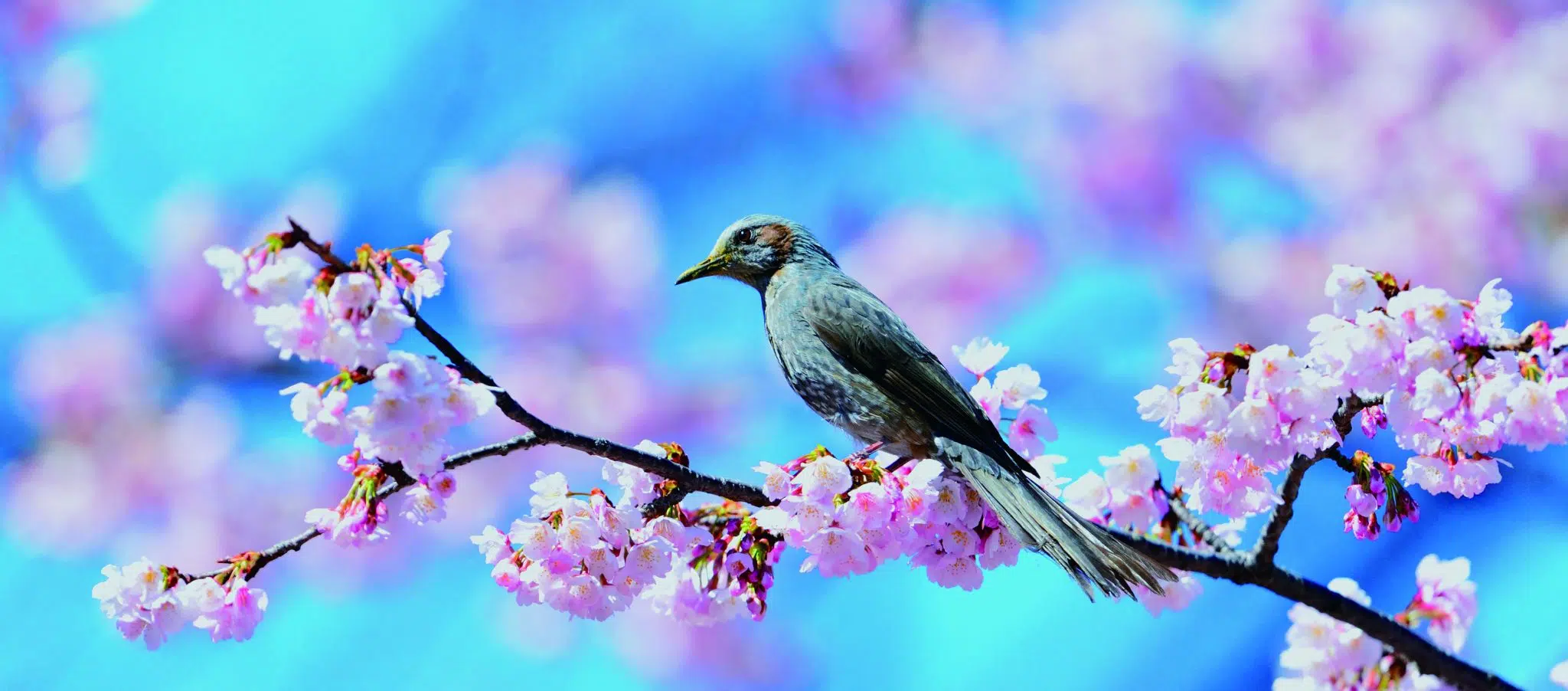
The advent of spring brings with it a gentle easing of winter’s chill, yet the changing rhythm of seasons, particularly the shortening of spring and autumn, remains a poignant reminder of the pervasive effects of climate change. Amidst these environmental shifts, Her Imperial Highness Princess Takamado, a renowned ornithologist and honorary president of BirdLife International, has drawn attention to a familiar avian resident often overlooked by many in Japan: the Brown-eared Bulbul (Hypsipetes amaurotis). Through a compelling photo essay featured in the April 2026 edition of Fujingahou Magazine, Princess Takamado challenges the prevailing dismissive attitude towards this common species, urging a deeper appreciation for its distinctive charm and remarkable adaptability. Her observations, accompanied by her own captivating photography, underscore a critical message about valuing biodiversity in all its forms, even within the most commonplace of creatures.
A Familiar Presence with Overlooked Charms
The Brown-eared Bulbul, known in Japanese as hiyodori—a name derived from its characteristic "hee-yo, hee-yo" call—is, alongside sparrows and crows, one of Japan’s most widely recognized birds. Despite its ubiquity, particularly in urban and suburban environments, it often suffers from a perception of being "plain" or "unremarkable." This sentiment is so prevalent that at birding gatherings, the sight of a Brown-eared Bulbul frequently elicits the dismissive remark, "Oh… it’s just a Brown-eared Bulbul," signaling a lack of enthusiasm for observing it. Princess Takamado, however, encourages a closer look, revealing a bird with a surprisingly charming appearance characterized by its distinctive brown cheek patch and a tousled head. The longer feathers extending from its crown to the back of its head form a crest, which becomes prominently erect when the bird is excited or alarmed, adding a dynamic aspect to its otherwise subtle aesthetic. When in flight, a broad pale band on the underside of its wings can appear strikingly whitish depending on the light, offering a glimpse of unexpected beauty.
Beyond its physical attributes, the Brown-eared Bulbul is often perceived negatively due to its boisterous nature and territorial aggression. Its loud, piercing cries, while serving a purpose in communication and defense, can shatter the tranquility of a garden, leading some to consider them annoying. They are frequently observed driving away other birds from prized food sources like camellia and cherry blossoms, reinforcing an image of being somewhat "mean." This combination of commonality and perceived unpleasant traits has unfortunately led to a widespread lack of affection for the species among the Japanese populace.
Global Interest in a Local Icon

In stark contrast to its domestic reception, the Brown-eared Bulbul enjoys considerable popularity among international birders visiting Japan. This intriguing dichotomy stems primarily from the species’ limited distribution. Hypsipetes amaurotis is largely endemic to East Asia, with its primary stronghold being the Japanese archipelago. This restricted geographic range makes it a sought-after sighting for foreign visitors, who consider it a unique "tick" on their global birding lists. For many, seeing a Brown-eared Bulbul is a distinct highlight of their Japanese birding experience, offering a perspective that often eludes local residents accustomed to its constant presence. This international interest serves as a valuable reminder that a species considered common in one locale can hold significant scientific and aesthetic value on a broader scale.
A History of Urban Adaptation: From Satoyama to Cityscapes
The current widespread presence of Brown-eared Bulbuls in urban areas throughout Japan is a relatively recent phenomenon, representing a remarkable case study in avian adaptation. Princess Takamado recalls that during her childhood, the loud calls of the bulbul were absent from the abundant greenery surrounding her central Tokyo family home, and she never observed them in her garden. This personal recollection aligns with historical ecological data. Until approximately 50 to 60 years ago, Brown-eared Bulbuls predominantly inhabited satoyama forests—secondary woodlands traditionally managed by local communities—at elevations ranging between 400 to 1,000 meters. During the colder winter months, these populations would descend to lower plains in search of food and milder conditions.
The species’ expansion into urban environments is closely linked to significant changes in Japan’s landscape and land use practices. A primary driver has been the increase in "greening" efforts within urban spaces. The deliberate planting of trees, shrubs, and flowering plants in city parks, residential areas, and along streets has created new habitats and foraging opportunities previously unavailable. This urban greening provides not only shelter and nesting sites but also a consistent and diverse food supply, enabling the bulbuls to thrive where they once could not. The decline of traditional satoyama landscapes due to urbanization and changing agricultural practices may have also pushed some populations towards adapting to human-dominated environments.
An Omnivore’s Advantage: Thriving on Urban Bounty
The Brown-eared Bulbul’s dietary flexibility has been a crucial factor in its successful colonization of cities. As an omnivorous species, it boasts a remarkably varied diet, allowing it to exploit a wide array of food sources available throughout the year in urban and suburban settings. Its diet includes nectar from a variety of blossoms such as camellias, cherry, plum, and apricot, providing essential sugars, particularly in spring. It also feeds on willow buds and young leaves, demonstrating its adaptability to different plant parts. Insects form another vital component of its diet, especially during breeding season when protein is crucial for chick development.

However, it is the abundance of fruits and berries in urban landscapes that truly sustains the bulbul year-round. Street trees like nandina and pyracantha provide berries, while gardens and suburban areas offer fully ripened fruits such as persimmons, mandarins, grapes, and apples. Even discarded leafy vegetables like cabbage and Chinese cabbage can supplement their diet, showcasing their opportunistic feeding habits. Furthermore, their ability to drink sap from broken branches provides a reliable source of hydration and nutrients, particularly when other food sources might be scarce. This incredible dietary plasticity ensures that Brown-eared Bulbuls never face a shortage of food, making urban areas highly attractive and sustainable habitats.
Resilient Breeders: Adapting Nesting to Human Habitats
The reproductive success of Brown-eared Bulbuls in urban settings further exemplifies their remarkable adaptability. They breed readily in city parks, residential areas, and even private gardens, utilizing the available vegetation for nesting. Their nest-building techniques highlight their resourcefulness: beyond natural materials like twigs and plant fibers, they are known to incorporate anthropogenic items such as vinyl and plastic into their nests. This skillful use of materials found within human living spaces demonstrates their "tough way of surviving," as Princess Takamado aptly puts it, transforming potential pollutants into functional components of their homes. This ability to integrate human-generated waste into their natural cycles is a testament to their evolutionary resilience in anthropocentric landscapes.
A Dynamic Ecosystem Role and Unexpected Interactions
Brown-eared Bulbuls play a dynamic role in urban ecosystems, acting as both seed dispersers and pollinators, albeit sometimes controversially due to their territorial behavior. Princess Takamado’s personal anecdotes offer a glimpse into their assertive character. She recounts how a bulbul’s loud cry serves as an immediate warning when she steps into her garden, prompting other birds to scatter from the birdbath. Her experience with a winter feeding table further illustrates their boldness: if the table was empty, a bulbul would sometimes flap its wings against the large glass window of her sunroom, flying straight up it from bottom to top to demand attention. This direct communication, almost an insistence, ensured the food was replenished, allowing other birds to also partake. Princess Takamado observes this as a "small act of mutual support among the birds," suggesting a complex social dynamic often masked by their perceived aggression. This interaction highlights how even seemingly "annoying" behaviors can be part of a larger, intricate web of inter-species relationships within an urban garden.
The Intricate World of Subspecies and Conservation Implications

While the Brown-eared Bulbul is a common and familiar bird across Japan, inhabiting regions from Hokkaido to Kyushu and the Izu Islands, its genetic diversity presents a fascinating and potentially critical conservation challenge. Currently, populations across the Japanese archipelago, including resident birds of island regions such as Ogasawara, Amami, and Okinawa, are classified into eight distinct subspecies. Each of these subspecies exhibits subtle yet discernible differences in form and coloration, reflecting adaptations to their specific island or regional environments.
Ornithological research suggests that these eight subspecies can be grouped into three larger categories, hinting at a deeper evolutionary divergence. There is a growing possibility that further genetic and morphological studies could lead to the reclassification of the Brown-eared Bulbul into three separate species. This potential taxonomic split carries significant conservation implications. At present, the Brown-eared Bulbul, as a single species, is classified as "Least Concern" on the IUCN Red List, reflecting its widespread distribution and robust overall population. However, if it were to be divided into three distinct species, the smaller, geographically isolated island populations—which often represent unique evolutionary lineages—could face immediate reclassification as "Endangered" or "Critically Endangered." This scenario underscores the importance of ongoing scientific research and careful taxonomic review, as such reclassifications directly impact conservation priorities, funding allocation, and the implementation of protective measures. The distribution of the species is indeed centered in Japan and its surrounding regions, including the southern Korean Peninsula and Sakhalin, with migratory populations from snowy areas like Hokkaido and Tohoku traveling south for winter and returning north from late April to May, making their migration observable across the country.
A Call for Reappraisal and Broader Conservation
Princess Takamado’s article serves as more than just an observation of a common bird; it is a profound call for a shift in perspective. Instead of the dismissive "Oh… it’s just a Brown-eared Bulbul," she advocates for a warm appreciation of its "handsome appearance and acrobatic movements." This sentiment extends beyond the Bulbul to encompass a broader philosophy of appreciating the natural world, particularly the common species that form the backbone of local ecosystems. In an era dominated by concerns over climate change and biodiversity loss, recognizing the ecological value and intrinsic beauty of every species, no matter how common, becomes paramount.
The Brown-eared Bulbul, with its resilience, adaptability, and complex social behaviors, offers a microcosm of the challenges and wonders of urban biodiversity. Its success in coexisting with humans, often despite human indifference, highlights its robust evolutionary strategies. By encouraging a closer look at these ubiquitous birds, Princess Takamado not only elevates the status of the Brown-eared Bulbul but also inspires a wider engagement with ornithology and conservation. Her advocacy, supported by BirdLife International’s mission, reminds us that true conservation begins with observation, understanding, and respect for all life forms, fostering a deeper connection to the natural world that enriches our own existence.
