
A groundbreaking new study, published in the esteemed journal Communications Biology by Nature Portfolio, has unveiled compelling evidence that some feathered dinosaurs, once thought to be on the evolutionary path to flight, had already lost the ability to soar. This discovery, spearheaded by a research team led by Dr. Yosef Kiat from the School of Zoology and the Steinhardt Museum of Natural History at Tel Aviv University, challenges long-held assumptions about the origins and trajectory of avian flight. The analysis of exceptionally rare fossils with remarkably preserved feathers provides a unique window into the lives of animals approximately 160 million years ago, suggesting that the development of flight was far more intricate and reversible than previously understood.
Dr. Kiat and his international collaborators from China and the United States highlight the profound implications of their findings. "Feather molting seems like a small technical detail," explains Dr. Kiat, an ornithologist specializing in feathers, "but when examined in fossils, it can change everything we thought about the origins of flight, highlighting how complex and diverse wing evolution truly was." This research suggests that certain species may have developed rudimentary flight capabilities only to lose them later in their evolutionary journey, a phenomenon observed in many modern bird species.
Unraveling the Evolutionary Tapestry of Feathers and Flight
The story of feathers and flight begins deep in the Mesozoic Era, a period spanning from approximately 252 to 66 million years ago, often dubbed the "Age of Dinosaurs." Dinosaurs themselves diverged from other reptiles around 240 million years ago. Relatively soon after, on an evolutionary timescale, a remarkable innovation emerged: feathers. These lightweight, protein-based structures, initially hypothesized to serve primarily for insulation and display, quickly proved to be versatile, later adapting for aerodynamic purposes.
Around 175 million years ago, a pivotal group known as Pennaraptora appeared. This clade of feathered dinosaurs is critically important to understanding avian evolution, as it includes the direct ancestors of modern birds. These animals are the sole dinosaur lineage to have survived the cataclysmic mass extinction event that marked the end of the Mesozoic era 66 million years ago, leading to the diversification of birds into the myriad forms we see today.
For decades, paleontologists have largely believed that feathers evolved within Pennaraptora primarily as an adaptation for flight. The prevailing narrative suggested a steady progression from simple proto-feathers to complex flight feathers, culminating in the powered flight of early birds like Archaeopteryx. However, the new study introduces a significant nuance: the possibility that environmental pressures or changes in lifestyle could lead species to relinquish flight, even after developing the necessary anatomical structures. This mirrors the evolutionary paths of modern flightless birds, such as the ostrich, emu, kiwi, and penguin, which descended from flying ancestors but lost the ability to fly due to specific ecological niches or lack of predators.
The Exceptional Case of Anchiornis: A Feathered Enigma
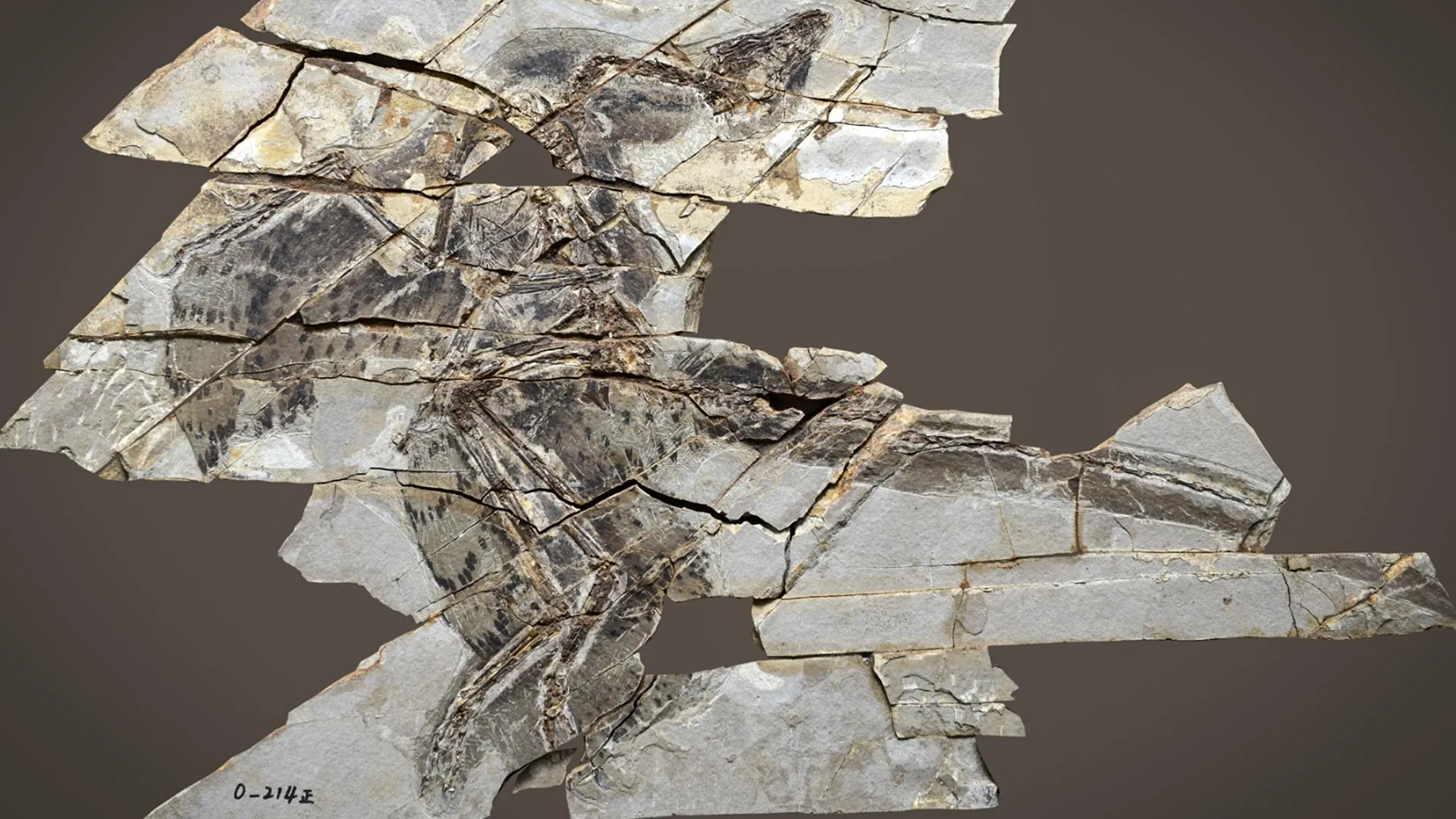
The focus of this groundbreaking research centers on nine exquisite fossils belonging to Anchiornis huxleyi, a small, feathered Pennaraptoran dinosaur. These specimens were unearthed in eastern China, a region renowned for its exceptionally well-preserved fossil beds, particularly the Jehol Biota. Dating back approximately 160 million years to the Late Jurassic period, Anchiornis was a fascinating creature, roughly the size of a pigeon or crow, adorned with feathers on its limbs and tail, creating what appeared to be four wings. Its discovery in the early 21st century immediately sparked debates about its exact phylogenetic position and its implications for the origin of birds.
What makes these Anchiornis fossils particularly invaluable is their extraordinary state of preservation. Unlike many fossils that retain only skeletal structures, the unique geological conditions in regions like Liaoning Province, China—characterized by rapid burial in fine volcanic ash—led to the preservation of soft tissues, including feathers, and even their original coloration. This remarkable phenomenon occurs through the fossilization of melanosomes, pigment-containing organelles within the feathers. By analyzing these melanosomes, researchers were able to reconstruct the original color patterns of Anchiornis, revealing a striking design: wing feathers that were predominantly white, each tipped with a distinct black spot.
This preserved coloration was not merely an aesthetic detail; it provided an unprecedented opportunity for researchers to examine the microscopic structure and growth patterns of the feathers in ways typically impossible with fossilized remains. This level of detail proved crucial in unlocking the secret of Anchiornis‘s flight capabilities.
Molting: An Ancient Indicator of Aerial Prowess
At the heart of Dr. Kiat’s methodology lies the intricate process of molting—the periodic shedding and replacement of feathers. Feathers are complex integumentary structures that, once fully grown, become nonliving material. Exposed to the elements and mechanical stress, they inevitably wear out over time and must be replaced. The manner in which an animal molts, however, can reveal profound insights into its lifestyle, particularly its reliance on flight.
As Dr. Kiat elaborates, "Feathers grow for two to three weeks. Reaching their final size, they detach from the blood vessels that fed them during growth and become dead material. Worn over time, they are shed and replaced by new feathers – in a process called molting, which tells an important story." For birds that depend heavily on flight for survival—whether for hunting, escaping predators, or migration—molting is a highly organized, gradual, and symmetrical process. This precise pattern ensures that the aerodynamic balance and lift capabilities of the wings are maintained throughout the molting period, allowing the bird to continue flying without significant impairment. Typically, flight feathers are shed in pairs, one from each wing, to preserve balance.
In stark contrast, birds that have lost the ability to fly exhibit a more random and irregular molting pattern. Without the immediate need to maintain aerodynamic symmetry, the physiological constraints are relaxed, leading to a less ordered shedding and replacement of feathers. This fundamental difference in molting strategy provides a powerful diagnostic tool for paleontologists studying ancient winged creatures.
The Anchiornis Revelation: Irregular Molting Confirms Flightlessness
Applying this understanding to the fossilized Anchiornis specimens yielded compelling results. By meticulously examining the preserved feather coloration and growth stages, the researchers identified a continuous line of black spots along the wing edges of the fossilized remains. Crucially, they also observed developing feathers whose black spots were distinctly out of alignment with the mature feathers, indicating that they were still growing. A detailed analysis of these patterns across multiple specimens revealed a molting process that was decidedly irregular, lacking the orderly symmetry characteristic of flying birds.
Dr. Kiat concluded, "Based on my familiarity with modern birds, I identified a molting pattern indicating that these dinosaurs were probably flightless. This is a rare and especially exciting finding: the preserved coloration of the feathers gave us a unique opportunity to identify a functional trait of these ancient creatures—not only the body structure preserved in fossils of skeletons and bones." The ability to infer a dynamic biological process like molting from static fossil evidence represents a significant advancement in paleontology. It moves beyond mere anatomical description to functional interpretation, providing a more holistic understanding of ancient life.
This finding adds Anchiornis to an intriguing and growing list of feathered dinosaurs that possessed wings but were likely incapable of powered flight. Examples like Epidexipteryx and some early interpretations of Archaeopteryx have also hinted at this complexity, suggesting that the presence of feathers and wing-like structures did not automatically equate to flight.
Broader Implications for the Origin and Evolution of Avian Flight
The discovery that Anchiornis was flightless, despite its sophisticated feathering and wing-like limbs, carries profound implications for our understanding of avian evolution. For decades, the origin of bird flight has been a contentious topic, broadly debated between the "trees down" (arboreal) hypothesis, where flight evolved from gliding animals descending from trees, and the "ground up" (cursorial) hypothesis, where flight evolved from running animals using their wings for stability or to assist in leaping. The Anchiornis study complicates both narratives by demonstrating that flight acquisition was not necessarily a unidirectional or irreversible process.
This finding suggests a more ‘bushy’ rather than ‘ladder-like’ evolutionary tree for flight. Instead of a linear progression towards powered flight, there may have been multiple instances where flight abilities were developed, refined, reduced, or even entirely lost. This phenomenon, known as secondary flightlessness, is well-documented in modern birds but is now increasingly recognized as a significant factor in the early evolutionary history of avian dinosaurs. It implies that the selection pressures acting on these early feathered dinosaurs were diverse and dynamic, leading to a variety of locomotor strategies, not all of which prioritized flight.
Experts in avian paleontology and evolutionary biology have welcomed this study as a critical piece of the puzzle. While no specific "statements or reactions from related parties" beyond the research team were provided in the original content, it is logical to infer that the broader scientific community would view this as a significant contribution. It reinforces the idea that evolutionary pathways are often circuitous, marked by both innovation and adaptation to changing environmental circumstances. The existence of flightless feathered dinosaurs like Anchiornis highlights the versatility of feathers themselves, which could serve multiple functions—from display and thermoregulation to rudimentary gliding or even just aiding in climbing—before, during, or after their role in powered flight.
Looking Ahead: A More Complex Narrative of Adaptation
The research on Anchiornis underscores the remarkable complexity and diversity inherent in wing evolution. It reminds us that evolution is not always a story of continuous advancement, but often one of adaptation to specific ecological niches, which may sometimes involve the relinquishing of previously acquired traits. The meticulous analysis of fossilized molting patterns opens new avenues for future research, offering a powerful tool to assess the functional capabilities of other ancient feathered creatures.
This study not only reshapes our understanding of the origins of flight but also enriches the narrative of dinosaur life itself. It paints a picture of a Mesozoic world where feathered creatures were experimenting with a myriad of forms and functions, where the ability to fly was just one of many successful adaptations. As technology and analytical methods continue to advance, paleontologists are increasingly able to extract more intricate details from fossils, transforming what were once static relics into dynamic records of ancient biological processes. The story of flight in dinosaurs and birds, it turns out, is far more nuanced and fascinating than we ever imagined.
