
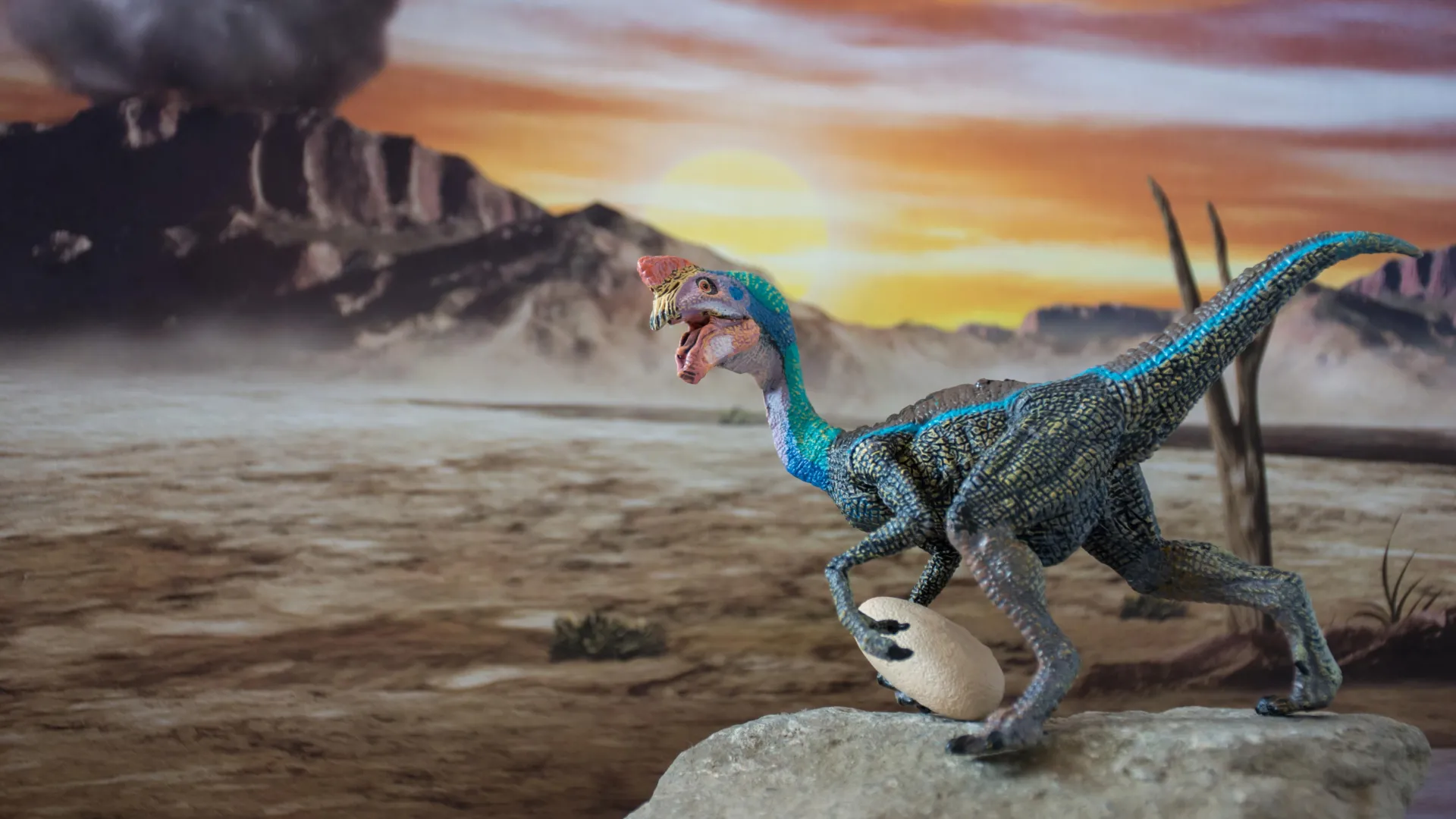
The long-standing enigma surrounding the incubation practices of oviraptors, those intriguing bird-like yet flightless dinosaurs, appears to have been significantly unravelled by a groundbreaking study. For decades, paleontologists have debated whether these creatures relied on ambient heat for their eggs, much like modern crocodiles and turtles, or if they provided direct, sustained warmth akin to contemporary birds. A novel investigation published in Frontiers in Ecology and Evolution presents compelling evidence suggesting a hybrid approach, termed "co-incubation," where oviraptors judiciously combined parental brooding with environmental thermal contributions. This discovery profoundly reshapes our understanding of dinosaur parenting and the evolutionary trajectory of avian incubation behaviors.
A Lingering Paleontological Puzzle: The Mystery of Dinosaur Incubation
The classification and behavioral interpretation of oviraptors have been subjects of intense scientific scrutiny and public fascination since their initial discovery. First unearthed in Mongolia in the 1920s, Oviraptor philoceratops earned its name, meaning "egg thief," from the initial mistaken assumption that a fossilized specimen was caught raiding a Protoceratops nest. Subsequent discoveries, however, revealed that these "egg thieves" were, in fact, doting parents, often found fossilized directly atop clutches of their own eggs in a brooding posture. This revelation repositioned oviraptors as pivotal figures in the debate about dinosaur parental care, particularly their close phylogenetic relationship to birds.
Despite clear evidence of brooding, the precise mechanism of heat transfer to their eggs remained elusive. The sheer size of many oviraptor species, combined with the distinct ring-shaped arrangement of their nests, presented a biological conundrum. Could a large dinosaur effectively cover and warm every egg in a multi-ringed clutch? Or did the environment play a more substantial role, leveraging the warmth of the sun or geothermally heated soil? Answering this question is critical not just for understanding oviraptor biology but also for tracing the evolutionary origins of endothermic (warm-blooded) incubation, a hallmark of modern birds, and differentiating it from the ectothermic (cold-blooded) incubation strategies prevalent in many reptiles.
A Novel Approach to Prehistoric Parenting: The Taiwan Research Initiative
To address this complex paleontological question, a team of researchers from Taiwan embarked on an innovative, interdisciplinary study. Led by senior author Dr. Tzu-Ruei Yang, an associate curator of vertebrate paleontology at Taiwan’s National Museum of Natural Science, and first author Chun-Yu Su, who initiated the research during his time at Washington High School in Taichung, the team devised an experimental framework that combined sophisticated heat transfer simulations with meticulously crafted physical models. This cutting-edge methodology allowed them to move beyond purely theoretical models, offering a tangible reconstruction of a prehistoric nesting scenario.
The research, conducted at the forefront of paleoecological investigation, sought to quantify the thermal dynamics within an oviraptor nest. By simulating heat flow and conducting physical experiments, the team aimed to discern how these dinosaurs incubated their eggs and, crucially, how their methods compared to the highly efficient incubation strategies observed in modern avian species. The study underscores a growing trend in paleontology: leveraging modern engineering and physics principles to reconstruct and understand the behaviors of extinct organisms.
Reconstructing a Cretaceous Nursery: The Heyuannia huangi Model
Central to the research was the creation of a life-sized physical model based on Heyuannia huangi, a well-documented species of oviraptor that roamed the Earth approximately 70 to 66 million years ago during the Late Cretaceous period. This particular species, known from numerous fossil discoveries in what is now China, provided an ideal template due to its relatively complete fossil record, including nests and brooding adults. Heyuannia huangi was a moderately sized oviraptor, typically measuring around 1.5 meters (approximately 5 feet) in length and weighing about 20 kilograms (around 44 pounds), making it comparable to a large modern emu in stature. Its nests were characteristic semi-open structures, often featuring eggs arranged in multiple concentric rings.
To recreate the brooding dinosaur, the researchers constructed a torso using a robust wooden frame for structural integrity, subsequently layering polystyrene foam to mimic the dinosaur’s bulk and form. This foundational structure was then enveloped with cotton, bubble paper, and various fabrics, meticulously shaped to approximate the soft tissues and insulating plumage that would have been present on a living oviraptor. This careful attention to detail was critical for accurately simulating the dinosaur’s thermal presence.
The eggs, another crucial component of the experimental setup, posed a unique challenge. As Chun-Yu Su explained, "Their eggs are unlike those of any living species, so we invented the resin eggs to approximate real oviraptor eggs as best as we could." These artificial eggs, made from casting resin, were designed to possess thermal properties as close as possible to actual fossilized oviraptor eggs, allowing for realistic heat transfer measurements. In the experiments, these resin eggs were arranged in two clutches, configured in double rings, precisely mirroring the fossil evidence of Heyuannia huangi nests. This meticulous reconstruction allowed the researchers to simulate the spatial relationship between the brooding adult and its clutch with unprecedented accuracy.
The Dynamics of Heat Transfer: Experiments and Simulations Unveiled
With the detailed model in place, the research team proceeded to conduct a series of experiments and simulations designed to illuminate the complex interplay between adult presence, nest design, and ambient environmental conditions on egg temperatures and, consequently, hatching patterns. The goal was to understand how heat was distributed throughout the nest and how effectively it facilitated embryonic development.
Their findings revealed significant variations in egg temperatures, particularly within the outer rings of the clutch. In colder environmental conditions, when the brooding oviraptor model was positioned over the nest, temperatures in the outer ring of eggs varied by as much as 6 degrees Celsius (approximately 10.8 degrees Fahrenheit). Such substantial temperature differentials within a single clutch are known to lead to asynchronous hatching, where eggs do not hatch simultaneously but rather over an extended period. This contrasts sharply with the more synchronized hatching often observed in modern birds.
Conversely, in warmer environmental conditions, the temperature variation in the outer ring plummeted to a mere 0.6 degrees Celsius (approximately 1.1 degrees Fahrenheit). This dramatic reduction in temperature disparity strongly suggests that in warmer climates, the external heat from direct sunlight played a crucial role in evening out the temperatures across the entire clutch. As Dr. Yang elaborated, "It’s unlikely that large dinosaurs sat atop their clutches. Supposedly, they used the heat of the sun or soil to hatch their eggs, like turtles. Since oviraptor clutches are open to the air, heat from the sun likely mattered much more than heat from the soil." This indicates that solar radiation provided a significant and stabilizing heat source, particularly for the more exposed eggs in the outer rings, potentially influencing more synchronous hatching outcomes during periods of higher ambient temperature. The study thereby posits that oviraptors were adept at leveraging their environment to complement their brooding efforts, a key characteristic of co-incubation.
Comparing Incubation Strategies: Oviraptors vs. Modern Birds
A critical aspect of the study involved comparing oviraptor incubation strategies with those of modern birds, providing a crucial evolutionary context. Most extant avian species employ a highly specialized and efficient method known as Thermoregulatory Contact Incubation (TCI). In TCI, the adult bird directly sits on its eggs, often utilizing a brood patch – a featherless area of skin richly supplied with blood vessels – to transfer body heat directly and consistently to the entire clutch. For TCI to be effective, three primary conditions must be met: the adult must maintain continuous physical contact with all eggs, act as the primary and often sole heat source, and ensure remarkably consistent temperatures across the entire clutch, typically within a narrow range of 37-39°C (98.6-102.2°F).
The research team concluded that oviraptors likely could not have met these stringent conditions for efficient TCI. Their distinctive ring-shaped egg arrangement, as evidenced by fossilized nests, meant that a single brooding adult, even one of Heyuannia huangi‘s size, would have been physically unable to maintain direct and consistent contact with every egg simultaneously. The outer rings, in particular, would have been difficult to cover directly. This architectural constraint of the nest inherently limited the oviraptor’s capacity for full-clutch thermoregulatory contact.
"Oviraptors may not have been able to conduct TCI as modern birds do," stated Chun-Yu Su. Instead, the study proposes that these dinosaurs engaged in a form of "co-incubation," where the incubating adult and environmental heat sources collaborated. While the oviraptor provided direct warmth to the central eggs and general insulation, external factors such as solar radiation contributed significantly to the temperature regulation of the more exposed eggs, especially in warmer conditions. This combined approach, though demonstrably less efficient in terms of consistent heat delivery across the entire clutch compared to modern avian TCI, was likely well-suited to their unique nesting style, which appears to have undergone an evolutionary shift from fully buried nests to these semi-open configurations.
Dr. Yang underscored a vital nuanced perspective on this comparison: "Modern birds aren’t ‘better’ at hatching eggs. Instead, birds living today and oviraptors have a very different way of incubation or, more specifically, brooding. Nothing is better or worse. It just depends on the environment." This statement highlights the principle of evolutionary adaptation, where different strategies emerge and thrive based on specific ecological pressures and available resources. The oviraptor’s co-incubation strategy, while seemingly less "advanced" than modern avian methods, was perfectly adequate and successful for its time and environment, enabling the propagation of its species for millions of years during the Late Cretaceous.
Broader Implications for Dinosaur Paleobiology and Evolution
This study offers profound implications for several facets of dinosaur paleobiology and evolutionary science. Firstly, it significantly refines our understanding of dinosaur parental care. Beyond merely laying eggs, oviraptors actively engaged in complex brooding behaviors, demonstrating a level of parental investment that was likely more sophisticated than previously assumed for many non-avian dinosaurs. This co-incubation model provides a plausible mechanism for how such large, feathered dinosaurs could effectively incubate their large clutches without necessarily possessing the advanced thermoregulatory capabilities of modern birds. It adds another layer of detail to the rich tapestry of dinosaur life history strategies.
Secondly, the research provides crucial insights into the evolution of avian traits. Oviraptors, as close relatives to birds, represent a key transitional group. Their co-incubation strategy offers a potential intermediate step between the purely environmental incubation of many reptiles and the highly active, endothermic incubation of modern birds. This study suggests that the evolution of highly efficient avian TCI might have been a gradual process, building upon ancestral behaviors like co-incubation, which allowed for increased parental control over embryonic development while still leveraging environmental benefits. It helps to bridge a gap in the behavioral evolutionary timeline from early dinosaurs to modern birds, showing how parental care intensified and became more specialized.
Thirdly, the findings have implications for paleoecological context. The observed sensitivity of hatching patterns to environmental conditions (temperature variations shrinking in warmer environments) suggests that Late Cretaceous climate dynamics could have played a significant role in oviraptor reproductive success and population dynamics. In a generally warmer Late Cretaceous world, solar contribution might have been a consistent and reliable factor, allowing oviraptors to conserve metabolic energy that modern birds expend on full-time endothermic incubation. Future studies could explore how regional climate fluctuations during the Late Cretaceous might have influenced the prevalence and success of this co-incubation strategy across different oviraptor populations.
Finally, the innovative methodological approach – combining detailed physical models with sophisticated heat transfer simulations – sets a new precedent for studying extinct animal behaviors. This interdisciplinary framework offers a powerful tool for investigating aspects of paleontology that are not directly preserved in the fossil record, pushing the boundaries of what can be inferred about ancient life.
Acknowledging Limitations and Future Directions
While the study provides robust evidence and compelling conclusions, the researchers responsibly acknowledge certain limitations inherent in reconstructing ancient biological processes. The experimental setup relies on a reconstructed nest and utilizes modern environmental conditions for the simulations. The actual atmospheric composition, solar intensity, and ambient temperatures of the Late Cretaceous period, approximately 70 million years ago, would have differed from those of today. These differences, particularly in the specific thermal properties of the ancient environment, could influence the precise numerical findings, such as the exact temperature variations or efficiency estimates.
Furthermore, the study notes that oviraptors likely had significantly longer incubation periods than modern birds. While modern bird incubation can range from a couple of weeks to a few months, large dinosaur incubation periods are hypothesized to have spanned several months, possibly up to half a year or more. This extended incubation time would have amplified the importance of consistent, albeit less efficient, heat delivery and prolonged the period of parental vulnerability. Future research could aim to incorporate more nuanced paleoenvironmental data into simulations or explore how varying incubation durations might impact the effectiveness of co-incubation.
Despite these caveats, the study stands as a monumental achievement, offering unprecedented insight into how oviraptors meticulously cared for their eggs. The innovative fusion of physical models and computational simulations not only illuminates a long-standing mystery but also unlocks new avenues for investigating other complex aspects of dinosaur reproduction and behavior.
The study also carries a message of encouragement, particularly for the scientific community in Taiwan. As Dr. Yang aptly concluded, "It also truly is an encouragement for all students, especially in Taiwan. There are no dinosaur fossils in Taiwan, but that does not mean that we cannot do dinosaur studies." This statement powerfully reinforces the idea that scientific contribution is not limited by geographical fossil deposits but by intellectual curiosity, innovative methodologies, and collaborative spirit, inspiring future generations of paleontologists to explore the ancient world from new perspectives.
