
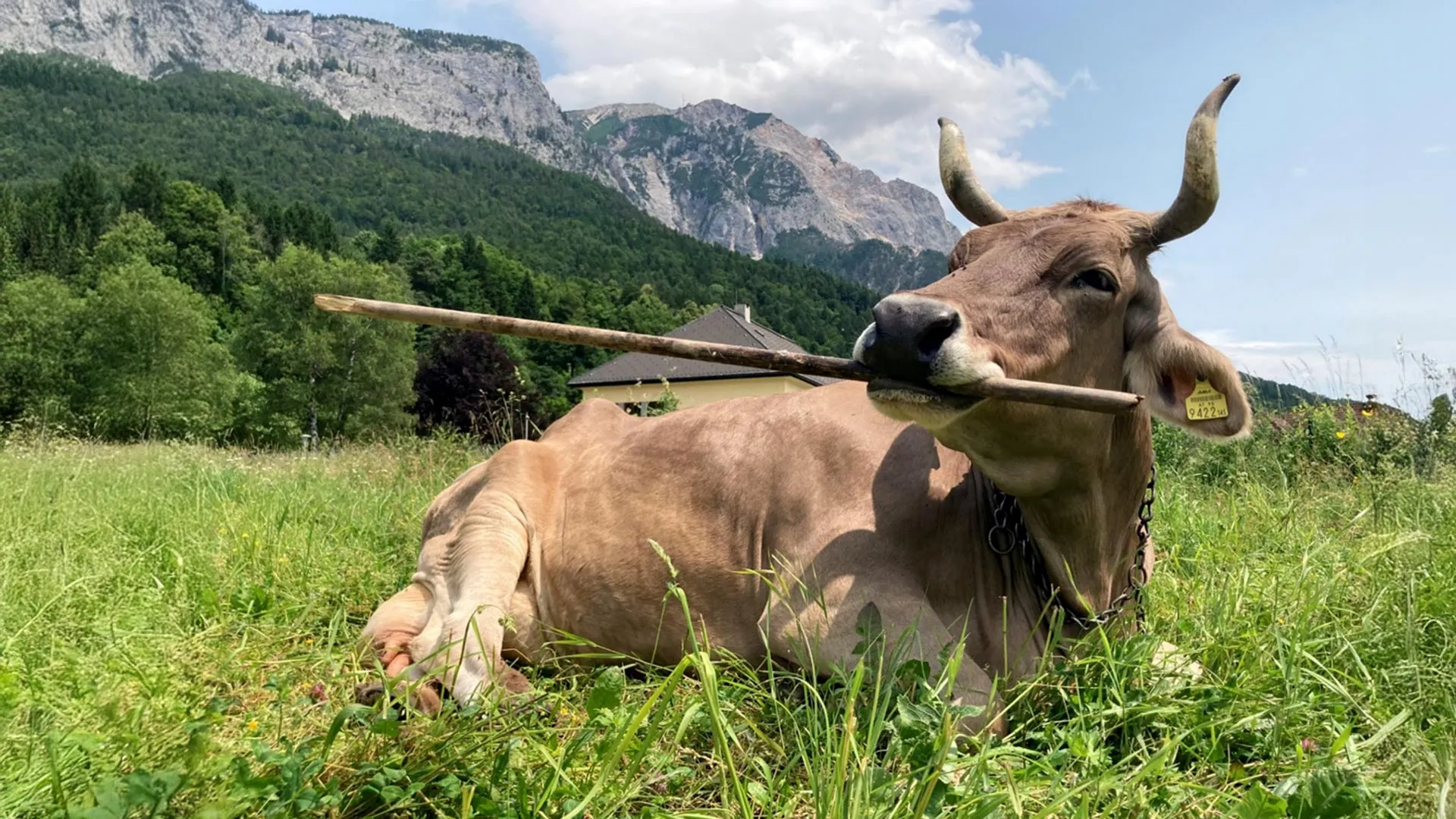
For decades, the popular imagination, heavily influenced by cartoonist Gary Larson’s iconic 1982 Far Side comic “Cow Tools,” has largely dismissed the idea of bovine intelligence, especially concerning tool use. The whimsical illustration, depicting a cow proudly displaying a bizarre assortment of seemingly useless implements, cemented a widespread belief that cows simply lack the cognitive capacity for such sophisticated behaviors. Now, however, that deeply ingrained assumption is being rigorously challenged by a real-life Swiss Brown cow named Veronika, whose documented ability to use tools has sent ripples through the scientific community, compelling a significant re-evaluation of livestock cognition.
A groundbreaking study published in the esteemed journal Current Biology reports the first scientifically documented instance of flexible, multi-purpose tool use in a pet cow. This remarkable finding suggests that cattle, often perceived merely as production animals, may possess far greater cognitive capabilities than previously understood. "The findings highlight how assumptions about livestock intelligence may reflect gaps in observation rather than genuine cognitive limits," states Alice Auersperg, a cognitive biologist at the University of Veterinary Medicine, Vienna, and a lead researcher on the study. This revelation not only broadens the scientific understanding of animal intelligence but also prompts a critical re-examination of our interactions with, and perceptions of, the animal kingdom.
The Enduring Legacy of "Cow Tools" and Shifting Scientific Paradigms
Gary Larson’s "Cow Tools" comic quickly became a cultural touchstone, ironically defining bovine intelligence (or lack thereof) for generations. The humor stemmed from the juxtaposition of a mundane farm animal with a complex, human-like activity like tool creation and use, highlighting what was then a universally accepted cognitive boundary. In the scientific realm, traditional views of livestock often relegated them to the status of biological machines, primarily studied for their productivity in agriculture rather than their cognitive prowess.
However, the burgeoning field of cognitive ethology, which studies the mental capacities of animals, has been steadily dismantling many long-held anthropocentric beliefs about intelligence. Over recent decades, researchers have uncovered astonishing cognitive abilities in a wide array of species, from the problem-solving skills of corvids and octopuses to the complex social structures and communication of elephants and dolphins. Even within the realm of mammals, species like pigs have demonstrated impressive problem-solving and memory skills, while goats have shown a remarkable ability to understand human cues and learn complex tasks. Yet, cattle largely remained outside this evolving narrative of sophisticated animal minds, until Veronika’s story emerged.
Veronika: A Companion Cow Redefines Bovine Potential
Veronika’s unique story begins not on a typical farm, but in a domestic setting where she is cherished as a companion animal. She is a Swiss Brown cow who lives with Witgar Wiegele, an organic farmer and baker in Austria, who treats her as a beloved member of his family rather than a unit of food production. This distinct upbringing, vastly different from that of most cattle, proved to be a critical factor in the discovery of her extraordinary abilities.
More than a decade ago, Wiegele began to notice an unusual and consistent behavior in Veronika. She would actively seek out sticks and, with remarkable dexterity, use them to scratch various parts of her body. Initially, these observations were anecdotal, charming peculiarities of a beloved pet. However, as the behavior persisted and became more refined over the years, Wiegele, recognizing its unique nature, decided to document it. He captured Veronika’s stick-wielding on video, footage that would eventually find its way to researchers, igniting a scientific inquiry that would challenge long-standing biological assumptions.
When Auersperg first viewed the footage, the significance was immediately clear. "When I saw the footage, it was immediately clear that this was not accidental," Auersperg recalls. "This was a meaningful example of tool use in a species that is rarely considered from a cognitive perspective." This initial observation served as the catalyst for a structured investigation, moving Veronika’s unique behavior from an interesting anecdote to a verifiable scientific phenomenon.
Scientific Scrutiny: Controlled Experiments Confirm Flexible Tool Use
To transition from observational evidence to robust scientific proof, Auersperg and her colleague Antonio Osuna-Mascaró designed a series of controlled experiments. Their goal was to ascertain whether Veronika’s actions constituted genuine tool use, demonstrating intentionality, flexibility, and adaptation, rather than mere accidental interaction or conditioned response.
The researchers presented Veronika with a deck brush, a multi-purpose object with both a bristled head and a smooth handle, placing it on the ground in various positions. They meticulously observed and recorded her interactions with the brush across multiple trials. The results were conclusive and compelling: Veronika consistently and deliberately chose specific parts of the brush based on the area of her body she intended to scratch. Her selections were far from random; they precisely matched the needs of different body regions, demonstrating a sophisticated understanding of the tool’s properties and its application.
Osuna-Mascaró elaborates on the findings: "We show that a cow can engage in genuinely flexible tool use. Veronika is not just using an object to scratch herself. She uses different parts of the same tool for different purposes, and she applies different techniques depending on the function of the tool and the body region." This observation is crucial because it elevates Veronika’s actions beyond simple object manipulation, placing them squarely in the realm of complex, flexible tool use—a cognitive feat previously attributed to a very limited number of species.
Defining Tool Use: A New Benchmark for Bovine Cognition
In the scientific community, tool use is generally defined as the employment of an external object to achieve a goal through physical interaction. While many species exhibit rudimentary forms of this behavior, such as using a rock to crack a nut, "flexible, multi-purpose tool use" is a far more advanced category. This specific type of behavior involves using different features of the same object to achieve varying outcomes or adapting the tool’s use based on the specific context or need. Prior to Veronika, this sophisticated level of tool use had been clearly documented in only a handful of non-human species, with chimpanzees being the most prominent example.
Veronika’s actions unequivocally meet, and indeed surpass, the basic definition of tool use. The researchers found clear patterns in her approach: for larger, firmer areas of her back, she consistently preferred the bristled side of the brush, applying broader, stronger motions. Conversely, for more sensitive regions on her lower body, she judiciously switched to the smoother handle, employing slower, more precise movements. This nuanced application of a single tool, adjusting both the part of the tool used and the technique applied, is the hallmark of flexible, multi-purpose tool use. It showcases an impressive level of cognitive processing, planning, and motor control.
Overcoming Physical Limitations: The Mouth as a Dexterous Tool
One of the most remarkable aspects of Veronika’s tool use is how she manages to manipulate objects despite lacking prehensile limbs. Unlike primates with their opposable thumbs, cows must rely solely on their mouths to grasp and control tools. This physical limitation makes her actions even more extraordinary. Veronika demonstrates careful control, adjusting her grip and movements with her mouth to achieve the desired result, seemingly anticipating the effects of her actions. This suggests a sophisticated sensorimotor integration and an internal model of how the tool interacts with her body.
Her behavior is classified as egocentric tool use, meaning the tool is directed at her own body. While some forms of egocentric tool use are considered less complex than using tools on external objects (like a chimpanzee using a stick to extract termites from a mound), Veronika’s specific application still presents significant challenges. The precision required to target specific, often hard-to-reach areas of her own body, combined with the limitations of oral manipulation, underscores the advanced nature of her cognitive and motor skills. It highlights that intelligence is not solely dependent on a particular anatomical structure like hands but can manifest through adaptive use of available physiology.
Why Veronika? The Crucial Role of Environment and Enrichment
The researchers hypothesize that Veronika’s unique living conditions played a pivotal role in the development and expression of her tool-using capabilities. Unlike the vast majority of cattle globally, who are typically raised in highly controlled, often confined environments for food production, Veronika has enjoyed a long life (over a decade, which is significant for a cow) in a complex, stimulating, and enriching environment.
Her daily interactions with humans, particularly Witgar Wiegele, provide a level of social engagement and cognitive stimulation rarely afforded to livestock. Furthermore, her access to a variety of objects in her environment has created ample opportunities for exploration, manipulation, and innovation. These factors—longevity, environmental complexity, social interaction, and access to diverse manipulable objects—are critical for fostering cognitive development and allowing for the emergence of novel behaviors.
In contrast, a typical dairy cow might live for only 4-6 years, often in conditions that prioritize efficiency over cognitive enrichment. Beef cattle have even shorter lifespans. Such environments, while optimized for production, offer minimal opportunity for the kind of exploratory play or problem-solving that could lead to tool use. The study posits that the "real absurdity lies not in imagining a tool-using cow, but in assuming such a thing could never exist" simply because our conventional farming practices preclude the conditions for such intelligence to manifest. Veronika, therefore, stands as a testament to the untapped cognitive potential within species often underestimated.
Broader Implications: Rethinking Animal Cognition, Welfare, and Our Place in the Ecosystem
The discovery of Veronika’s tool-using ability is far more than an isolated curiosity; it carries profound implications across several scientific and ethical domains.
Scientific Implications: This research expands the known repertoire of tool-using species, further challenging anthropocentric definitions of intelligence. It underscores the importance of studying animal cognition in naturalistic or enriched environments, rather than solely in highly controlled laboratory settings or production-focused contexts. This discovery suggests that many species might possess latent cognitive abilities that remain unobserved due to environmental constraints or lack of appropriate research methodologies. It reinforces the dynamic and diverse nature of intelligence across the animal kingdom, pushing scientists to look beyond traditional markers and embrace a broader understanding of cognitive flexibility.
Animal Welfare Implications: If cattle are capable of such sophisticated cognitive feats, it necessitates a critical re-evaluation of current livestock farming practices. The vast majority of the world’s approximately 1.5 billion cattle live in conditions that offer minimal environmental enrichment or cognitive stimulation. Recognizing their capacity for complex thought and problem-solving strengthens arguments for improved animal welfare standards, advocating for environments that allow for natural behaviors, exploration, and mental engagement. This aligns with a growing movement to acknowledge the sentience of farm animals and to provide them with lives that meet their cognitive and emotional needs, not just their physical ones. The debate around animal consciousness and the ethical treatment of livestock gains new urgency with such discoveries.
Future Research and Citizen Science: The research team is keenly aware that Veronika might not be an anomaly but rather the first documented case of a more widespread, albeit rarely observed, behavior. They are now actively exploring which specific environmental and social conditions foster the development of such behaviors. Furthermore, they are encouraging members of the public, particularly farmers and individuals who interact closely with cattle, to report any similar observations. "Because we suspect this ability may be more widespread than currently documented," Osuna-Mascaró urges, "we invite readers who have observed cows or bulls using sticks or other handheld objects for purposeful actions to contact us." This call to action exemplifies the power of citizen science in expanding our understanding of the natural world, leveraging everyday observations to contribute to significant scientific breakthroughs.
In essence, Veronika the cow has done more than just scratch an itch; she has scratched at the surface of deeply ingrained human assumptions about animal intelligence. Her story compels us to reconsider the boundaries of cognitive ability, to question our observational biases, and to open our minds to the astonishing and often underestimated intelligence that thrives within the diverse tapestry of life on Earth. The next time we encounter a cow, we might just look at it with a newfound respect, wondering what other hidden talents lie beneath the placid exterior.
