
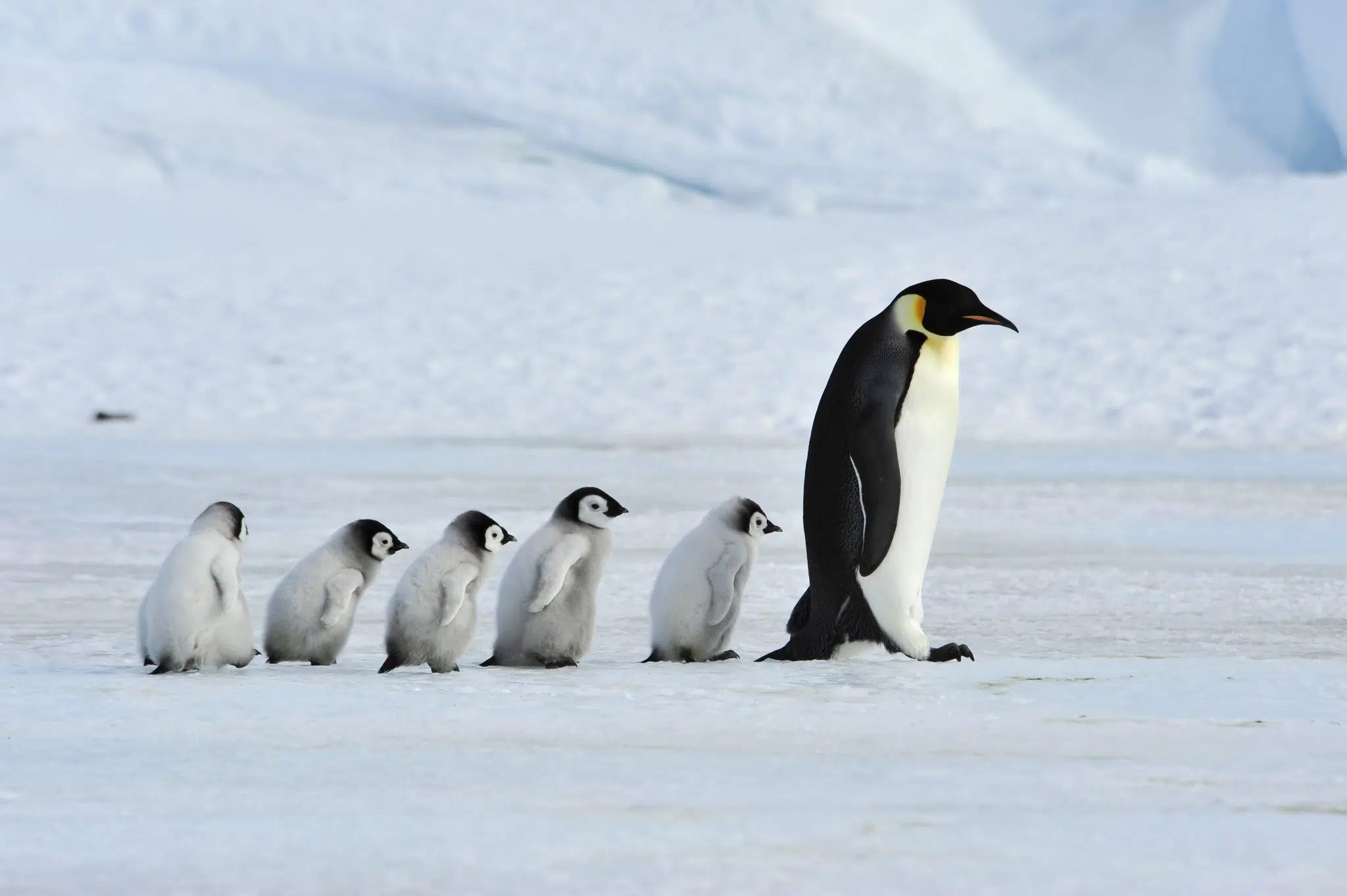
The majestic Emperor Penguin (Aptenodytes forsteri), an iconic emblem of Antarctica’s pristine wilderness, has been officially uplisted from Near Threatened to Endangered on the IUCN Red List of Threatened Species. This alarming reclassification, announced by BirdLife International – the official Red List Authority for birds – in collaboration with the IUCN SSC Penguin Specialist Group, serves as a stark warning of climate change’s devastating and rapidly accelerating impact on even the most remote corners of the planet. Conservation organizations are now issuing an urgent call to global governments to designate the Emperor Penguin as an Antarctic Specially Protected Species during the upcoming 48th Antarctic Treaty Consultative Meeting (ATCM) in May, emphasizing that immediate and decisive action is paramount to safeguard the future of this charismatic avian species.
The IUCN Red List: A Barometer of Global Biodiversity
The IUCN Red List of Threatened Species, established in 1964, stands as the world’s most comprehensive inventory of the global conservation status of biological species. It employs a rigorous, science-based approach to assess the extinction risk of species across various taxonomic groups, categorizing them from "Least Concern" to "Extinct." BirdLife International, with its deep expertise in avian biology and conservation, regularly undertakes the crucial task of re-assessing the global extinction risk for all bird species. This meticulous process helps to identify species facing the greatest threats, highlight where conservation efforts are proving effective, and inform policy decisions worldwide.
The uplisting of the Emperor Penguin to "Endangered" signifies a critical escalation in its perceived risk of extinction. Previously categorized as "Near Threatened," meaning it was close to qualifying for a threatened category, its new status reflects a significant and documented decline in its population, driven primarily by environmental degradation. An "Endangered" classification indicates that a species faces a very high risk of extinction in the wild, underscoring the urgent need for robust conservation interventions. This shift is not merely a bureaucratic change; it represents a scientific consensus that the species’ survival hangs precariously in the balance.
A Life Entwined with Ice: The Emperor Penguin’s Unique Vulnerability
Emperor Penguins are the largest and heaviest of all living penguin species, renowned for their striking black and white plumage, golden ear patches, and remarkable adaptations to the harshest environment on Earth. Unlike other penguin species that build nests on land, Emperor Penguins breed exclusively on "fast ice"—sea ice that is firmly anchored to the Antarctic coastline, ocean floor, or grounded icebergs. This fast ice provides a stable platform for their entire breeding cycle, which spans from April to December, covering the brutal Antarctic winter.

Their life cycle is meticulously synchronized with the annual formation and breakup of this stable ice. After migrating long distances across the ice, colonies gather to lay a single egg, which the male incubates on his feet for over 60 days, enduring extreme cold and starvation while the female forages at sea. Once hatched, the chicks spend several months developing on the ice, relying on its stability for protection from predators and the elements. Critically, during their moulting season, when they shed their old feathers and grow new waterproof ones, penguins are unable to enter the water to feed and are entirely dependent on solid, persistent ice.
This absolute reliance on fast ice makes them exceptionally vulnerable to the impacts of climate change. The Antarctic Peninsula, in particular, has experienced some of the most rapid warming on the planet. This warming leads to earlier and more frequent break-up events of the fast ice, disrupting breeding cycles and directly threatening chick survival. If the ice breaks up prematurely, before chicks have fully fledged and developed their waterproof plumage, they are plunged into the frigid ocean, where they invariably drown or succumb to hypothermia. Such catastrophic events have been observed in recent years, leading to the complete failure of entire breeding colonies.
Quantifying the Crisis: Satellite Data and Dire Projections
The scientific basis for the Emperor Penguin’s uplisting is robust, drawing on years of meticulous research, including advanced satellite imagery and population modeling. Satellite monitoring has proven invaluable in tracking the health and distribution of remote Emperor Penguin colonies, many of which are inaccessible by ground. These images have provided irrefutable evidence of the species’ decline. Between 2009 and 2018 alone, satellite data indicated a loss of approximately 10% of the global Emperor Penguin population, translating to more than 20,000 adult penguins. This significant reduction over a relatively short period underscores the rapid pace of environmental change in the Antarctic.
The primary driver of this observed decline is the unprecedented loss and erratic behavior of sea ice. Since 2016, Antarctica has witnessed record lows in sea ice extent, a trend that continues to worsen. In 2023, Antarctic sea ice reached its lowest extent ever recorded, a stark indicator of the accelerating impact of global warming on the polar regions. These record lows are not isolated incidents but part of a disturbing pattern that directly compromises the Emperor Penguin’s critical habitat.
Future projections paint an even bleaker picture. Population modeling, incorporating a wide range of future climate scenarios, consistently predicts severe reductions in Emperor Penguin numbers throughout the 21st century. Without aggressive and immediate reductions in global greenhouse gas emissions, scientists project that the Emperor Penguin population could halve by the 2080s. This isn’t merely a theoretical prediction; it’s a warning based on complex ecological models that account for the species’ specific habitat requirements, reproductive rates, and the anticipated trajectory of global warming. The collapse of breeding colonies into the sea before chicks can swim, as tragically observed, offers a grim preview of these projections.
Rob Martin, Red List Team Manager at BirdLife International, who spearheaded this reassessment, articulated the gravity of the situation: "The Emperor Penguin’s shift from Near Threatened to Endangered is a worrying signal of the reach of climate change impacts into the most remote parts of the globe. Future projections for the species robustly point to severe reductions over the rest of this century. Emperor Penguins are completely dependent on the Antarctic habitat for breeding, moulting and feeding, but it will become harder for them to survive as ice patterns become less predictable and this crucial habitat keeps decreasing."

A Critical Juncture: The Antarctic Treaty Consultative Meeting
The alarming reassessment by BirdLife International arrives at a pivotal moment, coinciding with the upcoming 48th Antarctic Treaty Consultative Meeting (ATCM), scheduled to take place in Hiroshima, Japan, in May. The ATCM is the premier forum for nations that are signatories to the Antarctic Treaty to discuss and decide on issues pertaining to the governance, environmental protection, and scientific research in the Antarctic region. This meeting represents a critical opportunity for global governments to translate scientific warnings into concrete policy action.
BirdLife International is actively contributing to this decision-making process by providing its comprehensive Red List assessment for the Emperor Penguin. The organization is urging governments to leverage this scientific evidence to officially designate the Emperor Penguin as an "Antarctic Specially Protected Species" (ASPS). This designation, under the framework of the Antarctic Treaty System, is not merely symbolic. It would create legally binding obligations for signatory governments to prevent actions that directly harm or disturb Emperor Penguins and their vital habitat.
An ASPS designation would mandate stricter protective measures, potentially including restrictions on human activities such as tourism, research, and fishing in critical Emperor Penguin breeding and foraging areas. It would also reinforce the need for environmental impact assessments to consider the species’ welfare and habitat needs rigorously. While an ASPS designation cannot directly halt climate change, it can mitigate local pressures, protect existing colonies, and provide a framework for adaptive management strategies, buying crucial time for the species while global efforts to decarbonize economies take effect.
Martin Harper, CEO of BirdLife International, emphasized the urgency of this political will: "Penguins are already among the most threatened birds on Earth. The Emperor Penguin’s move to Endangered is a stark warning: climate change is accelerating the extinction crisis before our eyes. Governments must act now – starting by designating the Emperor Penguin as an Antarctic Specially Protected Species this May."
Broader Implications: A Canary in the Global Coal Mine
The plight of the Emperor Penguin extends far beyond a single species; it serves as a powerful indicator of the health of the entire Antarctic ecosystem and, by extension, the planet. Birds are often referred to as "environmental compasses" or "canaries in the coal mine" because their sensitivity to environmental changes makes them early warning signals of broader ecological crises. The rapid decline of the Emperor Penguin signals profound disruptions occurring in one of Earth’s most pristine and vital regions.

The loss of sea ice in the Antarctic has cascading effects throughout the marine food web. Sea ice is not only a breeding platform for penguins but also a critical habitat for krill, tiny crustaceans that form the base of the Antarctic food chain. Krill feed on algae that grow on the underside of sea ice, and their populations are directly impacted by ice availability. A decline in krill can have devastating consequences for a wide array of Antarctic wildlife, including whales, seals, and other penguin species that rely on krill as a primary food source. Therefore, the Emperor Penguin’s struggle is a harbinger of potential ecological unraveling across the Southern Ocean.
The situation also highlights the profound challenge of conservation in an era of rapid climate change. While local conservation efforts and protected areas can play a crucial role, the primary threat to the Emperor Penguin is global in nature: anthropogenic greenhouse gas emissions. This underscores the imperative for international cooperation and a systemic shift towards decarbonized economies. The fate of the Emperor Penguin is inextricably linked to the world’s success in meeting ambitious climate targets, such as those outlined in the Paris Agreement.
The Path Forward: Decarbonization and Dedicated Conservation
To avert the projected catastrophic decline of Emperor Penguins, a dual approach is essential. Firstly, and most critically, there must be an "abrupt and dramatic reduction" in global greenhouse gas emissions. This requires an accelerated transition away from fossil fuels, significant investment in renewable energy, improvements in energy efficiency, and sustainable land-use practices worldwide. The science is unequivocal: without a fundamental change in global energy consumption and production patterns, the unique ecosystems of the polar regions will continue to degrade.
Secondly, specific conservation measures, such as the proposed ASPS designation, can offer vital protection. Complementary strategies could include increased monitoring of colonies, research into adaptive behaviors, and the establishment of robust Marine Protected Areas (MPAs) in the Southern Ocean, which could help buffer against other threats like overfishing and pollution, thereby strengthening the resilience of the ecosystem.
The world has a moral obligation to protect the Emperor Penguin and the unique Antarctic environment it inhabits. The call to action from BirdLife International is not merely for the sake of a single species but for the health of our planet and the future of biodiversity. The decisions made at the ATCM in May, and indeed by governments worldwide in their climate policies, will determine whether the Emperor Penguin continues its millennia-long reign in Antarctica or becomes yet another casualty of humanity’s impact on Earth. The time for deliberation is over; the time for decisive action is now.
