
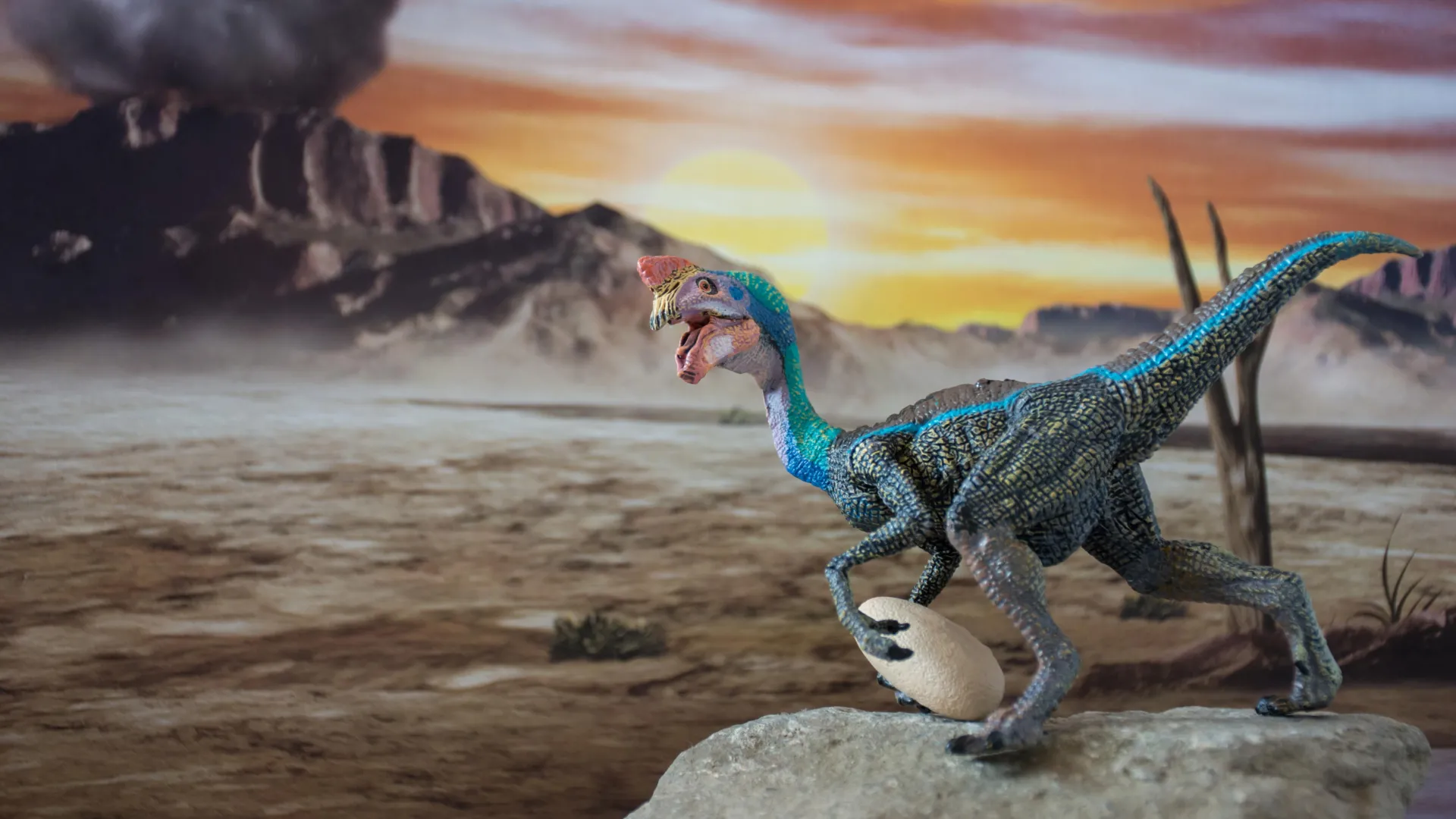
For decades, the precise methods by which oviraptors, those fascinating bird-like but flightless dinosaurs, brought their offspring into the world remained a subject of intense paleontological debate. Unlike their modern avian relatives, which typically provide direct, consistent heat to their eggs, or reptiles like crocodiles, which often rely on ambient environmental warmth, the incubation strategy of oviraptors was shrouded in uncertainty. A groundbreaking new study published in Frontiers in Ecology and Evolution has cast significant light on this enduring mystery, suggesting that these ancient creatures employed a sophisticated "co-incubation" method, blending direct parental brooding with environmental heat, a strategy that likely led to asynchronous hatching patterns within a single clutch.
The Incubation Conundrum: A Paleontological Puzzle
Oviraptors, whose name controversially means "egg thief" due to an initial misidentification of a fossilized individual found atop what was believed to be a Protoceratops nest (later corrected to be its own eggs), roamed the Earth during the Late Cretaceous period, approximately 70 to 66 million years ago. These dinosaurs were characterized by their toothless beaks, often crested skulls (in some species), and clear anatomical links to modern birds, solidifying their place in the evolutionary lineage leading to today’s avifauna. Fossil evidence, particularly exquisitely preserved brooding postures, demonstrated their parental care, with adults positioned over clutches of eggs in a manner reminiscent of modern birds. However, the unique, ring-shaped arrangement of their eggs and the sheer size difference between an adult oviraptor and its eggs presented a biological paradox for direct, bird-like incubation. The question lingered: did they merely guard their nests, relying solely on external heat sources, or did they actively warm their eggs, and if so, how efficiently?
A Novel Approach to Prehistoric Parenting
To address this complex question, a team of researchers in Taiwan embarked on an innovative, multidisciplinary investigation. Their methodology ingeniously combined advanced heat transfer simulations with meticulously designed physical experiments, offering an unprecedented window into the thermal dynamics of a 70-million-year-old dinosaur nest. The goal was not merely to determine if oviraptors incubated their eggs, but how effectively they did so, and what implications their method had for hatching outcomes.
The focal point of their reconstruction was Heyuannia huangi, an oviraptor species that lived during the Late Cretaceous in what is now China. This particular species, estimated to be about 1.5 meters long and weighing around 20 kilograms, was chosen due to the availability of detailed fossil records pertaining to its nesting behavior, including the characteristic semi-open nests arranged in multiple rings of eggs. This ring-like architecture is crucial, as it distinctly differs from the compact clutches of most modern birds.
To bring this ancient scene to life in a laboratory setting, the research team constructed a life-sized model of an adult Heyuannia huangi. The torso was fashioned from polystyrene foam, supported by a wooden frame, and then carefully layered with cotton, bubble paper, and fabric to mimic the soft tissues and insulating properties of a living animal. For the eggs, a significant challenge, researchers developed specialized resin eggs designed to approximate the thermal properties and dimensions of actual oviraptor eggs, which, as first author Chun-Yu Su highlighted, "are unlike those of any living species." These resin eggs were then arranged into two clutches, each in double rings, faithfully replicating fossil evidence of oviraptor nesting patterns.
Simulating a 70-Million-Year-Old Nursery
The experimental phase involved placing the oviraptor model over the reconstructed nest and subjecting it to various simulated environmental conditions, ranging from colder to warmer ambient temperatures. Infrared cameras and temperature sensors were strategically placed within and around the nest to monitor heat distribution and transfer dynamics between the adult model, the eggs, and the surrounding environment. The team then analyzed how both the presence of the "brooding" adult and external climatic factors influenced egg temperatures.
The findings revealed compelling insights into the thermal environment of an oviraptor nest. In colder simulated conditions, when the brooding adult model was positioned over the clutch, a significant temperature gradient was observed. Eggs in the outer ring of the nest exhibited temperature variations of up to 6 degrees Celsius (approximately 10.8 degrees Fahrenheit). Such substantial differences within a single clutch are highly indicative of asynchronous hatching, meaning that eggs would hatch at different times, rather than simultaneously. This staggered hatching could have profound implications for parental care, potentially extending the period an adult needed to tend to newly hatched young.
Conversely, in warmer simulated environments, the temperature variation across the outer ring of eggs drastically reduced to approximately 0.6 degrees Celsius (about 1.1 degrees Fahrenheit). This observation strongly suggests that in warmer climates, the ambient heat, particularly from direct sunlight, played a crucial role in evening out egg temperatures across the nest. As senior author Dr. Tzu-Ruei Yang, an associate curator of vertebrate paleontology at Taiwan’s National Museum of Natural Science, explained, "It’s unlikely that large dinosaurs sat atop their clutches. Supposedly, they used the heat of the sun or soil to hatch their eggs, like turtles. Since oviraptor clutches are open to the air, heat from the sun likely mattered much more than heat from the soil." This indicates a synergistic relationship where environmental heat supplemented the parental contribution, especially when conditions were favorable.
Oviraptors: Masters of "Co-Incubation"
The study’s findings led the researchers to propose that oviraptors practiced a form of "co-incubation," a hybrid strategy that differentiates them from both modern reptiles and birds. Modern birds predominantly rely on what is known as Thermoregulatory Contact Incubation (TCI), a highly efficient method where the adult sits directly on its eggs, using specialized brood patches—vascularized, featherless areas on their underside—to transfer heat directly and consistently to the entire clutch. For TCI to be effective, three conditions must be met: the adult must maintain direct contact with all eggs, act as the primary heat source, and ensure uniform temperatures across the clutch.
Oviraptors, given their anatomical structure and unique nesting style, were likely unable to fulfill these criteria. Their relatively large size compared to individual eggs, coupled with the distinctive ring-shaped arrangement of their clutches, would have prevented an adult from maintaining consistent, direct contact with every egg simultaneously. "Oviraptors may not have been able to conduct TCI as modern birds do," noted Chun-Yu Su. Instead, the dinosaur parent and environmental heat likely functioned as co-incubators, each contributing to the overall thermal management of the nest. While this method might appear less "efficient" in terms of uniform heating compared to modern avian TCI, it was evidently well-suited to the oviraptor’s specific biology and nesting behaviors.
Dr. Yang emphasized that this distinction should not be viewed as one strategy being inherently "better" than the other. "Modern birds aren’t ‘better’ at hatching eggs. Instead, birds living today and oviraptors have a very different way of incubation or, more specifically, brooding," he clarified. "Nothing is better or worse. It just depends on the environment." This perspective underscores the remarkable diversity of reproductive strategies that have evolved to suit specific ecological niches and climatic conditions throughout Earth’s history.
Environmental Dynamics and Evolutionary Adaptations
The Late Cretaceous period, when Heyuannia huangi thrived, was generally warmer globally than today, though regional climates varied. The semi-open nature of oviraptor nests, exposed to the air rather than buried, would have made them particularly susceptible to solar radiation. This reliance on environmental heat, particularly sunlight, aligns with observations of some modern reptile species that utilize solar energy for incubation. The study suggests that the interaction between parental brooding and solar heating was a finely tuned adaptation, allowing oviraptors to manage their incubation effectively within their specific climatic context.
This co-incubation strategy also provides clues about the evolutionary trajectory of nesting behaviors. The shift from entirely buried nests, common in many ancient reptiles, towards semi-open structures like those of oviraptors, represents an intermediate step. It bridges the gap between purely environmental incubation and the highly active, parental-driven incubation seen in birds. This transition likely offered advantages, perhaps reducing the energy expenditure for the parent compared to full TCI, while still providing some control over temperature fluctuations that purely buried nests would lack.
Broader Implications for Dinosaur Parental Care and Behavior
The findings from this study extend beyond merely understanding egg-warming mechanics; they offer profound insights into the broader aspects of dinosaur parental care and social behavior. Asynchronous hatching, a direct consequence of the temperature gradients observed in oviraptor nests, implies a staggered arrival of hatchlings. This could mean that parents would have been attending to a nest containing both unhatched eggs and newly emerged young, and potentially older, more developed hatchlings simultaneously. Such a scenario would demand extended parental vigilance and care, potentially influencing the social dynamics within a family unit and even extending the period of juvenile dependency.
This nuanced understanding of oviraptor incubation enriches our overall picture of non-avian dinosaur reproductive biology, moving beyond simplistic comparisons to modern reptiles or birds. It highlights the unique evolutionary pathways taken by different dinosaur lineages and the complex interplay between anatomy, behavior, and environment that shaped their life histories. The trade-offs inherent in co-incubation—less uniform heating but potentially reduced energetic demands on the parent—underscore the diverse adaptive solutions found in nature.
Methodological Advancements and Future Paleontological Research
The innovative methodology employed by the Taiwanese research team marks a significant advancement in paleontological studies. By integrating physical modeling, sophisticated heat transfer simulations, and comparisons with extant species, they have established a robust framework for investigating complex biological processes in extinct animals. This interdisciplinary approach, drawing from paleontology, physics, and engineering, opens new avenues for exploring other elusive aspects of dinosaur biology, such as their locomotion, physiology, and even social interactions.
While acknowledging the inherent limitations of reconstructing ancient scenarios—the study utilized a reconstructed nest and modern environmental conditions, which necessarily differ from the Late Cretaceous period—the researchers emphasize the foundational nature of their work. They also note that oviraptors likely had considerably longer incubation periods than most modern birds, a factor that would amplify the effects of temperature variations over time. Despite these caveats, the study’s contributions are undeniable.
Global Science, Local Impact
Beyond its scientific implications, the study carries a powerful message about the global nature of scientific inquiry and collaboration. Dr. Yang’s concluding remarks resonate particularly strongly within the scientific community: "It also truly is an encouragement for all students, especially in Taiwan. There are no dinosaur fossils in Taiwan, but that does not mean that we cannot do dinosaur studies." This statement champions the idea that intellectual curiosity, innovative methodologies, and a collaborative spirit can transcend geographical limitations, enabling profound contributions to global scientific understanding from any corner of the world.
In essence, this research portrays oviraptors not as evolutionary intermediates, but as highly adapted creatures with a unique and effective reproductive strategy. Their co-incubation method, balancing direct parental effort with ambient environmental heat, represents a distinct and sophisticated form of parental care, bridging the perceived gap between reptilian and avian reproductive behaviors and offering a richer, more complex narrative of dinosaur life.
