
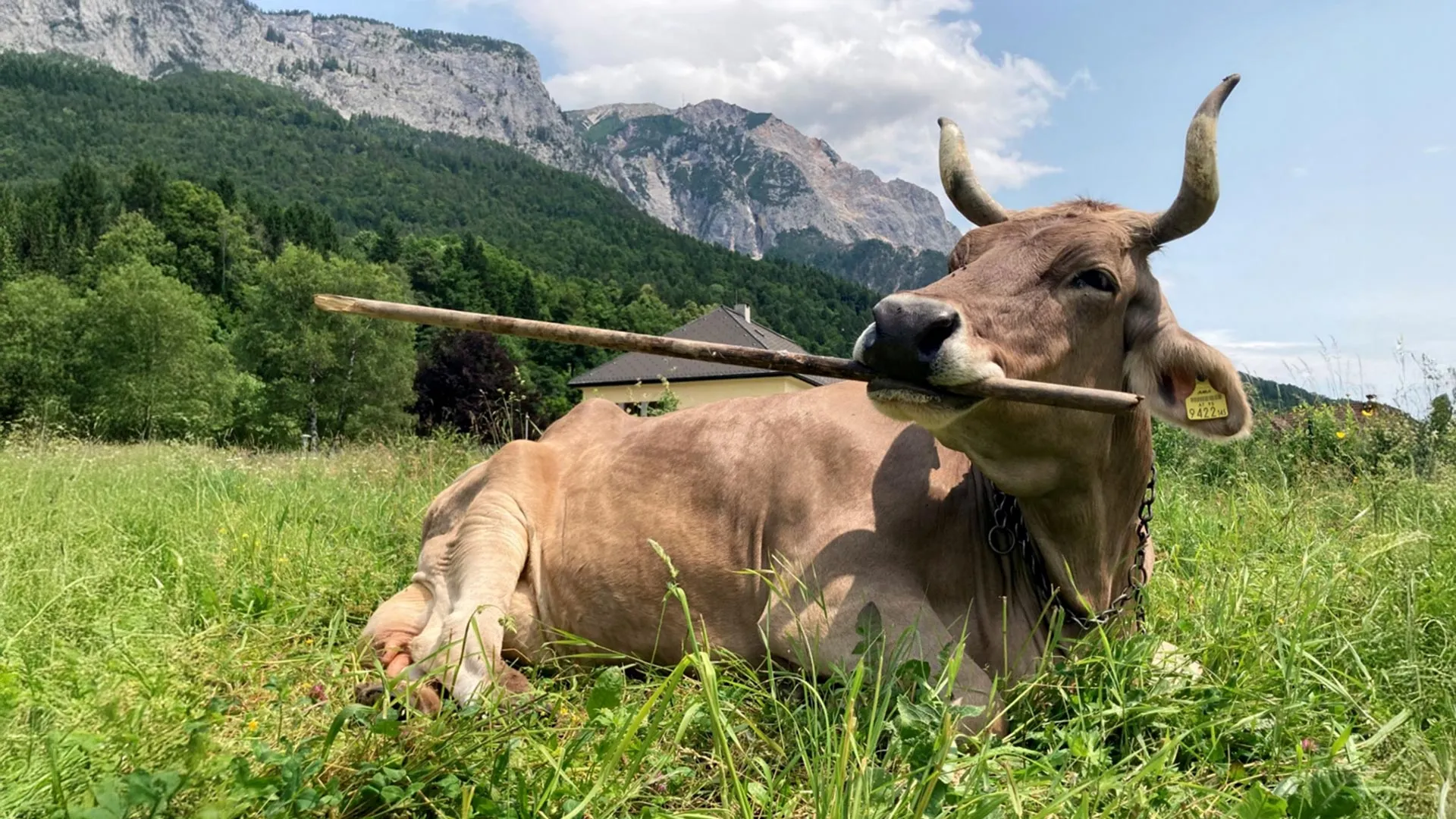
In 1982, the acclaimed cartoonist Gary Larson introduced a seminal Far Side comic panel titled Cow Tools. This now-iconic illustration depicted a cow standing proudly beside a bizarre assortment of crudely fashioned, seemingly useless objects, all labeled "tools." The humor of the strip was rooted in a widely accepted, almost axiomatic belief: that cows, and indeed most livestock, inherently lack the cognitive capacity to conceive of, create, or effectively utilize tools. This pervasive assumption, deeply ingrained in popular culture and, until recently, largely unchallenged in scientific circles, is now being fundamentally re-evaluated thanks to a groundbreaking discovery involving a real cow named Veronika. A recent study, published in the esteemed journal Current Biology, meticulously documents the first confirmed case of flexible, multi-purpose tool use in a pet cow, profoundly suggesting that cattle may possess far greater cognitive capabilities than previously understood or acknowledged.
The "Cow Tools" Legacy and Shifting Perceptions of Animal Intelligence
The Far Side comic "Cow Tools" transcended its immediate humor, becoming a cultural touchstone that encapsulated prevailing human perceptions of bovine intelligence – or rather, the perceived lack thereof. For decades, the image served as a shorthand for the absurdity of attributing complex problem-solving skills to farm animals. This perception was not merely anecdotal; it was reinforced by the historical context of animal science, which often focused on productivity and behavior related to domestication and agriculture, rather than intricate cognitive processes. Livestock were largely viewed through an anthropocentric lens, their behaviors interpreted primarily in terms of instinct and basic conditioning.
However, the past few decades have witnessed a dramatic paradigm shift in the field of animal cognition. Researchers employing innovative methodologies have progressively unveiled sophisticated cognitive abilities in a vast array of species, from the problem-solving prowess of corvids and parrots to the social complexities of elephants and cetaceans. Even within mammals traditionally underestimated, such as pigs, sheep, and goats, studies have revealed surprising capacities for memory, social learning, individual recognition, and emotional depth. Cows, often dismissed as simple grazers, have been shown to possess complex social structures, exhibit individual personalities, learn intricate tasks, and even display signs of emotional states like joy and stress. These accumulating findings have set the stage for discoveries like Veronika’s, challenging the very foundations of long-held assumptions.
Introducing Veronika: A Decade of Unconventional Observation
Veronika is a Swiss Brown cow whose life trajectory diverges significantly from that of most cattle. Rather than being raised for conventional food production, she lives as a cherished companion animal with Witgar Wiegele, an organic farmer and baker based in Switzerland. Wiegele treats Veronika as an integral member of his family, providing her with an environment rich in interaction, stimulation, and freedom. This unconventional upbringing, characterized by longevity and complex daily interactions, is believed by researchers to be a crucial factor in the development and manifestation of her unique behavior.
The initial observations of Veronika’s tool use date back over a decade. Around 2012, Wiegele first noticed Veronika picking up sticks and using them to scratch otherwise inaccessible parts of her body. Initially, he might have dismissed it as a curious quirk, but the consistent nature and apparent intentionality of the behavior eventually compelled him to document it. Over the years, these observations became more detailed, culminating in video recordings that Wiegele later shared with a network of researchers interested in animal cognition.
"When I saw the footage, it was immediately clear that this was not accidental," stated Alice Auersperg, a cognitive biologist at the University of Veterinary Medicine, Vienna, and a lead author of the study. Auersperg, renowned for her work on tool use in kea parrots, recognized the profound significance of Veronika’s actions. "This was a meaningful example of tool use in a species that is rarely considered from a cognitive perspective, typically overlooked in favor of primates or birds." Her initial assessment underscored the rarity and importance of the observation, prompting the design of structured experiments to rigorously validate the behavior.
Rigorous Scientific Validation: Testing Tool Use in Controlled Experiments
To move beyond anecdotal observation and scientifically confirm Veronika’s tool-using capabilities, Auersperg’s team, including Antonio Osuna-Mascaró, devised a series of controlled experiments. The researchers introduced a common deck brush – an object not naturally found in Veronika’s environment but resembling the sticks she habitually used – into her enclosure. The brush was placed in various positions, both accessible and slightly less convenient, to observe Veronika’s interactions. The aim was to determine if her use of the object was intentional, flexible, and adaptive.
Across multiple trials conducted over several months, Veronika consistently demonstrated a deliberate and sophisticated approach to using the brush. Her interactions were far from random; she actively chose specific parts of the brush based on the particular area of her body she wished to scratch. For instance, when aiming for broader, tougher areas like her back or flanks, she would manipulate the brush to utilize its bristled side. Conversely, for more sensitive or hard-to-reach regions on her lower body, such as her udder or abdomen, she would skillfully switch to using the smoother, firmer handle of the brush.
"We show that a cow can engage in genuinely flexible tool use," explained Osuna-Mascaró, highlighting the critical distinction between simple object manipulation and true tool use. "Veronika is not just using an object to scratch herself. She uses different parts of the same tool for different purposes, and she applies different techniques depending on the function of the tool and the body region she targets." This level of dexterity and adaptive decision-making is a hallmark of advanced cognitive processing.
Defining Flexible and Multi-Purpose Tool Use: Beyond Simple Scratching
The researchers meticulously documented clear patterns in Veronika’s brush usage. For instance, when addressing larger, firmer areas of her body, such as her back or rump, she consistently favored the bristled side of the brush. Her movements in these instances were broader, more vigorous, and designed to cover a wider surface area. In stark contrast, when targeting more delicate or difficult-to-reach regions, she would carefully adjust her grip and body position to employ the smoother, more precise handle. For these sensitive areas, her movements were notably slower, more controlled, and highly precise, indicative of fine motor control and an anticipation of the desired outcome.
Tool use, in the scientific context, is generally defined as the employment of an external object as a means to achieve a goal through physical interaction. Veronika’s actions not only meet this fundamental definition but also significantly exceed it. Her behavior qualifies as "flexible, multi-purpose tool use," a more advanced category that denotes the ability to utilize different features of the same object for distinct outcomes, adapting the tool’s application to specific needs.
This specific type of cognitive behavior is exceedingly rare in the animal kingdom. Among non-human species, it has been unequivocally documented only in a very select group, most prominently chimpanzees, which are known to adapt sticks for various tasks like fishing for termites or extracting honey. The fact that a cow, a species traditionally placed low on the cognitive ladder, exhibits this sophisticated level of tool use represents a significant expansion of our understanding of animal intelligence and the phylogenetic distribution of complex behaviors. It challenges the long-held notion that such flexibility is exclusive to primates and a few highly intelligent birds.
Overcoming Physical Constraints: The Ingenuity of Egocentric Tool Use
Veronika’s tool use is directed at her own body, a category known as egocentric tool use. While this form is typically considered less complex than using tools on external objects to manipulate the environment (e.g., a bird using a stick to pry open a shell), it still presents substantial cognitive and physical challenges, especially for an animal like a cow. The most obvious limitation is the absence of prehensile hands, which are crucial for fine manipulation in many tool-using species.
Despite this anatomical constraint, Veronika demonstrates remarkable ingenuity. She must manipulate the brush using only her mouth, a feat requiring considerable oral dexterity, jaw strength, and precise control. The study observed that she not only grips the tool effectively but also adjusts her grip and the angle of the brush with apparent foresight, anticipating the effects of her actions on her body. This level of anticipatory behavior and adaptive control, using a non-traditional manipulator like the mouth, underscores a high degree of motor planning and spatial awareness. It suggests a sophisticated internal representation of her body and the tool’s interaction with it.
The Enriched Environment Hypothesis: Why Veronika May Be Unique
The researchers propose that Veronika’s unique living conditions are likely a critical factor contributing to the development and manifestation of her tool-using behavior. Unlike the vast majority of cattle, who live in often confined or highly standardized agricultural settings, Veronika has enjoyed a long life (she is over a decade old, a considerable lifespan for a cow) in a complex, stimulating, and enriched environment. Her daily life includes extensive interactions with humans, access to varied terrain, and a diverse array of objects she can explore and manipulate.
These factors—longevity, consistent human interaction, and environmental complexity—are believed to have fostered an environment conducive to exploration, innovation, and learning. Most cattle are not afforded the luxury of such opportunities, which could explain why similar behaviors have not been widely observed. In typical farming operations, the focus is on efficiency and productivity, often at the expense of cognitive stimulation or the allowance for individual behavioral expression beyond basic needs. Veronika’s situation represents a natural experiment, showcasing the potential for cognitive development when an animal is given the space and opportunity to learn and innovate.
"[Veronika] did not fashion tools like the cow in Gary Larson’s cartoon, but she selected, adjusted, and used one with notable dexterity and flexibility," the researchers wrote, drawing a direct parallel to the Far Side comic. Their conclusion provocatively states: "Perhaps the real absurdity lies not in imagining a tool-using cow, but in assuming such a thing could never exist." This statement serves as a powerful reminder that our assumptions about animal intelligence are often limited by our observational biases and the constraints of typical animal husbandry.
Broader Implications for Animal Cognition, Welfare, and Agricultural Practices
This discovery represents a significant milestone, marking the first confirmed case of tool use in cattle and expanding the known range of species capable of demonstrating such complex behavior. Its implications are far-reaching, touching upon fundamental aspects of animal cognition, welfare, and even ethical considerations in agriculture.
Firstly, it challenges the hierarchical view of animal intelligence, suggesting that sophisticated cognitive abilities might be more widely distributed across the animal kingdom than previously thought. It underscores the importance of species-specific research, moving beyond a primate-centric model to explore the diverse manifestations of intelligence in various evolutionary lineages. This could lead to a re-evaluation of how we categorize and understand the cognitive potential of so-called "lower" animals.
Secondly, the findings have profound implications for animal welfare. If cattle possess such advanced cognitive capacities, the standard conditions under which most livestock are kept may be severely lacking in the necessary environmental enrichment and stimulation required for their mental well-being. Experts in animal welfare are likely to interpret this study as further evidence for the need to provide more complex and stimulating environments for farm animals, moving beyond mere physical comfort to address their cognitive and emotional needs. This could influence policy discussions around housing standards, activity provisions, and opportunities for exploration and play in agricultural settings.
Furthermore, the study highlights the potential for similar behaviors to exist in other species or even in other individual cattle, but to have gone unnoticed due to a lack of observation, preconceptions, or environmental limitations. The very act of looking for such behaviors, now informed by Veronika’s example, could unlock a cascade of new discoveries.
A Call for Further Observation and Research
The research team, encouraged by their groundbreaking findings, is now actively exploring the specific environmental and social conditions that enable such complex behaviors to develop in cattle. They aim to understand whether Veronika’s case is an isolated phenomenon or a manifestation of latent abilities that can be fostered under the right circumstances.
Crucially, the team has issued a broad appeal to the public and to individuals working with cattle, encouraging them to report any similar observations. "Because we suspect this ability may be more widespread than currently documented," Osuna-Mascaró stated, emphasizing the potential for citizen science to contribute to this field, "we invite readers who have observed cows or bulls using sticks or other handheld objects for purposeful actions to contact us." This open call underscores the collaborative spirit of modern scientific inquiry and acknowledges that some of the most profound discoveries can emerge from the careful, long-term observations of those closest to the animals. The story of Veronika serves as a potent reminder that the animal kingdom holds many more cognitive surprises than humanity has perhaps dared to imagine.
