
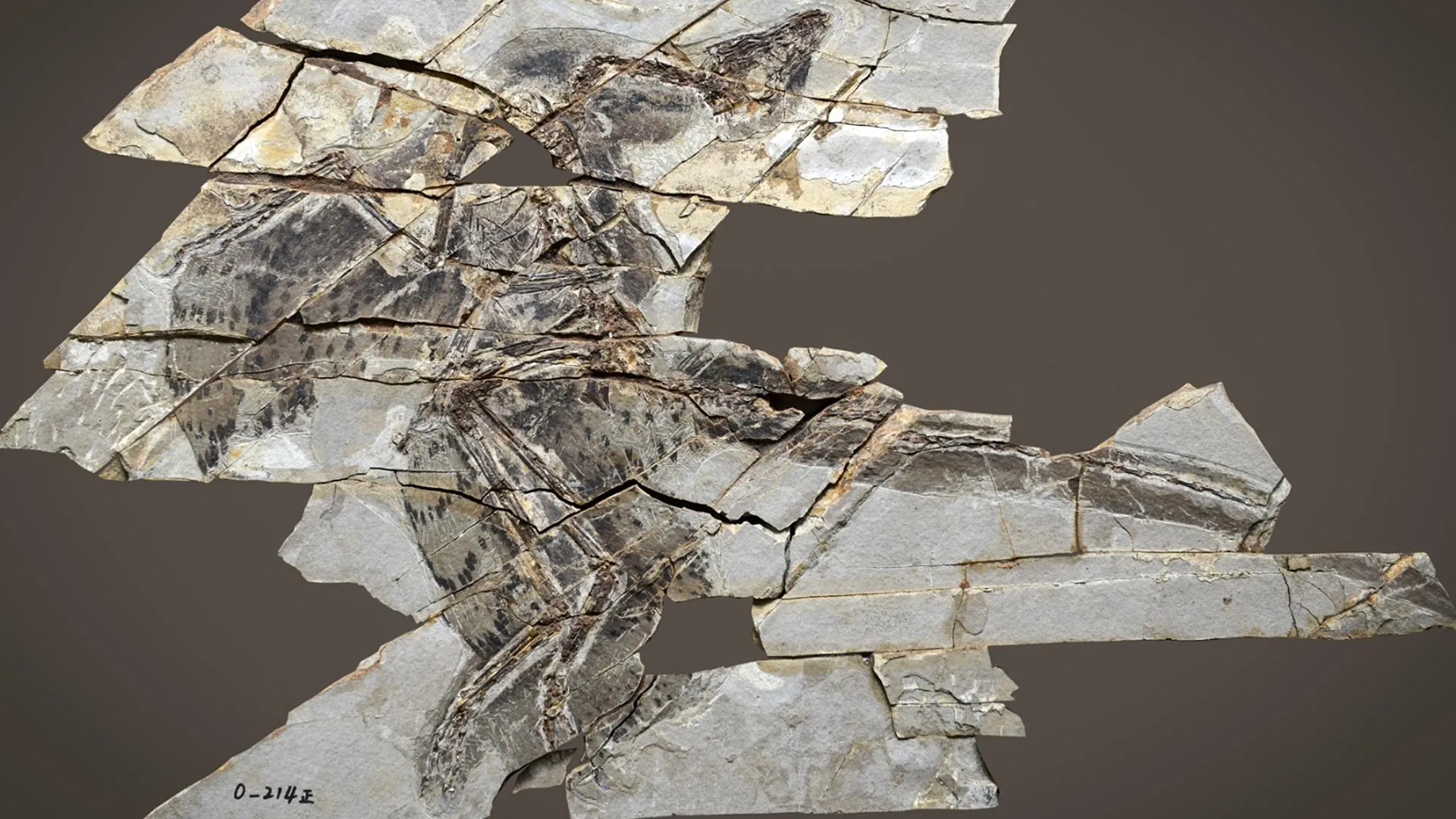
A groundbreaking new study, spearheaded by researchers from Tel Aviv University’s School of Zoology and the Steinhardt Museum of Natural History, has presented compelling evidence that some feathered dinosaurs, previously thought to be potential flyers, had in fact lost the ability to take to the skies. Analyzing extraordinarily preserved fossils of the dinosaur Anchiornis, the team, led by Dr. Yosef Kiat, meticulously examined the creatures’ molting patterns – a physiological process long understood to be a key indicator of flight capability in modern birds. The findings, published in the esteemed journal Communications Biology by Nature Portfolio, suggest a far more intricate and non-linear evolutionary path for flight than traditionally assumed, challenging prevailing theories and highlighting the complex interplay of adaptation and loss throughout the history of life.
This unusual discovery offers an unprecedented glimpse into the lives of animals approximately 160 million years ago, a pivotal period in the Mesozoic Era. By deciphering the subtle cues within fossilized feathers, the research has not only illuminated the daily existence of these ancient creatures but has also cast new light on the broader evolutionary trajectory of flight in both dinosaurs and their modern avian descendants. The researchers emphasize the broad significance of their findings, stating, "Feather molting seems like a small technical detail — but when examined in fossils, it can change everything we thought about the origins of flight, highlighting how complex and diverse wing evolution truly was." This implies a scenario where certain species may have developed nascent flight abilities only to subsequently relinquish them, echoing patterns seen in numerous flightless bird species today.
A Window into the Jurassic: The Significance of Anchiornis
The study primarily focused on nine exceptionally preserved fossils of Anchiornis, a genus of paravian dinosaur from the Late Jurassic period of eastern China. Anchiornis huxleyi, specifically, is a small, four-winged paravian known from the Tiaojishan Formation in Liaoning Province, a region famed for its exquisitely preserved feathered dinosaur and early bird fossils, often referred to as the Jehol Biota or, in this earlier context, the Daohugou Biota. Discovered in 2009, Anchiornis quickly became a key species in the ongoing debate about the origin of birds and the evolution of flight, due to its well-preserved plumage, including long feathers on both its forelimbs and hindlimbs, giving it a "four-winged" appearance reminiscent of Microraptor.
Prior to this study, Anchiornis was often considered a potential glider or even a primitive flyer, its feathered limbs appearing structurally capable of aerodynamic function. However, the meticulous analysis by Dr. Kiat and his collaborators from China and the United States has introduced a crucial new dimension to this understanding. The fossils’ remarkable preservation, extending beyond mere skeletal remains to include detailed soft tissues and even melanosomes (pigment-containing organelles), allowed for an unprecedented examination of feather structure and coloration. Each specimen revealed wing feathers that were distinctly white, adorned with a pronounced black spot at the tip – a detail that proved instrumental in discerning the animals’ molting patterns.
The Evolutionary Tapestry of Feathers and Flight
To fully appreciate the implications of this research, it is essential to understand the evolutionary journey of feathers and the lineage leading to modern birds. Dr. Kiat, an ornithologist specializing in feathers, explains that dinosaurs diverged from other reptiles approximately 240 million years ago during the Triassic period. Relatively soon thereafter, on an evolutionary timescale, many dinosaur species began to develop feathers. These lightweight, protein-based structures initially served functions beyond flight, such as insulation, display, and potentially even brooding eggs.
Around 175 million years ago, during the Middle Jurassic, a crucial group of feathered dinosaurs known as Pennaraptora emerged. This clade includes oviraptorosaurs, scansoriopterygids, dromaeosaurids, troodontids, and ultimately, Aves (birds). Pennaraptorans are widely recognized as the closest relatives to modern birds, forming the sole dinosaur lineage that successfully navigated the catastrophic mass extinction event at the end of the Mesozoic era, approximately 66 million years ago. It has long been a widely held scientific belief that the evolution of feathers within Pennaraptora was intrinsically linked to the development of flight. However, the new findings suggest that this evolutionary narrative might be far more nuanced. Environmental pressures, changes in ecological niches, or shifts in body size and lifestyle could have led certain species to secondarily lose flight capabilities, much like modern flightless birds such as ostriches, emus, penguins, and kakapos.
Unlocking Secrets: The Science of Molting and Feather Biology
The cornerstone of Dr. Kiat’s research lies in the physiological process of molting. Feathers, being dead structures once fully grown, are subject to wear and tear. To maintain optimal function, especially for flight, they must be regularly replaced. This cyclical shedding and regrowth of feathers is known as molting. The pattern of molting, as observed in living birds, provides a critical indicator of their flight dependence.
Dr. Kiat elaborates on this crucial distinction: "Feathers grow for two to three weeks. Reaching their final size, they detach from the blood vessels that fed them during growth and become dead material. Worn over time, they are shed and replaced by new feathers — in a process called molting, which tells an important story: birds that depend on flight, and thus on the feathers enabling them to fly, molt in an orderly, gradual process that maintains symmetry between the wings and allows them to keep flying during molting. In birds without flight ability, on the other hand, molting is more random and irregular. Consequently, the molting pattern tells us whether a certain winged creature was capable of flight."
For birds reliant on flight for survival, an asymmetrical or rapid loss of flight feathers would be catastrophic, rendering them vulnerable to predators and unable to forage effectively. Therefore, flying birds typically molt their primary flight feathers in a symmetrical, sequential manner, often replacing only a few feathers at a time across both wings to maintain aerodynamic balance. This ensures that they retain sufficient lift and thrust throughout the molting period. Conversely, flightless birds, free from the stringent aerodynamic requirements, exhibit a more haphazard and often simultaneous molting pattern, sometimes shedding large numbers of feathers at once without compromising their mobility or safety. Examples range from the synchronous molting of ducks, which renders them temporarily flightless, to the continuous, irregular feather replacement seen in ostriches.
The Fossil Evidence: A Molting Mystery Unraveled
The exceptional preservation of the Anchiornis fossils from eastern China proved to be the key to applying this understanding of molting to an extinct species. The unique taphonomic conditions of the region – often involving rapid burial in fine-grained volcanic ash – resulted in an astonishing level of detail, including the preservation of feather coloration through fossilized melanosomes. This allowed researchers to closely examine the structure and growth dynamics of the feathers in ways typically impossible with mere imprints or bone fragments.
By analyzing the distribution of the distinctive black spots on the wing feathers, the research team identified a continuous line of these spots along the edges of the wings. Crucially, they also observed developing feathers whose black spots were clearly out of alignment with the continuous line, indicating that these feathers were still in various stages of growth and had not yet reached their final, fixed position. This "out of sync" appearance, combined with other observations of feather development and replacement, pointed unequivocally to an irregular molting pattern rather than the orderly, symmetrical molting expected in a flying animal.
Dr. Kiat concluded, "Based on my familiarity with modern birds, I identified a molting pattern indicating that these dinosaurs were probably flightless. This is a rare and especially exciting finding: the preserved coloration of the feathers gave us a unique opportunity to identify a functional trait of these ancient creatures — not only the body structure preserved in fossils of skeletons and bones." This breakthrough underscores the power of integrating ornithological insights with paleontological data, bridging the gap between living species and their ancient relatives.
Implications for the Origins of Flight: A More Complex Narrative
The finding that Anchiornis, a dinosaur with well-developed feathered wings, was likely flightless has profound implications for our understanding of avian evolution. For decades, the debate surrounding the origin of avian flight has largely centered on two main hypotheses: the "trees down" (arboreal) theory, where ancestors glided from trees before evolving powered flight, and the "ground up" (cursorial) theory, where running dinosaurs flapped their forelimbs to gain lift. While Anchiornis‘s morphology might have superficially supported an arboreal or gliding lifestyle, the molting evidence redirects the narrative.
This study strongly suggests that flight, rather than being a straightforward linear progression, was a highly dynamic and iterative process. It introduces the concept of secondary flightlessness much earlier in the evolutionary history of feathered dinosaurs than previously recognized. This means that some lineages might have experimented with various forms of aerial locomotion – perhaps gliding, rudimentary flapping, or even just using feathers for display or insulation – only to then revert to a terrestrial existence. The evolution of flight, therefore, was not a one-way street but a complex network of gains, losses, and re-adaptations.
As Dr. Kiat aptly states, "Anchiornis now joins the list of dinosaurs that were covered in feathers but not capable of flight, highlighting how complex and diverse wing evolution truly was." Other feathered dinosaurs, such as Confuciusornis (an early bird) and Sapeornis, are also subjects of ongoing research regarding their flight capabilities. The Anchiornis study provides a robust methodological framework for re-evaluating these and other feathered dinosaur fossils, potentially revealing more instances of secondary flightlessness or varied flight styles.
Broader Impact and Future Directions
The implications of this research extend far beyond the specific case of Anchiornis. It encourages paleontologists and evolutionary biologists to critically re-examine assumptions about functional morphology based solely on skeletal or external feather impressions. The study emphasizes the importance of subtle biological details, like molting patterns, which can reveal crucial behavioral and physiological traits that are otherwise hidden.
This discovery also strengthens the view that feathers initially evolved for purposes other than flight. Their roles in thermoregulation, camouflage, sexual display, or even as tools for insect capture (the "insect net" hypothesis) are increasingly supported by fossil evidence. Flight, it appears, was a later, highly specialized adaptation of these versatile structures, and even then, it was not a universal or permanent acquisition for all feathered lineages.
The findings resonate with the broader theme of convergent and divergent evolution observed throughout the tree of life. Just as marine mammals like whales and dolphins evolved from terrestrial ancestors, losing their limbs and readapting to an aquatic environment, Anchiornis demonstrates that flight, once acquired or partially developed, could also be lost if ecological pressures or advantages shifted. This flexibility in evolutionary pathways underscores the incredible adaptability of life on Earth.
Moving forward, this study will likely spur further interdisciplinary research, combining advanced fossil analysis techniques with comparative studies of extant birds. Researchers may seek to identify similar molting patterns in other feathered dinosaur fossils, refine dating methods for these ancient specimens, and explore the precise environmental or selective pressures that might have led to the loss of flight in Anchiornis and potentially other early paravians. The intricate dance between anatomy, behavior, and environment continues to unfold, revealing a dinosaurian world far richer and more complex than previously imagined, where the path to the skies was paved with many detours and even dead ends.
