
In an era often dominated by the relentless pursuit of technical sharpness and objective documentation, Mohammad Murad, a distinguished wildlife photographer and Canon EMEA Ambassador, has carved a distinctive path, advocating for an interpretive and emotionally resonant approach to capturing the natural world. Murad’s philosophy pivots away from mere replication, instead embracing motion, the nuanced interplay of light, and profound emotional expression as the bedrock of his acclaimed wildlife photography. His work transcends conventional boundaries, inviting viewers to delve deeper into the stories he perceives within the wild, translating nature’s pulse into a deeply personal visual language.

The Genesis of an Artistic Vision: A Shift in Perspective

Murad’s unique artistic direction wasn’t an immediate revelation but an evolution stemming from a transformative encounter. He recounts a pivotal moment involving a flock of cormorants gliding across water. Initially, an experiment with a lowered shutter speed yielded an unexpected result: the birds and ripples dissolved into a fluid, living painting. This serendipitous discovery fundamentally altered his perception of photography’s potential. Prior to this, the prevailing trend in wildlife photography largely emphasized clinical precision, freezing moments in time with meticulous detail to document species and behaviors accurately. While such documentary styles remain vital, Murad recognized an untapped dimension – the ability to convey the dynamic essence of life, to imbue images with the very energy of movement. From that day forward, his practice became dedicated to infusing his work with this vital pulse, employing techniques such as slow shutter speeds, deliberate panning, and Intentional Camera Movement (ICM). These methods are not merely technical tricks but integral tools for narrating the ceaseless motion and vibrant spirit of nature.

Blurring Boundaries: The Mastery of Motion

Murad’s application of motion-centric techniques serves a dual purpose: to challenge the viewer’s expectation of static imagery and to evoke the intrinsic dynamism of wildlife. By consciously manipulating shutter speed, he transforms fleeting moments into evocative blurs that communicate speed, urgency, and grace. For instance, an image of zebras fleeing a cheetah mother’s hunt is rendered with a slow shutter speed, blurring their forms into streaks of motion that powerfully convey the high-stakes drama of survival. This artistic choice accentuates the raw energy of the chase, making the viewer feel the thundering hooves and desperate flight rather than merely observing a frozen snapshot. Similarly, a herd of gazelles racing across the Maasai Mara’s vast plains, with only their forms partially sharp against a blurred landscape, evokes the sheer velocity and freedom of their movement, an almost ethereal quality that a fast shutter speed might diminish.

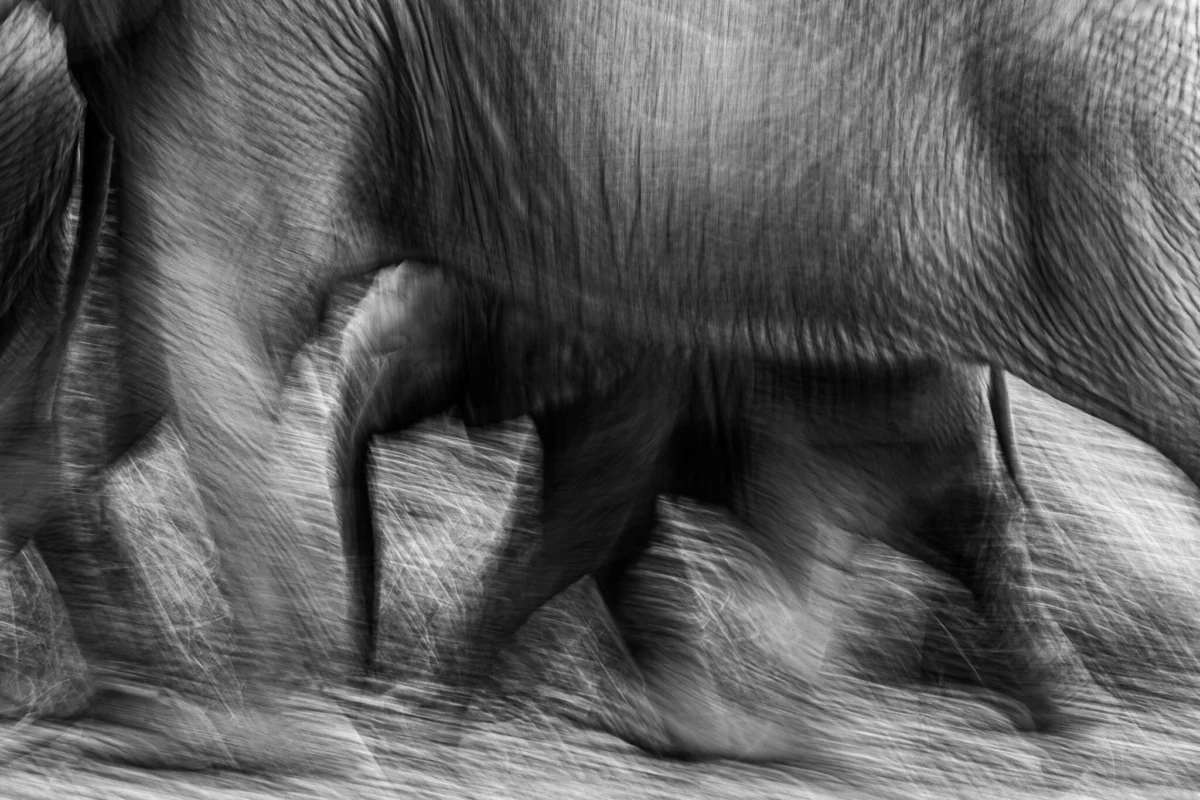
Further examples illustrate this consistent artistic intent. A lone Grant’s gazelle, captured with a slow shutter and an aperture of f/5, appears to glide across the frame, its edges kissed by a soft rim light. Here, the blur isn’t a loss of detail but an enhancement of the animal’s elegant stride and the serene atmosphere. The broader aperture contributes to a dreamlike quality, transforming the scene into a living painting. Even the seemingly mundane subject of an elephant’s legs becomes a canvas for Murad’s motion study. By blurring everything except the powerful, pillar-like limbs, he draws attention to their immense strength and the rhythmic cadence of the animal’s walk, a testament to the creature’s colossal presence and its ability to traverse vast distances. This deliberate blurring invites contemplation, forcing the observer to move beyond identification and into an appreciation of the subject’s inherent motion and power.

Light as the Primal Storyteller: Crafting Mood and Emotion

Beyond motion, light is a fundamental element in Murad’s narrative, perceived not merely as illumination but as an active storyteller. He demonstrates a profound understanding of how varying light conditions can dramatically alter the mood and emotional resonance of an image. Golden hour light, for instance, is masterfully used to soften harsh landscapes and imbue subjects with a warm, almost ethereal glow, evoking feelings of nostalgia or tranquility. Shadows, conversely, are employed to add depth, tension, or mystery, strategically obscuring details to invite viewer imagination. Backlight, a challenging technique for many, is a favorite of Murad’s, used to create stunning silhouettes or luminous halos around subjects, transforming a simple bird into a poetic outline against a radiant backdrop.

Murad’s patience is legendary, often waiting for hours for the precise quality of light to filter through a scene. This isn’t for technical perfection, he emphasizes, but to capture the scene "honestly – as it feels." An image of a White (Pied) Wagtail at sunset in a Kuwaiti nature reserve exemplifies this. With the sun positioned behind the bird, its form is silhouetted, and the surrounding mosquitoes are illuminated, creating a "beautiful, glowing backdrop." This not only highlights the bird’s delicate presence but also the vibrant ecosystem it inhabits. Similarly, a full-bellied hyena wandering at sunset is depicted in solitude, the low sun casting long shadows and warm tones that emphasize the quiet dignity and resilience of this often-misunderstood predator at the close of its day. Another powerful image captures a herd of blue wildebeest pausing after fleeing predators, their hooves kicking up dust under a setting sun. The warm, yellow glow dramatically enhances the raw intensity of the moment, transforming the dust into a golden cloud of motion and tension, illustrating light’s capacity to elevate a factual event into a deeply emotional experience.

An Urban Symphony: Foxes Under Kuwait’s Streetlights

Perhaps the most compelling testament to Murad’s unique vision and dedication is his series on Arabian red foxes thriving amidst the urban sprawl of Kuwait City. This project offers a rare glimpse into the adaptability of wildlife against a backdrop of human development. The setting, near the Doha shore, is characterized by a dynamic interplay of artificial light from streetlights and passing cars reflecting off the sea. To achieve the captivating rim lighting on his subjects, Murad innovatively employed two small handheld flashlights, demonstrating an ingenious adaptation of studio lighting techniques to a challenging nocturnal outdoor environment. This unique methodology allowed him to highlight the foxes’ forms against the vibrant, blurred urban glow, creating a magical fusion of nature and cityscape.

The genesis of this series involved an extraordinary commitment. For over two months, Murad visited the foxes’ den four days a week, spending countless hours after sunset. This sustained presence, marked by respectful distance and quiet observation, gradually fostered an unparalleled level of trust with the fox family. The foxes, particularly the curious kits, began to approach him, even licking his camera gear and feet. This personal connection, deeply resonating with Murad as a father of five, extended beyond mere observation; he felt a profound responsibility for their protection. The images from this series—an Arabian red fox cub gazing into the camera with bokeh-filled streetlights, a kitten exploring the night, or two kits digging up food buried by their mother—are not just aesthetically stunning; they serve as poignant narratives. They underscore the remarkable resilience of urban wildlife and implicitly advocate for greater awareness and conservation efforts in rapidly expanding urban environments. The mother fox’s nightly ritual of burying food for her cubs—sometimes fish, birds, or scraps—adds a layer of intimate behavioral documentation to the artistic portrayal, highlighting the constant struggle for survival even in unexpected habitats.

Global Expeditions: Lessons from the Wild

Murad’s artistic journey has taken him far beyond the familiar landscapes of Kuwait, stretching from the arid deserts of his homeland to the icy expanses of Mongolia and Iceland. Each expedition has served as a crucible for developing his patience, adaptability, and unwavering openness to the unexpected. He openly shares the myriad challenges encountered: lost luggage in remote regions, relentless arctic winds, and bone-chilling extreme temperatures. These aren’t merely logistical hurdles but vital teachers, reinforcing his belief that nature adheres to its own rhythms, and photographers must learn to move with it, not against it. The most profound images, he contends, often emerge when one ceases to try and control every variable and instead allows the scene to unfold organically.

His encounters with specific species further illustrate this philosophy. In the remote Hornstrandir Nature Reserve in Iceland, a pristine wilderness untouched since the 1950s and accessible only by a arduous boat journey, Murad photographed an Arctic fox. The image captures the fox peacefully napping behind snow-covered dry plants, its nose curled under its tail, gazing directly into his lens. His commitment to "fill the frame without disturbing it" speaks to the ethical imperative guiding his work in such fragile ecosystems. The resulting image conveys the profound tranquility and untouched beauty of this isolated land.

Another significant achievement was the rare capture of an elusive snow leopard in Mongolia’s Altai Mountains. Known as "nature’s ghost" due to its masterful camouflage and shy nature, the snow leopard presented immense challenges. Murad endured brutal conditions, including temperatures as low as -34°C and fierce winds, to secure this extraordinary glimpse. The photograph shows the leopard blending seamlessly with the fiery orange lichens and rugged rocks of its habitat. Beyond its aesthetic appeal, this image carries a critical conservation message, reminding viewers of the urgent need to protect this endangered predator whose survival is threatened by habitat loss and climate change. Such experiences underscore the blend of artistic vision, physical endurance, and ethical responsibility inherent in Murad’s photographic practice.

Beyond the Visible: Finding Your Creative Voice

At the very core of Mohammad Murad’s photographic endeavor lies a singular desire: to express something beyond mere visual representation. He aims for his images to be felt, to resonate deeply on an emotional plane. This aspiration drives his continuous experimentation with techniques that extend far beyond conventional photographic norms. He seeks to translate the fragile beauty of a bird in flight, the enduring resilience of a migrating herd, or the silent, complex interactions between predator and prey. For Murad, his work is not simply about showcasing wildlife; it is about sharing a unique, personal interpretation of life itself—its struggles, its joys, and its inherent mysteries.

He actively encourages aspiring and established photographers to liberate themselves from the relentless pursuit of technical perfection, advocating instead for an intuitive approach. Trusting one’s instincts and embracing an individual creative voice, he believes, are paramount to producing art that truly connects. His images of seagulls in flight along Kuwait’s seaside, captured with slow shutter speeds to create an abstract, "fiery-wing effect," embody this artistic freedom. They are less about identifiable birds and more about the sensation of flight and the elemental power of nature. Similarly, his photograph of a lion in the African wilderness, which he personally identifies with, symbolizes a profound self-discovery, a connection to the wild that transcends the physical realm. The image of a baby elephant and its mother in Tanzania, captured with a slow shutter, is described as "reinventing the scene, adding mystery, and expressing my inner self," akin to a musician playing a personal melody. This evocative statement encapsulates his artistic creed: photography as a medium for profound personal expression, leaving interpretation open to the viewer’s own emotional landscape. His shot of the Greater Crested Tern colony on Kubbar Island, rendered with slow shutter speeds and upward camera movement, is described as "painting with light" and capturing "the mystical oneness of our universe," showcasing the spiritual dimension of his art.

Conclusion: An Ongoing Dialogue with Nature

For Mohammad Murad, photography remains an unending journey, a dynamic interplay between light and shadow, motion and stillness, technical precision and serendipitous chance. Through his distinctive images, he endeavors to draw viewers into this intricate dance, inviting them to experience the profound heartbeat of the natural world. Each frame he meticulously captures carries a fragment of his own story—his challenges, his boundless wonder, and his deep-seated respect for nature. As a prominent Canon EMEA Ambassador and an artist featured by the Nature Photographers Network and Nature Vision Magazine, his influence extends widely, inspiring a growing community of photographers. He hopes his work encourages others to look beyond the surface, to discover their own unique rhythm within the wild, and to perceive photography not merely as a technical craft but as an ever-evolving, deeply personal conversation with the natural world. In a world increasingly fragmented, Murad’s art serves as a powerful reminder of our intrinsic connection to the wild and the endless possibilities of creative expression.
