
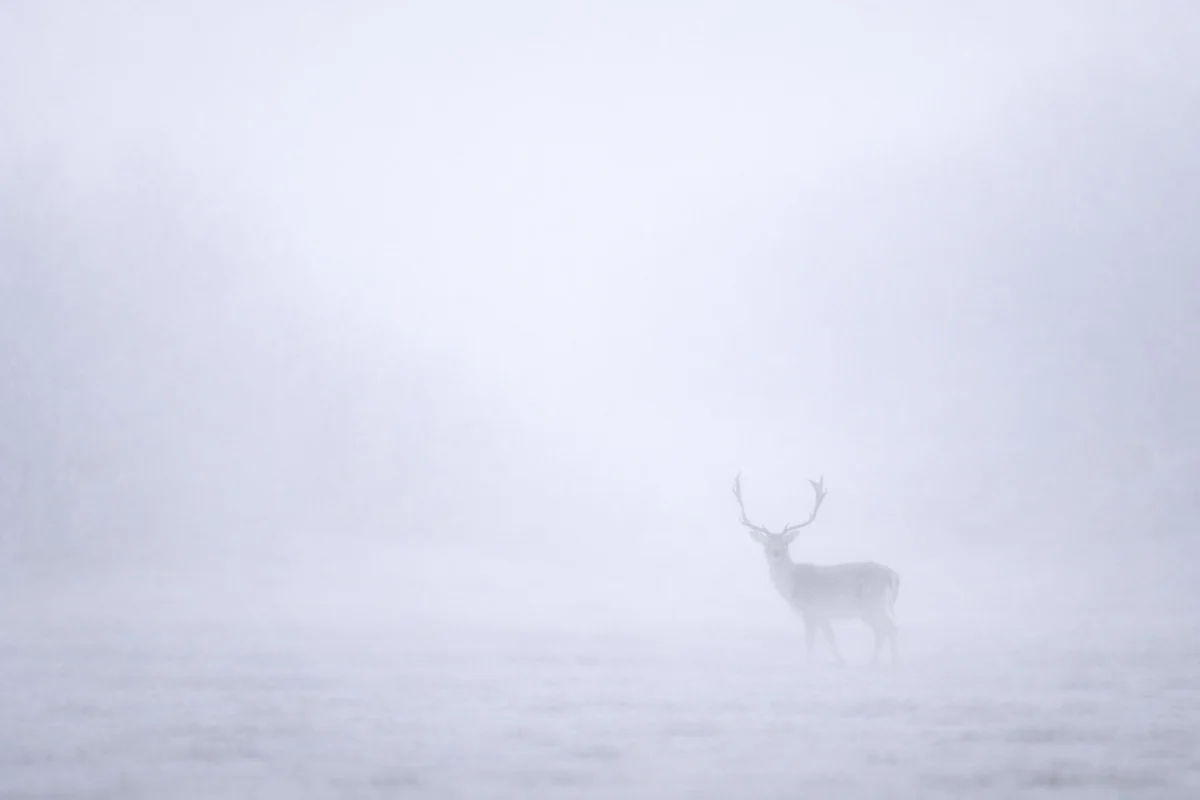
The realm of nature photography, often celebrated for its vibrant depictions of wildlife and grand landscapes, is increasingly witnessing a profound shift towards introspection and quietude, exemplified by a distinct approach that prioritizes minimalism and emotional resonance over explicit detail. This evolving perspective, embraced by a growing number of contemporary artists, seeks to distill the essence of natural encounters, inviting viewers into a contemplative space rather than overwhelming them with visual information. It represents not merely a stylistic choice but a deeply ingrained philosophical commitment to capturing the felt experience of nature, where silence is never empty and space holds profound meaning.
The Genesis of an Introspective Vision

For many practitioners of this minimalist style, the journey begins not with a conscious decision or a learned technique, but with an intuitive pull towards simplicity. It often manifests as an unconscious gravitation towards stepping back, allowing subjects to recede within the frame, and embracing negative space. This foundational inclination, characterized by a search for quietude, frequently predates formal photographic education or an understanding of established aesthetic movements. It’s an inherent sensibility that perceives clutter as overwhelming, finding solace and clarity in serene backgrounds and a pervasive sense of air within the composition.
The discovery of high-key and low-key photography techniques often serves as a pivotal moment for these artists. Far from being merely technical tools, these methods resonate deeply, feeling less like learned skills and more like a recognition of an innate artistic language. High-key photography, characterized by predominantly bright tones and minimal shadows, and low-key, defined by dark tones and stark contrasts, both serve to simplify the visual field. They strip away extraneous detail, allowing the core subject and its emotional context to emerge with heightened intensity. This deliberate reduction of visual information fosters an environment where subtleties can thrive, transforming the photographic frame into a canvas for introspection.
The Landscape of Calm: Nature as a Sanctuary

The preference for minimalist aesthetics is deeply intertwined with the artist’s personal experience of nature. Moments spent amidst fog or snowfall, for instance, are not just opportunities for unique lighting; they are transformative experiences that induce a profound sense of calm. The world, softened by atmospheric conditions, slows down, and thoughts become less turbulent. This interaction with nature is described as a source of deep, quiet happiness, occasionally punctuated by unexpected waves of gratitude and a powerful sense of belonging. In these solitary moments, the artist finds freedom from the pressures of explanation or expectation, experiencing a rare state of being understood and held by the natural world.
This profound connection underscores a broader psychological phenomenon: the restorative power of nature. Research in environmental psychology consistently demonstrates that exposure to natural environments can significantly reduce stress, improve mood, and enhance cognitive function. The "Attention Restoration Theory," proposed by psychologists Rachel and Stephen Kaplan, suggests that natural settings provide "soft fascination," allowing for effortless attention and mental recovery from the directed attention demanded by modern urban life. The minimalist photographer, in seeking quiet and space within their frames, is intuitively tapping into this restorative quality, not just for themselves during the act of creation, but also for their eventual audience.
Minimalism Beyond Aesthetics: A Philosophical Imperative

The artist’s intense experience of the world – a heightened sensitivity to details, moods, and shifts in light and energy – often creates a complex inner landscape. While beautiful, this internal richness can also be overwhelming. Nature, particularly when approached with a minimalist sensibility, offers a crucial counterbalance. The expansive openness of natural settings mirrors and facilitates an internal sense of space, allowing this intensity to find balance. This is where minimalism transcends mere aesthetic preference to become a psychological necessity, a means of managing internal complexity by reflecting external simplicity.
In a society characterized by relentless motion and constant stimuli, the act of pausing in nature is a radical departure. People frequently move through natural spaces with urgency, rarely stopping long enough for deeper observation. However, the artist observes that nature reveals itself differently to those who linger. When one remains in a single location, free from urgency or specific expectation, subtle shifts become apparent. The light imperceptibly changes, faint movements appear at the periphery of vision, and previously unseen details slowly come into focus. This heightened attentiveness, born from prolonged stillness, transforms the act of seeing, making it difficult to revert to a fast-paced, superficial gaze.
This deliberate slowing down is not just a photographic technique; it’s a way of being. It invites attention and presence, revealing that the emptiness often associated with minimalism is, in fact, rich with depth. The silence within these images is never truly empty; it is pregnant with possibility, an invitation for feeling and interpretation. White space in a photograph becomes metaphorical breathing room, while darkness offers a sense of rest. High-key and low-key compositions serve to "soften the world," stripping away superficiality until only the essential remains, not to diminish meaning but to create ample room for it to resonate.

The Artist’s Ethos: Authenticity Over Convention
The commitment to this minimalist approach is not a fleeting phase but a steadfast direction. It is a conscious choice rooted in the desire to preserve the raw, authentic feeling of the moment of capture. Simplicity keeps the artist intimately connected to that initial emotional experience. Distance in composition provides space – both for the subject to exist within its environment and for the artist’s own internal processing. Restraint ensures that the image remains open-ended, inviting the viewer’s personal engagement rather than dictating a singular interpretation.
Crucially, this minimalist philosophy is not an afterthought applied during post-processing; it is integral to the entire photographic process, beginning in the field. It manifests in the duration of the artist’s stay, the patience exercised, and the conscious decision of how much to leave untouched within the frame. This pre-visualization and pre-composition based on restraint define the work long before the shutter clicks.

The artist’s motivation is deeply personal and internal, entirely independent of external validation or prevailing trends. Only images that evoke a visceral, bodily response are deemed worthy of sharing. If an image fails to move the artist, it remains private, regardless of its technical perfection or potential market appeal. This uncompromising commitment to emotional truth over external metrics underscores a profound artistic integrity.
Technical knowledge, while present and foundational, never dictates the creative process. Instead, it serves as a silent partner, allowing the moment itself to lead. The artist often perceives, within a split second, whether an image possesses the desired resonance – a physical response that precedes conscious thought. This intuitive trust allows for the breaking of conventional rules when necessary, prioritizing authentic feeling over rigid adherence to established norms. Photography, in this context, becomes a sanctuary where the artist can fully immerse themselves without losing their sense of self, a space free from the need to perform or explain, where pure feeling is sufficient.
Beyond the Frame: Presence and Connection

When questioned about the subject matter of their photographs, the artist acknowledges that the answer is rarely straightforward. The images are not merely about animals, landscapes, or minimalism as a theoretical concept. They are fundamentally about presence – about being fully immersed in a moment that demands nothing in return. Encounters in ethereal conditions like snow or mist are often fleeting and delicate. A fox pausing quietly, a deer momentarily appearing then vanishing – these are fragile, almost weightless experiences. The artist’s approach is to respect this fragility, stepping back, giving space, and allowing distance to become an integral part of the narrative. The true draw is not the encounter itself, but the lingering feeling it imprints.
This perspective challenges common perceptions of strength and value. It posits that stillness possesses a unique voice, that softness can carry immense power, and that there is inherent value in restraint and choosing less over more. Minimalism, often mistakenly equated with emptiness, is re-framed as an invitation – an expansive, open space where viewers are encouraged to pause and connect with their own experiences, free from the pressure to understand or resolve anything within the frame.
The ultimate aspiration for these photographs is not to impress, but to invite. To invite viewers into a space of quietude, into a moment where nothing needs to be solved. The purpose of this photography is not merely to document what nature looks like, but to profoundly share how it feels when silence itself is enough. In an increasingly noisy world, this minimalist approach offers a vital counter-narrative, reminding us of the profound beauty and wisdom found in stillness and the unburdened gaze. It stands as a testament to the enduring power of art to foster connection, not just between the artist and nature, but between the art and the soul of the viewer.
