
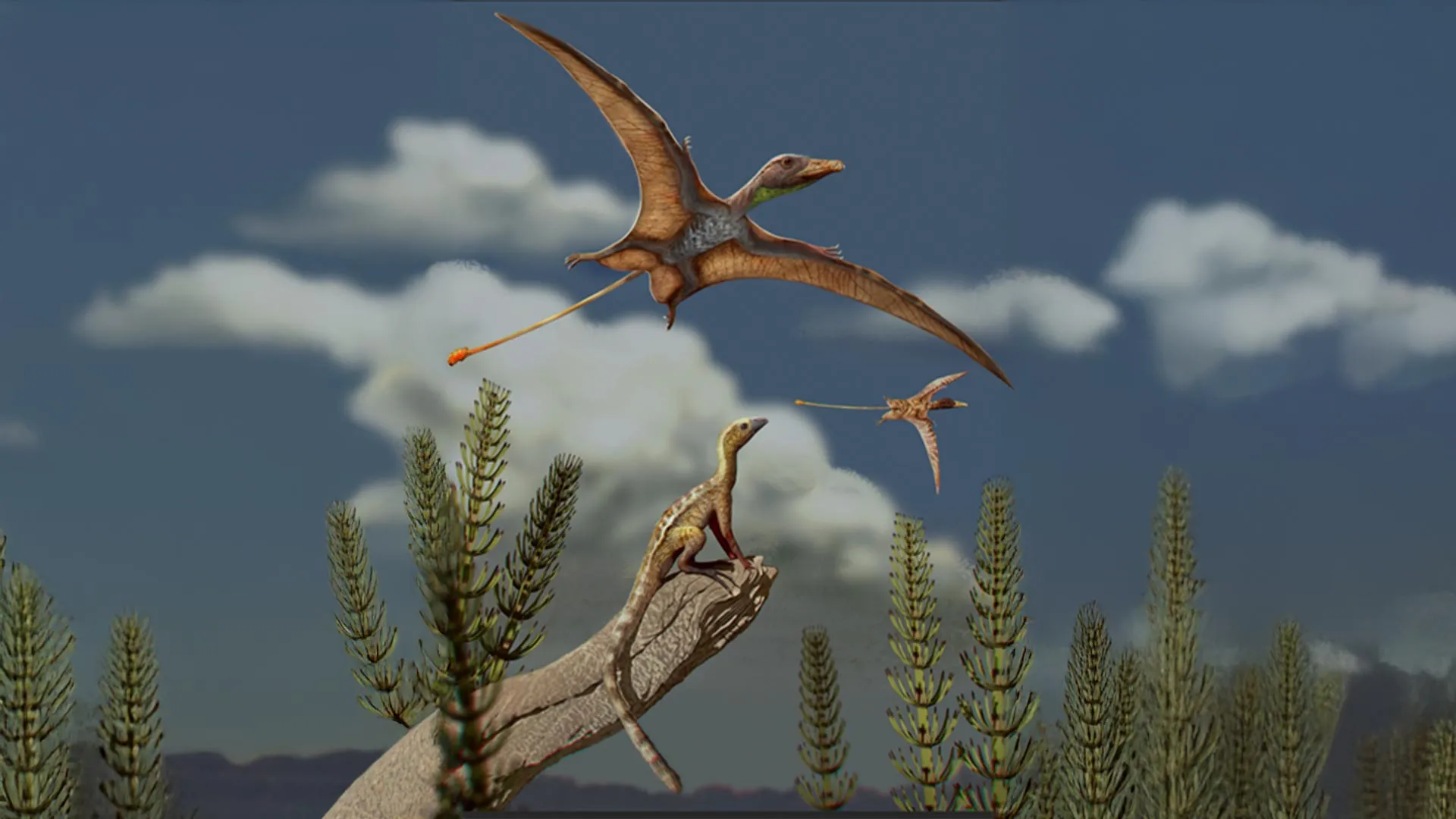
A research group led by evolutionary biologist Dr. Matteo Fabbri at Johns Hopkins Medicine reports that giant reptiles living as far back as 220 million years ago may have developed the ability to fly at the very start of their evolutionary history, a finding that contrasts sharply with the ancestors of modern birds, which are thought to have reached powered flight more slowly and with larger, more complex brains. This groundbreaking investigation, which relied on advanced imaging methods to meticulously examine the internal brain cavities of pterosaur fossils and received partial support from the National Science Foundation, had its detailed findings published on November 26 in the esteemed scientific journal Current Biology. The study challenges long-held assumptions about the neural prerequisites for powered flight, suggesting that different evolutionary paths can lead to similar complex adaptations.
The Mesozoic Skies: Pterosaurs, Earth’s First Vertebrate Fliers
The Mesozoic Era, often dubbed the "Age of Reptiles," spanning approximately 252 to 66 million years ago, witnessed the rise and dominance of dinosaurs, marine reptiles, and crucially, the pioneering vertebrate aviators: pterosaurs. Long before birds took to the skies, and millions of years prior to the emergence of bats, pterosaurs evolved the remarkable ability of powered flight. These formidable creatures ranged dramatically in size, from sparrow-sized forms to colossal giants like Quetzalcoatlus northropi, which boasted wingspans exceeding 30 feet and could weigh up to 500 pounds, making them the largest known flying animals of all time. Their unique wing structure, a membrane of skin, muscle, and other tissues stretching from an elongated fourth finger to their ankles, presented a distinct biological solution to the challenge of aerial locomotion. Despite their immense evolutionary success and global distribution across the Triassic, Jurassic, and Cretaceous periods, the precise mechanisms and neurological underpinnings of how pterosaurs achieved flight have remained a subject of intense scientific debate. This new research from Johns Hopkins Medicine offers crucial insights into this ancient mystery.
According to Dr. Matteo Fabbri, an assistant professor of functional anatomy and evolution at the Johns Hopkins University School of Medicine, the results of their investigation significantly strengthen the idea that the enlarged brains seen in birds, and likely in their theropod dinosaur ancestors, were not a necessary condition for pterosaurs to take to the air. "Our study shows that pterosaurs evolved flight early on in their existence and that they did so with a smaller brain similar to true non-flying dinosaurs," Fabbri stated, underscoring a fundamental divergence in evolutionary strategy between the two major reptilian lineages that achieved powered flight.
Unveiling Ancient Brains: Advanced Imaging Techniques
To delve into the evolutionary trajectory of pterosaur flight and understand how their path might have diverged from that of birds and bats, the research team employed state-of-the-art methodologies. Their investigation centered on examining shifts in the shape and size of the brain over deep time, with a particular focus on the optic lobe—a critical brain region intrinsically linked to vision and, by extension, to the complex sensory processing required for flight capabilities. The delicate and often fragmented nature of fossilized brains means direct observation is impossible. Instead, scientists rely on endocasts, which are natural or artificial casts of the brain cavity within a skull, providing a reliable proxy for the external morphology of the brain.
The Johns Hopkins team utilized advanced computed tomography (CT) imaging and specialized software. This powerful combination allowed them to digitally reconstruct and model fossilized nervous system structures from various specimens. This non-invasive approach enabled them to peer inside the fossilized skulls without causing damage, creating detailed 3D models of the brain and inner ear structures. These digital endocasts offered unprecedented resolution, revealing nuances of brain size, shape, and the relative proportions of different brain regions that would be impossible to discern through traditional paleontological methods. The precision of these techniques was crucial for making comparative analyses across different species and evolutionary stages.
The Lagerpetid Link: A Pre-Adaptation for Flight
A pivotal aspect of the study involved concentrating on the closest known relative of the pterosaur: the lagerpetid. First identified by scientists in 2016 and further confirmed in 2020 to have a close evolutionary connection to pterosaurs, the lagerpetid was a flightless, quadrupedal, and likely arboreal (tree-climbing) reptile. It roamed the Earth during the Triassic period, specifically between 242 and 212 million years ago, predating the widespread appearance of pterosaurs. This ancient creature offered a unique window into the ancestral condition from which pterosaurs evolved.
Upon analyzing the lagerpetid’s brain endocasts, the researchers made a significant discovery. As corresponding author Mario Bronzati, a researcher at the University of Tübingen, Germany, explained, "The lagerpetid’s brain already showed features linked to improved vision, including an enlarged optic lobe, an adaptation that may have later helped their pterosaur relatives take to the skies." This finding suggests a concept known as exaptation, where a trait evolves for one purpose (e.g., enhanced vision for arboreal navigation or hunting in a dense Triassic forest) and is later co-opted and adapted for a new, entirely different function, such as powered flight. The enlarged optic lobe in lagerpetids provided a foundational neural architecture that pterosaurs could then rapidly build upon.
Dr. Fabbri noted that pterosaurs also possessed enlarged optic lobes, indicating the retention and further refinement of this visual acuity. However, beyond this shared trait, he clarified that the overall brain shape and size of pterosaurs differed considerably from those of the lagerpetid. This divergence is key to understanding the rapid evolutionary leap. "The few similarities suggest that flying pterosaurs, which appeared very soon after the lagerpetid, likely acquired flight in a burst at their origin," Fabbri elaborated. "Essentially, pterosaur brains quickly transformed acquiring all they needed to take flight from the beginning." This implies a rapid, almost instantaneous, neurological reorganization that facilitated the complex motor control and sensory processing required for powered flight, rather than a protracted, step-by-step accumulation of adaptations.
Pterosaur vs. Avian Flight: Divergent Evolutionary Paths
The findings from the Johns Hopkins team present a compelling contrast to the widely accepted model of avian flight evolution. Modern birds are thought to have evolved flight through a more gradual, incremental process, building upon neurological and anatomical adaptations inherited from their theropod dinosaur ancestors. This gradual model posits that key traits, including the expansion of the cerebrum (responsible for higher cognitive functions), the cerebellum (crucial for motor coordination and balance), and the optic lobes, were present in various stages of development in early bird relatives before being further refined and integrated for the demands of powered flight.
Support for this gradual model comes from a separate but complementary line of research, including a 2024 study from the laboratory of Dr. Amy Balanoff, an assistant professor of functional anatomy and evolution at Johns Hopkins Medicine. Balanoff’s work highlights the paramount importance of cerebellum expansion in the origins of bird flight. The cerebellum, located at the back of the brain, acts as a sophisticated control center, regulating muscle coordination, posture, balance, and fine motor skills—all indispensable for the intricate maneuvers of flight. For birds, the gradual enlargement of this region, along with the cerebrum and optic lobes, represented a continuous refinement of neurosensory capabilities over millions of years, culminating in the highly efficient and agile flight characteristic of modern avians.
"Any information that can fill in the gaps of what we don’t know about dinosaur and bird brains is important in understanding flight and neurosensory evolution within pterosaur and bird lineages," Dr. Balanoff emphasized, highlighting the broader significance of comparative neuroanatomy in unraveling the complexities of evolutionary adaptation. The distinct paths taken by pterosaurs and birds underscore the principle of convergent evolution, where different lineages arrive at similar solutions (powered flight) through disparate evolutionary mechanisms and neurological configurations.
Comparative Neuroanatomy: Insights Across Species
To place their pterosaur findings in a broader evolutionary context, the research team extended their analysis to include brain cavities from other significant reptilian groups. They examined endocasts from crocodilians (which represent an ancient lineage closely related to archosaurs, the group that includes dinosaurs, pterosaurs, and birds) and various early, extinct birds. This comparative approach allowed them to identify shared ancestral traits and pinpoint unique specializations.
Their comprehensive analysis revealed that pterosaurs had moderately enlarged brain hemispheres, a feature comparable in proportion to other non-avian dinosaur groups. This included the two-legged, bird-like troodontids, a group of agile theropod dinosaurs that lived between the Late Jurassic and Late Cretaceous periods (approximately 163 to 66 million years ago), known for their relatively large brains among dinosaurs. The pterosaur brain structure was also comparable to that of Archaeopteryx lithographica, famously known as the oldest-known bird, which lived between 150.8 and 125.45 million years ago. These prehistoric species, while exhibiting some neurological sophistication, differ strongly from modern birds, which possess significantly larger and more complex brain cavities relative to their body size, particularly in the cerebrum and cerebellum. This comparison further solidifies the notion that pterosaurs achieved flight without the extensive cerebral and cerebellar expansion that characterized the avian lineage, suggesting a different neural strategy for mastering the air.
Implications and Future Research Directions
The findings from Dr. Fabbri’s team have profound implications for our understanding of the evolution of complex behaviors and the neurological underpinnings of flight. They suggest that there isn’t a single, predetermined neurological pathway to achieving powered flight. Instead, evolution can leverage existing structures (like the lagerpetid’s optic lobe) and facilitate rapid reorganization to meet new adaptive challenges, as seen in pterosaurs. This "burst" model for pterosaur flight evolution challenges the assumption that larger, more complex brains are always a prerequisite for such advanced capabilities. It highlights the efficiency and adaptability of natural selection in finding diverse solutions to similar environmental pressures.
Looking ahead, Dr. Fabbri indicates that future progress in this field will depend on moving beyond just size and shape to understand the brain’s internal structure and how it enabled pterosaurs to achieve flight. He explains that delving into the neural circuitry and specific functional organization within these ancient brains will be essential for uncovering the broader biological principles that govern the evolution of flight across all vertebrate lineages. This next phase of research will likely involve even more sophisticated imaging techniques and comparative studies, potentially drawing on insights from modern neuroscience to interpret fossil evidence.
This groundbreaking research was supported by a diverse array of international funding bodies, including the Alexander von Humboldt Foundation, the Brazilian Federal Government, The Paleontological Society, Agencia Nacional de Promoción Científica y Técnica, Conselho Nacional de Desenvolvimento Científico e Tecnológico, the European Union NextGeneration EU/PRTR, the National Science Foundation (NSF DEB 1754596, NSF IOB-0517257, IOS-1050154, IOS-1456503), and the Swedish Research Council. The extensive list of contributing scientists underscores the highly collaborative and interdisciplinary nature of modern paleontological and evolutionary biology research. In addition to Dr. Fabbri and Dr. Bronzati, key contributors included Akinobu Watanabe from New York Institute of Technology; Roger Benson from the American Museum of Natural History; Rodrigo Müller from Federal University of Santa Maria, Brazil; Lawrence Witmer from the University of Ohio; Martín Ezcurra and M. Belén von Baczko from Bernardino Rivadavia Museum of Natural Science; Felipe Montefeltro from São Paulo State University; Bhart-Anjan Bhullar from Yale University; Julia Desojo from Universidad Nacional de La Plata, Argentina; Fabien Knoll from Museo Nacional de Ciencias Naturales, Spain; Max Langer from Universidade de São Paulo, Brazil; Stephan Lautenschlager from University of Birmingham; Michelle Stocker and Sterling Nesbitt from Virginia Tech; Alan Turner from Stony Brook University; and Ingmar Werneburg from Eberhard Karls University of Tübingen. Their combined expertise has significantly advanced our understanding of how one of Earth’s most spectacular evolutionary innovations came to be.
