
The annual spectacle of spring migration, a global ballet performed by billions of birds, captivates ornithologists and enthusiasts alike. This profound ecological event, driven by ancient instincts and the pursuit of optimal breeding grounds, transforms landscapes with a vibrant influx of color and song. To celebrate the distinct personalities and remarkable feats within this grand procession, observers often playfully assign "superlatives" to these feathered travelers. Far from mere whimsy, these classifications, while anthropomorphic, serve as a compelling framework to highlight the unique characteristics, behaviors, and ecological significance of some of North America’s most cherished spring migrants, particularly the Neotropical species undertaking arduous journeys from their wintering grounds in Central and South America.
The very concept of spring migration is a testament to avian resilience. Triggered by increasing daylight hours and hormonal shifts, birds embark on journeys spanning thousands of miles, navigating by the Earth’s magnetic field, celestial cues, and even olfactory maps. These migrations are fraught with peril, from extreme weather and predation to habitat loss and exhaustion. Yet, year after year, these tiny voyagers return, their arrival signaling the rebirth of the northern ecosystems. Understanding their individual traits – their songs, plumage, foraging styles, and even their shyness or gregariousness – deepens our appreciation for this natural wonder and underscores the critical importance of conservation efforts.
While the selection of "superlatives" inherently involves a degree of subjective interpretation, these informal accolades are rooted in decades of birding observations, ecological patterns, and the undeniable charisma certain species possess. They reflect not only aesthetic appeal but also profound biological adaptations and ecological roles. The focus here remains primarily on Neotropical migrants, species that undertake epic journeys across continents, embodying the very spirit of spring’s return.
The Phenomenon of Spring Migration: An Ecological Masterpiece
Spring migration is one of the planet’s most awe-inspiring natural phenomena, an annual movement of avian populations from their wintering grounds to their breeding territories. For Neotropical migrants, this often means traveling from Central and South America, across the Gulf of Mexico or land bridges, to breeding grounds across North America, including vast stretches of Canada’s boreal forest. This monumental undertaking is driven by the seasonal availability of food, longer daylight hours for foraging, and suitable nesting sites with fewer predators.
The challenges faced by these migrants are immense. They must build up significant fat reserves for sustained flight, navigate complex routes, and contend with unpredictable weather patterns. A single storm system over the Gulf of Mexico can decimate populations. Furthermore, habitat fragmentation and loss along their migratory flyways, both in wintering and breeding grounds, pose significant threats. Conservation organizations, such as the National Audubon Society, Cornell Lab of Ornithology, and Birds Canada, continually monitor population trends and advocate for the protection of crucial stopover sites and breeding habitats. The timing of migration is also a delicate balance, with some species arriving in early spring to claim prime territories, while others, like the Blackpoll Warbler, appear much later, sometimes well into June.
Most Popular: Scarlet Tanager (Piranga olivacea)
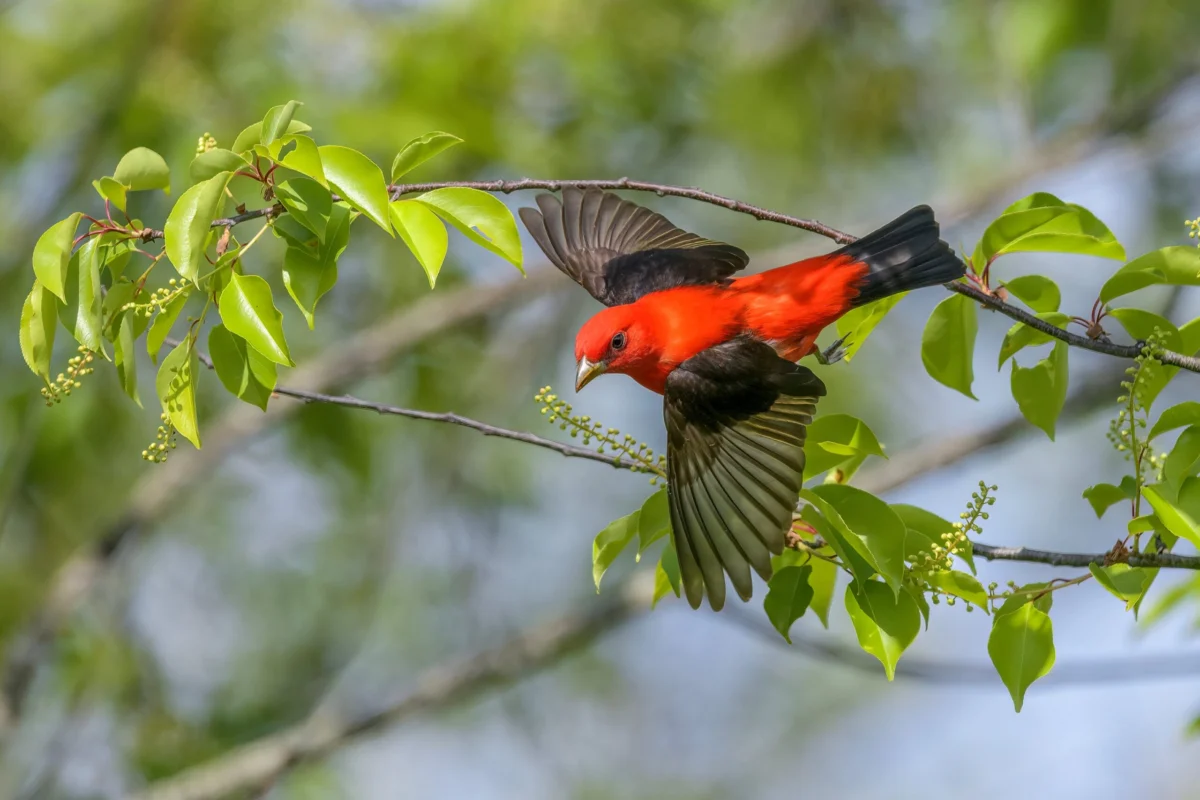
The Scarlet Tanager stands out as a veritable superstar of spring migration, consistently captivating both novice and seasoned birders. Its vivid, almost incandescent scarlet plumage, sharply contrasted by jet-black wings and tail, creates a visual spectacle that is hard to forget. This striking coloration is due to carotenoid pigments in their diet, making a healthy, brightly colored male a clear indicator of fitness. While highly sought-after species like the Cerulean Warbler or Blackburnian Warbler might excite experienced birders with their rarity and intricate patterns, the Scarlet Tanager’s sheer brilliance and relatively larger size make it more accessible and, therefore, broadly popular. Its tendency to forage higher in the canopy still requires a keen eye, but when sunlight illuminates its crimson form, the moment is truly unforgettable. The species breeds across eastern North America, typically in mature deciduous or mixed forests, arriving from its wintering grounds in northern South America. Despite being listed as "Least Concern" by the IUCN, like many forest-dwelling birds, it faces ongoing threats from habitat loss and fragmentation.
Runners-up: Cerulean Warbler, Blackburnian Warbler, Indigo Bunting, Prothonotary Warbler
Best Dressed: Black-throated Blue Warbler (Setophaga caerulescens)
In the realm of avian fashion, the Black-throated Blue Warbler exhibits an understated elegance that earns it the "Best Dressed" accolade. Unlike the flashier displays of some other warblers, this species presents a sophisticated, chic aesthetic. The male’s deep blue back, stark black throat and flanks, and pure white belly are undeniably striking. However, it’s the distinctive white patch at the base of the primaries on both males and females – often referred to as their "handkerchief" – that elevates their attire to an exceptional level of refinement. This field mark is not only beautiful but also highly diagnostic, aiding in identification. The females, though duller overall with olive-brown backs and buffy underparts, also sport this elegant white wing patch, demonstrating a consistent sense of style across both sexes. These warblers prefer the dense understory of mature deciduous and mixed forests in eastern North America, arriving from their wintering grounds in the Caribbean islands, often signaling their presence with a buzzy, zur-zur-zur-zweee song.
Runners-up: Bay-breasted Warbler, Canada Warbler, Chestnut-sided Warbler, Western Tanager
Most Musical: Wood Thrush (Hylocichla mustelina)
The Wood Thrush is the undisputed maestro of the spring forest, its ethereal, flute-like song a definitive soundtrack to eastern woodlands. Ornithologists and bird guides consistently describe its vocalizations with reverence, often highlighting its unique ability to sing two notes simultaneously due to a specialized vocal organ called the syrinx. This anatomical marvel allows the Wood Thrush to produce complex, haunting melodies that resonate with a rich, reverberating quality. Its song is not merely pleasant; it’s a multi-part, symphonic performance, weaving together short, distinct phrases that echo through the canopy. This exceptional vocal talent has inspired numerous composers, including Olivier Messiaen, who famously incorporated bird songs into his symphonic works. The Wood Thrush breeds in mature deciduous and mixed forests across eastern North America, typically arriving in mid-to-late spring from its wintering grounds in Central America. Sadly, its populations have experienced significant declines over recent decades, primarily due to habitat loss and fragmentation, making its mystical song an increasingly poignant reminder of vanishing forest ecosystems.
Runners-up: Swainson’s Thrush, Veery, Brown Thrasher, Gray Catbird
Best Song: Baltimore Oriole (Icterus galbula)
While the Wood Thrush might be the most talented vocalist, the Baltimore Oriole earns the "Best Song" distinction for its bright, full-throated serenade that is instantly recognizable and profoundly cheerful. Its song is a series of rich, clear whistles, often described as a lively, rolling melody that seems to encapsulate the joy of spring. It’s an earworm in the best possible sense, immediately drawing attention and bringing a smile to anyone fortunate enough to hear it. The sound often precedes the sighting of the male’s brilliant orange and black plumage, a vibrant flash against the green canopy. Baltimore Orioles are adept at finding food, often seen gleaning insects from leaves or probing flowers for nectar. They are also known to visit backyard feeders offering oranges or grape jelly, providing an accessible opportunity for direct observation. These iconic birds construct distinctive pendulous, woven nests, often high in deciduous trees, after migrating from their wintering grounds in Central and northern South America. Their arrival is a quintessential sign that spring has firmly taken hold.
Runners-up: Rose-breasted Grosbeak, White-throated Sparrow, Summer Tanager, Indigo Bunting
Most Talkative: Warbling Vireo (Vireo gilvus)
Many birds are vocal, but the Warbling Vireo distinguishes itself through sheer persistence and an almost ceaseless flow of song, making it the "Most Talkative." Its continuous, rambling warble, often described as an upward-spiraling series of notes ending with a flourish, can be heard for extended periods. Whether it’s the eastern or western subspecies, these inconspicuous birds, often hidden high in the canopy of deciduous trees along waterways or in open woodlands, will sing for hours on end, seemingly without pause. A birder might pass under a singing Warbling Vireo, leave for an hour, and return to find the same bird still delivering its tireless monologue. This constant vocalization serves primarily to defend territory and attract mates, highlighting the intense competitive pressures during the breeding season. Despite their relentless singing, their cryptic olive-gray plumage and preference for upper canopy branches can make them surprisingly difficult to spot, cementing their reputation as a bird more often heard than seen.
Runners-up: Gray Catbird, Yellow-breasted Chat, Northern House Wren, Red-eyed Vireo
Teacher’s Pet: Ovenbird (Seiurus aurocapilla)
The Ovenbird earns its "Teacher’s Pet" moniker with a song that is almost comically on the nose: a loud, emphatic "teacher, TEACHER, TEACHER!" that increases in volume and intensity. This distinctive vocalization, echoing through the forest understory, is one of the most memorable sounds of spring. Beyond its mnemonic call, the Ovenbird is a charming and often cooperative species. During migration, these small, plump warblers with their olive-brown backs and orange-striped heads can be remarkably accommodating, hopping about on the forest floor in plain view as they forage for insects. Their unique "oven-shaped" dome nests, cleverly camouflaged on the ground, further attest to their distinctive character. However, while singing from a perch, they can become maddeningly difficult to locate, often remaining perfectly still, making their initial approach a delightful surprise for birders. Ovenbirds breed in mature deciduous and mixed forests across eastern North America and winter in Central America and the Caribbean.
Runners-up: White-throated Sparrow, Black-and-white Warbler, Yellow-rumped Warbler, Ruby-crowned Kinglet
Friendliest: Black-and-white Warbler (Mniotilta varia)
The Black-and-white Warbler is arguably the most approachable and obliging warbler, deserving the title of "Friendliest." Its zebra-striped plumage makes it visually distinctive, but it’s its foraging behavior that truly sets it apart. Unlike many warblers that flit quickly through the canopy, the Black-and-white Warbler creeps along tree trunks and branches, meticulously searching for insects in bark crevices, much like a nuthatch. This behavior often brings it down to eye-level, allowing birders remarkably close views as it diligently works its way up and down trees. During migration, these adaptable birds can be found in a wide variety of wooded habitats, including urban street trees and suburban parks, making them accessible even in bustling city environments. This combination of distinct appearance, cooperative foraging, and widespread presence during migration has earned it the affectionate nickname among some birders as "The People’s Warbler," highlighting its consistent willingness to interact, albeit unknowingly, with human observers.
Runners-up: White-throated Sparrow, Yellow-rumped Warbler, Common Yellowthroat, Palm Warbler
Shyest: Mourning Warbler (Geothlypis philadelphia)
For every friendly bird, there’s a shy counterpart, and the Mourning Warbler epitomizes avian elusiveness, making it the "Shyest" spring migrant. This skulking warbler has a notorious reputation for being incredibly difficult to observe, often remaining hidden deep within dense thickets, brush piles, and the tangled undergrowth of clearcuts and forest edges. Birders frequently report hearing its distinctive, whistled song – a rich, ringing chirry-chirry-chirry-chorry-chorry – only to be frustrated by its uncanny ability to disappear into the shadows the moment it’s spotted, even if just feet away. The male’s striking slate-gray hood and black breast patch are beautiful, but fleeting glimpses are often all that are granted. This warbler breeds in northern deciduous and mixed forests, particularly in areas with dense shrubbery resulting from disturbance, and winters in Central and northern South America. Its secretive nature demands extreme patience and quiet observation, a challenging but rewarding pursuit for dedicated birders.
Runners-up: Swainson’s Warbler, Worm-eating Warbler, Kentucky Warbler, Yellow-billed/Black-billed Cuckoo
Class Clown: American Woodcock (Scolopax minor)
The American Woodcock, often affectionately called a "bogsucker" or "timberdoodle," is the undisputed "Class Clown" of spring migration. This odd-looking shorebird, with its disproportionately long bill, large eyes set high on its head, and cryptic brown plumage, transforms from an elusive, nocturnal resident into a surprisingly public entertainer during its spring courtship. Woodcocks can appear in unexpected urban locations during migration, drawing significant attention, as evidenced by recent sightings in city parks. Their courtship display, known as the "sky dance," is a remarkable aerial ballet: the male performs spiraling flights high into the twilight sky, producing a unique whistling sound with specialized outer primary feathers, followed by a series of vocalizations as he descends. On the ground, their peculiar foraging "dance," a rhythmic bobbing and rocking motion believed to help them detect earthworms, adds to their whimsical charm. These unique behaviors make the American Woodcock a source of pure delight and entertainment for anyone fortunate enough to witness them. They breed across eastern North America in moist woodlands and old fields, wintering in the southern U.S.
Runners-up: Gray Catbird, Common Yellowthroat, Northern House Wren, Great Crested Flycatcher
Most Creative: Northern Parula (Setophaga americana)
Creativity in the avian world often manifests in nest construction, and the Northern Parula excels in this regard, earning it the "Most Creative" superlative. While many birds build intricate nests, the female Northern Parula employs a particularly ingenious approach by repurposing natural materials in a highly specialized manner. She constructs a hanging, cup-shaped nest almost exclusively within dense clumps of Spanish moss or beard lichen. This unique choice of material provides exceptional camouflage and insulation, seamlessly blending the nest into its surroundings. The resulting structure is a cozy, perfectly hidden abode, a testament to the bird’s resourcefulness and adaptation to specific habitat features. The Northern Parula itself is a diminutive, beautiful warbler with a blue-gray back, a yellowish-green patch on its back, two white wing bars, and a distinctive reddish-brown breast band. They breed in humid forests with abundant moss or lichen, often near water, across eastern North America, arriving from their wintering grounds in the Caribbean and Central America.
Runners-up: Baltimore Oriole, Anna’s Hummingbird, Ovenbird, Barn Swallow
Cutest Couple: American Redstart (Setophaga ruticilla)
The American Redstart embodies vibrant energy and coordinated charm, making them the "Cutest Couple" of spring migration. The male, with his striking black body, brilliant blaze-orange patches on his wings and tail, and white belly, is a dynamic splash of color. However, it’s the female’s coordinating, yet subtly distinct, plumage that completes the pair: she sports gray and olive tones with equally eye-catching yellow patches where the male has orange. Together, they create an undeniably attractive and lively duo. American Redstarts are incredibly active flycatchers, constantly flitting through the mid-story and canopy, fanning their tails flamboyantly to flush out insects. This energetic foraging behavior, coupled with their contrasting yet complementary coloration, makes watching a pair of redstarts a captivating experience. They breed in a variety of deciduous and mixed forests across North America, wintering extensively in Central and South America and the Caribbean, their arrival a quintessential sign of spring’s full bloom.
Runners-up: Black-throated Blue Warbler, Painted Bunting, Northern Parula, Scarlet Tanager
Most Likely to Succeed (at Breeding): Gray Catbird (Dumetella carolinensis)
The Gray Catbird, a familiar inhabitant of dense shrubs and forest edges, earns the "Most Likely to Succeed (at Breeding)" superlative due to a remarkable suite of reproductive strategies and robust population trends. Firstly, catbirds are prolific breeders, often raising two to three clutches per year, significantly increasing their overall reproductive output and the odds of successful fledgling. Secondly, and critically for their success, they possess an extraordinary ability to identify and remove the eggs of brood parasites, particularly the Brown-headed Cowbird, from their nests. This defense mechanism is crucial, as cowbird chicks would otherwise outcompete the catbird’s own young for food and parental care. This behavioral adaptation provides a significant advantage in areas where cowbirds are prevalent. Lastly, population data from sources like the Christmas Bird Count indicate that Gray Catbird populations have been steadily rising since the 1980s, demonstrating their adaptability and resilience in the face of environmental changes. Their distinctive cat-like mewing call and varied, mimetic song are also hallmarks of their presence in suburban gardens and wilder thickets across North America.
Runners-up: American Redstart, Yellow-rumped Warbler, Black-throated Blue Warbler, American Woodcock
Most Athletic: Ruby-throated Hummingbird (Archilochus colubris)
While many birds undertake incredible migrations, the Ruby-throated Hummingbird stands out as the "Most Athletic" due to its astonishing feats of endurance and physiological prowess relative to its diminutive size. Weighing no more than a penny (typically 2-6 grams), these tiny birds embark on an epic journey from their wintering grounds in Mexico and Central America to breeding territories across eastern North America. The most mind-boggling aspect of this migration is their non-stop flight across the Gulf of Mexico, a journey of over 500 miles that can take 18-22 hours of continuous flight. Their wings beat at an astonishing rate of 50-80 times per second, allowing them to hover and dart with unparalleled agility. This high-energy lifestyle requires constant refueling, as they must consume nectar and small insects frequently throughout their journey. The sheer scale of their migration, coupled with their miniature size and incredibly high metabolism, makes the Ruby-throated Hummingbird a true marvel of avian athleticism.
Runners-up: Bar-tailed Godwit, Red Knot, Blackpoll Warbler, Swainson’s Thrush
Most Likely to Miss Migration: Blackpoll Warbler (Setophaga striata)
The Blackpoll Warbler earns the "Most Likely to Miss Migration" superlative, not because it’s lazy, but because it is one of the very last Neotropical migrants to arrive on its northern breeding grounds. When birders hear the Blackpoll’s high-pitched, thin, reedy tsit-tsit-tsit song emanating from the treetops, it’s a clear signal that the peak of spring migration is winding down. These black-capped, orange-legged warblers typically peak in mid-to-late May, with some individuals still migrating into June, well after most other warblers have settled on their territories. Their journey from northern South America is protracted in the spring, often involving multiple stopovers in the West Indies and Florida before they reach their breeding grounds in Canada’s vast boreal forests and Alaska. Conversely, their fall migration is an even more spectacular, albeit speedy, affair: Blackpolls undertake the longest migration of any warbler, often making an epic, non-stop flight across the entire Atlantic Ocean from northeastern North America to South America. This stark contrast in spring and fall migration strategies highlights their unique adaptations to seasonal resource availability and wind patterns.
Runners-up: Willow Flycatcher, Alder Flycatcher, Yellow-bellied Flycatcher, Red-eyed Vireo
Best All-Around: Rose-breasted Grosbeak (Pheucticus ludovicianus)
The male Rose-breasted Grosbeak is a truly exceptional bird, embodying a winning combination of aesthetic appeal, vocal talent, and surprising accessibility, making it the "Best All-Around" spring migrant. Its striking plumage features a bold black head and back, brilliant white wing patches, and a distinctive, triangular patch of rose-red on its breast, contrasting with its white belly. This coloration is visually stunning and instantly recognizable. Beyond its beauty, the Rose-breasted Grosbeak possesses a rich, melodious song often likened to an enthusiastic American Robin, but with a more refined, fluid quality. It’s a joyful and complex vocalization that adds significantly to the soundscape of spring. Furthermore, unlike many canopy-dwelling Neotropical migrants, these birds are known to visit backyard feeders during migration, particularly for sunflower seeds, making them relatively accessible for direct observation. While they primarily breed in deciduous and mixed forests across eastern North America and winter in Central and South America, their willingness to visit feeders offers a delightful opportunity for the public to connect with this magnificent species. The female, though less flamboyant, with streaky brown and white plumage and a prominent white eyebrow, is often mistaken for a female Purple Finch, adding another layer of interest to this remarkable species.
Runners-up: Baltimore Oriole, Scarlet Tanager, Black-throated Blue Warbler, Magnolia Warbler
In conclusion, the practice of assigning superlatives to spring migrants, while lighthearted, serves a profound purpose: it draws attention to the extraordinary diversity, intricate behaviors, and awe-inspiring journeys of these remarkable creatures. Each species, whether celebrated for its song, plumage, athletic prowess, or unique breeding strategies, contributes to the rich tapestry of our natural world. By engaging with birds in this way, we not only foster a deeper appreciation for their individual characteristics but also reinforce the critical importance of conservation efforts to protect the habitats and migratory pathways essential for their survival. The annual return of these feathered ambassadors is a powerful reminder of nature’s enduring cycles and the vital role we play in safeguarding them for future generations.
