
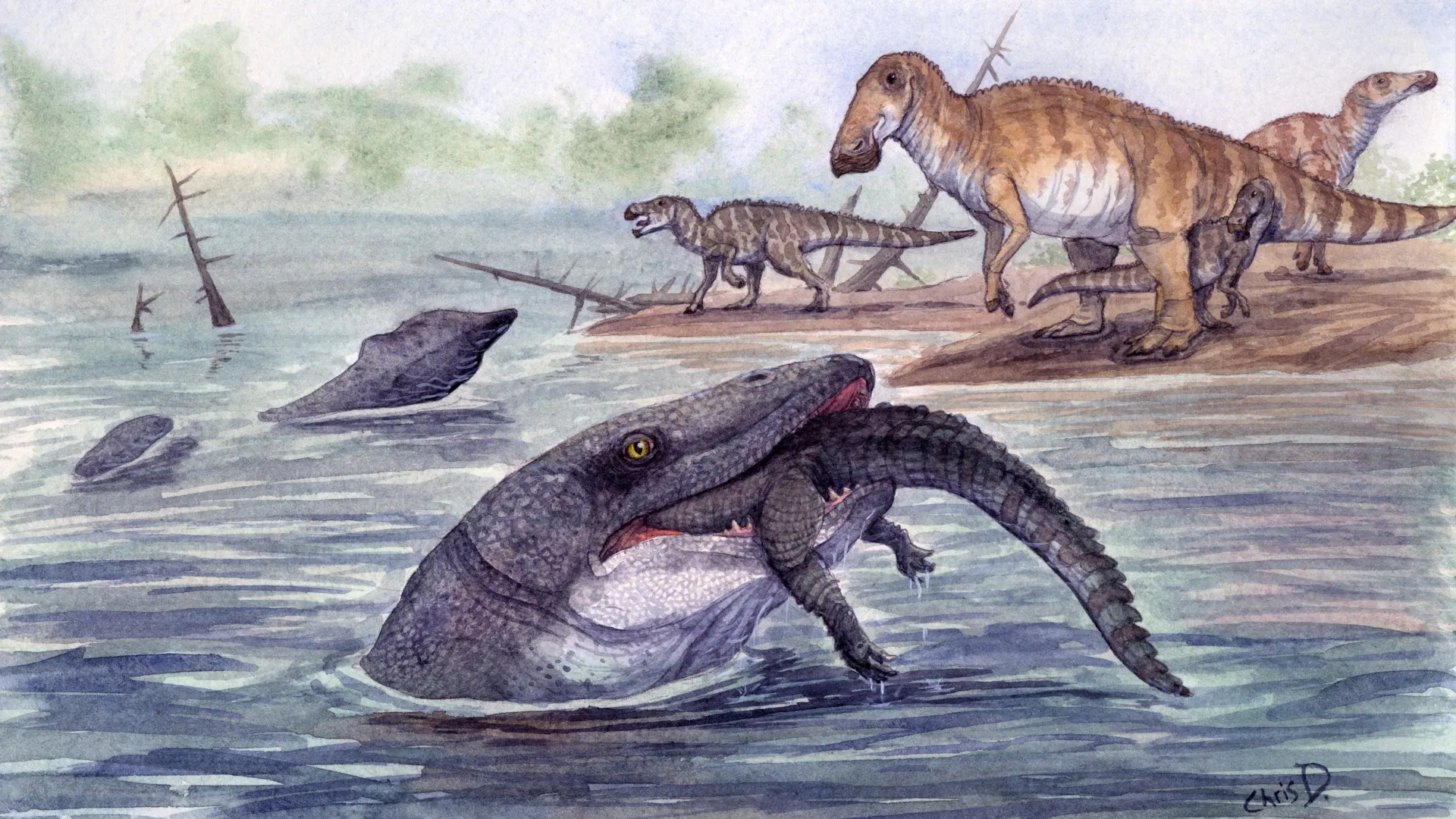
Mosasaurs were colossal marine reptiles, apex predators of ancient oceans, whose reign concluded over 66 million years ago. However, groundbreaking new evidence challenges the long-held belief that these formidable creatures were exclusively ocean-dwellers. An international research team, spearheaded by scientists from Uppsala University, has uncovered compelling indications that certain mosasaur populations ventured beyond the saline confines of the sea, adapting to freshwater river systems during the final million years leading up to their extinction. This revolutionary insight stems from the meticulous analysis of a mosasaur tooth unearthed in North Dakota, belonging to an individual estimated to have reached an astonishing length of up to 11 meters.
The Unexpected Discovery in North Dakota
The pivotal fossil, a mosasaur tooth, was retrieved in 2022 from a river deposit situated within North Dakota’s geological formations. Its discovery site presented an immediate enigma to paleontologists: it lay in close proximity to a tooth from a Tyrannosaurus rex and a jawbone fragment from a crocodylian. This unusual assemblage—comprising terrestrial dinosaurs, undisputed river-dwelling crocodiles, and what was historically considered a strictly giant marine reptile—piqued the curiosity of researchers. The prevailing understanding of mosasaurs as inhabitants of vast oceans made their presence in a freshwater riverine context deeply perplexing. How could the remains of such an archetypal marine predator become preserved alongside inland fauna, far from the ancient coastlines? This incongruity became the central question driving the subsequent scientific investigation. The region itself, known for its rich fossil record, including the remains of the duck-billed dinosaur Edmontosaurus, further underscored the unique nature of this particular find, as mosasaur remains in North Dakota are exceedingly rare, especially in non-marine settings. The blend of fossils suggested a fluvial environment where terrestrial and aquatic ecosystems intersected, an unlikely resting place for a creature thought to be purely pelagic.
Unlocking Ancient Secrets Through Isotope Analysis
To unravel this paleontological puzzle, a collaborative team of scientists from the United States, Sweden, and the Netherlands embarked on a detailed examination of the mosasaur tooth’s chemical composition. Their primary tool was isotope analysis, a sophisticated technique that scrutinizes the ratios of different atomic isotopes within a sample, providing a chemical fingerprint of an organism’s past environment and diet. Given that the mosasaur tooth, the T. rex tooth, and the crocodylian jawbone all originated from roughly the same geological stratum, dating back approximately 66 million years, the researchers were afforded a rare opportunity for direct chemical comparison, providing a contemporaneous environmental snapshot.
The analytical work was meticulously conducted at the Vrije Universiteit (VU) in Amsterdam, focusing specifically on stable isotopes of oxygen, strontium, and carbon. The results proved revelatory. The mosasaur tooth exhibited unusually elevated levels of the lighter oxygen isotope (¹⁶O), a signature unequivocally associated with freshwater environments rather than the heavier oxygen isotope ratios typically found in marine settings. This is because freshwater has a higher proportion of ¹⁶O due to differential evaporation and precipitation processes, making it a reliable indicator of an aquatic organism’s habitat. Complementary analysis of strontium isotope ratios further corroborated this finding, also pointing definitively towards a freshwater habitat for the creature. Strontium isotopes, derived from rocks weathered by water, carry a distinct signature of the geology through which the water flows, differing significantly between marine and continental river systems.
Delving deeper, the carbon isotopes within the tooth enamel offered insights into the mosasaur’s dietary habits. Melanie During, one of the study’s corresponding authors and a lead researcher from Uppsala University, explained the significance of these findings. "Carbon isotopes in teeth generally reflect what the animal ate. Many mosasaurs have low ¹³C values because they dive deep into the ocean, where the carbon cycling differs. The mosasaur tooth found with the T. rex tooth, on the other hand, has a higher ¹³C value than all known mosasaurs, dinosaurs and crocodiles examined from this period," During stated. "This higher ¹³C value is highly suggestive that it did not dive deep, implying a shallower habitat, and may even sometimes have fed on drowned dinosaurs that washed into the river system from the terrestrial environment." This dietary inference further solidifies the notion of a freshwater existence, as drowned terrestrial fauna would be far more common in a river than in the open ocean, providing a unique food source not typically available to deep-diving marine predators.
To ensure the robustness of their initial findings, the research team extended their analysis to two additional mosasaur teeth discovered at nearby, slightly older sites within North Dakota. Critically, these specimens also displayed similar freshwater isotope signatures, reinforcing the conclusion that this was not an isolated incident but rather a more widespread phenomenon. "The isotope signatures indicated that this mosasaur had inhabited this freshwater riverine environment," During confirmed. "When we looked at two additional mosasaur teeth found at nearby, slightly older, sites in North Dakota, we saw similar freshwater signatures. These analyses collectively demonstrate that mosasaurs indeed inhabited riverine environments during the final million years before their ultimate extinction." This corroboration across multiple specimens provides strong statistical backing for the team’s groundbreaking hypothesis, suggesting a sustained period of freshwater occupation.
A Changing World: The Western Interior Seaway’s Transformation
The findings not only present compelling evidence of mosasaurs in freshwater but also offer a plausible explanation for how such a dramatic lifestyle shift became evolutionarily feasible. The key lies in the dynamic geological and climatic changes that reshaped the North American continent during the Late Cretaceous period. At this time, a vast epicontinental sea known as the Western Interior Seaway bisected North America, extending from the Arctic Ocean to the Gulf of Mexico. This immense waterway, hundreds of kilometers wide and up to several hundred meters deep, fundamentally altered the continent’s geography and climate for millions of years, acting as a barrier to terrestrial animal migration and fostering unique marine ecosystems.
However, as the Late Cretaceous progressed, increasing volumes of freshwater, derived from extensive continental runoff and precipitation, began to flow into this colossal inland sea. This continuous influx gradually diluted the seaway’s salinity. Over geological timescales, likely tens to hundreds of thousands of years, the Western Interior Seaway underwent a profound transformation, evolving from a predominantly salty marine environment to one that was increasingly brackish, and eventually, in certain regions and at specific depths, resembling a mostly freshwater system. Researchers draw a modern parallel to the Gulf of Bothnia, a northern arm of the Baltic Sea, which today exhibits a significant salinity gradient, with its northern reaches being almost entirely fresh due to substantial river inflow from surrounding landmasses. This natural phenomenon demonstrates how large bodies of water can develop complex salinity profiles.
This influx of lighter freshwater over denser saltwater is theorized to have created a distinct ‘halocline’ within the seaway – a vertical salinity gradient where a less saline, often warmer, surface layer floats atop a more saline, cooler, deeper layer. Such stratification would have provided a unique ecological niche for animals capable of exploiting the upper freshwater zone while potentially avoiding the physiological challenges of deeper, saltier waters. Isotope data gathered from various fossil samples strongly supports this environmental reconstruction, painting a picture of a complex, layered aquatic environment.
Per Ahlberg, a coauthor of the study and Dr. During’s promotor, elaborated on this crucial aspect. "For comparison with the mosasaur teeth, we also measured fossils from other marine animals found in contemporary deposits and observed a clear difference," Ahlberg explained. "All gill-breathing animals, such as fish and certain invertebrates, had isotope signatures unequivocally linking them to brackish or salty water, indicating they inhabited the deeper, more saline layers. Conversely, all lung-breathing animals, like the mosasaurs, lacked such saline signatures. This distinct pattern strongly suggests that mosasaurs, which, by their very nature as air-breathers, needed to frequently ascend to the surface, inhabited and primarily utilized the upper freshwater layer, effectively avoiding the lower, more saline water where their prey might also reside." This elegant solution allowed these marine-adapted giants to thrive in an environment that was once considered entirely hostile to them, demonstrating a remarkable capacity for niche partitioning in a changing environment.
Evolutionary Ingenuity: Adapting to New Habitats
The researchers contend that the analyzed teeth unequivocally belonged to mosasaurs that had undergone significant physiological and behavioral adjustments to these evolving environmental conditions. The phenomenon of large predators shifting between vastly different habitats is not unprecedented in the annals of evolutionary history, underscoring the remarkable adaptability of life. Such transitions often involve complex changes in osmoregulation (the regulation of water and salt balance), feeding strategies, and even locomotion.
Melanie During highlighted a key evolutionary principle at play: "Unlike the complex physiological and osmoregulatory adaptations required to move from freshwater to marine habitats, a transition that demands specialized mechanisms to cope with increased salinity, the reverse adaptation – moving from marine to freshwater environments – is generally simpler from an evolutionary perspective." This is because freshwater animals must actively prevent water from flooding their cells and losing essential salts, while marine animals face the challenge of conserving water and expelling excess salts. Moving from salt to fresh reduces the osmotic stress on an organism adapted to high salinity, making the transition less metabolically demanding.
Numerous modern animal examples echo this evolutionary flexibility. River dolphins, such as the Amazon river dolphin (Inia geoffrensis) and the South Asian river dolphin (Platanista gangetica), provide a compelling parallel. Though their ancestors were unequivocally marine, these cetaceans have evolved to live entirely within freshwater river systems, demonstrating a complete and successful transition over millions of years, complete with adaptations like reduced dorsal fins and elongated snouts for murky river environments. Similarly, the estuarine crocodile (Crocodylus porosus), famously known in Australia as the saltwater crocodile, exhibits remarkable adaptability, regularly traversing between freshwater rivers, estuaries, and the open ocean. These apex predators exploit a wide range of habitats, hunting wherever prey is most abundant and accessible, showcasing a degree of environmental plasticity that mirrors the inferred behavior of these Late Cretaceous mosasaurs. The mosasaurs, too, likely capitalized on the rich food resources available in these freshwater-influenced seaways, where a blend of terrestrial and aquatic prey could have been found, providing a competitive advantage.
Giants of the River: The Mosasaur’s New Domain
Mosasaur fossils are typically abundant in marine deposits spanning North America, Europe, and Africa, dating from approximately 98 to 66 million years ago. Their widespread presence underscores their dominance as apex predators in ancient oceanic ecosystems. In stark contrast, their fossils are exceedingly rare in North Dakota, making the discovery of these freshwater-adapted specimens particularly striking and scientifically significant. The sheer size inferred from the primary tooth – suggesting an animal up to 11 meters long – is formidable, roughly equivalent to the length of a modern city bus or a large motor yacht. This estimate is further supported by earlier discoveries of mosasaur bones at a nearby site, which independently pointed to similarly immense dimensions.
While the exact genus of the mosasaur cannot be definitively identified from a single tooth, the morphology strongly suggests it belonged to a prognathodontine mosasaur, likely a close relative of the genus Prognathodon. Members of the Prognathodon genus were characterized by massive, powerfully built heads, robust jaws, and formidable, often blunt, teeth capable of crushing hard-shelled prey such as ammonites, turtles, and even other marine reptiles. They are widely regarded as opportunistic predators, equipped to tackle a diverse range of prey, making them well-suited to exploit new food sources in a freshwater environment. Their robust build and powerful bite would have made them formidable hunters in any aquatic system.
Per Ahlberg emphasized the profound ecological implications of such a creature inhabiting freshwater environments. "The size of this animal means that it would rival the largest modern killer whales, which are themselves apex predators in marine environments, capable of taking down large marine mammals," Ahlberg remarked. "This makes it an extraordinary predator to encounter in riverine environments, settings not previously associated with such giant marine reptiles. Imagine a bus-sized, highly efficient predator patrolling the rivers of ancient North Dakota—it paints a vivid and unexpected picture of Late Cretaceous ecosystems." The presence of such a formidable predator would have undoubtedly reshaped the freshwater food web, potentially preying on large fish, freshwater turtles, crocodylians, and even young or drowned dinosaurs that entered the river systems, acting as a crucial component of the fluvial ecosystem.
The Final Chapter of an Era
This discovery of mosasaur adaptation to freshwater river systems during the Late Cretaceous offers a poignant glimpse into the resilience of life in the face of profound environmental change. The final million years before the K-Pg (Cretaceous-Paleogene) extinction event, approximately 66 million years ago, were a period of immense ecological flux, marked by significant volcanic activity and shifting climates even before the ultimate catastrophe. While the ultimate demise of the mosasaurs, along with the non-avian dinosaurs and countless other species, was precipitated by the cataclysmic Chicxulub asteroid impact, this research highlights their capacity for adaptive innovation right up to the very end. The ability to exploit new, freshwater niches in a changing seaway demonstrates a remarkable evolutionary flexibility, suggesting that mosasaurs were actively responding to their shifting world, seeking new opportunities for survival even as global conditions deteriorated. It underscores that even the most dominant and specialized creatures possess a latent capacity for adaptation, a trait that can buy precious time in the face of environmental pressures, though ultimately insufficient against a global catastrophe of asteroid impact scale. This adaptability likely allowed them to persist longer and in more varied habitats than previously thought, enriching our understanding of their ecological breadth.
The Research Team and Future Prospects
The comprehensive research underpinning these findings was a collaborative effort, involving scientists from Uppsala University, in conjunction with Eastern West Virginia Community and Technical College in Moorefield, West Virginia, Vrije Universiteit Amsterdam, and the North Dakota Geological Survey. The article draws heavily on a chapter from Melanie During’s extensive doctoral thesis, which she successfully defended at Uppsala University in November 2024, culminating years of dedicated paleontological and geochemical investigation. This interdisciplinary approach, combining fieldwork, advanced laboratory analysis, and theoretical ecological modeling, was crucial for such a
