
Thousands of years ago, on the lush, volcanic, and limestone-riddled landscapes of Hispaniola, a giant barn owl, an indigenous rodent known as a hutia, and a burrowing bee initiated an unusual chain of events that would baffle and enlighten scientists millennia later. The dramatic narrative, now meticulously reconstructed by paleontologists, began when the formidable owl, a nocturnal hunter with an impressive wingspan, captured a hutia. Carrying its prey back to a cavernous lair to feed its hungry owlets, the owl unwittingly set the stage for a remarkable interspecies interaction. The meal concluded, leaving scattered skeletal remains of the unlucky rodent across the cave floor. Much later, a burrowing bee, seeking refuge and a suitable place to raise its own offspring, arrived. The question that has puzzled many is: which one of these three—the owl, the hutia, or the bee—ultimately stayed behind, leaving an indelible mark for future discovery? The answer, as the scientific record now reveals, is the one that could not fly: the hutia, whose fossilized remains became a unique testament to ecological ingenuity.
This extraordinary discovery, detailed in the Proceedings of the Royal Society B, provides an unprecedented glimpse into the intricate ecological relationships of ancient Hispaniola, specifically within the Cueva de Mono (Monkey Cave) in the southern Dominican Republic. It highlights not only the predator-prey dynamics of a bygone era but also an astonishing instance of ecological adaptation by burrowing bees, which utilized the hollowed-out sockets within fossilized bones as ready-made nurseries.
Echoes of an Ancient Food Web: The Predators and the Prey
The initial act of this ancient drama unfolded through the lens of a powerful predator: a giant barn owl. While the exact species of owl involved remains a subject of ongoing study, paleontological evidence points to extinct forms like Tyto noeli or Tyto ostologa, formidable birds that dwarfed modern barn owls, possibly standing over a meter tall with wingspans exceeding two meters. These apex predators were crucial components of the Caribbean’s Pleistocene and early Holocene ecosystems, preying on a variety of endemic fauna, including ground sloths, monkeys, and the diverse family of hutias. Their habit of roosting and nesting in caves, where they would dismember their prey and leave behind a rich accumulation of bones, created veritable paleontological treasure troves.
The victim in this particular scenario was a hutia, likely an extinct species such as Plagiodontia ipnae, a type of large, herbivorous rodent endemic to Hispaniola. Hutias, which are still found in various forms across the Caribbean, though many species are critically endangered, were once a dominant part of the island’s mammalian fauna. They occupied a niche similar to guinea pigs or small capybaras, browsing on vegetation and serving as a vital food source for predators like the giant barn owls, native boa constrictors, and later, early human settlers. The remains of these hutias, along with those of other prey items, accumulated over generations within the Cueva de Mono, turning it into a vast larder and a paleontological goldmine.
How Bees Transformed Fossil Remains into Functional Nests
The second act of this paleo-ecological narrative began long after the owl had feasted and the hutia’s soft tissues had decayed, leaving behind only bones. Over vast stretches of time, fine, clay-rich silt, carried by water and wind, began to accumulate in the darker, undisturbed recesses of the cave. It was into this sediment that a burrowing bee, perhaps thousands of years after the hutia’s demise and subsequent fossilization, began to dig. Bees typically require stable, soft substrates for constructing their nests, often comprising a central larval cell provisioned with pollen and nectar.
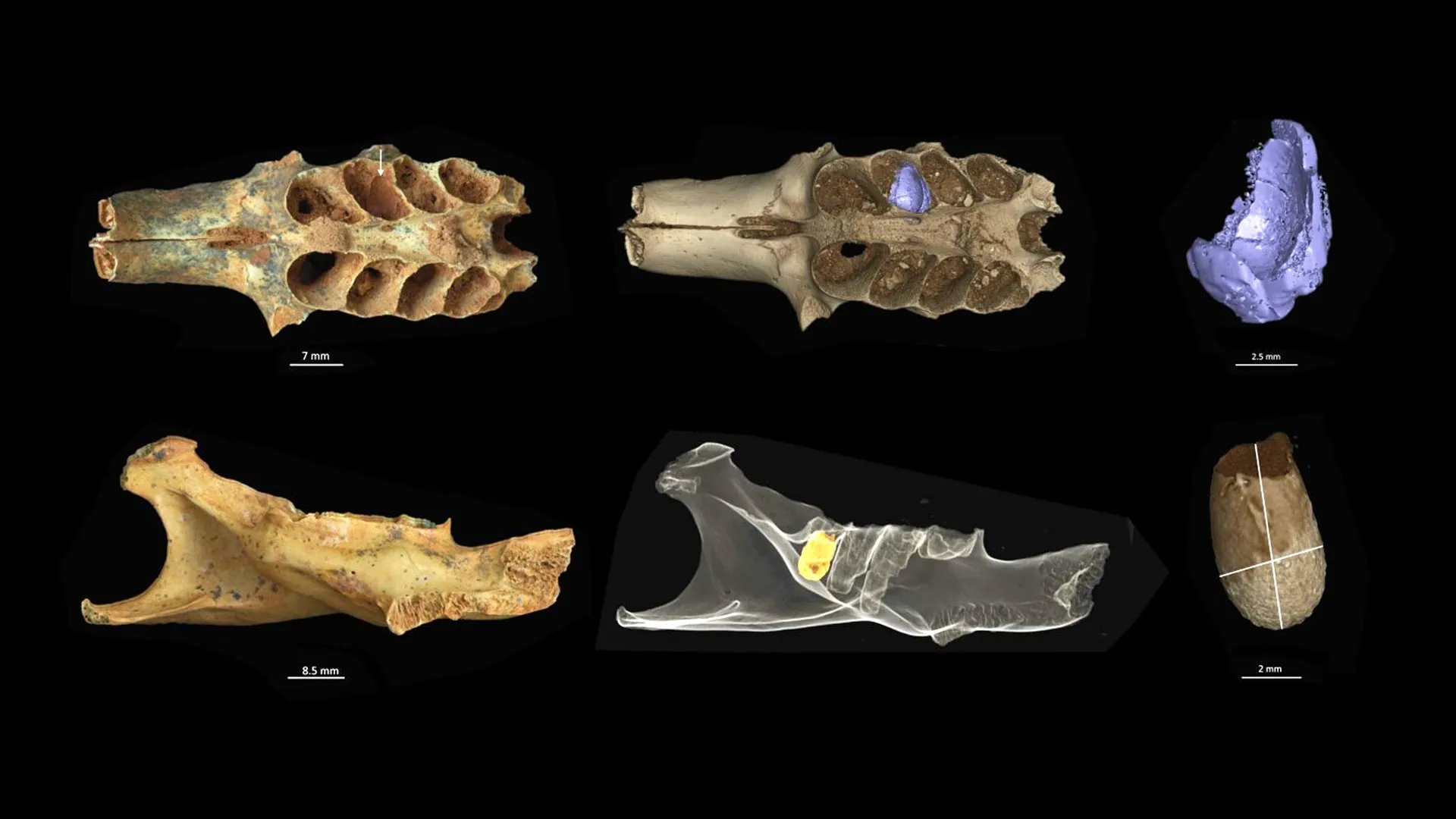
However, as the bee burrowed, it encountered an unexpected resource: the fossilized remains of the hutia. Specifically, it found the empty sockets in the hutia’s jawbones, known as alveoli, where teeth had once been held. Though the teeth themselves were long gone, these hollow spaces remained intact and, crucially, their dimensions closely matched the size and shape required for a bee’s larval cell. This serendipitous discovery provided the bee with a ready-made, pre-excavated, and protected nesting site, saving it the considerable energy and time required to dig its own burrow in the sometimes-challenging cave environment.
This innovative behavior was not a one-off event. Over successive generations, more bees followed suit, utilizing these natural cavities within the fossilized bones. The study revealed that these nesting sites were not limited to hutia jawbones; nests were also found within the pulp cavity of an extinct tree sloth’s tooth and even inside a hutia vertebra, specifically in the space that once housed the spinal cord. This widespread adoption of fossilized bone as nesting substrate points to a significant environmental pressure that drove such an unusual adaptation.
A Careful Observation Leads to a Groundbreaking Discovery
The journey from a forgotten ancient interaction to a published scientific paper is often fraught with meticulous effort and fortunate observation. The discovery of these unique fossilized bee nests might easily have been overlooked, as standard paleontological practice often involves thoroughly cleaning sediment from bone cavities during excavation.
Lazaro Viñola Lopez, who excavated the fossils as a doctoral student at the Florida Museum of Natural History, was particularly interested in the hutia species found in Cueva de Mono, a species rarely encountered elsewhere on the island. His work at the cave yielded thousands of fossils, strongly suggesting its role as a long-term feeding site for giant barn owls across many generations. It was Viñola Lopez’s unusual decision to inspect the fossils closely, rather than immediately clean them, that proved pivotal. He noticed a peculiar cavity whose inner surface was smooth, a stark contrast to the rough texture of bone.
Recalling a similar observation from 2014 during a dinosaur fossil excavation in Montana, where he and colleagues had found wasp cocoons, Viñola Lopez initially hypothesized that he was looking at fossilized wasp nests. He even considered writing a short paper on the "occurrence of these wasp nests in the mandibles." He shared this idea with his colleague, Mitchell Riegler, another doctoral student at the museum. Riegler, initially skeptical about the "niche project," eventually took on the challenge as part of a friendly competition to write a scientific paper within a week.
Correcting the Record: Wasps vs. Bees
The initial assumption of wasp nests was a reasonable one, given previous findings. However, as the team delved deeper into the study of ichnofossils—trace fossils that provide evidence of past life activities like footprints, burrows, or nests—they uncovered a crucial discrepancy. Wasp nests, typically constructed from chewed plant material mixed with saliva, possess a characteristically rough internal texture. The structures within the Hispaniolan fossils, however, were strikingly smooth.
This detail led to a re-evaluation. Bees, particularly many species of burrowing bees, are known to line their nests with a waxy, waterproof secretion that creates a polished, smooth interior. This key difference definitively revealed the true identity of the ancient nest builders: they were bees, not wasps. This correction dramatically elevated the significance of the discovery.
A Rare and Unprecedented Behavioral Adaptation
The identification of bee nests, rather than wasp nests, transformed the finding from an interesting observation into a groundbreaking revelation. The scientific literature holds only one other known case of burrowing bees nesting inside a cave environment, and crucially, none where bees utilized pre-existing fossil structures without significantly altering them. A prior report described bees drilling into human bones, but this new discovery showcased bees simply occupying natural, pre-formed cavities, making it a truly unprecedented example of behavioral adaptation.
Realizing the profound importance of their findings, Viñola Lopez and Riegler expanded their study, consulting with experts in modern bee biology and conducting extensive literature reviews. Viñola Lopez also returned to the Cueva de Mono to further examine its geological layers, seeking to establish a clearer chronology for the events.
The site itself faced a threat during this critical period. An attempt was made to develop the land, with plans to convert the historically significant cave into a septic tank. Recognizing the imminent danger to invaluable paleontological data, the research team sprang into action, launching a "rescue mission" to recover as many fossils as possible. Their swift response saved a wealth of scientific information from irreversible loss.
Insights from the Cave: Why Bees Chose Bone
The final study provides a comprehensive understanding of the cave’s long history and the extraordinary nesting behavior of these ancient bees. Advanced imaging techniques, such as CT scans, offered non-destructive glimpses into the internal structures of the fossilized bones. These scans revealed astonishing details: some cavities contained multiple layers of nests, suggesting that certain bees not only used existing tunnels but also reused them if they were found empty. In one remarkable instance, six nests were discovered stacked within a single alveolus, fitting together like a set of Russian nesting dolls.
The researchers also put forth a compelling explanation for this unusual behavior. The landscape surrounding Cueva de Mono is characterized by karst topography—a sharp, rugged limestone terrain that naturally lacks stable soil. As Riegler noted, "The area we were collecting in is karst, so it’s made of sharp, edgy limestone, and it’s lost all of its natural soils. I actually fell on it at one point, so I can tell you all about it."
In such an environment, any loose soil that does accumulate on the surface is often washed into caves, where it settles into pockets of suitable material. These localized deposits, including the fine silt mixed with bone debris, may have provided some of the only viable nesting conditions for burrowing bees in the region. Faced with a scarcity of traditional nesting substrates, the bees adapted by exploiting the readily available, pre-formed cavities within the abundant fossilized bones, turning a paleontological graveyard into a vibrant nursery.
Broader Implications and Future Discoveries
This discovery offers critical insights into paleoecology, illuminating how species adapt to environmental constraints over vast timescales. It underscores the immense value of ichnofossils in reconstructing ancient behaviors and ecological interactions that might otherwise remain invisible. The unique adaptation of these Hispaniolan bees provides a powerful example of resourcefulness in nature, driven by the pressures of a challenging environment. It also serves as a poignant reminder of the rich biodiversity that once thrived in the Caribbean, much of which has been lost since human arrival. The presence of extinct sloth and hutia remains in the cave, alongside the bee nests, paints a vivid picture of a diverse ecosystem that has undergone significant transformation.
The researchers are continuing their study of the extensive collection of fossils recovered from the Cueva de Mono, with additional findings anticipated in future publications. Each fossil, each trace, holds a piece of the puzzle, contributing to a more complete understanding of Hispaniola’s ancient past. Their work, published in a prestigious journal, reveals a remarkable example of how life can adapt in unexpected ways, transforming a cave filled with the remains of past meals into a shelter and a nursery for a completely different kind of inhabitant, leaving behind a scientific legacy that transcends millennia. This unprecedented discovery is a testament to the meticulous work of paleontologists and the enduring stories that ancient landscapes continue to tell.
