
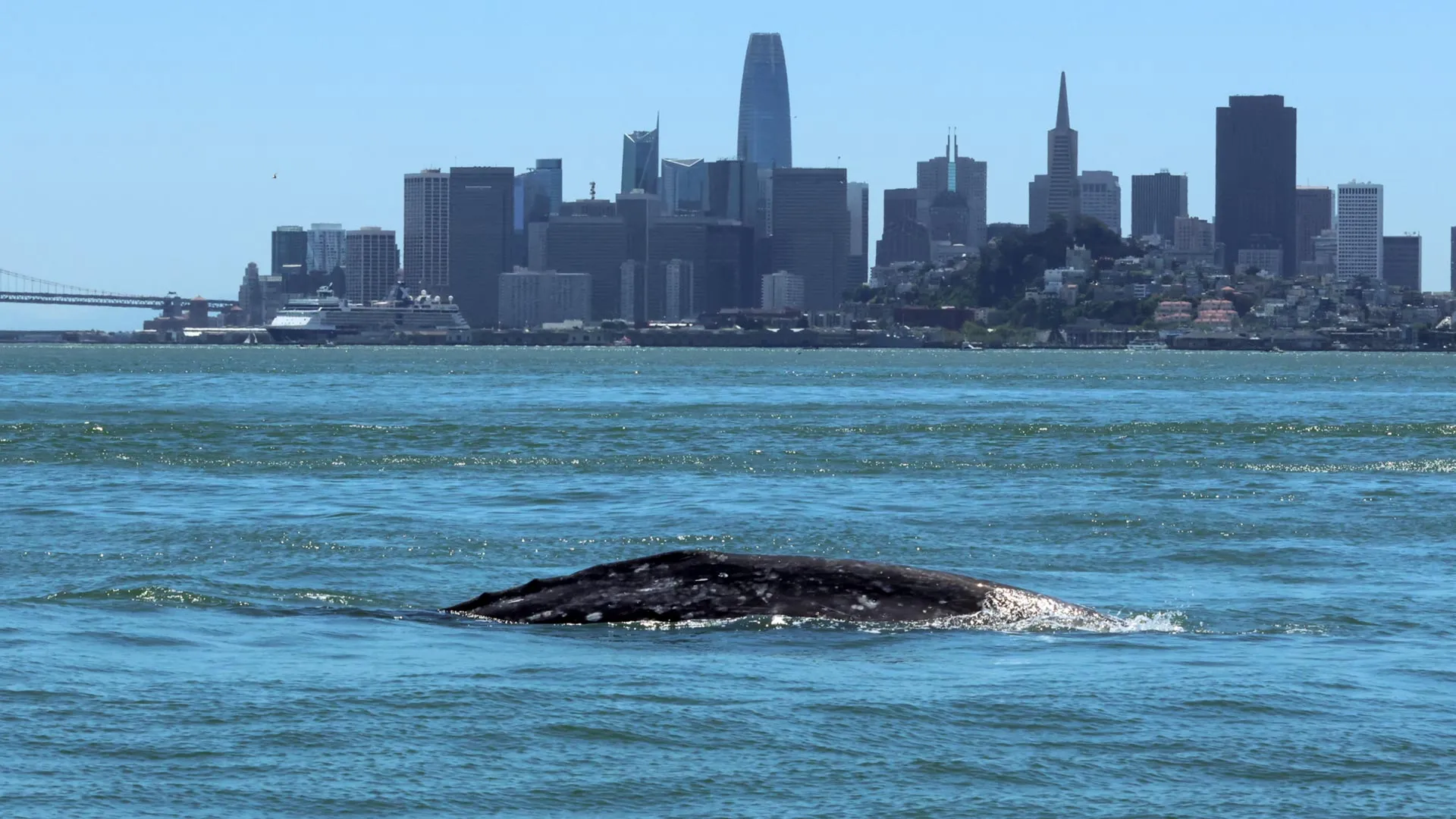
Gray whales, renowned for their monumental annual migration between the food-rich Arctic and the warm, sheltered lagoons of Baja California, are confronting unprecedented challenges that are fundamentally altering their ancient behaviors. As the planet’s oceans warm at an alarming rate, disrupting delicate marine ecosystems and traditional food sources, these majestic cetaceans are increasingly deviating from their established migratory routes, leading them into unexpected and often perilous territories. One such area, the heavily trafficked waters of San Francisco Bay, has emerged as a new, albeit dangerous, foraging ground, raising urgent concerns among scientists and conservationists. Research indicates a disturbingly high mortality rate among whales entering the Bay, with vessel strikes accounting for a significant proportion of these deaths, painting a stark picture of the threats posed by a rapidly changing world.
A Global Odyssey Disrupted: The Gray Whale’s Epic Migration
The Eastern North Pacific (ENP) gray whale population traditionally undertakes one of the longest migrations of any mammal, covering up to 12,000 miles round trip. Their journey typically begins in the spring, heading north from their breeding and calving grounds in Mexico to their primary feeding grounds in the Bering and Chukchi Seas of the Arctic. Here, they spend the summer months gorging on benthic invertebrates, particularly amphipods, building up crucial blubber reserves to sustain them through the arduous non-feeding migration south to their tropical breeding lagoons in the autumn. This ancient cycle has largely defined the species’ existence for millennia, allowing them to thrive by exploiting seasonal abundance in distinct geographical regions.
Historically, the San Francisco Bay was not considered a regular part of this vast migratory corridor, and certainly not a primary feeding area. Gray whales, known as "bottom feeders," typically require specific benthic environments found in shallower, colder Arctic waters. The Bay’s entrance through the Golden Gate Strait, while a natural gateway, was usually a transit point, not a destination for sustained foraging. However, beginning in 2018, researchers observed a marked increase in gray whale sightings within the Bay itself, a phenomenon that has continued and intensified in subsequent years, signaling a significant departure from established patterns.
Climate Change: The Unseen Architect of Shifting Behavior
The primary driver behind this behavioral shift is increasingly understood to be the profound impact of climate change on Arctic ecosystems. The Arctic region is warming at a rate two to three times faster than the global average, leading to dramatic reductions in sea ice extent and thickness. This rapid warming directly affects the availability and distribution of the gray whales’ primary food sources. Amphipods, crucial to the whales’ diet, are highly sensitive to changes in water temperature and oceanographic conditions. Disruptions to the cold, nutrient-rich waters and the associated benthic communities mean that whales arriving at their traditional Arctic feeding grounds may find diminished sustenance, leaving them in a weakened and undernourished state.
The dire consequences of these environmental shifts are reflected in the overall health of the gray whale population. The National Oceanic and Atmospheric Administration (NOAA) declared an Unusual Mortality Event (UME) for the Eastern North Pacific gray whale population in 2019, citing concerns about malnutrition, reproductive failures, and strandings along the Pacific coast. Data from NOAA indicates that the population has plummeted by more than half since 2016, dropping from an estimated peak of 27,000 individuals to approximately 13,000 today. Furthermore, observations of calves have become increasingly rare, a troubling indicator for the long-term recovery and viability of the species. These factors suggest that whales are leaving their Arctic feeding grounds with insufficient energy reserves, compelling them to seek alternative food sources in unconventional locations like San Francisco Bay during their migration.
San Francisco Bay: A Lure and a Trap
For whales struggling with malnutrition, San Francisco Bay may present itself as an emergency feeding stop, a desperate attempt to find sustenance where none should typically be needed. However, the Bay, while potentially offering some benthic invertebrates, is far from an ideal foraging ground and presents a host of unique dangers. "Gray whales have a low profile to the water when they surface, and this makes them difficult to see in conditions like fog which are common to San Francisco Bay," explained Josephine Slaathaug of Sonoma State University, lead author of a recent article in Frontiers in Marine Science. "Additionally, San Francisco Bay is a highly trafficked waterway, and the Golden Gate Strait serves as a bottleneck through which all traffic and whales must enter and exit."
The Bay is one of the busiest maritime hubs on the U.S. West Coast, accommodating a constant flow of commercial cargo ships, tankers, ferries, recreational boats, and fishing vessels. This dense and diverse vessel traffic creates a gauntlet for any large marine mammal, particularly for a species not adapted to navigating such human-dominated environments. The combination of poor visibility, the whales’ inconspicuous surfacing behavior, and the sheer volume of maritime activity creates a recipe for disaster, making ship strikes an acute and ever-present threat.
Unraveling the Mystery of the "Bay Grays": A Collaborative Study
To better understand this emerging phenomenon, scientists launched a dedicated effort to study these "Bay Grays." Researchers from institutions like Sonoma State University and the Center for Coastal Studies embarked on a comprehensive investigation, building a catalog of individual whales sighted within the Bay. This study, spanning from 2018 to 2025, leveraged a combination of opportunistic sightings and photographs contributed by the public – a testament to the power of citizen science – alongside more structured surveys. These visual records were then meticulously compared with necropsy data from stranded whales in the region.
Identification relied on the unique markings found on each whale’s skin, which act like natural fingerprints. However, this method presented challenges, as these distinctive markings can fade after death, potentially leading to missed matches. Despite these difficulties, the study successfully documented 114 individual whales entering the Bay during the observation period. A crucial finding was that only four of these individuals were observed in more than one year. This low return rate strongly suggests that most whales entering the Bay are either transient visitors that do not linger or, more concerningly, succumb to the dangers within the Bay or nearby waters. Scientists hypothesize that the Bay functions as a critical, albeit risky, refuge for whales in poor condition, a theory supported by observations of unusually thin individuals foraging in other nontraditional habitats globally.
The Deadly Toll: Vessel Strikes and Malnutrition
The grim reality of the Bay’s dangers is starkly evident in the mortality statistics. Between 2018 and 2025, a total of 70 gray whales were found dead in the broader San Francisco Bay region. Of these, 30 were definitively confirmed to have died from vessel strikes, underscoring the severity of this anthropogenic threat. For the remaining whales where a cause of death could be determined, many exhibited clear signs of malnutrition, further solidifying the link between disrupted Arctic food sources and the whales’ desperate search for sustenance. Researchers were able to match 21 of the 45 identifiable dead whales to individuals previously documented in their living catalog, providing direct evidence of the perilous journey these whales undertake.
Bekah Lane of the Center for Coastal Studies, a co-author of the study, highlighted the alarming fatality rates. "At least 18% of the individuals identified in San Francisco Bay later died in the area," she stated. "Our broader analysis of local strandings both inside and outside San Francisco Bay found that over 40% of these whales died of trauma from vessels." These figures paint a chilling picture, indicating that entering the Bay significantly increases a gray whale’s risk of mortality, primarily from collisions with ships. It is a cruel irony that whales seeking refuge from starvation in a changing climate often find a more immediate end in the path of human commerce. The weakened state of malnourished whales may also render them less agile and therefore less able to avoid oncoming vessels, creating a compounding vulnerability.
Urgent Action Required: Protecting Whales in a Busy Waterway
The scientific community emphasizes the critical need for further research to gain a more granular understanding of gray whale movements and behaviors within the Bay. In 2025 alone, 36 whales were recorded entering the area, sometimes in groups exceeding ten individuals, signaling a persistent and growing trend. More detailed tracking technologies, such as satellite tagging, combined with additional comprehensive necropsies, could provide invaluable insights. This ongoing research would help ascertain whether the low number of returning whales is predominantly due to high mortality rates, and whether the primary cause of death is starvation, vessel strikes, or, most likely, a complex interaction between both factors.
In parallel with continued research, there is an urgent call for the implementation of proactive conservation measures to mitigate the risks. Preventive steps could include a multi-pronged approach targeting the maritime industry and infrastructure. Educating commercial vessel operators about whale presence and safe navigation practices is paramount. This could involve real-time alerts about whale sightings, workshops on whale biology and behavior, and promoting voluntary speed reductions. Adjusting ferry routes to avoid known whale hotspots or critical foraging areas within the Bay is another viable strategy. Furthermore, implementing mandatory speed restrictions in high-risk areas, similar to measures successfully deployed in other whale habitats globally, could significantly reduce the likelihood and severity of vessel strikes.
"In San Francisco Bay, the biggest threat to these whales is vessel traffic," reiterated Lane. "Continued monitoring will help illuminate their distribution patterns and behaviors while within the Bay, which can impact risk. Route changes and speed restrictions have been found to significantly reduce vessel strike mortality to large whales, and an assessment of risk can help identify the most effective strategies to protect these animals." The challenge lies in balancing the economic imperatives of one of the world’s busiest ports with the ecological imperative to protect a vulnerable, endangered species. This will require collaboration between regulatory bodies like NOAA and the U.S. Coast Guard, port authorities, maritime shipping companies, and conservation organizations.
A Barometer of Ocean Health: Broader Implications
While researchers acknowledge that there are still gaps in their day-to-day understanding of individual whale movements, the findings from the San Francisco Bay study provide a crucial snapshot of how gray whales are reacting to the rapidly changing environmental conditions driven by climate change. These "Bay Grays" serve as a potent barometer for the health of the broader Eastern North Pacific ecosystem and, indeed, the global ocean. Their desperate search for food, their increased vulnerability to human activities, and the alarming decline in their population underscore the profound and cascading impacts of a warming planet.
The gray whale’s struggle in San Francisco Bay is a microcosm of a much larger global challenge. It highlights the urgent need for sustained international efforts to combat climate change, protect marine biodiversity, and foster coexistence between human activities and wildlife. As Slaathaug concluded, "This study is our best analysis of the data we collected, but it’s important to consider that we do not have the full picture of each whale’s movements on a daily timescale. These results are an important piece of the larger puzzle of what is going on in the overall population as they attempt to adapt to climate change in real time." The fate of these magnificent creatures in the face of an uncertain future rests heavily on humanity’s collective will to understand, adapt, and protect.
