
Fifty years after Donald Griffin’s groundbreaking 1976 book, "The Question of Animal Awareness," the scientific community continues to grapple with the profound implications of nonhuman consciousness. Griffin’s seminal work challenged the prevailing view that animals were merely instinct-driven automatons or creatures conditioned solely by reward and punishment. Instead, he proposed that many nonhuman species possessed demonstrable levels of self-awareness comparable to humans. While this assertion was revolutionary at the time, the debate remains far from settled, particularly concerning non-primate species like birds.
Recent developments underscore the enduring relevance of this discussion. In 2024, a significant declaration, signed by hundreds of scientists, asserted that "strong scientific support" exists for consciousness in mammals, birds, and potentially all other vertebrates. This collective statement, stemming from initiatives like the New York Declaration on Animal Consciousness, signifies a growing consensus within certain scientific circles. However, as the original article notes, achieving definitive "proof" of consciousness, whether in humans or animals, remains an exceptionally complex endeavor.
Sentience vs. Consciousness: Navigating the Definitional Landscape
A primary focus in the contemporary study of animal consciousness is the concept of sentience – the capacity to experience emotions and sensations. Researchers often utilize indicators of sentience as proxies for consciousness, acknowledging that a being capable of feeling pain, pleasure, fear, or joy might possess a more complex inner life. However, this approach immediately raises further questions: How can we reliably assess emotions and sensations in species that cannot verbally articulate their internal states? The inherent difficulty humans face in precisely defining and evaluating their own emotions, as explored in psychological literature, highlights the formidable challenge of extrapolating such understanding to nonhuman animals.
While some might propose focusing on more readily observable sensations, such as sensitivity to pain, as a simplified metric, experts caution against such a narrow approach. Pain sensitivity, while a crucial indicator of a capacity to suffer, may represent a necessary but not sufficient condition for arguing human-like consciousness. The quest to define and measure consciousness in nonhumans necessitates a more comprehensive and nuanced approach.
Evolving Methodologies and the Search for a "Neural Correlate"
Over the decades, researchers have developed increasingly sophisticated methodologies to probe animal cognition and consciousness. Early work by Pepperberg and Lynn in the late 1990s proposed the existence of "levels of consciousness," positing a relationship between these levels and quantifiable cognitive abilities within a species. This perspective suggested that evolutionary parallels in brain structures, sensory systems, and learning mechanisms could underlie similar cognitive processes across different species.

However, these early arguments were immediately confronted with the challenge of establishing parallels between human and nonhuman cognitive processes and the elusive search for a "neural correlate of consciousness" (NCC) – the specific brain activity associated with conscious experience. Intriguingly, even in humans, the precise identification of an NCC remains an active area of research, with initiatives like the Cogitate Consortium in 2025 continuing to explore theoretical frameworks such as the global neuronal workspace and integrated information theories. The ongoing struggle to pinpoint consciousness in our own species naturally complicates efforts to find comparable markers in nonhuman animals.
The advent of advanced artificial intelligence (AI) systems has further complicated the debate. While AI can exhibit impressive cognitive processing power, demonstrating capabilities like complex problem-solving, current systems are understood to lack self-awareness. This distinction raises a critical question: If processing power alone does not equate to consciousness, does the focus shift back to sentience, or does it necessitate a re-evaluation of what constitutes higher-order cognitive processing? This philosophical and scientific quandary is being actively debated, with scholars like Ned Block exploring the relationship between artificial systems and the possibility of consciousness.
The Grey Parrot: A Case Study in Complex Cognition
Within the ongoing scientific discourse, Grey parrots (Psittacus erithacus) have emerged as particularly compelling subjects for studying animal cognition, offering tantalizing glimpses into complex mental capacities. Research into their abilities, notably pioneered by Dr. Irene Pepperberg and her successors, has provided compelling evidence that challenges simplistic views of avian intelligence.
One area of intense investigation has been the capacity for delayed gratification. This cognitive skill involves the ability to forgo an immediate, less desirable reward in anticipation of a larger or more appealing reward at a later time. Success in delayed gratification tasks requires a sophisticated interplay of cognitive functions: the ability to recognize and suppress immediate impulses and desires, an understanding of the conflict between short-term urges and long-term goals, the capacity to maintain the long-term objective in memory, and the development of a strategy to actively engage cognitive resources to achieve that goal.
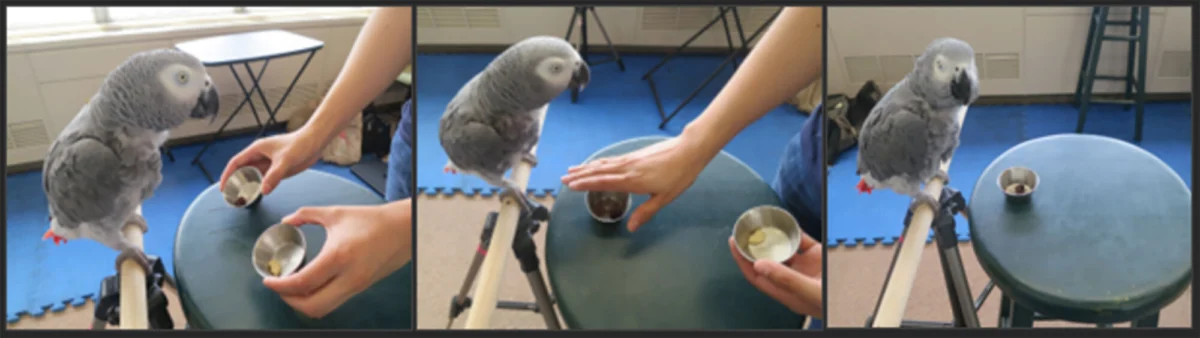
Studies involving Grey parrots, such as those conducted by Koepke et al. (2015) and further explored by Pepperberg and Hartsfield (2023) and Pepperberg and Rosenberger (2022), have demonstrated that these birds are remarkably adept at such tasks. For instance, in experiments, parrots have been shown to consistently wait for a preferred treat over a less desirable one, even when the latter is immediately available. This behavior, when observed in humans, is widely accepted as indicative of self-awareness and executive control.
The experimental setup often involves presenting the parrot with two distinct reward options. One reward is then removed, and the other is briefly covered while the bird is instructed to "wait." During this delay period, the parrot must endure the presence of a less appealing, though still desired, reward without succumbing to the immediate urge to consume it. The success of Grey parrots in these scenarios suggests a capacity for self-regulation and foresight that transcends mere instinctual behavior.

However, even these impressive findings are presented with scientific caution. As noted in the underlying research by Pepperberg (2026), these behavioral demonstrations do not constitute definitive "proof" of avian consciousness. Rather, they offer significant insights and provide a crucial layer of evidence that, when considered alongside other consciousness assessment methods, contributes to a more holistic understanding of avian cognitive capabilities.
The Broader Implications: Towards Humane Coexistence
The persistent scientific inquiry into animal consciousness, while academically rigorous, carries profound ethical and practical implications. The New York Declaration on Animal Consciousness, for example, emphasizes a precautionary principle: "Do no harm." This principle suggests that even when definitive scientific proof of consciousness is elusive, evidence that is merely "indicative" of conscious experience should be integrated into the design of protocols for animal welfare, humane treatment, and conservation efforts.
This perspective advocates for a shift in how we approach our interactions with other species. If behaviors observed in animals, like delayed gratification in Grey parrots, strongly suggest an inner life, a capacity for subjective experience, and a degree of self-awareness, then prudence dictates a re-evaluation of our ethical obligations. The high standards of certainty typically required for scientific proof of consciousness might need to be tempered when considering the practicalities of coexistence.
The ongoing debate surrounding animal consciousness is not merely an academic exercise. It is a fundamental re-examination of our place within the broader tapestry of life on Earth and a critical step towards fostering a more compassionate and responsible relationship with the diverse sentient beings with whom we share our planet. The work initiated by Donald Griffin half a century ago continues to inspire a generation of scientists to explore the intricate question of what it truly means to be aware.
