
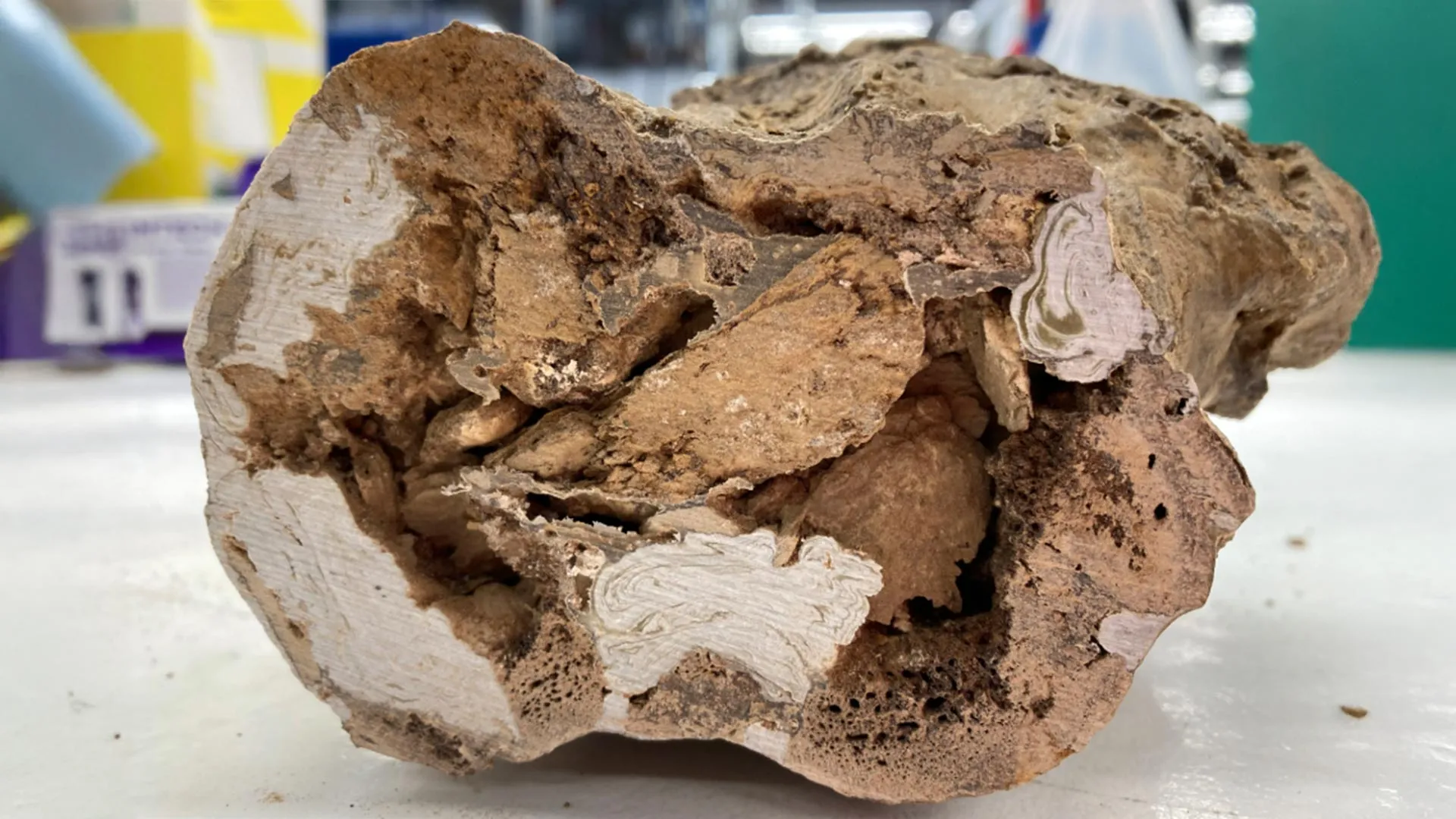
For decades, scientists believed dinosaur fossils were little more than mineralized rock, with any original biological material long since destroyed by time. But an extraordinary study centered on a remarkably preserved Edmontosaurus fossil is challenging that assumption in a major way, providing compelling evidence that traces of original organic molecules, including collagen, can indeed survive inside dinosaur bones dating back roughly 66 million years. This groundbreaking discovery, spearheaded by researchers from the University of Liverpool and UCLA, adds powerful new support to a controversial idea that has divided paleontologists for more than three decades, signaling a potential paradigm shift in how we interpret the fossil record and the information it can yield about extinct life.
The fossil at the heart of this transformative investigation is a substantial 22-kilogram Edmontosaurus sacrum, a critical component of the dinosaur’s hip region. This specimen was meticulously recovered from the renowned Hell Creek Formation in South Dakota, a geological treasure trove famous for its exceptionally preserved Cretaceous-period fossils, including those of Tyrannosaurus rex. Edmontosaurus, a genus of large, herbivorous duck-billed dinosaurs, was a prominent inhabitant of North America during the late Cretaceous Period, thriving alongside apex predators like T. rex just before the cataclysmic asteroid impact that ended the age of dinosaurs. The preservation quality of this particular sacrum, already noted for its excellent macroscopic integrity, proved to be a microscopic marvel.
Unprecedented Analytical Rigor Confirms Organic Survival
To ascertain the presence of ancient organic molecules, the research team employed a sophisticated array of advanced laboratory methods, moving far beyond previous techniques. This multi-pronged approach included high-resolution protein sequencing, which allows scientists to identify the specific amino acid chains that constitute proteins, and several forms of mass spectrometry, a highly sensitive analytical technique used to measure the mass-to-charge ratio of ions, thereby identifying the composition of a sample. These techniques were applied to detect remnants of collagen embedded deeply within the fossilized bone matrix. Collagen, recognized as the primary structural protein in bone tissue, cartilage, and connective tissues across vertebrates, is particularly significant. Its identification in such an ancient context is profoundly challenging to attribute to modern contamination, lending immense credibility to the study’s conclusions.
Further bolstering these findings, researchers from UCLA independently identified hydroxyproline, a distinctive amino acid that is a major constituent of collagen and is rarely found in other proteins. The presence of hydroxyproline, specifically in its chemically modified form within the fossil, served as a crucial and independent confirmation that degraded collagen fragments were genuinely preserved within the ancient bone, rather than being an artifact of environmental contamination or microbial activity. The painstaking work involved in extracting and analyzing these minute molecular traces underscores the technical prowess required for such a discovery. The methodologies chosen were specifically designed to address and mitigate the skepticism that has historically surrounded claims of ancient organic preservation.
Professor Steve Taylor, chair of the Mass Spectrometry Research Group at the University of Liverpool’s Department of Electrical Engineering & Electronics, articulated the profound implications of their work. "This research shows beyond doubt that organic biomolecules, such as proteins like collagen, appear to be present in some fossils," Taylor stated, emphasizing the definitive nature of their results. He further elaborated, "Our results have far-reaching implications. Firstly, it refutes the hypothesis that any organics found in fossils must result from contamination." This direct challenge to a long-held scientific assumption marks a pivotal moment, validating decades of research by others who faced significant opposition.
A Decades-Long Paleontological Controversy Reaches a Turning Point
The notion of preserved soft tissues and original proteins in dinosaur fossils has been a fiercely debated topic in paleontology since the early 2000s, often leading to impassioned arguments and deep scientific divisions. For many years, the prevailing scientific dogma held that proteins, being inherently unstable organic molecules, could not possibly survive the immense timescales involved in fossilization—tens of millions of years—without complete degradation. Any reported findings of such materials were often dismissed by a significant portion of the scientific community as either modern contamination from handling, bacterial biofilm residue, or misidentified mineral structures.
One of the most famous and controversial discoveries came to light in 2005, when paleontologist Mary Schweitzer and her colleagues at North Carolina State University reported finding what appeared to be flexible, transparent blood vessel-like structures and red blood cell-like microstructures inside a 68-million-year-old Tyrannosaurus rex femur. Subsequent studies by Schweitzer’s team and others identified possible collagen fragments and additional soft tissue-like structures in various dinosaur specimens, including other tyrannosaurids and hadrosaurs related to Edmontosaurus. These claims, while revolutionary, were met with intense scrutiny and a wave of skepticism. Critics argued that the findings were either experimental artifacts, environmental contaminants, or the products of unique taphonomic processes that mimicked organic material without preserving the original chemistry. Some suggested that iron, released from hemoglobin, might play a role in preserving soft tissues, acting as a potent cross-linking agent and antioxidant. However, definitive proof of original biomolecular composition remained elusive to many.
What distinguishes this new Edmontosaurus analysis from previous studies is its robust, multi-methodological approach to verification. By combining advanced microscopy techniques, detailed chemical analysis, and precise protein sequencing on the same fossil specimen, the research team created a powerful cumulative argument. This integrated strategy was specifically designed to systematically rule out alternative explanations, such as contamination or mineral mimics, thereby strengthening the case that the identified molecules were indeed endogenous—original to the dinosaur itself. The findings were formally published in the prestigious journal Analytical Chemistry in 2025, under the unequivocal title "Evidence for Endogenous Collagen in Edmontosaurus Fossil Bone," a testament to the confidence the researchers have in their data.
Why This Discovery Matters: Unlocking New Avenues of Paleontological Inquiry
The implications of proteins surviving in fossils for tens of millions of years are nothing short of revolutionary for the field of paleontology. If the preservation of such complex biomolecules is indeed possible, scientists may gain an entirely new and unprecedented way to study extinct animals, moving beyond skeletal morphology into the realm of molecular biology.
One of the most significant potential applications lies in refining our understanding of evolutionary relationships. Tiny molecular traces, particularly specific protein sequences, could potentially reveal intricate phylogenetic connections and evolutionary divergences between dinosaur species that are incredibly difficult to discern from bone structures alone. Morphological similarities can sometimes be misleading, resulting from convergent evolution rather than shared ancestry. Molecular data offers a more direct, independent line of evidence for evolutionary biology.
Furthermore, molecular analysis of ancient proteins could provide invaluable insights into various aspects of dinosaur biology. Researchers may learn more about dinosaur growth rates, aging processes, their overall physiology (e.g., metabolic rates, thermoregulation), and even the diseases they might have suffered from. For instance, specific protein isoforms or molecular markers could indicate growth spurts, reproductive cycles, or even evidence of ancient infections or genetic predispositions. This moves paleontology from macroscopic observation to microscopic, offering a new dimension of biological inquiry.
Professor Taylor highlighted another intriguing consequence: the need for scientists to revisit countless fossil samples collected over the past century. He suggested that cross-polarized light microscopy images, often taken decades ago and archived without molecular analysis in mind, could contain overlooked evidence of preserved collagen in ancient bones. "These images may reveal intact patches of bone collagen, potentially offering a ready-made trove of fossil candidates for further protein analysis," Taylor explained. "This could unlock new insights into dinosaurs, for example revealing connections between dinosaur species that remain unknown." This call to re-examine historical collections underscores the transformative potential of this discovery, turning old data into new frontiers.
The Enduring Mystery of Molecular Survival Across Geological Time
Beyond its immediate implications for understanding dinosaurs, the discovery also raises a fascinating and fundamental scientific question: how did these complex organic molecules, especially proteins, manage to survive for such immense spans of geological time? Proteins are known for their inherent instability; they normally break down relatively quickly through hydrolysis and other degradation pathways, particularly under the harsh conditions typically associated with burial and fossilization. The persistence of intact or even fragmented protein structures across millions of years, therefore, presents a significant biochemical puzzle.
Scientists are increasingly investigating various hypotheses to explain this extraordinary preservation. One leading theory centers on the intricate interactions between organic molecules and the mineral components of bone. Bone tissue is primarily composed of hydroxyapatite, a calcium phosphate mineral, which forms a complex matrix with collagen fibers. It is hypothesized that the tightly packed mineral crystals within the bone may physically encapsulate and shield fragments of collagen from complete decay. This mineral-organic interaction might create a protective microenvironment that dramatically slows down chemical breakdown. Additionally, the presence of metal ions, such as iron (as suggested by Schweitzer’s work), could play a role in cross-linking proteins and inhibiting bacterial degradation, further contributing to molecular stability.
Recent studies exploring fossil biomolecules suggest that specific burial environments and microscopic bone structures may be crucial. Anoxic (oxygen-deprived) conditions, rapid burial, and particular sediment compositions can all contribute to creating stable, low-energy environments that dramatically slow down the rate of chemical degradation. For instance, clay minerals have been shown to bind and protect organic molecules.
Edmontosaurus fossils are already famous among paleontologists for their often-exceptional preservation. Some specimens discovered over the last century, particularly those found in the fine-grained sediments of places like the Hell Creek Formation, have retained remarkably detailed skin impressions and other soft tissue features, earning them the evocative nickname "dinosaur mummies." These specimens often show not just the outlines of skin but also textures, scales, and even evidence of fleshy structures. More recent paleontological research has continued to uncover surprisingly detailed soft tissue preservation in various Edmontosaurus specimens, including internal fleshy structures, evidence of muscle attachment, and intricate skin anatomy, all pointing to unique taphonomic conditions favorable for soft tissue retention.
Together, these accumulating discoveries—from external skin impressions to internal molecular traces—are fundamentally reshaping how scientists conceptualize fossils. Instead of viewing them solely as inert stone replicas of ancient bones, researchers are beginning to see some fossils as potential molecular time capsules. These rare and precious specimens may still preserve direct chemical and biological information, offering tangible, microscopic traces of prehistoric biology millions of years later. This new perspective promises to unlock an unprecedented wealth of information about the deep past, pushing the boundaries of what we thought was possible to learn from the ancient world. The journey into the molecular fossil record has only just begun, and its findings are poised to redefine our understanding of life on Earth.
