
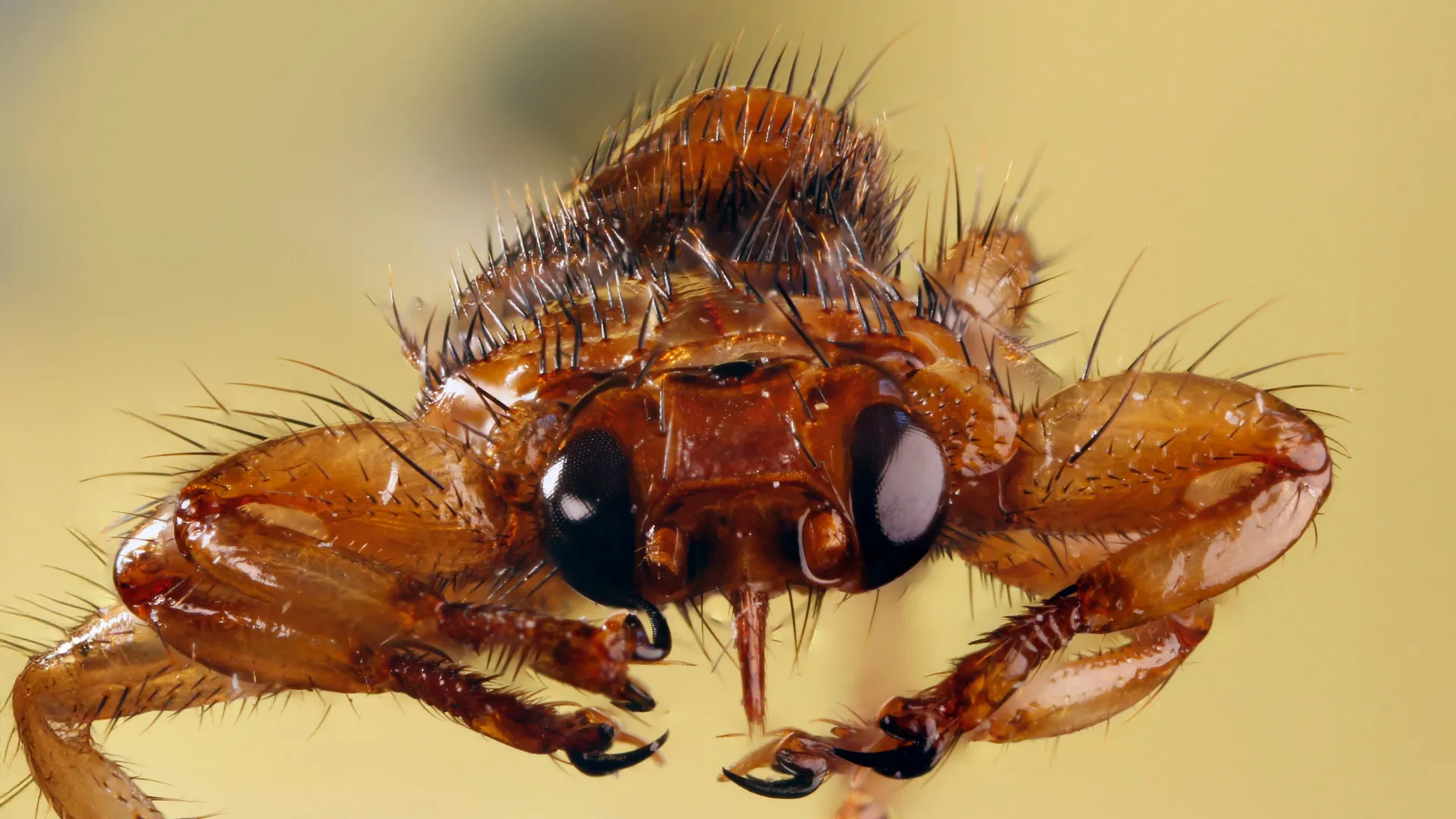
New research has unveiled a remarkable adaptation in a strange blood-feeding fly, the deer ked, demonstrating that it significantly reduces its visual sensitivity once it has successfully located a host and permanently abandons flight. This finding provides crucial insights into the intricate evolutionary trade-offs organisms make, particularly in the realm of parasitism, where energy allocation for survival and reproduction dictates fundamental biological changes. The study, a collaboration between scientists at Aberystwyth University and the University of Florence, was recently published in the Journal of Experimental Biology.
The Enigmatic Deer Ked: A Dual Lifestyle
Known scientifically as Lipoptena cervi, deer keds are a fascinating group of ectoparasitic flies belonging to the family Hippoboscidae, often referred to as louse flies. These biting insects are widely distributed across the Holarctic region, inhabiting forests throughout Europe, Asia, parts of North Africa, and North America. Their primary hosts are cervids, such as red deer, roe deer, and moose, but they are opportunistic feeders and can readily infest other mammals, including humans, dogs, horses, and wild boar, causing considerable irritation and discomfort.
The life cycle of the deer ked is particularly unique, characterized by a dramatic behavioral and physiological shift in adulthood. As newly emerged adults, they are winged and highly mobile, relying heavily on both flight and acute vision to actively seek out a suitable host. This phase is critical for their survival and reproductive success, as failure to find a host within a few days results in death. During this initial questing phase, their visual acuity is paramount for detecting the movement, shape, and contrast cues that signal the presence of a potential host in their arboreal environment.
However, once a deer ked successfully lands on a host, its entire existence undergoes a profound transformation. The insect permanently sheds its wings, often within minutes of attachment, and dedicates the remainder of its adult life to burrowing through the host’s fur or hair, feeding on blood. This transition from an agile, flying hunter to a sedentary, wingless ectoparasite represents a fundamental change in its ecological niche and a radical shift in the sensory demands placed upon it.
Evolutionary Pressures and Energetic Trade-offs
Life is a series of trade-offs, and nowhere is this more evident than in the allocation of energy within an organism. Every biological process, from growth and reproduction to movement and sensory perception, requires energy. Vision, in particular, is an energetically expensive sense. The development, maintenance, and operation of complex visual systems, including the synthesis of photoreceptor proteins (opsins), the vast neural networks for processing visual information, and the rapid muscle contractions required for flight control in response to visual input, all demand significant metabolic resources.
For an organism like the deer ked, which transitions from a highly mobile, visually-dependent hunter to a sessile, fur-dwelling parasite, the evolutionary pressure to optimize energy expenditure becomes immense. If a sophisticated visual system is no longer necessary for its survival once attached to a host, maintaining it would represent a wasteful drain on resources that could be better directed towards other vital functions, such as digestion of blood meals, reproduction, and evading host grooming. This principle of energetic efficiency is a cornerstone of evolutionary biology, driving organisms to develop sensory systems that are precisely matched to their specific ecological lifestyles.
The Research Mandate: Unraveling Sensory Adaptation
It was this striking behavioral dichotomy that captured the attention of Dr. Roger Santer from the Department of Life Sciences at Aberystwyth University, who spearheaded the recent study, in collaboration with colleagues from the University of Florence. The central research question was to investigate how the deer ked’s sensory system, specifically its vision, adapts to this dramatic and permanent lifestyle change. "Vision plays a vital role in animal behavior, but it is also energetically expensive," Dr. Santer explained. "Evolution favors sensory systems that are efficiently matched to an animal’s way of life. Some blood-feeding flies rely heavily on vision, while others live permanently on hosts and have little need for it. Deer keds are especially interesting because they switch between these two lifestyles."
The team sought to understand if this major behavioral shift was accompanied by corresponding changes in the fly’s sensory physiology, hypothesizing that a reduction in visual investment would be an adaptive response to their parasitic existence.
Methodology: A Glimpse into Genetic Switches
To investigate how deer keds adapt to this dramatic transition, the researchers employed a comparative genetic approach, studying the insects at different, crucial points in their adult life cycle. They meticulously collected two distinct groups of adult deer keds:
- Host-searching adults: These were winged flies actively seeking hosts, captured shortly after emergence and before host attachment. These represented the "flying hunter" phase.
- Host-attached adults: These were wingless flies collected directly from deer after they had successfully settled and adopted their parasitic lifestyle. These represented the "permanent parasite" phase.
The core of their investigation focused on genes associated with visual sensitivity, specifically opsins. Opsins are a family of G protein-coupled receptors that are the primary photoreceptor proteins in the retina, responsible for converting light into electrical signals. Different opsin types are sensitive to different wavelengths of light, contributing to an animal’s ability to perceive color and brightness. By analyzing the activity levels of these opsin genes in both groups of flies, the researchers could infer changes in the overall investment in visual system maintenance and function. Techniques likely involved RNA extraction from the eyes or heads of the flies, followed by quantitative PCR (qPCR) or RNA sequencing to measure the expression levels of specific opsin genes, providing a precise molecular snapshot of their visual capabilities.
Key Findings: A Half-Light World
The results of the study provided compelling evidence for their hypothesis. The team discovered a significant and measurable reduction in opsin gene activity in the host-attached, wingless deer keds compared to their winged, host-searching counterparts. Specifically, they found that the activity of opsin genes in the parasitic phase reduced to approximately half the level observed in the flying phase.
Dr. Santer elaborated on the findings: "We found that a flying deer ked’s visual system is much like that of a tsetse fly, which famously hunt out mammal hosts in Africa. However, after a deer ked loses its wings and becomes an ectoparasite, activity of its opsin genes reduces to around half the previous level." This comparison to tsetse flies (genus Glossina) is particularly illuminating. Tsetse flies are renowned for their highly developed visual systems, which they use to detect moving hosts and are vectors for devastating diseases like human sleeping sickness and animal nagana. Unlike deer keds, tsetse flies remain winged throughout their lives, continually relying on vision for host location and evasion. The initial similarity in visual gene activity suggests that flying deer keds possess a robust visual apparatus comparable to other active insect hunters.
Crucially, the study indicates that deer keds do not become entirely blind after finding a host. Instead, they appear to scale back their visual capabilities, entering a state of reduced visual sensitivity. "This suggests that the flies do not lose vision entirely, but that their visual sensitivity is reduced. We think the fly might be sacrificing sight to conserve energy for functions such as digestion and reproduction," Dr. Santer concluded. This energy reallocation is a prime example of adaptive plasticity, where an organism’s phenotype (observable traits) changes in response to environmental cues, driven by underlying genetic regulation.
Beyond the Eye: The Broader Implications for Parasitology
This study offers profound insights not just into the specific biology of deer keds, but into the broader field of parasitic adaptation and evolutionary biology. Parasites often exhibit remarkable reductions or specializations in their sensory systems, as well as morphological simplifications, once they have secured a stable host environment. Endoparasites, for instance, often lack complex eyes entirely, as light is absent within their hosts. Ectoparasites like fleas or lice, while still possessing some vision, generally have much simpler eyes compared to their free-living relatives, relying more on chemoreception and mechanoreception to navigate their host’s body.
The deer ked provides a unique model for studying this transition within a single adult life stage. It demonstrates that the investment in sensory organs is not static but dynamically adjusted based on immediate ecological demands. This phenotypic plasticity, governed by differential gene expression, highlights the sophisticated molecular mechanisms underlying evolutionary adaptation. The findings suggest that the genetic machinery for a robust visual system remains present but is downregulated when its energetic cost outweighs its utility. This flexible genetic response allows the deer ked to efficiently manage its energy budget, prioritizing functions essential for its parasitic lifestyle once a host is secured.
A Timeline of Adaptation: From Forest Floor to Host Fur
To fully appreciate the significance of this adaptation, it is helpful to consider the deer ked’s full life cycle. Adult deer keds typically emerge from pupae in the late summer and autumn, often around August to October, depending on the geographical location. These newly emerged adults are winged and immediately begin their quest for a host. This period, lasting only a few days, is their most vulnerable phase, where flight and keen eyesight are indispensable for navigating the complex forest environment and locating a warm-blooded target.
Upon successful host attachment, the wings are shed, marking the irreversible commitment to a parasitic existence. The fly then spends the subsequent months, often through winter, embedded in the host’s fur, feeding multiple times a day. Females will then produce larvae, which are immediately deposited as pre-pupae onto the host or into the environment, where they quickly drop off and pupate in the soil or leaf litter, overwintering until the following year. The observed reduction in visual gene activity occurs precisely at the point of wing-shedding, indicating an almost immediate physiological adjustment to its new, sedentary, and visually less demanding life within the dense fur of its host.
Towards Better Management: Practical Applications
Beyond its fundamental scientific contribution, this research also carries practical implications, particularly for pest monitoring and control strategies. Deer keds, while primarily a nuisance to wildlife, can also impact livestock and significantly bother humans, causing itchy, persistent bites that can lead to dermatitis and allergic reactions in some individuals. In areas where populations are dense, they can cause considerable stress to deer, potentially affecting their health and behavior.
A deeper understanding of how deer keds utilize their senses—and how those senses adapt—could pave the way for more effective management strategies. For instance, if researchers can pinpoint the precise visual cues or olfactory signals that attract winged deer keds to hosts, it might be possible to develop more targeted traps or repellents. Current control methods are limited, often focusing on treating affected animals or using general insect repellents. Knowledge of their sensory priorities could inform the design of traps that mimic host visual signatures during the questing phase or exploit their reduced visual sensitivity once on a host, perhaps through chemical attractants rather than visual ones. Furthermore, understanding the energy allocation trade-offs could inform studies on how environmental factors might impact their reproductive success or vulnerability to control measures.
Future Research Horizons
The current study opens several avenues for future research. Dr. Santer’s team may next explore other sensory modalities in deer keds. While vision is clearly reduced, what about olfaction (smell) or mechanoreception (touch and vibration)? These senses are likely to become even more critical for navigating dense fur, locating feeding sites, and evading host grooming once the fly is permanently attached. Investigating the neural circuitry underlying these sensory shifts would also provide a more complete picture of the adaptive changes. Comparative studies across other species of Lipoptena or even other Hippoboscidae that exhibit similar life cycle transitions could reveal common evolutionary patterns and genetic mechanisms. Furthermore, understanding the precise triggers and molecular pathways that initiate opsin gene downregulation could offer targets for future intervention strategies.
In conclusion, the discovery that deer keds dramatically scale back their visual capabilities after locating a host and shedding their wings stands as a testament to the remarkable efficiency of natural selection. It underscores how organisms meticulously optimize their resources, shedding what is no longer essential to thrive in a newly adopted ecological niche. This research not only enriches our understanding of parasitic evolution and sensory ecology but also lays foundational knowledge that could ultimately contribute to more informed strategies for managing these prevalent and often irritating blood-feeding insects.
