
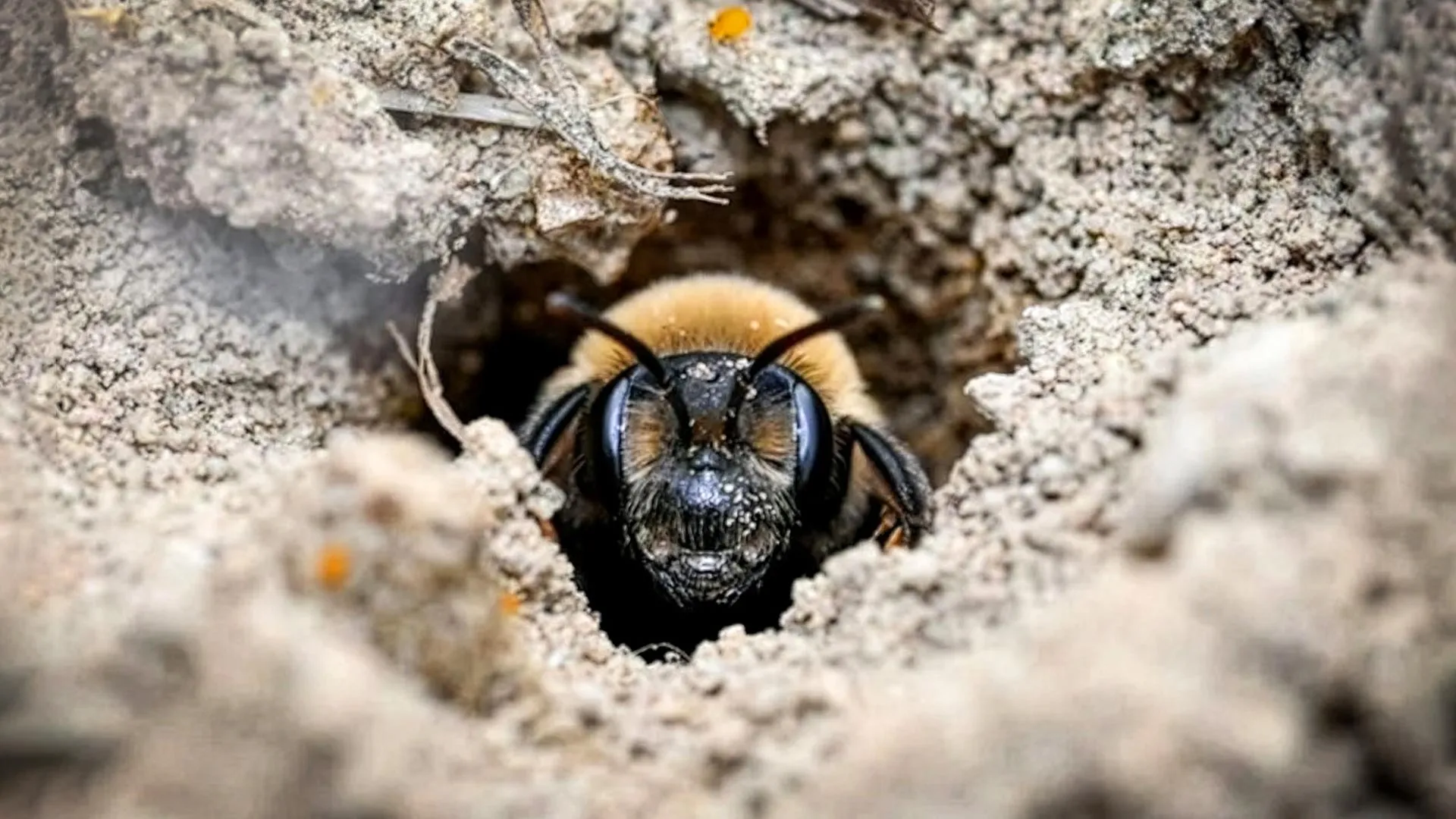
A chance observation by a Cornell University entomology lab technician has led to the extraordinary discovery of one of the largest and oldest known aggregations of ground-nesting bees ever documented. East Lawn Cemetery in Ithaca, New York, a tranquil urban green space, has been identified as home to an estimated 5.5 million individual Andrena regularis, commonly known as the "regular mining bee," concentrated within a mere 1.5-acre area. This staggering figure is comparable to over 200 honeybee hives and surpasses Manhattan’s human population by more than threefold, highlighting the critical, often unseen, biodiversity flourishing within unexpected urban landscapes.
The Serendipitous Discovery
The remarkable find began in the spring of 2022. Rachel Fordyce, then a lab technician at Cornell University’s entomology department, routinely saved money on her commute by parking at Ithaca’s East Hill Plaza and walking through the serene grounds of East Lawn Cemetery to her workplace. During one of these walks, she noticed an unusual abundance of bees. "Bees were everywhere," she recounted, describing the sheer density of the insects emerging from the ground. Intrigued, Fordyce collected a sample in a jar and brought them to her supervisor, Bryan Danforth, a distinguished professor of entomology in Cornell’s College of Agriculture and Life Sciences. Her simple statement, "These are all over the cemetery," set in motion a scientific investigation that would redefine understanding of solitary bee aggregations.
The specimens were swiftly identified as Andrena regularis, a solitary wild bee species. Unlike the communal, hive-dwelling honeybees that capture most public attention, A. regularis are ground-nesters, creating individual burrows in the soil to lay their eggs. These bees are vital pollinators, contributing significantly to the health of both wild plant ecosystems and valuable agricultural crops. Their identification sparked immediate interest within Danforth’s lab, given the sheer numbers observed.
Unprecedented Scale: A Megacity of Bees
Under the guidance of Professor Danforth, undergraduate researcher Steve Hoge ’24 took the lead in studying this burgeoning bee population. The findings of their meticulous research were published on April 13 in the peer-reviewed journal Apidologie, a leading publication focusing on bee science. Hoge, as the lead author, emphasized the unprecedented nature of the discovery. "I’m sure there are other large bee aggregations that exist around the world that we just haven’t identified, but in terms of what is in the literature, this is one of the largest," he stated.
The estimated 5.5 million bees represent an extraordinary concentration, indicating an ecological hotspot of immense significance. To put this into perspective, a typical healthy honeybee colony might contain 50,000 to 80,000 bees. The East Lawn Cemetery aggregation, therefore, represents the equivalent of over two hundred such colonies, compressed into a relatively small area. This density underscores the vital role specific habitats can play in supporting massive insect populations, even within human-modified environments. The discovery challenges conventional wisdom about where such large-scale insect aggregations might occur, often assumed to be in pristine wilderness rather than an urban cemetery.
Introducing Andrena regularis: The Regular Mining Bee
Andrena regularis belongs to the genus Andrena, one of the largest bee genera globally, with over 1,500 species described. These bees are part of the family Andrenidae, often referred to as "mining bees" due to their characteristic habit of excavating underground nests. Approximately 75% of all bee species are solitary ground-nesters, making Andrena regularis a representative of the most common bee lifestyle, despite the honeybee’s pervasive public image.
Professor Danforth noted the surprising lack of detailed scientific information available on A. regularis. "It’s the most common lifestyle for bees," he remarked, yet one of the most comprehensive references Hoge found dated back to 1978. This knowledge gap provided the Cornell team with a unique opportunity to significantly advance understanding of the species’ biology, ecology, and behavior.
The life cycle of A. regularis is fascinating. Female bees construct individual subterranean nests, typically consisting of a main burrow with several lateral tunnels leading to brood cells. Each cell is provisioned with a ball of pollen and nectar, meticulously collected by the mother bee, before an egg is laid. The larvae develop within these sealed chambers, feeding on the stored provisions. A unique aspect of A. regularis biology, as explained by Hoge, is their overwintering strategy: "This species overwinters as adults, which is relatively rare, and that’s part of the reason why they come up out of the ground so early in the spring, timed to the apple bloom." This early emergence, typically in April when daytime temperatures consistently reach around 70 degrees Fahrenheit in New York, aligns perfectly with the bloom of important agricultural crops like apples, positioning A. regularis as a crucial early-season pollinator. Beyond apples, they also visit other early-blooming fruit trees and wildflowers, contributing broadly to spring pollination networks.
East Lawn Cemetery: An Unlikely Biodiversity Haven
The presence of such an immense bee population in a cemetery might seem counterintuitive, yet the research strongly suggests that these historic sites can serve as invaluable refuges for biodiversity. East Lawn Cemetery, established in 1878, has likely hosted A. regularis since at least the early 1900s, according to historical records. Its long history as a relatively undisturbed green space makes it an ideal habitat.
Cemeteries, particularly older ones located within urban or suburban areas, are increasingly recognized by ecologists as critical biodiversity hotspots. They often contain mature trees, varied flora, and undisturbed soil, creating microhabitats that are scarce in surrounding developed areas. Beyond bees, these sites are known to shelter uncommon plants, insects, birds, and even mammals. Keven Morse, superintendent of East Lawn Cemetery, whose family has managed the nonprofit cemetery for 46 years, attested to this biodiversity. He has observed deer, geese, hawks, foxes, coyotes, and, of course, countless bees, noting that the bees have never stung him. Morse acknowledged the challenge of maintaining the grounds without disturbing the bees: "I just felt bad having to mow in certain areas," he said. "There’s probably three or four sections where they really migrate heavy, there’s a lot of them."
Unraveling the Mystery: Why Here?
The research delved into the specific environmental factors that make East Lawn Cemetery such a prime location for Andrena regularis. Several key elements converge to create this bee haven:
- Undisturbed Soil: The fundamental requirement for ground-nesting bees is undisturbed soil. Unlike agricultural fields that undergo regular tilling, or residential areas subject to construction and landscaping, cemeteries offer vast tracts of relatively stable ground. The infrequent digging for interments is localized and does not disrupt the broader nesting areas.
- Pesticide-Free Environment: A critical factor contributing to bee decline globally is the widespread use of pesticides, particularly neonicotinoids. Cemeteries, especially those managed with an environmental consciousness, are often free from such chemical applications, providing a safe haven for insect populations.
- Soil Composition: Professor Danforth noted that A. regularis prefers sandy soil, which the cemetery contains in large amounts. Sandy loam provides good drainage, is relatively easy for bees to excavate, and retains warmth, all beneficial for underground nesting.
- Proximity to Food Sources: The cemetery’s location, approximately one-third of a mile from Cornell Orchards, provides a consistent and abundant source of early spring flowers, particularly apple blossoms. This close proximity ensures that emerging bees have immediate access to the pollen and nectar they need to provision their nests and sustain themselves. This ecological linkage between the nesting site and a significant food source is crucial for supporting such a massive population.
- Peaceful Environment: The overall tranquil nature of a cemetery, with minimal human traffic compared to other urban parks, further reduces disturbance and stress on bee populations.
Precision in Numbers: The Emergence Trap Methodology
Estimating a population of millions of subterranean insects across a 1.5-acre site presented a significant methodological challenge. The research team employed a novel monitoring method involving "emergence traps." These small, mesh tents, typically covering less than a square meter of ground, are designed to funnel any insects emerging from the soil into a collection jar at the top. This technique allows researchers to capture a representative sample of the "whole community of animals coming out of the ground," as Professor Danforth described.
Between March 30 and May 16, 2023, the Cornell team strategically placed 10 such traps throughout the cemetery. Over this period, they collected an astonishing 3,251 individual insects, representing 16 different species of bees, beetles, and flies. Andrena regularis overwhelmingly dominated these samples, confirming their numerical superiority within the aggregation.
Using the data from these traps, researchers calculated the average bee density across the cemetery’s approximately 6,000 square meters. Based on these calculations, the estimated total population ranged from about 3 million to 8 million bees, with the average estimate settling at a robust 5.5 million. This rigorous methodology provides a high degree of confidence in the population estimate, solidifying the claim of one of the largest known aggregations.
The traps also offered insights into the emergence patterns of the bees. They revealed a distinct difference in timing between male and female A. regularis. Male bees typically appeared first during warm periods in April, preceding the females by several days. Hoge explained the evolutionary advantage of this staggered emergence: "The males come out first and wait for the females, so that they have the best opportunities to mate and pass on their genes." This synchronized emergence with early spring blooms and the male-first strategy are critical components of the species’ reproductive success.
Life Cycle and Ecological Dynamics
The study also shed light on other ecological interactions within this vibrant bee community. Notably, it documented instances of brood parasitism by nomad (or "cuckoo") bees, specifically Nomada imbricata. These parasitic bees do not build their own nests or collect pollen; instead, they stealthily invade the nests of other bee species. Nomada imbricata females wait until A. regularis females have meticulously prepared their brood cells and provisioned them with pollen and nectar. The nomad bee then lays its own eggs within these cells. Once the nomad larvae hatch, they exhibit a ruthless strategy: they kill the host A. regularis larvae and consume the stored provisions intended for the mining bees. This ecological dynamic, while seemingly detrimental to A. regularis, is a natural part of many insect communities and highlights the complex food web interactions within the cemetery.
Conservation Imperatives and Broader Implications
The discovery at East Lawn Cemetery carries profound implications for conservation, agriculture, and urban planning.
From a conservation perspective, this aggregation underscores the critical importance of preserving undisturbed land, particularly within developed areas. Cemeteries, churchyards, utility easements, and even well-managed private gardens can serve as vital refuges for ground-nesting bees and other pollinators. The study strengthens the argument for adopting ecological management practices in such spaces, minimizing pesticide use, and allowing natural processes to flourish. As bee populations face global decline due to habitat loss, pesticide use, and climate change, identifying and protecting these "hotspots" becomes paramount.
For agriculture, the massive Andrena regularis population represents a significant ecological service. As key early-season pollinators, these bees are invaluable for crops like apples, a signature commodity for New York State. The economic value of insect pollination to global agriculture is estimated in the hundreds of billions of dollars annually. Understanding and leveraging natural pollinator populations, rather than relying solely on managed honeybee colonies, offers a more resilient and sustainable approach to food security. The proximity of the cemetery to Cornell Orchards illustrates a symbiotic relationship that could be intentionally fostered elsewhere.
In urban planning and design, the findings challenge cities to reconsider the ecological potential of their green infrastructure. Cemeteries, often overlooked as purely memorial sites, can be reimagined as urban ecological parks, contributing significantly to local biodiversity, ecosystem services, and environmental education. This discovery encourages a broader perspective on land use, where seemingly passive spaces can be active contributors to ecological health.
From a scientific standpoint, the research not only provides invaluable data on Andrena regularis but also validates the emergence trap methodology for estimating large, diffuse insect populations. It opens avenues for future research into the long-term stability of such aggregations, their genetic diversity, and their resilience to environmental changes.
A Call for Citizen Science and Future Protection
Recognizing the urgent need to locate and protect similar nesting sites, Professor Danforth and his colleagues have launched a global citizen science initiative. This program encourages individuals to report ground-nesting bee aggregations they encounter, empowering the public to contribute directly to scientific discovery and conservation efforts. Such initiatives are crucial for scaling up the identification of these hidden ecological treasures, especially given the vast number of solitary bee species and their often-underappreciated presence.
The message from the Cornell team is clear and urgent: "These populations are huge, and they need protection," Danforth asserted. "If we don’t preserve nest sites, and someone paves over them, we could lose in an instant 5.5 million bees that are important pollinators." This stark warning underscores the fragility of these aggregations and the immediate need for protective measures, whether through land-use planning, community engagement, or policy changes.
The study’s co-authors included postdoctoral researchers Jordan Kueneman and Katherine Odanaka, undergraduate students Steve Hoge ’24 and Cassidy Dobler ’26, and lab technician Rachel Fordyce, whose initial curiosity sparked this remarkable journey of discovery. Funding for this pivotal research was provided by the Cornell Atkinson Center for Sustainability, the National Science Foundation, and the Federal Capacity Funds program, highlighting the collaborative and multi-faceted support required for such impactful scientific endeavors. The unassuming East Lawn Cemetery in Ithaca now stands as a powerful testament to the hidden wonders of the natural world and the critical role of scientific inquiry in unveiling them, urging a renewed appreciation and protection for our planet’s smallest, yet most vital, inhabitants.
