
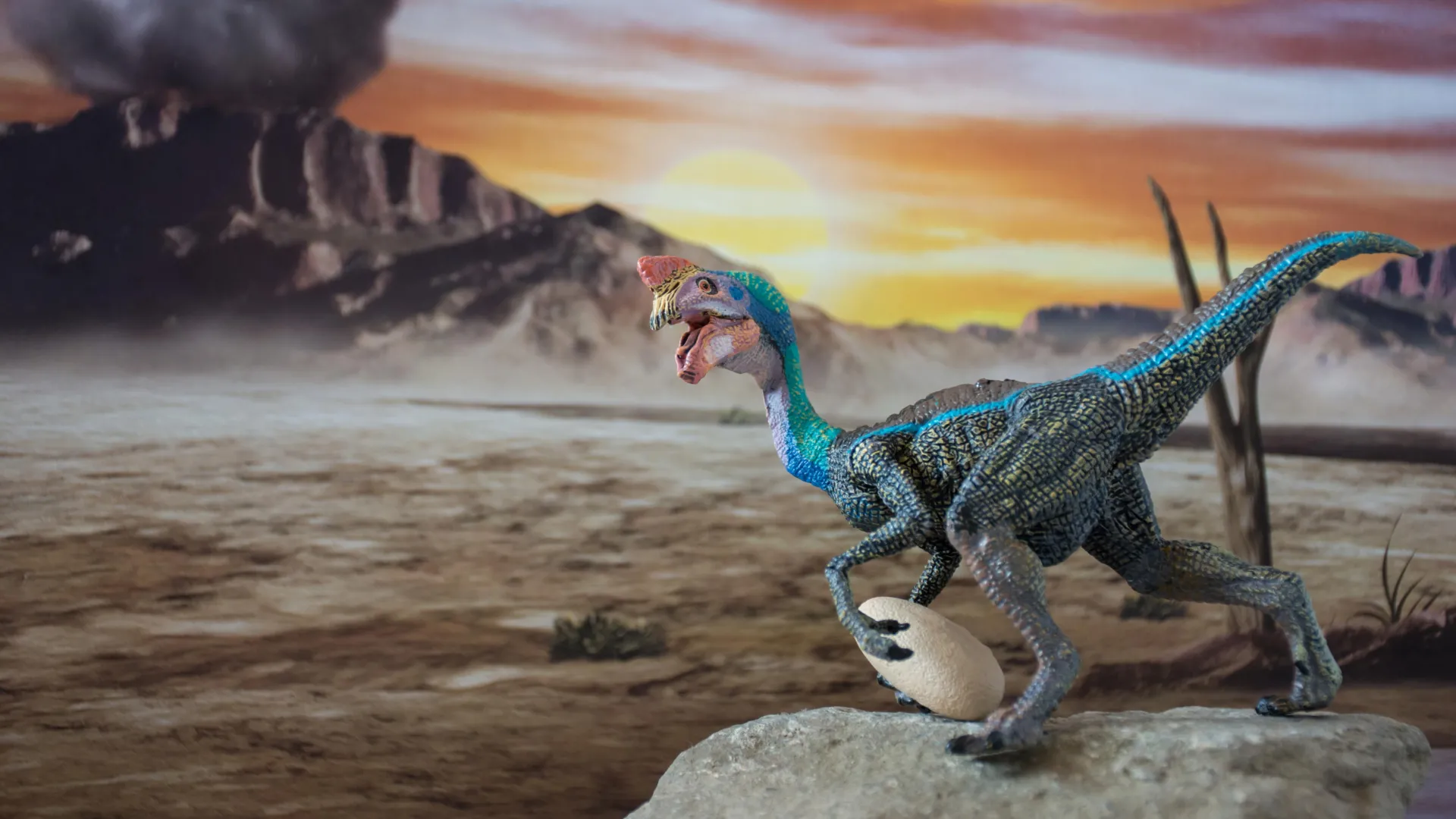
The question of how oviraptors, those fascinating bird-like yet flightless dinosaurs, managed to hatch their eggs has long presented a significant enigma for paleontologists. For decades, researchers debated whether these ancient creatures relied predominantly on external heat sources, much like modern crocodiles, or if they actively warmed their eggs through direct contact, a behavior characteristic of today’s birds. A groundbreaking new study published in Frontiers in Ecology and Evolution has now shed considerable light on this complex question, meticulously exploring oviraptor nesting behavior and the resultant hatching patterns through an innovative combination of scientific methodologies, revealing a unique "co-incubation" strategy.
Unlocking Ancient Secrets with Modern Science
Researchers based in Taiwan embarked on an ambitious project to decipher the incubation mechanisms of these Late Cretaceous dinosaurs. Their approach was multidisciplinary, integrating sophisticated heat transfer simulations with meticulously crafted physical experiments. This dual methodology allowed them to model the intricate ways in which heat would have permeated oviraptor eggs within their nests. To contextualize their findings, the team also conducted comparative analyses with contemporary bird incubation strategies, providing a vital bridge between extinct and extant species. A pivotal element of their experimental design involved constructing a life-size model of an oviraptor, complete with a realistic nest, to empirically test the dynamics of heat distribution and transfer across the egg clutches.
Dr. Tzu-Ruei Yang, a senior author of the study and an associate curator of vertebrate paleontology at Taiwan’s National Museum of Natural Science, highlighted a key discovery: "We show the difference in oviraptor hatching patterns was induced by the relative position of the incubating adult to the eggs." This insight suggests that the physical interaction, or lack thereof, between the parent and its clutch played a critical role in the developmental synchronicity of the embryos. Adding to this, first author Chun-Yu Su, who contributed to the research as a high school student at Washington High School in Taichung, revealed a significant difference in efficiency: "Moreover, we obtained an estimate of the incubation efficiency of oviraptors, which is much lower than that of modern birds." These initial findings underscore a departure from purely reptilian or avian incubation models, pointing towards a unique evolutionary adaptation.
The Enduring Mystery of Dinosaur Parenting
For many years, the reproductive strategies of dinosaurs have been a topic of intense scientific scrutiny and public fascination. The discovery of dinosaur nests and fossilized eggs in the late 19th and early 20th centuries provided tantalizing clues, but direct observation of incubation behavior, naturally, remains impossible. Early theories often posited that most dinosaurs, particularly the larger species, likely buried their eggs, relying on geothermal heat or decaying vegetation for incubation, similar to some modern reptiles. However, subsequent fossil discoveries, particularly of oviraptorids found fossilized atop their egg clutches in brooding postures, began to challenge this simplistic view, suggesting a more active role in parental care, akin to birds.
The term "oviraptor," meaning "egg seizer" or "egg thief," was originally coined in the 1920s based on the initial belief that the first specimen was found stealing Protoceratops eggs. This misconception persisted for decades until later discoveries in the 1990s revealed oviraptorids fossilized directly on their own nests, unequivocally demonstrating brooding behavior. This pivotal shift in understanding cemented oviraptors as crucial models for understanding the evolution of avian-like parental care among non-avian dinosaurs. Their distinct bird-like skeletal features, including a fused clavicle (wishbone) and pneumatized bones, further emphasized their close evolutionary relationship with birds, making their incubation strategy a particularly important piece of the puzzle.
Reconstructing a Late Cretaceous Brooder: Heyuannia huangi
The foundation of the Taiwanese team’s physical experiment was a detailed reconstruction of Heyuannia huangi, a species of oviraptor that roamed the Earth approximately 70 to 66 million years ago during the Maastrichtian stage of the Late Cretaceous period. This particular species, whose fossils have been primarily unearthed in what is now China, notably in the Ganzhou region of Jiangxi Province, was a relatively modest-sized dinosaur, measuring about 1.5 meters (approximately 5 feet) in length and weighing around 20 kilograms (about 44 pounds). These dinosaurs were characterized by their semi-open nests, which typically featured eggs arranged in multiple, distinct rings—a configuration that has been well-documented through fossil evidence, including the famous "Big Mama" oviraptor fossil from Mongolia.
To bring this ancient parent back to life for experimental purposes, the researchers meticulously constructed the dinosaur’s torso using a robust framework of wood, subsequently padding it with polystyrene foam to mimic musculature and bulk. Layers of cotton, bubble paper, and fabric were then applied to simulate the soft tissues, aiming for a realistic representation of the brooding posture. The eggs, a critical component of the experiment, presented their own unique challenge. Unlike the eggs of any living species, oviraptor eggs possess distinct characteristics, including a thick shell and a specific elongated, oval shape. To approximate these properties as closely as possible for heat transfer studies, the team innovatively crafted them from casting resin. In the experiments, these resin eggs were arranged in two clutches, configured in double rings, precisely mirroring the arrangement observed in numerous fossilized oviraptor nests.
"Part of the difficulty lies in reconstructing oviraptor incubation realistically," Su elaborated, underscoring the complexities inherent in such paleobiological reconstructions. "For example, their eggs are unlike those of any living species, so we invented the resin eggs to approximate real oviraptor eggs as best as we could." This ingenuity in recreating the physical parameters of a 70-million-year-old biological process highlights the interdisciplinary nature of modern paleontology, blending engineering, material science, and biology.
Heat Dynamics, Nest Architecture, and Hatching Synchronicity
The experimental setup allowed the research team to investigate the interplay between the brooding adult’s presence, ambient environmental conditions, and their collective impact on egg temperatures and, by extension, hatching outcomes. The findings revealed a fascinating variability in thermal conditions within the nest, contingent on the external environment.
In simulated colder conditions, the presence of a brooding adult oviraptor resulted in significant temperature disparities within the nest. Specifically, eggs situated in the outer ring of the clutch experienced temperature variations as wide as 6°C. Such substantial thermal gradients could have profound implications for embryonic development, potentially leading to asynchronous hatching. This phenomenon, where eggs within the same nest hatch at different times, is observed in some modern reptiles and birds and can affect the survival rates and parental care strategies for offspring. In contrast, when the experiments were conducted under warmer environmental conditions, this temperature variation dramatically decreased to approximately 0.6°C. This stark difference suggests that in warmer climates, the ambient solar radiation likely played a crucial role in evening out the temperatures across the entire clutch, promoting a more synchronous hatching pattern.
Dr. Yang posited on the role of environmental heat: "It’s unlikely that large dinosaurs sat atop their clutches. Supposedly, they used the heat of the sun or soil to hatch their eggs, like turtles. Since oviraptor clutches are open to the air, heat from the sun likely mattered much more than heat from the soil." This observation provides critical context for understanding the evolutionary pressures that shaped oviraptor nesting strategies. Unlike buried nests, which would primarily rely on stable soil temperatures, the semi-open, ring-shaped nests of oviraptors were optimally positioned to leverage solar insolation, especially in warmer periods. This dependency on external heat sources, combined with parental presence, paints a picture of a nuanced incubation strategy.
Dinosaur Versus Bird Incubation Efficiency: A Tale of Two Strategies
A central tenet of the study involved comparing oviraptor incubation with the highly evolved strategies employed by modern birds. The vast majority of avian species utilize a method known as Thermoregulatory Contact Incubation (TCI), a highly efficient process where the adult parent sits directly on its eggs, acting as the primary heat source. For TCI to be effective, several conditions must be met: the adult must maintain consistent physical contact with all eggs in the clutch, provide the bulk of the necessary heat, and meticulously regulate temperatures to ensure uniform development.
The research team concluded that oviraptors likely could not fulfill these stringent requirements for effective TCI as observed in modern birds. Their characteristic ring-shaped egg arrangement, while potentially offering some protection or thermal benefits, inherently prevented the adult oviraptor from maintaining consistent, simultaneous contact with every egg in the clutch. The sheer physical geometry of the nest and the brooding dinosaur made it impossible for the parent to uniformly transfer its body heat to all embryos.
"Oviraptors may not have been able to conduct TCI as modern birds do," Su affirmed. Instead, the evidence strongly suggests that these dinosaurs adopted a unique "co-incubation" strategy. In this model, the parental brooding behavior worked in conjunction with environmental heat sources, primarily solar radiation, to maintain the eggs at viable temperatures. While this method was calculated to be significantly less efficient than the highly refined TCI of modern birds, it was likely an optimal adaptation for their specific nesting style and the environmental conditions of the Late Cretaceous. The study further speculates that this co-incubation strategy might represent an evolutionary transitional phase, as oviraptor nesting appears to have evolved from entirely buried nests to these more exposed, semi-open configurations.
Dr. Yang offered a compelling philosophical perspective on the comparative efficiency: "Modern birds aren’t ‘better’ at hatching eggs. Instead, birds living today and oviraptors have a very different way of incubation or, more specifically, brooding." He emphasized that the concept of "better" is subjective and misleading in an evolutionary context. "Nothing is better or worse. It just depends on the environment." This statement encapsulates the core principle of natural selection: organisms evolve strategies that are best suited to their specific ecological niches and environmental pressures, rather than striving for a universal "perfection."
Implications for Dinosaur Parental Care and Future Research
While the study offers profound new insights, the researchers responsibly acknowledge certain inherent limitations. The experimental setup relies on a reconstructed nest and utilizes modern environmental conditions, which inevitably differ from the climatic and atmospheric conditions prevalent during the Late Cretaceous period. These differences, including variations in solar intensity, atmospheric composition, and ambient temperatures, could potentially influence the exact quantitative findings. Furthermore, it is widely accepted that dinosaurs, owing to their size and physiology, likely had significantly longer incubation periods compared to most modern birds, a factor that could not be directly modeled in these experiments.
Despite these caveats, the study represents a monumental leap forward in our understanding of oviraptor reproductive biology and, by extension, dinosaur parental care. By innovatively combining detailed physical models with sophisticated computational simulations, the work establishes a powerful new methodological framework for investigating the life histories of extinct species. This interdisciplinary approach opens up exciting new possibilities for future research into various aspects of dinosaur reproduction, including embryonic development rates, hatchling survival, and the evolutionary trajectories of parental investment.
The broader implications extend beyond pure scientific inquiry. Dr. Yang articulated the inspirational aspect of the research: "It also truly is an encouragement for all students, especially in Taiwan." He highlighted the fact that despite the absence of indigenous dinosaur fossils within Taiwan, the nation’s scientific community can still make globally significant contributions to dinosaur studies through innovative methodologies and interdisciplinary collaboration. This study stands as a testament to the power of scientific curiosity, ingenuity, and the ability to transcend geographical boundaries in the pursuit of knowledge about Earth’s ancient past. It reinforces the idea that understanding life’s vast history is a collaborative, global endeavor, constantly enriched by fresh perspectives and cutting-edge scientific techniques.
