
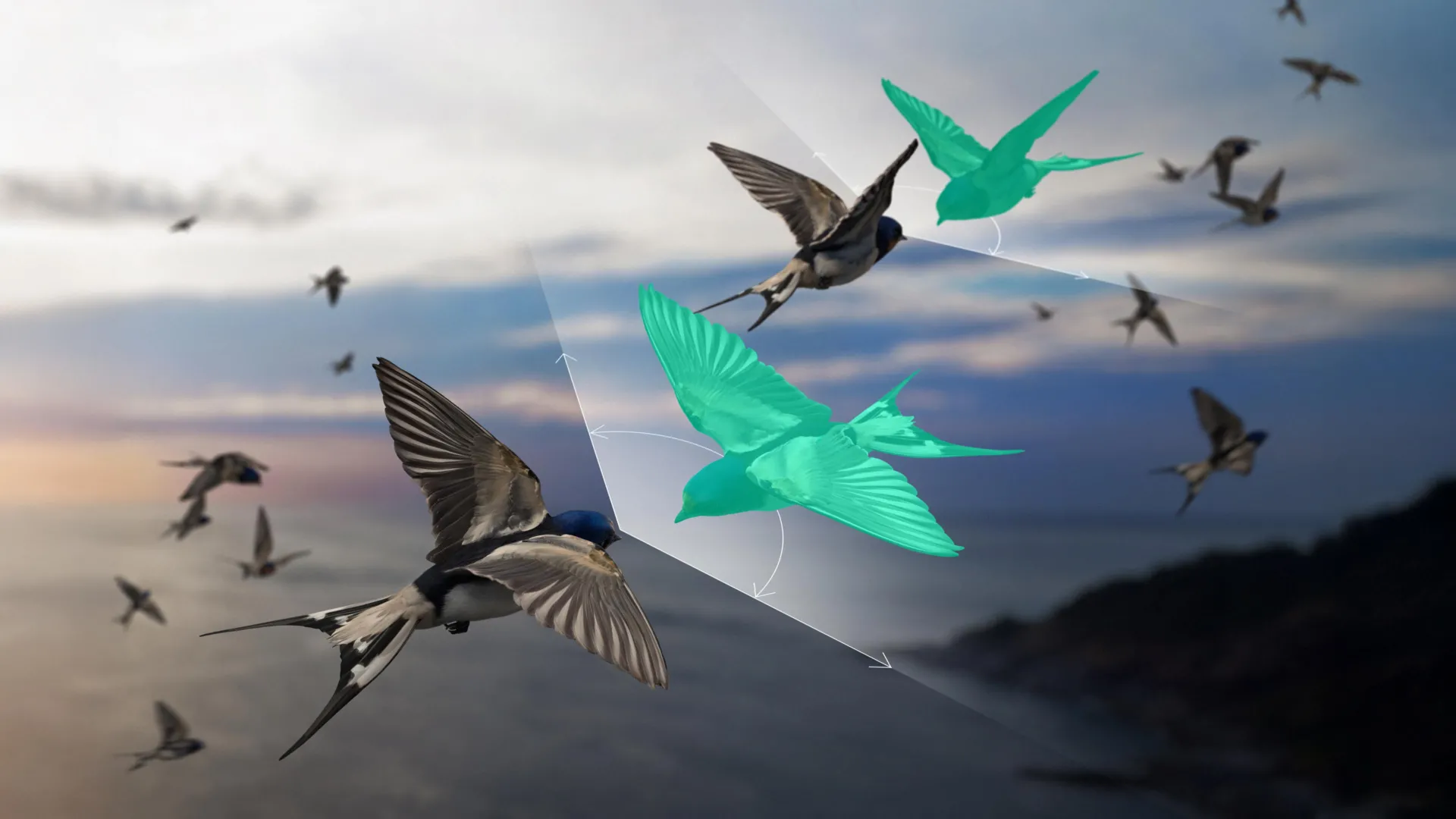
For over three centuries, Isaac Newton’s third law of motion, the principle asserting that "for every action, there is an equal and opposite reaction," has stood as an unshakeable pillar of classical physics. It elegantly explains phenomena from the mundane, like walking, to the monumental, such as rocket propulsion. However, the complex, self-organizing behaviors observed in the natural world – from the intricate aerial ballets of bird flocks to the coordinated movements of bacterial swarms and even the cellular dynamics within living tissues – have long presented a perplexing challenge to this foundational law. These systems, characterized by interactions that operate in a single direction rather than reciprocally, have consistently defied accurate description and simulation using traditional physical frameworks.
Now, a groundbreaking development by a team of researchers in Dresden, led by physicist Roderich Moessner, a Principal Investigator of the Würzburg-Dresden Cluster of Excellence ctd.qmat and director at the Max Planck Institute for the Physics of Complex Systems, offers a profound solution. Their innovative theory, detailed in a recent publication in the prestigious journal Nature Physics, introduces a novel mathematical approach that allows non-reciprocal systems to be precisely modeled and understood, effectively extending the reach of classical mechanics into previously inaccessible domains. This breakthrough is poised to revolutionize our understanding of collective behavior across biological, social, and quantum systems.
The Enduring Legacy and Limits of Newton’s Third Law
To fully appreciate the significance of this new theory, it is essential to revisit the profound impact and perceived universality of Newton’s third law. First articulated by Sir Isaac Newton in his seminal work, Philosophiæ Naturalis Principia Mathematica, published in 1687, this law provides a bedrock for understanding interactions between objects. It dictates that forces always occur in pairs: if object A exerts a force on object B, then object B simultaneously exerts an equal and opposite force on object A.
This principle is demonstrably evident in countless everyday scenarios. When a person walks, their foot pushes backward against the ground, and the ground, in turn, pushes forward on the foot with an equal and opposite force, propelling the person forward. Similarly, a car’s tires push against the road, and the road pushes back, enabling movement. The propulsion of a boat by oars, the recoil of a firearm, and the forward thrust of a balloon expelling air are all classic illustrations of action-reaction pairs in perfect balance. For more than 300 years, this elegant symmetry has formed the bedrock of engineering, astronomy, and nearly all branches of classical mechanics, shaping our technological advancements and scientific worldview. As research group leader Marín Bukov explains, "Whatever we normally teach our students in theoretical mechanics, it ultimately rests on the action-reaction principle."
However, the scientific community has increasingly encountered complex systems where this seemingly universal reciprocity appears to break down. One of the most striking examples, and the initial inspiration for this research, is the collective flight of bird flocks. When thousands of birds wheel and turn in a synchronized aerial display, individual birds do not respond to every other bird in the flock. Instead, they primarily align their movements with birds directly beside them or those flying immediately ahead. Crucially, they do not seem to react to or align with birds behind them. This one-way interaction creates a system where the "action" (a bird influencing its neighbor) does not necessarily elicit an "equal and opposite reaction" from the bird it just influenced, at least not in the traditional Newtonian sense.
This observation is not an isolated anomaly. Similar non-reciprocal dynamics are pervasive across the natural world. Bacterial swarms, for instance, exhibit intricate self-organization where individual bacteria respond to local chemical gradients or mechanical cues from their immediate neighbors, but these interactions are often asymmetric. In human crowds, individuals react to the movements of those directly in front or beside them, influencing the collective flow without a perfectly reciprocal counter-influence from those behind. Even at the microscopic level, within living tissues, groups of cells engage in non-reciprocal interactions that drive processes like tissue development, wound healing, and disease progression, such as cancer metastasis. In these diverse systems, individual components respond to only a subset of their environment, leading to interactions that are inherently unbalanced in the Newtonian framework.
The Historical Challenge of Non-Reciprocal Systems
The existence of these non-reciprocal systems has presented a formidable challenge to physicists for decades. Traditional theoretical models, meticulously crafted over centuries to describe reciprocal interactions, simply could not accurately capture the nuanced dynamics of these complex assemblies. The mathematical equations and computational simulations developed under the assumption of action-reaction symmetry were inherently limited when applied to systems where this symmetry was absent.
This limitation has had significant practical consequences. The inability to precisely simulate non-reciprocal systems has hampered progress in various fields. In biology, understanding how cells migrate collectively or how immune cells coordinate their responses could lead to breakthroughs in medicine. In social sciences, accurate models of crowd behavior are vital for public safety, urban planning, and even predicting market trends. For animal collective motion, better simulations could illuminate ecological processes and evolutionary strategies. The absence of a robust theoretical framework meant that scientists were largely operating in the dark when trying to predict or manipulate these ubiquitous phenomena.
A Dresden Breakthrough: A New Paradigm for Complex Systems
The team in Dresden, spearheaded by Marín Bukov and Ricard Alert, working with Roderich Moessner, has now introduced a revolutionary framework that sidesteps this long-standing impasse. Their solution involves an ingenious extension of the traditional action-reaction framework, allowing non-reciprocal systems to be analyzed and simulated using many of the same powerful tools already employed for ordinary reciprocal systems. The elegance of their approach lies in the introduction of "additional artificial variables," or "fictitious partners."
"The research team has developed and proven a theory that makes much of what we teach our students applicable to non-reciprocal systems as well. These systems, where Newton’s third law does not apply, can now finally be described exactly and simulated precisely – even using established methods. This is exactly the kind of tool that has been missing in recent years," says Bukov, highlighting the transformative potential of their work.
Physicists typically describe natural systems using mathematical variables that correspond directly to real, measurable properties: a bird’s position and velocity, the concentration of a chemical, or a cell’s orientation. The Dresden team’s "trick," as described by biophysicist Ricard Alert, is to augment this reality with an imaginary dimension. "The trick behind the new theory is that it constructs a partner for each component of the system – a fictitious partner that doesn’t exist in nature. The original non-reciprocal interactions are replaced by reciprocal interactions with these auxiliary degrees of freedom," Alert explains.
The Case of the Imaginary Bird: Practical Application
To illustrate this abstract concept, consider the example of the bird flock. The challenge is that real birds only react to a subset of their neighbors, creating an asymmetric interaction. The new theory addresses this by introducing a "fictitious bird" for each real bird. "To simulate the birds’ movements precisely, we describe the dynamic system ‘flock of birds’ using established methods – as if it were a reciprocal system, even though it is not. The elegant solution is to artificially place a fictitious bird in front of each real bird, aligned in exactly the opposite direction," says Alert.
These imaginary partners are not meant to represent actual physical entities. Instead, they serve as sophisticated mathematical constructs. By introducing these auxiliary degrees of freedom, the researchers effectively "complete" the incomplete interactions. The non-reciprocal influence of a real bird on its neighbor is mathematically balanced by a reciprocal interaction involving its fictitious partner. This clever transformation converts a one-way interaction into a system that, from a mathematical perspective, behaves as if it were reciprocal, thereby making it amenable to existing analytical and computational tools. This allows physicists to leverage the extensive and well-developed framework of many-body physics – a field dedicated to understanding the collective behavior of a large number of interacting particles – which was previously largely inapplicable to non-reciprocal systems.
Chronology of a Paradigm Shift
This breakthrough didn’t happen in a vacuum but is the culmination of centuries of scientific inquiry and the increasing complexity of phenomena under investigation.
- 17th Century (1687): Isaac Newton publishes Principia Mathematica, establishing the three laws of motion, including the third law of action and reaction, which forms the bedrock of classical mechanics.
- 18th-19th Centuries: Classical mechanics flourishes, successfully explaining planetary motion, fluid dynamics, and the behavior of macroscopic objects, all largely based on reciprocal interactions.
- 20th Century: The rise of statistical mechanics and complex systems science begins to highlight phenomena like self-organization, emergent properties, and collective behaviors (e.g., phase transitions, flocking, swarming) that push the boundaries of traditional Newtonian descriptions. Scientists increasingly recognize that simple pairwise interactions, particularly when non-reciprocal, present unique challenges.
- Late 20th – Early 21st Century: The study of "active matter" – systems composed of many interacting, energy-consuming components – gains prominence. This field explicitly acknowledges and grapples with the inherent non-reciprocity in systems like bacterial colonies, cytoskeletal networks, and animal groups. The need for a theoretical framework capable of accurately modeling these systems becomes acute.
- Present Day (2024): The Dresden team’s publication in Nature Physics marks a significant milestone, providing a general theoretical solution to the long-standing problem of non-reciprocal interactions, effectively extending the applicability of classical mechanical tools to these complex systems.
New Possibilities and Far-Reaching Implications
The implications of this new theory are vast and extend across multiple scientific disciplines. By providing a robust and accessible method for simulating non-reciprocal systems, the researchers have opened up entirely new avenues for investigation and discovery.
- Biological Systems: The ability to accurately model non-reciprocal interactions in biological contexts could lead to profound insights into processes like cell migration during embryonic development, immune cell coordination to fight pathogens, and the collective behavior of cancer cells. This could pave the way for novel therapeutic strategies and a deeper understanding of life itself.
- Social Dynamics and Crowd Behavior: Understanding how individuals influence each other in crowds, financial markets, or social networks, even without direct reciprocal feedback, could revolutionize fields like urban planning, disaster management, and behavioral economics. Simulations based on this new theory could help predict crowd flow, prevent stampedes, or even model the spread of ideas and information.
- Materials Science and Active Matter: The field of active matter, which studies systems composed of self-propelled units, stands to benefit immensely. This theory could accelerate the design of new "smart" materials that exhibit self-organization or autonomous functions, such as self-healing robots or reconfigurable soft materials.
- Quantum Physics and Emergent Phenomena: Perhaps one of the most exciting and speculative implications lies in the realm of quantum matter. Roderich Moessner, whose expertise lies in quantum physics, points to this frontier: "In Würzburg and Dresden, we study quantum matter whose particles interact under certain conditions in ways that give rise to new phenomena such as magnetism or lossless current transport. The exciting question now is whether these exceptions to Newton’s law lead to entirely new forms of collective quantum behavior. We still know very little about this – and that is precisely what makes this so fascinating." The possibility that non-reciprocal interactions could manifest at the quantum level and lead to novel states of matter or quantum phenomena opens up a tantalizing prospect for future research, potentially impacting quantum computing and fundamental physics.
Beyond these specific applications, the theory offers a deeper, more fundamental understanding of the underlying physics of complex systems. By demonstrating how a seemingly disparate set of phenomena can be brought under a unified theoretical umbrella, it enriches our conceptual toolkit for interpreting the natural world. This kind of foundational understanding is often the fertile ground from which future, unforeseen discoveries blossom.
In essence, this work represents more than just a new computational tool; it signifies a conceptual advancement that expands the very boundaries of classical physics. It acknowledges the limitations of a 300-year-old law in specific contexts, not by refuting it, but by providing a sophisticated extension that allows for the description of a broader class of natural phenomena. As such, it is poised to become an indispensable framework for a new generation of physicists, biologists, and materials scientists grappling with the intricate dance of collective motion in the universe.
