
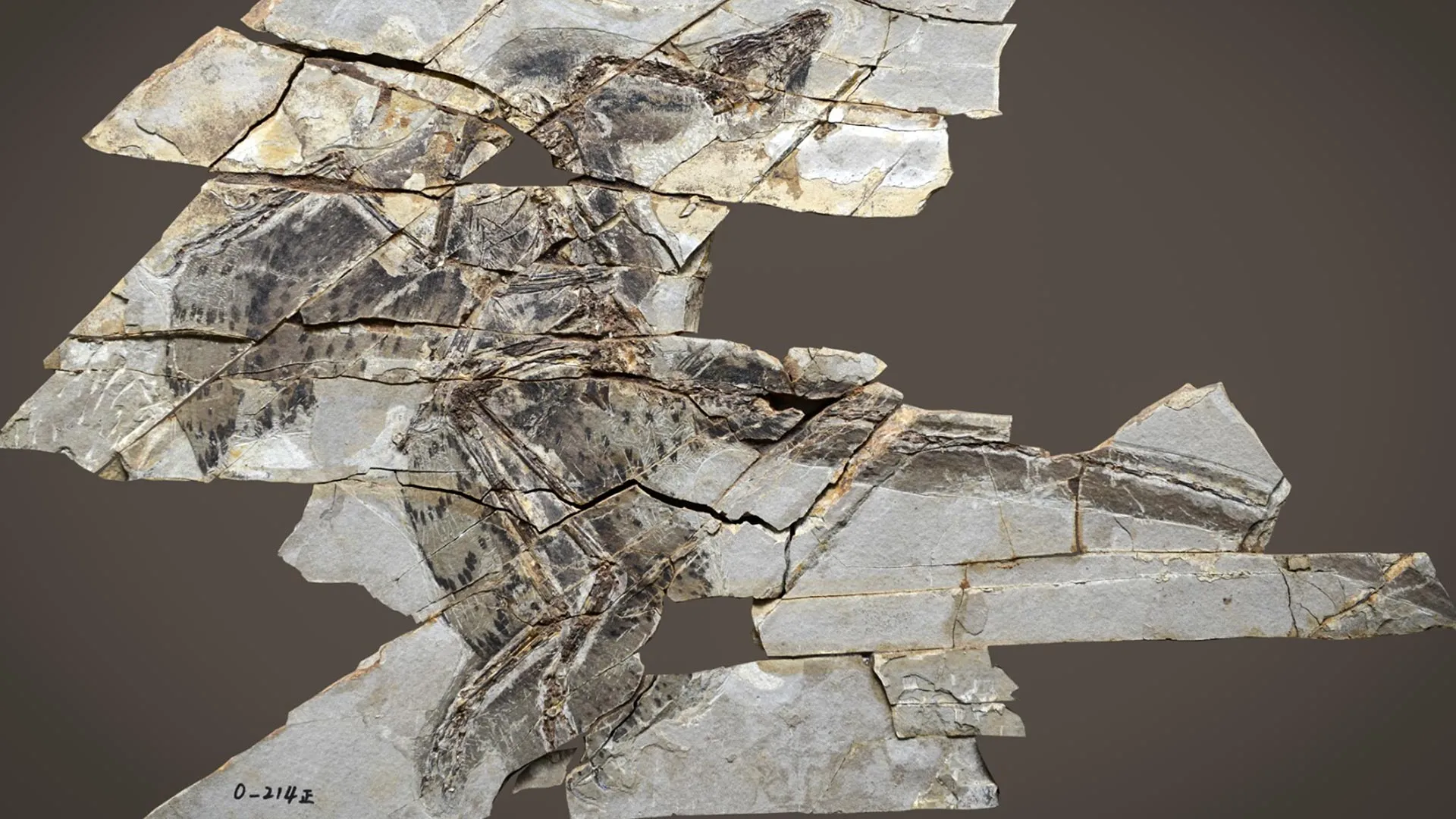
The pivotal research, led by Dr. Yosef Kiat, an ornithologist specializing in feather studies, in collaboration with esteemed colleagues from China and the United States, was published in the prestigious journal Communications Biology, part of the Nature Portfolio. Their work not only reframes our understanding of ancient avian ancestors but also underscores the incredible information locked within the fossil record, waiting for innovative analytical approaches to unlock its secrets.
Unraveling Flight Secrets Through Ancient Molting Patterns
At the heart of this study lies an ingenious method: the analysis of molting patterns in fossilized feathers. Dr. Kiat explains that feathers, intricate protein-based structures, undergo a growth phase of two to three weeks. Upon reaching their full size, they detach from the blood vessels that nourished them during development, transforming into nonliving material. Over time, these feathers wear out and are systematically replaced by new ones in a process known as molting. This seemingly mundane biological process, however, holds critical clues regarding an animal’s flight capability.
In modern birds, the molting process is highly differentiated based on their dependence on flight. Birds that rely heavily on flight for survival, foraging, or escaping predators exhibit an orderly, gradual molting pattern. This meticulous process ensures symmetry between the wings is maintained throughout, allowing them to continue flying effectively even while new feathers are growing. This staggered replacement prevents any significant impairment of aerodynamic function. Conversely, birds that have lost the ability to fly, such as ostriches, emus, and penguins, display a far more random and irregular molting pattern. Without the imperative to maintain aerodynamic efficiency, there is no evolutionary pressure for a symmetrical or gradual feather replacement. Consequently, the pattern of molting serves as a reliable indicator of whether a winged creature, whether modern or ancient, possessed the capacity for flight.
By meticulously examining the fossilized feathers of Anchiornis, the researchers identified a continuous line of black spots along the wing edges, indicating mature feathers. Crucially, they also observed developing feathers whose black spots were distinctly out of alignment, signifying active growth. A detailed, comparative analysis of these patterns against known molting strategies in extant birds revealed an irregular and disorderly molting sequence, rather than the systematic, symmetrical molting characteristic of active fliers.
Dr. Kiat concluded, "Based on my familiarity with modern birds, I identified a molting pattern indicating that these dinosaurs were probably flightless. This is a rare and especially exciting finding: the preserved coloration of the feathers gave us a unique opportunity to identify a functional trait of these ancient creatures — not only the body structure preserved in fossils of skeletons and bones." This direct observation of a functional trait, rather than an inference from skeletal morphology alone, represents a significant advancement in paleontological research.
Anchiornis: A Feathered Enigma from the Jehol Biota
The study focused on nine remarkably preserved fossils from eastern China, all belonging to a feathered Pennaraptoran dinosaur named Anchiornis. Anchiornis huxleyi, first described in 2009, is a small paravian dinosaur, roughly the size of a crow, known from the Late Jurassic period, approximately 160 million years ago. Its name, meaning "near bird," reflects its pivotal position in the evolutionary lineage leading to modern birds.
These particular fossils are exceptionally rare and invaluable to science because they preserved not only the skeletal structure but also the intricate details of the feathers, including their original coloration. This extraordinary preservation is attributed to the unique fossilization conditions prevalent in the Liaoning Province of eastern China, particularly within the famous Jehol Biota. This region is renowned for its Lagerstätte deposits – sedimentary rock formations that exhibit an exceptional richness and quality of fossilized organisms, often preserving soft tissues and fine details rarely seen elsewhere. The volcanic ashfalls and anoxic conditions in ancient lakebeds of the Jehol Biota rapidly buried and preserved these creatures, preventing decay and ensuring the fidelity of delicate structures like feathers and even skin impressions.
Each Anchiornis specimen examined in the study displayed wing feathers that were predominantly white, strikingly accented with a distinct black spot at the tip. This preserved coloration was crucial, as it allowed researchers to closely examine the structure and growth of individual feathers in ways typically impossible with most fossil records. The presence of melanosomes, pigment-bearing organelles, within these fossilized feathers has allowed paleontologists in previous studies to reconstruct the likely color patterns of these ancient animals, but this study leveraged that preservation for a functional analysis of molting.
The Evolutionary Tapestry of Feathers and Flight
The journey of feathers is a compelling narrative in evolutionary biology, tracing back far earlier than the advent of flight. Dr. Kiat highlights that dinosaurs diverged from other reptiles approximately 240 million years ago, during the Middle Triassic period. Relatively soon thereafter, on an evolutionary timescale, many species began to develop feathers. Initially, these lightweight, protein-based structures were not primarily for flight but likely served other crucial functions, such as thermal regulation (insulation), display for mating or territorial defense, or even aiding in short bursts of speed or agility on the ground. Early feathered dinosaurs like Sinosauropteryx, discovered in the 1990s, possessed simple, filamentous protofeathers, providing the first definitive evidence that feathers predated the evolution of flight.
Around 175 million years ago, during the Middle Jurassic, a significant group of feathered dinosaurs known as Pennaraptora emerged. This clade includes oviraptorosaurs, dromaeosaurids (like Velociraptor), troodontids, and avialans (the group containing birds). These animals are considered the closest non-avian relatives and direct ancestors of modern birds. They were the only dinosaur lineage to survive the catastrophic mass extinction event at the end of the Mesozoic era, approximately 66 million years ago, which wiped out all other non-avian dinosaurs.
For decades, scientists largely believed that Pennaraptora evolved feathers specifically for flight, a logical assumption given the aerodynamic design of many of their fossilized feathers and their close relationship to birds. However, the Anchiornis study adds a critical nuance to this understanding. It suggests that while feathers certainly evolved to facilitate flight in many lineages, environmental pressures and shifts in ecological niches may have subsequently led some species, like Anchiornis, to lose that ability over time. This phenomenon is well-documented in modern avifauna, with numerous examples of flightless birds adapting to specific terrestrial or aquatic lifestyles, such as the aforementioned ostriches, emus, kiwis, kakapos, and penguins. The evolutionary cost of maintaining flight, including high energy demands and specialized anatomical structures, can be significant, leading to its loss when not strictly necessary for survival in a particular environment.
Implications for the Origins of Flight: A Non-Linear Path
The discovery that Anchiornis, a feathered dinosaur so closely related to birds, was likely flightless has profound implications for our understanding of avian origins. For much of the 20th century, the prevailing narrative of flight evolution was a relatively straightforward, linear progression: feathers evolved, then flight evolved, culminating in modern birds. However, the "dinosaur renaissance" of the late 20th and early 21st centuries, fueled by an explosion of exquisitely preserved feathered dinosaur fossils from China, has radically reshaped this view.
The Anchiornis finding reinforces the growing consensus that the evolution of flight was not a single event or a simple, one-way street. Instead, it was a complex, multi-stage process characterized by experimentation, adaptation, and even reversal. It suggests a scenario where various dinosaur lineages developed flight-capable wings, some perhaps achieving only rudimentary gliding or powered flight, while others then lost that ability due to changing selective pressures. This "mosaic" evolution, where different traits evolve at different rates and in different directions, is a common theme in evolutionary biology.
The study challenges the notion that all feathered paravians were necessarily flight-capable. Anchiornis now joins a growing list of feathered dinosaurs, such as Epidexipteryx and some dromaeosaurids, whose feathers and wing-like structures are increasingly interpreted as serving purposes other than sustained aerial locomotion, or as representing lineages that either never fully achieved flight or secondarily lost it. This complex picture aligns with Dr. Kiat’s assertion that "wing evolution truly was complex and diverse."
Furthermore, this research contributes to the ongoing debate about the "ground-up" (cursorial) versus "trees-down" (arboreal) hypotheses for the origin of flight. While Anchiornis was a small, arboreal-dwelling creature, its likely flightlessness suggests that an arboreal lifestyle did not automatically guarantee the development or retention of flight. It could have used its feathers for gliding, parachuting, or simply for insulation and display within its tree-dwelling niche.
Future Directions and Enduring Mysteries
The insights gleaned from Anchiornis open up new avenues for future paleontological and evolutionary research. Scientists will likely scrutinize other feathered dinosaur fossils with renewed attention to molting patterns, looking for similar evidence of flightlessness or varying degrees of flight capability. Advanced imaging techniques, such as synchrotron microtomography, could provide even finer details of feather structure and attachment, further refining our understanding.
The discovery also highlights the importance of exceptional fossil preservation sites like the Jehol Biota, which continue to yield treasures that fundamentally alter our understanding of ancient life. As more such sites are discovered and excavated, the detailed picture of dinosaur-bird evolution will undoubtedly become even richer and more nuanced.
Ultimately, the study of Anchiornis and its flightless feathers serves as a powerful reminder of the relentless creativity of natural selection. Evolution is not a teleological march towards perfection, but a branching, meandering path, full of dead ends, detours, and unexpected reversals. The ability to fly, while a remarkable adaptation, is not universally advantageous, and its presence or absence reflects the specific ecological pressures faced by a species at any given point in its evolutionary history. The detailed analysis of ancient molting patterns has not only added Anchiornis to the roster of flightless feathered dinosaurs but has also deepened our appreciation for the astonishing complexity and diversity inherent in the origin and evolution of one of life’s most captivating adaptations: powered flight.
